
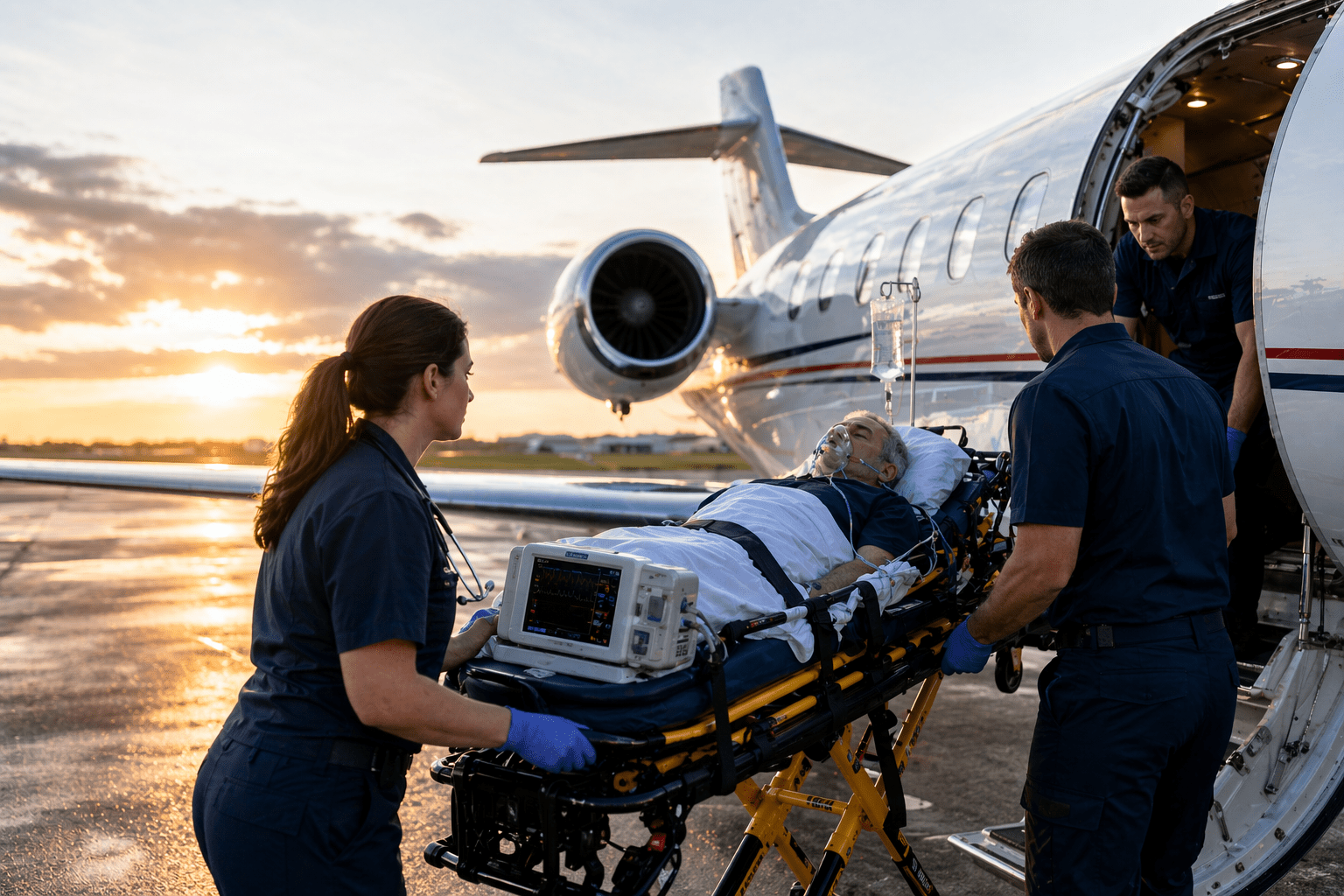
Most people don’t think about air ambulances until they have to.
And by the time they have to, it’s usually a rough day.
A hospital wants a patient moved fast. A family is trying to get a loved one closer to home. A case manager is juggling bed availability, physician communication, transport timing, and about 19 other things before lunch. Same song, different verse. The need is urgent, the details are messy, and nobody involved has time for a learning curve.
That’s where air ambulance service matters.
Not the vague idea of it. The real thing. The actual process of moving a patient safely, with the right aircraft, the right medical crew, and the right coordination from bedside to bedside.
It’s not just a flight
This is the first thing people get wrong.
An air ambulance is not just a private plane with a stretcher in it. Not even close.
A real medical flight is a flying critical care environment. The aircraft has to be properly equipped. The crew has to be trained for patient transport at altitude. And the whole mission has to be built around the patient’s condition, not just the route on the map. That means medical equipment, oxygen, monitoring, communication, timing, paperwork, and the kind of coordination that most people never see from the outside.
When it’s done right, it feels smooth. Almost simple.
It isn’t simple.
The clock matters. A lot.

If I had a dollar for every time someone said, “Can’t we just book a regular flight?” I’d have a nice lunch waiting for me.
Sometimes a commercial option with a medical escort can work. Sometimes it absolutely cannot. It depends on the patient. Their condition. Their stability. Their equipment needs. Their mobility. Their oxygen requirements. The distance. The urgency. The sending facility. The receiving facility. It’s a long list.
And that’s the thing people miss. In medical transport, time isn’t the only variable. Condition is.
A patient who needs close monitoring, advanced support, or a tightly managed handoff may need an aircraft and flight team prepared for exactly that. No shortcuts. No improvising in the gate area. No hoping the airline is in a good mood that day.
Florida sees a lot of this
That’s not surprising.
Florida has a huge mix of retirees, seasonal residents, visitors, specialty medical centers, rehab facilities, and families trying to coordinate care across long distances. So the demand for medical transportation stays pretty steady. Without fail.
And when people search for air ambulance florida, they’re usually not doing casual research. They’re in the middle of something difficult. They need answers fast, and they need them from people who know what they’re doing.
That’s why local access matters. For families, discharge planners, and medical professionals in South Florida, having a regional option like Boca Raton air ambulance service gives them a direct starting point instead of sending them into a black hole of forms, transfers, and hold music.
Aircraft choice is not a small detail
It sounds technical. Because it is.
But it also matters in plain English.
The wrong aircraft can create delays, airport limitations, loading issues, extra ground time, or unnecessary transfers. The right aircraft can shorten the total trip, reduce complications, and get the patient closer to the receiving facility with less disruption. That’s a big deal. A very big deal.
And in air ambulance work, “close enough” is usually bad strategy.
The better operators think about runway access, airport proximity, patient loading, equipment setup, range, weather, and what the patient will actually need during the flight. Not what looks good in a brochure. What works.
The medical crew is the mission
People love talking about jets. Fine. Jets are interesting.
But the real story is the team.
An air ambulance flight depends on the medical staff just as much as the aircraft, maybe more. Critical care nurses, paramedics, respiratory therapists, physicians, pilots, coordinators. Everybody has a lane. Everybody has a job. And when that machine is running well, the patient gets continuity of care instead of chaos.
That’s what families remember.
They remember whether someone explained the process. They remember whether the handoff felt organized. They remember whether the patient looked cared for instead of hurried along like cargo. Harsh way to put it, maybe. Still true.
Coordination is half the battle
Actually, more than half.
A good air ambulance trip doesn’t start at takeoff. It starts with records, physician communication, receiving-facility confirmation, transport planning, and all the invisible details that make the flight possible. Ground transportation has to line up. Medical information has to be current. The team has to know what they’re walking into before they ever arrive at bedside.
When that work is sloppy, everything downstream gets harder.
When it’s done right, families often say the same thing afterward: “I had no idea how much was involved.”
Exactly.
So what should people look for?
Start with the obvious stuff.
Is the provider operating as a real medical transport service? Do they have experienced flight crews? Are they equipped for the level of care the patient needs? Can they explain the process clearly? Can they coordinate the full trip instead of just the airplane part?
And maybe my favorite question of all: do they sound calm when you call?
Because this work should feel steady. Not salesy. Steady.
For people in Southeast Florida, Med Jets’ Boca Raton office is one practical place to start when the need is local and the situation is urgent.
What this really comes down to
Air ambulances exist because some patients can’t wait, can’t ride, or can’t be moved safely through normal travel channels.
That’s the plain version.
And when families, hospitals, and case managers need that kind of transport, they’re not looking for fluff. They’re looking for competence. Speed, yes. But also judgment. Medical support. Clear communication. A team that has seen this movie before and knows how to keep things moving when the pressure is on.
Because on a day like that, “good enough” is a terrible standard.