

You’re probably dealing with the part nobody warns families about. The flight is arranged, the appointment is set, the hospital knows the patient is coming, and then one practical question starts causing real stress.
How do we get from the airport, hotel, or temporary lodging to the Texas Medical Center without adding cost, confusion, or unnecessary strain?
In Houston, that question matters. The city is big, traffic is real, and patients coming for cancer care or other serious treatment often aren’t in shape to handle rental cars, curbside pickup chaos, or repeated rideshare handoffs. That’s why ground angels houston deserves attention. It fills a very specific gap that families, case managers, and transport coordinators run into every day.
If you need the short version, here it is. Ground Angels Houston is one of the best local resources for free, non-emergency, volunteer-based rides for ambulatory patients traveling to care in the Texas Medical Center. It is not the answer for every patient. But when it fits, it can make the entire trip more humane.
What Is Ground Angels Houston
A lot of families first hear about ground angels houston when they’re already under pressure. They’ve landed in a city they don’t know well. They’re heading to MD Anderson or another Texas Medical Center facility. The patient is tired, the caregiver is juggling bags and paperwork, and nobody wants to argue with a driver about pickup locations.
That’s the problem Ground Angels Houston was built to solve.

A local service with a clear purpose
Ground Angels Houston is a 501(c)(3) non-profit established in 2000 that provides complimentary ground transportation for patients needing care at the Texas Medical Center. It has completed over 38,000 missions, and volunteers donate their time, vehicles, and fuel to serve both local patients and out-of-town arrivals coming through Houston airports, according to Ground Angels history.
That matters because medical travel isn’t only about the air leg. The “last mile” is often where plans start to fray. A patient may arrive safely by private vehicle, commercial flight, or medical transport, but if nobody has solved the Houston ground segment, the entire trip feels unstable.
Ground Angels exists because patients shouldn’t have to spend limited energy on transportation logistics when they should be focused on treatment.
Practical rule: If the patient can safely ride in a regular vehicle and the destination is within the Greater Houston medical ecosystem, Ground Angels is worth checking before you pay for a rideshare or ask family to scramble.
Why families trust it
This isn’t a gig app with random availability. It’s a mission-driven service built specifically around medical travel. The volunteer model gives it a different tone than commercial transportation. Patients aren’t treated like one more fare. They’re treated like someone headed to care.
That distinction matters more than people think.
Ground angels houston also fits into the broader reality of patient transfer planning. Many families assume the hard part is the long-distance leg. In practice, discharge planners and transport teams know that continuity matters just as much as mileage. A smooth handoff from airport to hotel, hotel to clinic, or clinic to airport often determines whether the day stays manageable. If you want a better sense of how that handoff fits into larger patient movement planning, Med Jets has a helpful overview of patient transfer coordination.
What I tell families
Use Ground Angels for what it is. A compassionate, no-cost, local transportation resource with a strong track record in Houston medical travel.
Don’t treat it like a guaranteed, medically staffed transport service. Treat it like one of the most valuable support layers available when the patient is ambulatory and the trip is non-emergency.
Who Can Use Their Services
The fastest way to decide whether ground angels houston is right for your patient is to ask one question.
Can the patient safely ride in a standard vehicle without onboard medical care?
If the answer is yes, this service may be a very good fit.
The patients most likely to qualify
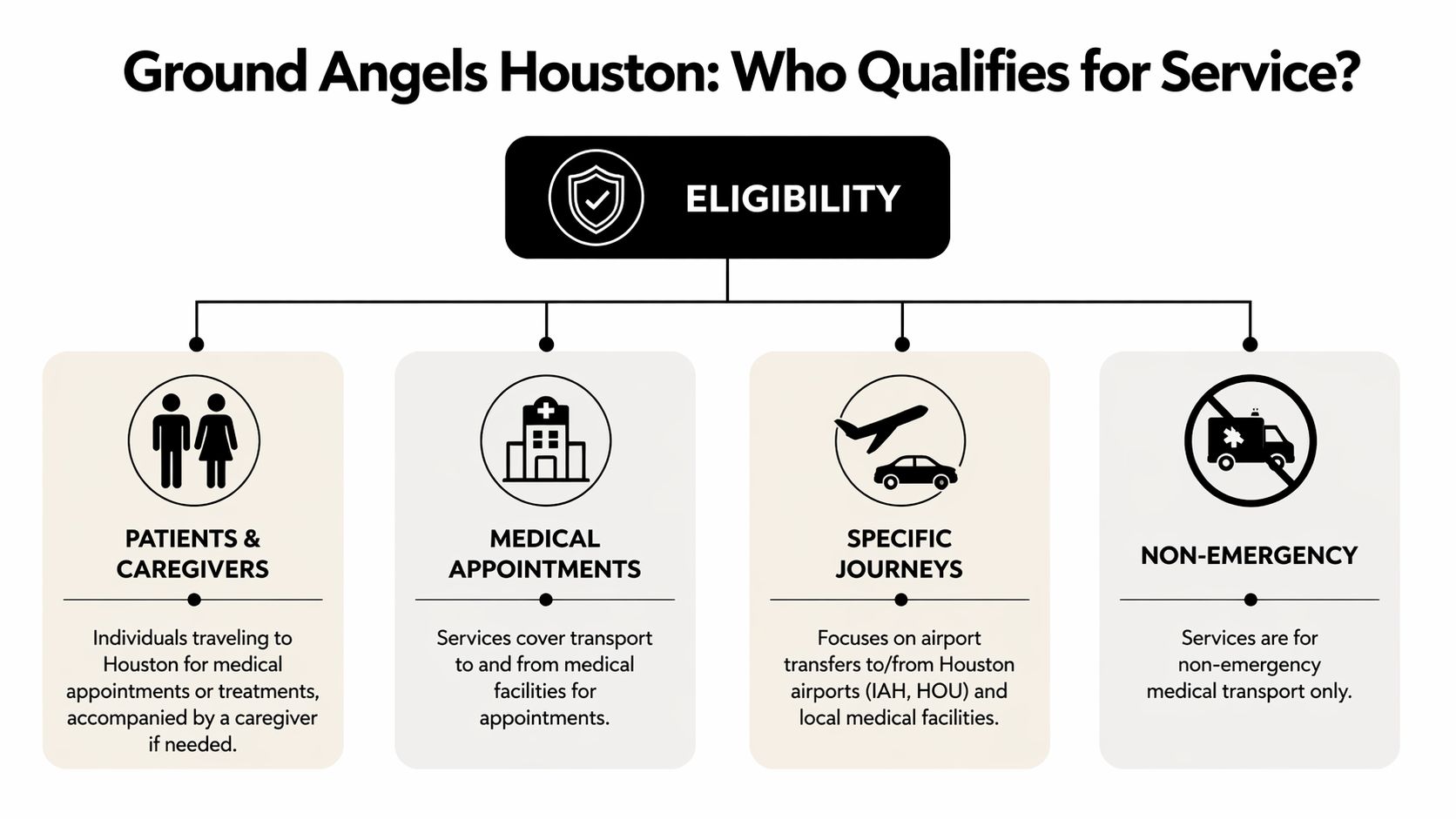
Ground Angels serves people traveling for critical care in the Greater Houston Area, especially within the Texas Medical Center network. That includes patients going to places like MD Anderson, along with arrivals from Houston airports and regional airfields.
In 2025, Houston Ground Angels managed 6,870 patient ride requests with 87 active volunteer drivers, according to the 2025 management review. That tells you two things. First, the need is substantial. Second, they’re built for real medical traffic, not occasional favors.
Here’s the practical fit:
- Ambulatory patients: People who can get in and out of a passenger vehicle on their own or with minimal assistance.
- Out-of-town patients: Families arriving for treatment, consultations, or follow-up care in Houston.
- Caregivers traveling with the patient: When the trip involves support from a spouse, adult child, or companion.
- Airport and appointment riders: People needing transport to or from airports, lodging, and medical facilities inside the service area.
What the service is designed for
Ground Angels is most useful when the transportation challenge is logistical, not clinical.
That means trips such as:
- Airport to treatment center
- Hotel to clinic
- Clinic back to lodging
- Houston-area transfers tied directly to medical care
It’s especially useful for patients whose travel chain includes a long inbound trip. A patient may arrive exhausted from air travel and still need a clean, dependable ride to the next point of care. That’s where ground angels houston shines.
The best candidates are stable patients who need kindness, coordination, and a dependable local ride. They do not need a stretcher team, oxygen setup, or continuous clinical monitoring during the vehicle trip.
When it is not the right choice
Some families try to make a volunteer ride fit a patient who really needs a higher-acuity solution. Don’t do that.
Ground Angels is not the right choice when the patient:
- Is non-ambulatory
- Needs lifting, bariatric handling, or stretcher transport
- Requires a medical escort or active monitoring
- Has an unstable condition that could change during the ride
In those cases, you need formal transport planning, not just a ride. That distinction protects the patient and the volunteers.
How to Book a Ground Angels Ride
Booking ground angels houston isn’t complicated, but you do need to be organized. Families lose time when they submit incomplete details or wait until the last minute. The volunteers can only match what they can understand and schedule.
My advice is simple. Treat the request like a care coordination task, not a casual ride order.
What to gather before you submit
Before you request a ride, have these details ready:
- Patient name and direct contact information
- Caregiver contact information
- Exact pickup address
- Exact destination
- Appointment date and time
- Flight details if arriving by air
- Any luggage or mobility considerations that affect the ride
- A backup transportation plan
The airport detail matters. Ground Angels notes that the service can work very well for patients arriving by air, including private aircraft at regional airports like Sugar Land and Conroe, which can reduce the ground leg compared with Bush Intercontinental Airport, according to Ground Angels service information. For some patients, choosing the closer arrival point makes the whole day easier.
The booking approach that gives you the best chance
Ground Angels uses an online request process, and volunteer matching happens after the request is submitted. To improve your odds, don’t wait until the evening before travel if you can avoid it.
Use this process:
- Submit the request early. Earlier is better when volunteers are coordinating around work, family, and existing missions.
- Use exact times, not estimates. “Around lunch” is not useful. “Appointment check-in at 1:30 p.m.” is.
- List the specific pickup point. Use the hotel name, clinic entrance, airport terminal, or FBO details clearly.
- Answer your phone. Volunteer coordination depends on direct communication.
- Prepare for changes. Flights get delayed. Clinic visits run late. Keep communication active.
If you’re a case manager, build this into your workflow the same way you’d handle any outside service referral. Med Jets also offers a useful case worker tool kit for organizing transport details and communication points when multiple parties are involved.
If the travel day includes a hospital discharge, airport arrival, and a narrow appointment window, submit everything in writing and double-check every timestamp. Houston rewards precision.
What happens after the request
Once the request is in, the organization works to match a volunteer driver. If a ride is secured, the patient and driver typically connect directly to confirm details.
That direct handoff is good. It cuts confusion. It also means the patient or caregiver needs to be reachable, responsive, and clear about any updates.
If your patient tends to miss calls, delay replies, or juggle changing plans across multiple family members, assign one person to own communication. One contact person reduces mistakes.
Your Patient Preparation Checklist
A successful Ground Angels ride starts before the car arrives. Most avoidable problems happen because the patient wasn’t ready, the caregiver didn’t have details handy, or the clinic timeline was fuzzy.
Keep the prep simple and disciplined.
Checklist for a smooth day
| Preparation Step | Details |
|---|---|
| Confirm the ride details | Recheck pickup time, driver contact, pickup location, and destination the day before travel. |
| Charge every phone | The patient and caregiver should both have a fully charged phone and ringtone on. |
| Keep appointment information accessible | Have the clinic name, address, department, and appointment time ready to show or read back. |
| Pack lightly and intentionally | Bring only what the patient needs for the day. If luggage is involved, communicate that in advance. |
| Carry medical essentials | Keep medications, ID, insurance cards, and referral paperwork in a small, easy-to-reach bag. |
| Dress for easy transfers | Choose clothing and shoes that make getting in and out of a vehicle easier. |
| Build a backup plan | Ground Angels itself advises patients to have alternate transportation available if a ride cannot be matched. |
| Pick one communication lead | One family member should handle driver texts and calls to avoid crossed wires. |
Day-of habits that help volunteers help you
Families often focus on the big logistics and overlook small operational details. Those details matter.
- Be curb-ready: Don’t make the driver wait while bags are still being packed.
- Share delays quickly: If a clinic discharge is running behind or a flight is late, send the update as soon as you know.
- Tell them about companions: If a caregiver or family member is riding along, clarify that ahead of time.
- Respect the mission nature of the ride: This is a volunteer service. Courtesy and punctuality matter.
One overlooked issue is appointment adherence. Missed or late appointments don’t just disrupt care. They also waste a volunteer slot that another patient could have used. If your team is trying to tighten scheduling and communication around treatment travel, these strategies to reduce patient no show appointments are worth reviewing.
My non-negotiables for families
I tell families to do three things every time:
- Keep a written itinerary
- Carry a backup transportation option
- Never assume everyone has the latest update
That last one causes more trouble than anything else. The spouse knows the appointment moved. The patient doesn’t. The driver is still headed to the old pickup point. Now everyone is stressed.
Bring order to the day before the day starts. Good transport feels calm because someone prepared for the obvious failure points.
Choosing The Right Houston Transport
Not every patient in Houston needs the same transportation solution. That sounds obvious, but families still make the wrong choice all the time. They either overbuy a service they don’t need or under-plan for a patient who needs more support than a regular car ride can provide.
Ground angels houston is excellent when it fits. It is not a universal answer.
A direct comparison
| Option | Best for | Main advantage | Main limitation |
|---|---|---|---|
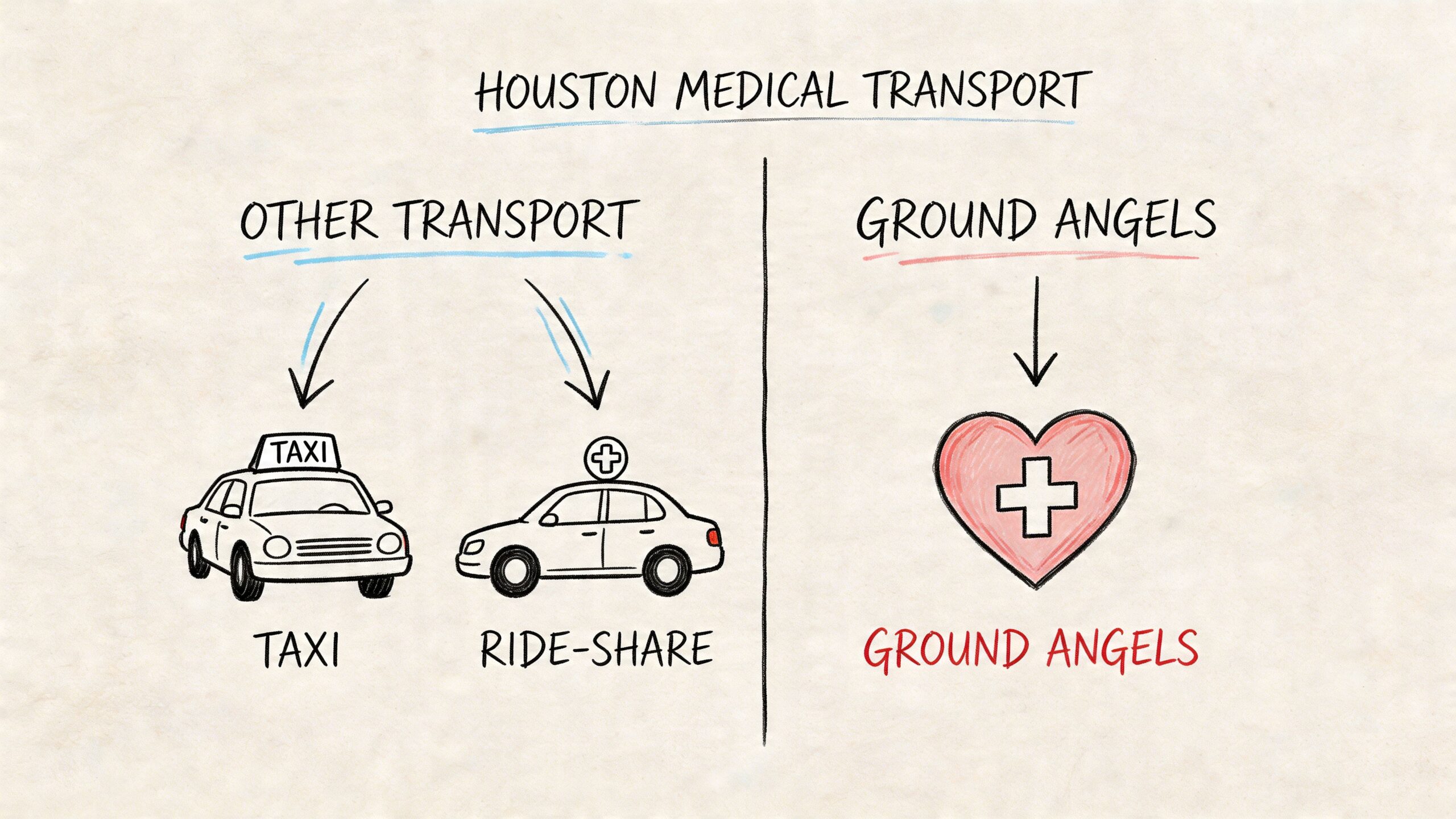
| Ground Angels Houston | Ambulatory patients traveling for medical care | Free, patient-centered, built around Houston medical travel | Availability is not guaranteed |
| Rideshare or taxi | Simple, last-minute trips | Fast to request when available | Variable driver quality, accessibility issues, and no medical focus |
| Formal ground ambulance | Non-ambulatory or medically complex patients | Clinical support and proper equipment | Higher cost and more intensive coordination |
| Medical escort with coordinated transport | Patients needing supervision across the full journey | Strong continuity and oversight | More planning required than a standard ride |
Ground Angels reports a mission success rate around 66 to 75 percent with real-time digital coordination, and that kind of reliability matters in a medical environment where the Texas Medical Center handles over 10 million patient visits annually, according to Ground Angels provide-a-ride information.
That’s strong performance for a volunteer model. Still, the key phrase is “for the right patient.”
When Ground Angels is the smartest choice
Choose Ground Angels when the patient is stable, ambulatory, and mainly needs a kind, organized ride between Houston medical destinations.
Choose something else when the transportation problem includes safety risks such as frailty, confusion, fall risk, oxygen dependence, or inability to transfer in and out of a passenger seat. Families also need to think hard about driving ability for older adults. If that’s part of your planning, this practical guide on when elderly drivers should stop driving can help frame the decision.
Where coordinated care changes the outcome
The strongest patient travel plans combine the right air segment, the right ground segment, and the right level of oversight. For some patients, that means a volunteer ride is enough for the Houston leg. For others, especially seniors and medically fragile travelers, a professional medical escort service is the safer choice.
That isn’t about prestige. It’s about matching the ride to the patient.
Use Ground Angels when the challenge is transportation access. Use formal medical transport when the challenge is patient condition.
Frequently Asked Questions
Families usually ask the same practical questions once they understand what ground angels houston does. Here are the answers I give most often.
Is Ground Angels Houston really free
Yes. It is a complimentary service for eligible medical travelers. Volunteers donate their time, vehicles, and fuel.
That’s exactly why families should treat the service with respect. Be ready, communicate clearly, and don’t overbook rides you may not use.
Can I tip the driver
No. Ground Angels states that volunteers do not accept tips.
The right response is gratitude, punctuality, and good communication.
Can a caregiver or family member ride too
Often, a caregiver is part of the medical travel reality, and companion arrangements are usually addressed during ride planning. Still, don’t assume. State clearly who will be riding so the volunteer knows the expected passenger load.
What if the flight is delayed or the appointment runs late
Call or text as soon as you know. Don’t wait and hope it works itself out.
Houston medical travel is full of moving parts. Delays happen. Silence causes major damage because the driver may already be in motion or trying to coordinate the next mission.
Is this service available for every patient
No. Ground Angels is a small operation. The organization says it operates with a small staff and around 100 volunteers, and it also tells patients that requests are high and a backup transportation plan is mandatory because ride fulfillment cannot be guaranteed, according to Ground Angels about us.
That honesty is one reason I recommend them. They are useful, but they are not pretending to be limitless.
What if no volunteer is available
Have another plan ready immediately.
That might mean a hotel shuttle if appropriate, a family vehicle, a rideshare, or a professionally coordinated medical transport option depending on the patient’s condition. The mistake is waiting until the last minute to think about fallback options.
Is Ground Angels the same as an ambulance service
No. This is not emergency response, stretcher transport, or onboard clinical care.
It is best understood as free non-emergency medical transportation for ambulatory patients inside the Houston care ecosystem.
What’s my bottom-line recommendation
If the patient is ambulatory and traveling to the Texas Medical Center, check ground angels houston early. It’s one of the smartest local resources available.
If the patient is medically fragile, non-ambulatory, bariatric, or likely to need supervision during transfers, move straight to a professionally coordinated transport plan. The right ride isn’t the cheapest one. It’s the one the patient can complete safely.
If you’re arranging a longer-distance transfer and need the Houston ground segment coordinated with the flight itself, contact Med Jets by Air Trek. Since 1978, the team has provided end-to-end medical transportation support, including air ambulance flights, medical escorts, and ground coordination for families, case managers, and insurers who can’t afford gaps in the plan.