
You're probably looking at the same kind of posting many pilots do. Good schedule. Meaningful flying. Better pay than another year of grinding through routine charter legs. Maybe you've flown freight, instructed, or sat right seat in Part 135, and now you're asking whether air ambulance pilot careers are the move.
That question gets more interesting when you stop thinking only about helicopters.
Many observers hear “air ambulance pilot” and picture a rotorcraft landing near a highway scene. That's part of the industry, but fixed-wing medevac is its own lane. Jet crews handle longer-range hospital transfers, time-sensitive patient movements, and missions that demand smooth instrument flying, sharp coordination with medical teams, and patience with logistics that can change by the hour. In a Citation or similar aircraft, you're not dropping into a roadside landing zone. You're solving a different problem. Range, weather, airport access, patient comfort, cabin setup, fuel planning, alternates, family coordination, and often a fragile passenger who cannot tolerate rough handling.
That makes this one of the most rewarding and least understood paths in aviation.
Is an Air Ambulance Career Right for You
A lot of pilots first notice the upside. Rotating schedules. Purpose-driven work. A cockpit that feels more meaningful than another anonymous reposition. The catch is that this job asks more from your judgment than most recruiting copy admits.
Job listings frequently highlight 7-on/7-off schedules and bonuses, yet they often overlook the demands of 24/7 operations, night flying, and irregular pressure. Industry data also indicates burnout rates for air ambulance pilots are 20 to 30 percent higher than for commercial pilots because of unpredictable overtime and high-stakes calls, as noted by GMR pilot career information.
In fixed-wing work, the pressure has a different texture than helicopter EMS. You may have more runway, better weather tools, and more stable platforms. You also carry the burden of longer mission planning, airport-to-bedside coordination, and patient transport decisions that ripple through hospitals, families, and insurers.
The temperament test
This career fits pilots who can do three things at once without letting any one of them slip:
- Fly precisely: You need disciplined instrument habits, clean checklist use, and a stable approach mindset.
- Handle medical context: You won't provide clinical care, but you must understand that your choices affect a patient's pain, safety, and continuity of treatment.
- Stay even-keeled with people: Dispatch, nurses, respiratory therapists, case managers, family members, and maintenance all touch the mission.
Practical rule: If you like being the hero in the cockpit, this probably isn't your best fit. If you like being the calm adult on a complicated day, it might be.
A smart first step is comparing mission types before you chase openings. This look at fixed-wing and rotary-wing medical transport helps frame the operational difference clearly.
And if you're sorting through whether this path fits your long-term goals, it can help to talk with someone outside your current circle. Pilots who are making a career pivot sometimes benefit from hiring a professional career strategist to pressure-test timing, positioning, and application strategy before they commit to another training cycle.
Questions to ask yourself now
Ask these before you apply anywhere:
- Do you like structured flying more than improvisational flying? Jet medevac rewards preparation.
- Can you live with mission unpredictability? The schedule may look clean on paper. The day often won't.
- Are you comfortable around illness and family stress? You won't be insulated from the human side of the work.
- Would you rather do fewer, more complex legs than many short ones? That's often the fixed-wing trade.
If those answers lean yes, keep going.
Core Pilot Qualifications Your FAA Licensing Roadmap
Before an operator cares about your bedside manner or interview polish, they care whether your foundation is solid. In air ambulance pilot careers, weak fundamentals show up fast.
Start with the certificates that matter
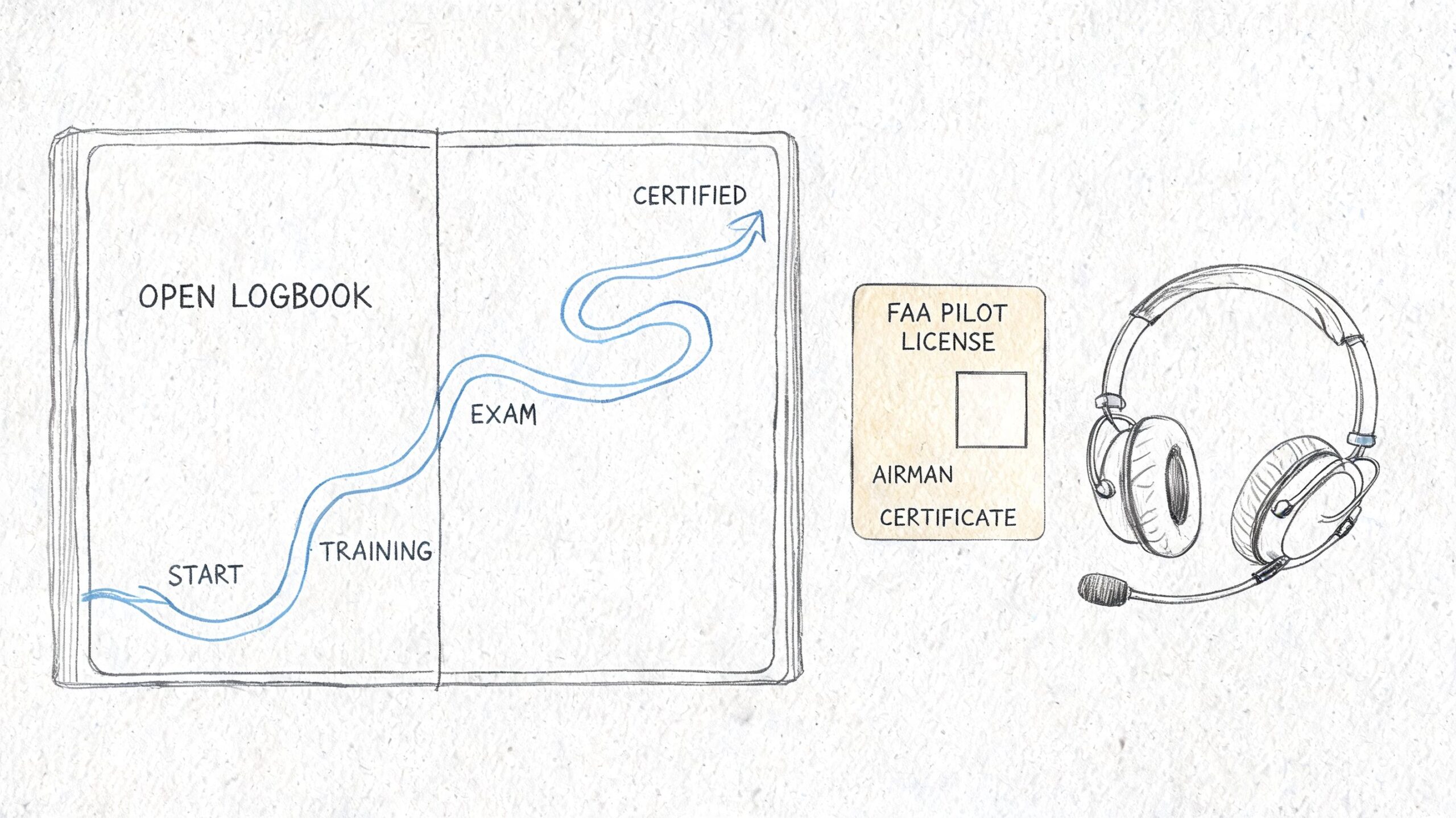
For the fixed-wing path, the sequence is straightforward even if the work is not.
| Certificate or rating | Why it matters in medevac |
|---|---|
| Private Pilot License | Gives you the base stick-and-rudder habits and aeronautical decision-making you build everything else on. |
| Instrument Rating | This is where you learn to trust procedures, scan properly, and work safely in the weather system you'll actually live in as a professional pilot. |
| Commercial Pilot License | Lets you fly for hire and marks the shift from student habits to professional standards. |
| Multi-engine experience | Fixed-wing air ambulance work commonly depends on multi-engine proficiency, systems management, and disciplined abnormal procedures. |
| ATP track | Many serious operators want pilots moving toward or already holding ATP-level qualifications because the job demands mature judgment. |
The “why” matters more than the checklist. A medevac jet crew can't afford sloppy IFR habits. Patients often don't care what certificate you hold. They care that the flight is smooth, timely, and safe. Hospitals care about reliability. Your chief pilot cares whether you can operate to standard every time, including at the end of a long day.
Why instrument proficiency is non-negotiable
Fixed-wing medevac is procedure-heavy by nature. You'll work with reroutes, changing destination needs, alternates, time pressure, and medical teams who are focused on patient status rather than cockpit limitations.
That's why a pilot with average instrument habits usually struggles. This job rewards people who brief clearly, fly stable profiles, and don't get mentally overloaded when the plan changes.
Your instrument rating shouldn't just be legal currency. It should be the skill that defines how you think.
If you're still early in training and want a rotorcraft comparison for context, this resource on professional helicopter flight training is useful because it shows how differently helicopter and airplane career pipelines develop.
Build the right foundation, not just any foundation
A practical roadmap looks like this:
- Earn the private certificate well: Don't rush basic airmanship.
- Treat instrument training like your professional turning point: For jet medevac, it is.
- Add commercial privileges and multi-engine competence: Operators need paid-flight eligibility and aircraft systems discipline.
- Move toward ATP readiness: Even when not immediately required, ATP-level knowledge helps in interviews and line operations.
If you want a broad snapshot of what operators typically look for before the hiring conversation even starts, Med Jets has a useful overview of pilot qualifications for medical transport roles.
The pilots who last in this field usually didn't cut corners on training. They built a base they could lean on when everything else got busy.
Accumulating Flight Time Pathways to the Right Seat
Many careers stall, not because the pilot lacks talent, but because they build the wrong time, in the wrong environment, for the wrong next job.
For fixed-wing medevac, operators often look for experience levels that align with 2,500 total hours, including 1,000 PIC and 100 actual instrument hours, while rotor operators such as PHI Air Medical set high helicopter thresholds of 2,000 total hours, 1,500 helicopter hours, 1,000 PIC helicopter hours, and 100 unaided night hours, as described by Air Methods pilot role information.
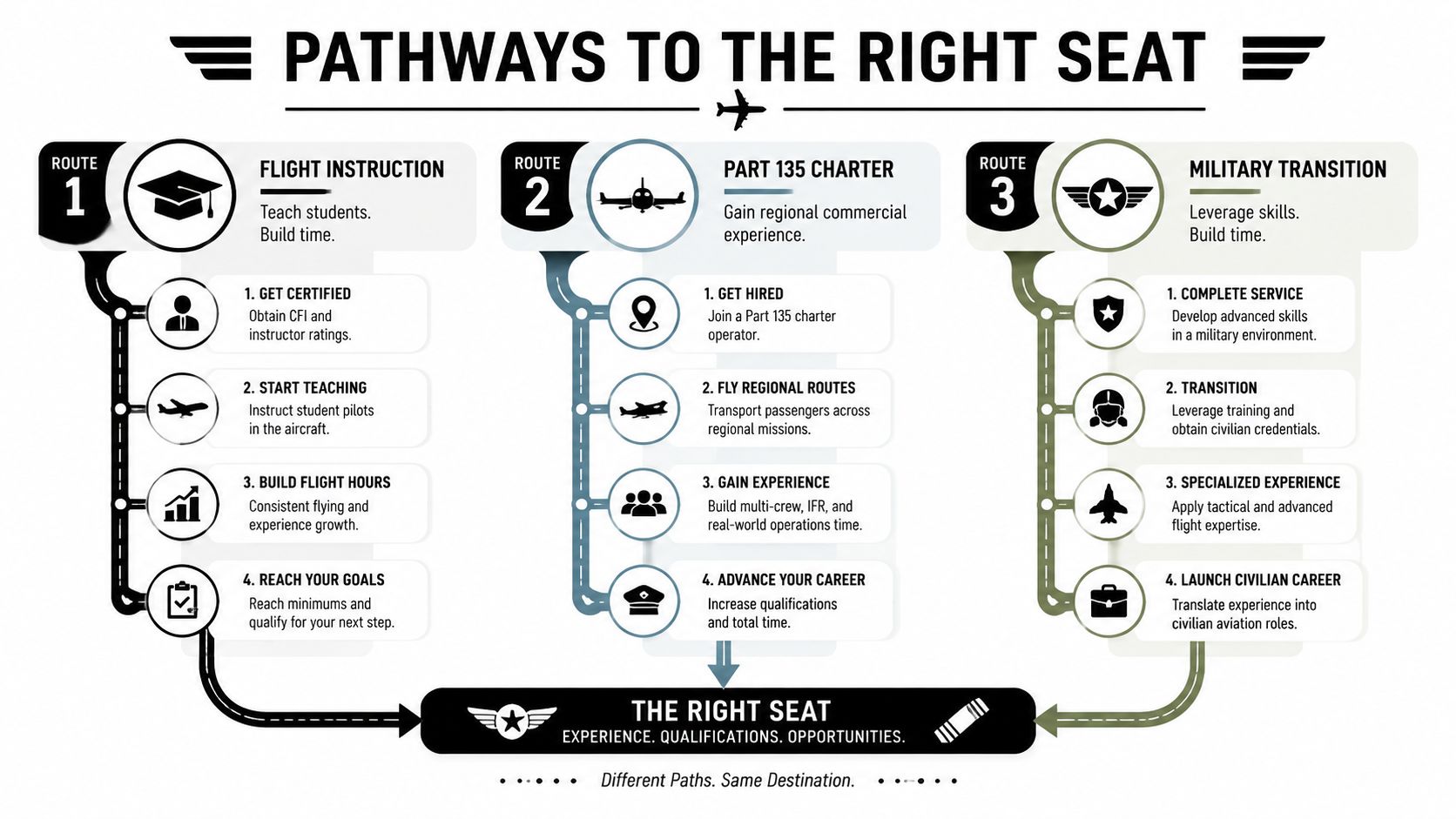
Civilian route
This is the most common path, and it works if you're deliberate.
A civilian pilot often starts by instructing, then moves into Part 135 charter, freight, survey, or a right-seat turbine job. The danger is building a lot of hours that don't sharpen the skills medevac departments care about. Logging time is not the same as becoming employable.
What helps:
- CFI work with standards: Instructing builds judgment, communication, and systems repetition.
- Actual IFR exposure: Fixed-wing medevac hiring managers notice whether your instrument time is real and recent.
- Multi-engine and turbine progression: Even small turbine opportunities can matter if they lead to PIC responsibility later.
What doesn't help much:
- Random hour chasing: A thick logbook with thin decision-making is easy to spot.
- Low-discipline flying jobs: If a role teaches shortcut habits, it will cost you later.
- Ignoring CRM: Jet medevac is team flying. Lone-wolf habits are expensive.
Military transition
Military pilots often arrive with excellent systems discipline, mission focus, and crew coordination. Those are real advantages. Still, military time doesn't automatically translate into a strong civilian medevac application.
The pilots who transition well do two things early. They learn the civilian paperwork and regulatory culture, and they translate experience in a way recruiters understand. “Mission complexity” means something, but “actual instrument decision-making, crew coordination, and patient transport suitability” means more.
Military experience opens doors. Civilian relevance keeps them open.
For fixed-wing candidates, the strongest military-to-medevac transitions usually show stable instrument performance, strong standardization habits, and a willingness to adapt to customer-facing operations that are less tactical and more service-oriented.
Corporate and charter route
This is the sleeper path for fixed-wing air ambulance pilot careers.
A pilot coming from charter or corporate flying may already understand multi-leg planning, changing passenger needs, turbine systems, and the expectation that no two days will run exactly as scheduled. That carries over well to jet medevac. The best candidates from this lane know how to blend professionalism with flexibility.
Here's the trade-off:
| Pathway | Main strength | Common weakness |
|---|---|---|
| Civilian CFI to Part 135 | Strong teaching base, gradual skill building | Can take longer to reach turbine PIC quality |
| Military transition | High procedural discipline and crew culture | Civilian translation can be awkward if not framed well |
| Corporate or charter | Strong customer-facing IFR and turbine environment | Some pilots need to adjust to medical mission priorities |
What fixed-wing recruiters really want
For jet medevac, a recruiter is usually asking a quieter question behind the hour totals: can this pilot carry responsibility without creating friction?
That means your flight-time strategy should favor:
- PIC time that reflects command judgment
- Actual instrument time, not just hood work
- Multi-engine or turbine exposure in structured operations
- Evidence that you can work with dispatch and support teams
- A clean training record, or honest explanations where it isn't clean
The right seat goes to pilots who built useful time, not just sufficient time.
From Pilot to Medevac Pilot Essential EMS Training
Licenses and hours get your file opened. Specialized training decides whether you stay.
Some operators require applicants to prove instrument proficiency in a Level 7 FAA-approved simulator before training begins. Proprietary initial courses can run 18 to 21 days, and reported simulator washout rates of 15 to 25 percent show how selective the process can be, according to Air Evac Lifeteam aviation information.
What changes when medicine enters the mission
A good charter pilot thinks about passengers. A good medevac pilot thinks about patients.
That difference sounds small until you see it in practice. A passenger can be inconvenienced by a delay, a bump, a long taxi, or a last-minute route change. A patient may be destabilized by the same things. Even in fixed-wing jets, where the flight profile is often smoother and more controlled than rotor work, your decisions still affect pain, anxiety, equipment management, and handoff timing.
That's why EMS training is not just emergency procedure training. It's operational judgment inside a medical system.
Skills that separate a medevac pilot from a good jet pilot
Three areas matter most.
Medical crew coordination
You're not there to run the medicine. You are there to create the safest, most workable platform for the clinical team.
That means learning when to push for a faster departure and when to slow the operation down. It means listening when a nurse says a patient needs a gentler climb profile. It means understanding that a “simple transport” can turn complicated before the cabin door closes.
CAMTS mindset and standardization
Even when applicants don't yet know every CAMTS detail, operators expect them to understand that medical transport standards are tighter than ordinary flying in many respects. Standardization matters because the mission chain is long. Dispatch, medical crew, ground ambulance, airport handling, receiving hospital, and family all depend on predictability.
Pilots who resist standardization usually struggle in this environment.
Recurrent simulator discipline
The simulator is where operators find out whether your confidence is built on skill or on habit. The pilots who do well in recurrent training don't just know the profile. They brief crisply, communicate under pressure, and recover without ego.
The medevac pilot the team trusts most is usually not the flashiest pilot. It's the one who stays predictable when the mission gets messy.
Hospital flying is not airport-to-airport flying
Fixed-wing medical transport often starts and ends with airport operations, but the mission is never just airport-to-airport. The essential job is hospital-to-hospital continuity.
Keep these realities in mind:
- Ground segments matter: Delays on the ramp can undo good planning in the air.
- Cabin configuration matters: Equipment, family seating, and patient loading shape how the flight runs.
- Comfort matters operationally: Smooth handling is not cosmetic. It can support patient tolerance.
- Communication matters as much as stick skill: Medical crews need accurate timing and no surprises.
A jet air ambulance operation may use aircraft such as Cessna Citation variants for patient transfers that include longer-range missions and specialized accommodations. That's one reason fixed-wing work deserves to be treated as its own discipline inside the broader medevac field.
Getting Hired Your Application and Interview Strategy
The hiring market can open up quickly for the right pilot. Recent FAA updates have created a 15 to 20 percent pilot gap in fixed-wing medevac roles, with a 25 percent increase in job postings for pilots qualified to fly aircraft such as the Cessna Citation or King Air, according to Indeed air ambulance pilot job market information.
That helps. It does not replace a sharp application.
Why hours alone won't close the deal
Chief pilots don't hire logbooks. They hire judgment.
A pilot with solid turbine time and sloppy presentation often loses to the pilot who clearly understands the mission. In air ambulance pilot careers, operators want evidence that you can represent the company, support the medical crew, and stay stable when plans change at the last minute.
Your resume should show more than totals. It should signal context.
Include experience that points to:
- Part 135 discipline
- Actual IFR operations
- Multi-pilot CRM
- Passenger or patient-facing professionalism
- Checkride and training consistency
If you've flown aircraft or missions relevant to longer-range medical transport, say so plainly. Don't make recruiters decode your background.
How to answer the questions that matter
You should expect scenario questions, not just technical ones.
Examples:
- A nurse asks for a delay because the patient isn't ready, but dispatch is pushing hard. What do you do?
- Weather is legal but uncomfortable. The family is anxious. How do you frame the decision?
- You arrive at a small field and the ground portion is falling apart. How do you keep the mission organized?
Good answers show hierarchy. Safety first. Standards second. Communication throughout. No drama.
If your interview answers make you sound combative, heroic, or casual about procedure, you're making the wrong impression.
For practice, some candidates use an AI interview prep tool to rehearse scenario responses out loud and tighten how they explain aeronautical judgment under pressure.
Research operator fit before you apply
Not every medevac operation runs the same way. Some are large and highly centralized. Some are regional. Some are family-operated and emphasize a tighter operational footprint.
A thoughtful candidate studies:
- Aircraft type and mission profile
- Home-base or residency expectations
- Whether the work is scene-based, interfacility, or mixed
- How much crew interaction the role requires
- What “patient-centered” means in actual operations
For example, Med Jets career information can help candidates understand how one fixed-wing provider frames pilot opportunities within a medical transport operation.
The strongest interview strategy is simple. Show that you know what this job is, and that you want this job, not just any flying job with better pay.
A Day in the Life Salary Schedules and Benefits
Compensation gets attention first, and it should. According to U.S. Bureau of Labor Statistics May 2025 data, the median annual wage for commercial pilots is $142,960, while pilots in nonscheduled air transportation earn an annual mean wage of $137,530, based on the wage summary presented by MyMajors using BLS data.
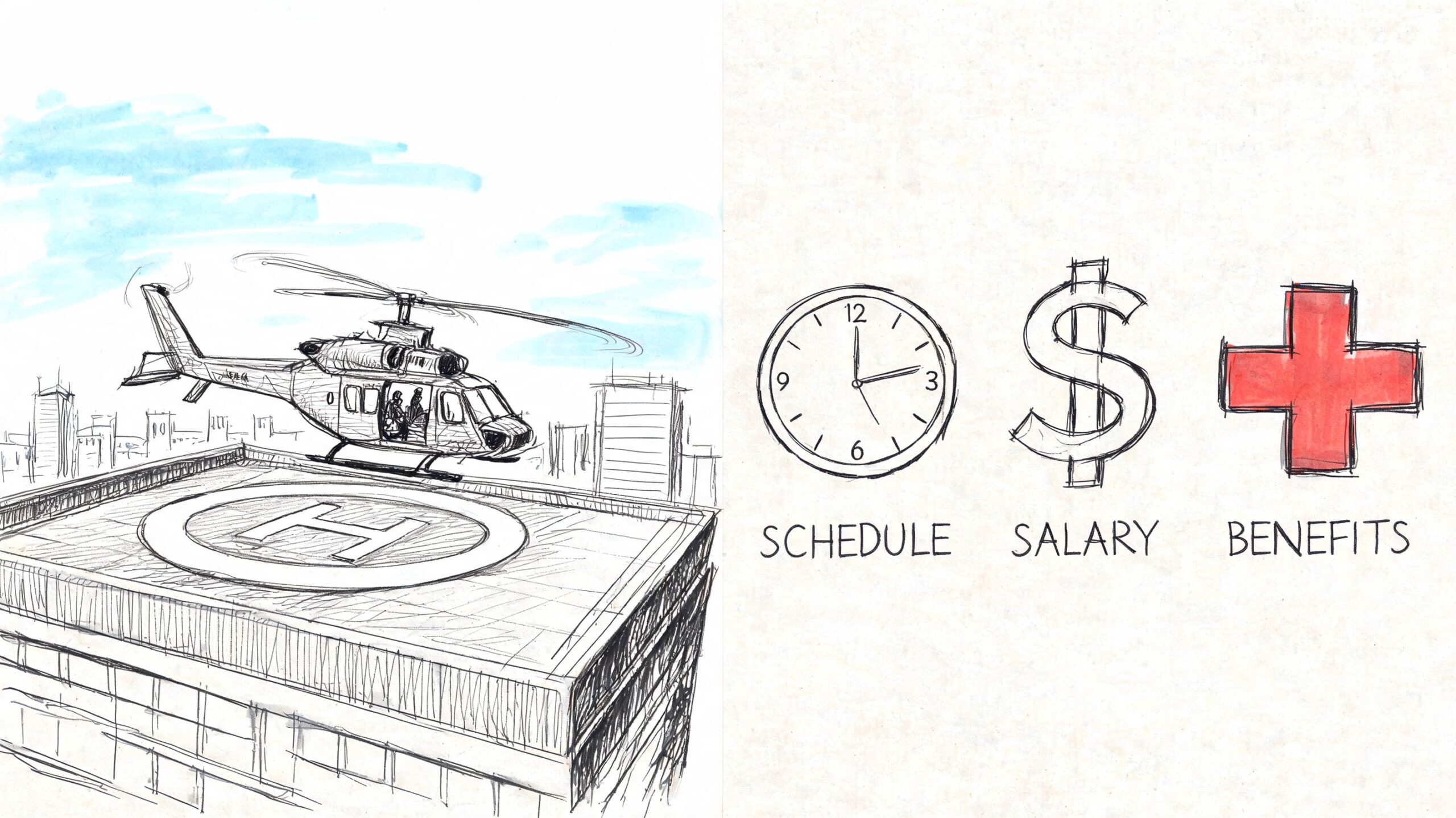
That gives you a benchmark, not a promise. Fixed-wing medevac pay varies by aircraft, base, schedule, and whether the operator is flying interfacility missions, longer-range specialty transports, or a mix.
What the schedule looks like on paper and in real life
Many pilots are attracted to medevac because the schedule can look cleaner than other corners of aviation. Rotations appeal to people who want concentrated duty periods and concentrated time off.
In practice, the value of the schedule depends on four things:
| Schedule factor | What it looks like in real life |
|---|---|
| Duty structure | A good rotation still feels long if the phone can ring at any hour. |
| Base location | A great job can become a draining one if the location isolates you from family life. |
| Mission mix | Longer-range jet work often means more planning and coordination even when flight legs are smoother. |
| Company culture | The best schedule on paper means little if dispatch and leadership create avoidable chaos. |
Fixed-wing crews often trade some of the immediacy of helicopter scene response for longer transport legs, more airport coordination, and more interaction with hospital transfer systems. That can be a better lifestyle for some pilots. For others, it feels like being on standby for logistics rather than emergency response.
What a typical duty block actually includes
A day may involve far more than flying.
You may brief weather and alternates, coordinate fuel, confirm patient loading constraints, wait on hospital release timing, revise ETAs, and work through destination changes. If the aircraft is configured for one or two patients plus family seating, cabin setup and loading sequence matter. If the transport involves a larger patient or special equipment, handling and balance planning become part of the mission rhythm, not an exception.
Here's a useful industry snapshot for visual context:
The benefits that don't show up in payroll
The strongest benefit is usually mission meaning. You know why the flight matters. That keeps many pilots in the field longer than they might stay in a comparably demanding charter role.
The hardest cost is emotional load. Not every patient is stable. Not every family is calm. Not every mission ends with the kind of closure people imagine when they first enter air ambulance pilot careers.
A pilot considering fixed-wing medical transport should weigh both sides:
- Strong upside: Purpose-driven work, advanced IFR flying, and transport missions that rely on planning and professionalism.
- Real trade-off: Fatigue, standby stress, emotionally charged operations, and the need to perform smoothly for people having a very bad day.
Common Questions About Air Ambulance Pilot Careers
Is fixed-wing medevac easier than helicopter EMS
No. It's different.
Helicopter EMS usually gets more public attention because the missions look dramatic. Fixed-wing medevac asks for a different kind of discipline. You're often dealing with longer-range planning, IFR complexity, airport coordination, and patient comfort over a longer transport window. Jet operations also put more emphasis on systems management, weather strategy, and smooth handling for medically fragile passengers.
If you like structured procedures and cross-country judgment, fixed-wing may fit you better.
Can I go straight from flight school into air ambulance work
This is often not the type of role that many individuals truly seek.
Operators expect maturity, not just certificates. The gap between “commercially rated” and “ready for a medevac cockpit” is where you build command judgment, IFR consistency, crew coordination, and professional habits. Most pilots need intermediate jobs to get there.
What time matters most for fixed-wing hiring
For jet medical transport, the quality of your PIC, actual instrument, and turbine-relevant experience usually matters more than raw total time by itself.
A pilot who arrives with disciplined IFR habits and evidence of good command decisions is more attractive than a pilot who found a way to stack hours. This is one reason charter and corporate backgrounds can translate well.
Am I too old to pursue this path
Age by itself doesn't answer the question.
What matters is whether you can still invest in training, build meaningful experience, and meet the operational demands of the role. Some pilots start later and do well because they bring maturity, work ethic, and better decision-making than younger candidates. The central issue is runway. Do you have enough time and commitment to build the qualifications operators expect?
What do interviewers want beyond flying skill
They want signs that you won't create friction in a medical environment.
That includes:
- Professional communication
- Respect for procedure
- Comfort with changing plans
- Calm interaction with medical crews and families
- Honest self-assessment
The pilot who gets hired is often the one who sounds safest to work with at 2 a.m., not the one with the most colorful stories.
Do fixed-wing medevac pilots deal with patient care
Not clinically. Operationally, yes.
You're not administering treatment. You are influencing the patient experience through aircraft handling, timing, communication, loading decisions, and coordination with the medical crew. In fixed-wing operations, that often includes thinking about smoother climbs and descents, practical airport choices, and how to avoid avoidable delays.
Good medevac pilots never hide behind “I just fly the airplane.” They understand where flying ends and mission responsibility begins.
Is a family-operated program different from a large national operator
It can be.
Some pilots prefer large systems with highly standardized processes and broader internal mobility. Others prefer smaller or family-operated environments where communication lines are shorter and the mission profile is more focused. Neither is automatically better. The right choice depends on how you work, how much structure you want, and whether the operator's flying matches the kind of pilot you are trying to become.
If you're serious about air ambulance pilot careers, especially the fixed-wing jet path, treat this as a specialty, not a fallback. Build clean IFR habits. Chase useful time. Learn how medical missions work. Then apply where your background fits the mission, not just the salary line.