

You get the call, and the questions come fast. A parent needs to be moved from one hospital to another. A spouse can't travel on a commercial flight. A case manager is trying to line up discharge, oxygen, medications, records, and a receiving facility before the day is over.
At that point, patients and families don't ask for “aero medical supplies.” They ask, “How will they keep my loved one safe in the air?” That's the right question.
The answer is that a proper medical flight isn't just an airplane with a stretcher. It's a tightly planned clinical environment built for altitude, vibration, limited space, and no room for failure. The supplies on board determine what care can continue in flight, what risks can be managed, and how smoothly the handoff happens from bedside to bedside.
What Are Aero Medical Supplies
Aero medical supplies are the medical tools, medications, monitoring systems, and support equipment used to care for a patient during air transport. In practice, they function as a mobile treatment space that has to perform reliably in a cabin, not a hospital room.

More than a bag of equipment
Families often picture a medic carrying a jump bag and a few oxygen bottles. That's not what serious fixed-wing transport looks like. Aero medical supplies include cardiac monitoring, airway equipment, suction, infusion pumps, oxygen delivery systems, medications, immobilization gear, and patient-specific items such as bariatric transport supports or neonatal hardware when needed.
What matters is how those pieces work together. The monitor has to be readable in a cramped cabin. The ventilator has to keep delivering appropriate support while cabin conditions change. The IV pump has to stay accurate even when the aircraft vibrates or banks.
Practical rule: If a device works well on a hospital floor but hasn't been integrated for flight, that alone doesn't make it air-ready.
Why demand is growing
This category matters because the broader supply ecosystem is growing. The global medical supplies market was valued at USD 140 billion in 2022 and is projected to reach USD 185.81 billion by 2032 according to Custom Market Insights on the medical supplies market. For air medical transport, that growth reflects a larger reality. More patients depend on specialized consumables and support devices, and more transfers involve clinically complex care.
What people usually want to know
When families or discharge planners ask about aero medical supplies, they're usually asking one of these:
- Can my loved one stay on the same level of care in the air? That depends on the aircraft setup, crew scope, and what equipment is loaded for that mission.
- Will their medications be organized safely? Good programs treat onboard medication setup with the same discipline you'd expect from a code cart. If you want a simple refresher on that logic, this guide to crash cart medication organization is useful because it shows why fast access and clear labeling matter when seconds count.
- Can personal medical equipment come along? Sometimes yes, but it has to be reviewed for flight compatibility and power needs before departure.
Ground equipment and flight equipment aren't the same
Many people are surprised by these requirements. Ground ambulance inventory can be excellent and still not be suitable for flight. In an aircraft, every item has to justify its place, weight, mounting method, and power draw. Space is tighter. Access to the patient can be more limited. Once airborne, replacing a failed device isn't an option.
That's why aero medical supplies should be thought of as an integrated airborne care system, not a checklist of random items.
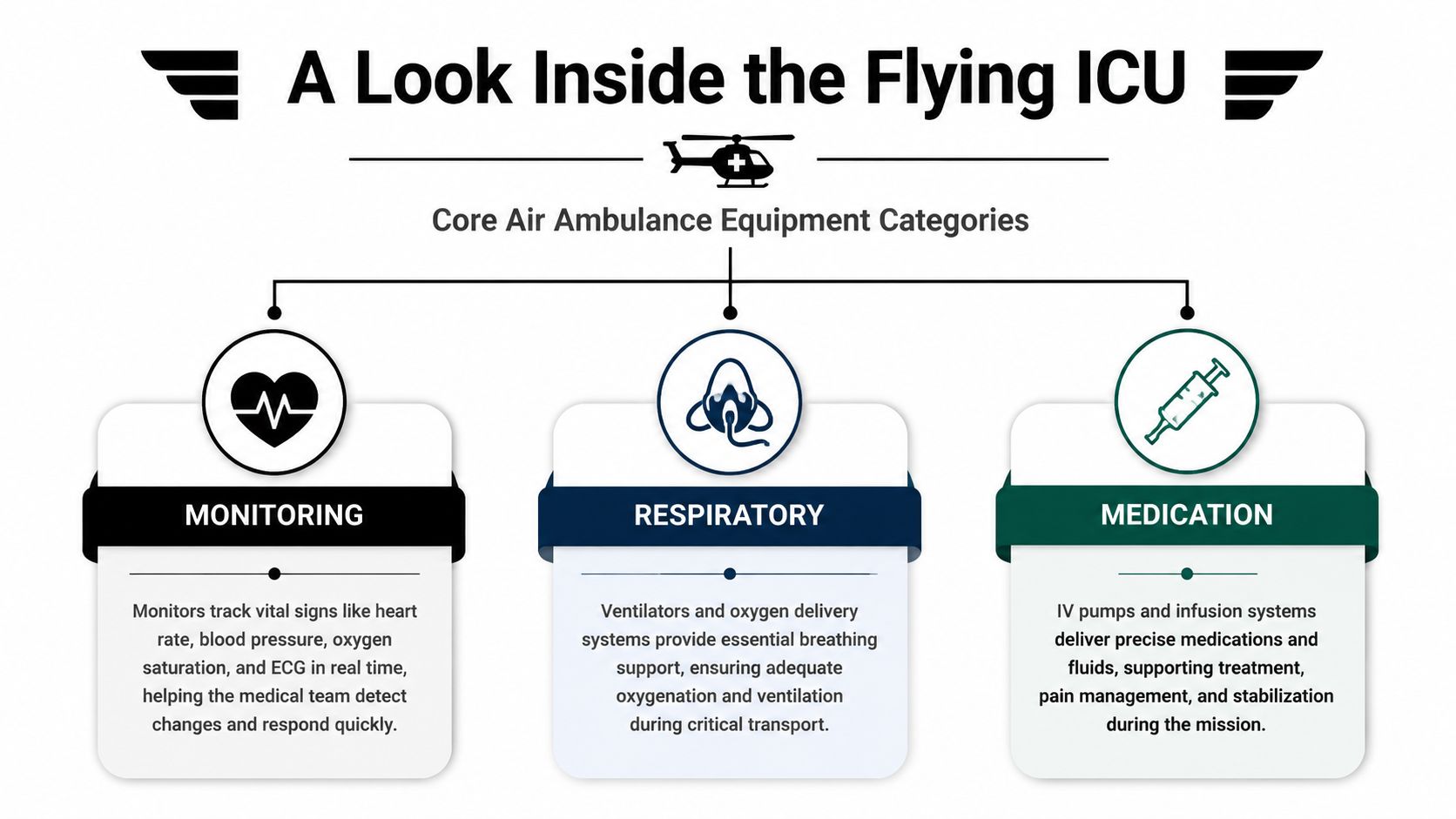
A Look Inside the Flying ICU
A well-equipped air ambulance carries the same clinical intent as an intensive care bedside. The difference is that every item has to survive the aircraft environment and still let the crew work without wasting motion.
Monitoring equipment that stays readable and dependable
The first category is patient monitoring. At minimum, crews need continuous visibility into heart rhythm, pulse oximetry, blood pressure trends, and the patient's clinical trajectory during every phase of the trip.
A good flight monitor isn't just compact. It has to be mounted securely, easy to interpret at a glance, and resilient enough to keep functioning through movement, cabin noise, and changes in pressure. If the patient deteriorates, the crew needs immediate information, not a screen that's hard to read or sensors that drop out constantly.
A practical review of onboard configurations can help families understand what to ask for. Med Jets hosts a useful overview of flight equipment used during medical transport.
Respiratory gear built for cabin conditions
The second category is airway and respiratory support. This includes oxygen delivery hardware, suction, airway control devices, and ventilators designed for transport.
A flight ventilator has one job. It must keep working whether the cabin feels close to sea level or the environment changes during climb and descent. Standard bedside devices can be excellent in a hospital and still be a poor fit in an aircraft because they weren't designed for shifting pressure, restricted mounting options, or transport power systems.
This is why manufacturers custom-build and integrate equipment for aircraft use. As described by AeroMedical's aircraft medical equipment approach, these systems are engineered to meet ISO 13485 standards while accounting for pressurization changes, extreme temperatures, vibration, and aircraft-specific integration demands.
For families managing oxygen outside the hospital, it can also help to understand the difference between home devices and transport systems. A local resource like Affinity Home Medical Equipment in St. Petersburg is useful for understanding home oxygen concentrators, but those products still need provider review before anyone assumes they're appropriate for an air ambulance mission.
Medication and infusion systems that support continuity of care
The third category is medication delivery. This usually means IV pumps, emergency drugs, sedation support when indicated, and the supplies needed to continue time-sensitive therapy without interruption.
In flight, medication setup has to be simple enough to verify under pressure and durable enough not to shift, disconnect, or become hard to access. Multi-channel infusion matters for some patients because one line may not be enough. A patient might need maintenance fluids, a scheduled infusion, and another medication ready to adjust if their condition changes.
The best onboard layouts reduce searching, untangling, and improvising. Crews should be treating the patient, not fighting the equipment.
Specialized equipment for uncommon but high-stakes cases
Some transports need more than the usual monitor, oxygen, and pump setup. A larger patient may require a bariatric-rated stretcher and secure loading configuration. An infant may need a neonatal transport platform. A patient with multiple drains, a feeding pump, or complex respiratory support may need a custom loadout before wheels-up.
The “Swiss Army knife” comparison fits here. A flying ICU doesn't carry everything. It carries the right tools, purpose-built for flight, chosen for the exact patient on board.
Ensuring Safety Above the Clouds
The safest equipment is the equipment that has been selected, mounted, checked, and maintained with discipline long before the patient arrives at the airport.
What FAA compliance means in plain language
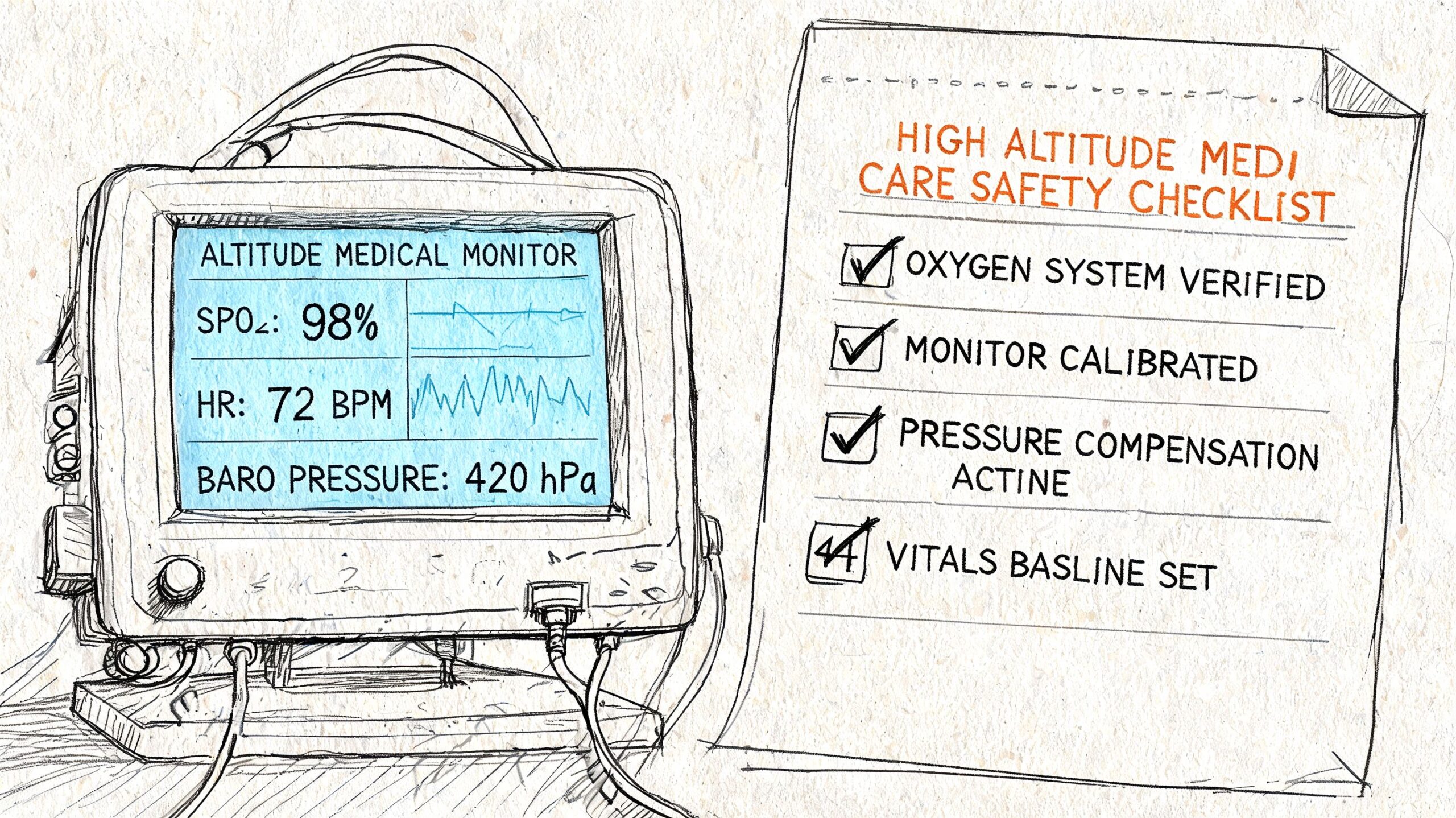
For families, regulatory language can feel distant. In practice, it's very concrete. FAA Advisory Circular 121-33B sets enhanced emergency medical equipment expectations for air carriers, including standardized equipment placement, redundant systems that account for altitude effects, and strict maintenance protocols, as outlined in the FAA advisory circular documentation.
That translates to real patient benefits:
- Standardized placement means the crew knows where critical gear is without hunting for it.
- Redundancy means a failure in one power source or device doesn't automatically become a patient emergency.
- Maintenance discipline means equipment is inspected on a schedule, not just glanced at before departure.
Why redundancy matters so much in flight
On the ground, a hospital can swap devices quickly. In the air, the crew works with what's on board. That's why redundancy isn't a luxury. It's one of the foundations of safe care aloft.
A patient on continuous respiratory support can't wait while someone improvises a workaround. A monitor that loses power during a turbulent segment creates risk at exactly the wrong time. When operators build in backup power and inspection routines, they're protecting the patient from the kinds of failures that become much harder to solve after takeoff.
For pediatric cases, families often have even more questions about equipment fit, monitoring, and specialized staffing. This overview of the pediatric flight nurse role gives helpful context on how transport planning changes when the patient is a child.
What to ask before you say yes
Before agreeing to a transport, ask the operator questions that reveal whether safety systems are built into daily operations:
- How is critical equipment secured in the aircraft?
- What backup power is available for patient care devices?
- How are maintenance checks documented?
- Can you explain how my family member's current therapies will continue in flight?
A provider should be able to answer those clearly.
Here's a short visual overview of why onboard readiness matters during transport operations.
Compliance isn't paperwork for its own sake. It's the system that keeps the monitor on, the oxygen flowing, and the crew ready when the patient needs an intervention.
Planning and Costs The Role of Medical Supplies
When families see an air ambulance quote, they're often reacting to the aircraft. The bigger driver is usually the clinical package built around the patient.
The supply list shapes the mission
A stable patient who needs monitoring and oxygen is one kind of transport. A patient who needs a ventilator, multiple medication infusions, specialized positioning, or bariatric accommodations is another. The aircraft, crew composition, loading plan, and timing all change based on those requirements.
That's why one of the first planning questions should be, “What care has to continue without interruption from bedside pickup to bedside arrival?” Once that answer is clear, the supply and staffing plan starts to make sense.
Why specialized supplies affect cost
Medical equipment doesn't sit in a vacuum. It has to be purchased, integrated, inspected, replaced, and stocked. The broader manufacturing picture helps explain the pressure behind that. The U.S. medical equipment and supplies manufacturing sector has an average operating margin of 2.87%, according to the Maine medical equipment and supplies manufacturing profile. Tight margins and ongoing operational costs influence what providers spend to keep aircraft mission-ready with current equipment.
That doesn't mean every flight should be expensive by default. It does mean the price reflects more than fuel and flight time. It reflects readiness.
A simple way to think about value
These are the trade-offs I'd want any family to understand:
- Basic transport mindset: Move the patient fast, then solve problems if they appear.
- Clinical transport mindset: Anticipate what can go wrong, load the right supplies, and avoid creating new problems in the air.
The second approach usually costs more. It's also the one that protects continuity of care.
When the patient's needs are complex, the aircraft choice matters too. This comparison of fixed-wing vs rotary-wing medical transport helps explain why one platform may be more appropriate than another depending on distance, cabin needs, and mission profile.
Where one provider can fit
One factual example is Med Jets by Air Trek, which coordinates fixed-wing medical transport, medical escorts, and ground segments with aircraft configured for one to two patients plus accompanying family. In practical terms, that kind of end-to-end model can simplify supply planning because the clinical team, aircraft setup, and transport coordination are handled together rather than pieced together by the family.
Decision point: Don't ask only what the flight costs. Ask what equipment, staffing, and continuity of care are included in that number.
Your Pre-Flight Medical Supply Checklist
If you're under time pressure, don't start by trying to learn everything about air medicine. Start by gathering the details that affect the supply plan.
Your 5-minute prep guide
The fastest way to reduce delays is to prepare one clean packet of information. Families often know the history but not the current device settings. Hospitals often know the settings but not the personal equipment traveling with the patient. The provider needs both.
Here's a practical checklist you can use right away.
| Information to Prepare | Key Questions to Ask Your Provider |
|---|---|
| Current medication list with doses and schedule | Can these medications be continued during transport, and how will they be stored and administered? |
| Recent medical records, discharge summary, and physician notes | What records do you need before accepting the flight? |
| Current oxygen use or ventilator settings | How will you manage continuous oxygen or ventilator support during the trip? |
| Personal medical devices such as CPAP, BiPAP, feeding pump, or suction equipment | Is my personal device flight-compatible, or will you substitute your own onboard equipment? |
| Mobility needs, including walker, wheelchair, or bariatric support needs | Can the aircraft and loading plan safely accommodate this equipment and the patient's size or transfer limitations? |
| Allergies and medication sensitivities | How will the crew document and verify allergies before departure? |
| Contact information for sending and receiving facilities | Who confirms bedside handoff details at both ends of the trip? |
| Family escort plans | Can a family member travel, and what personal items or medical supplies can come onboard? |
Questions worth asking out loud
Don't worry about sounding repetitive. The right provider will expect these questions.
- Will you use the hospital's equipment or your own? Most programs prefer aircraft-integrated equipment for safety and compatibility.
- Can my father bring his CPAP? Sometimes yes, but it needs review before the flight.
- What happens to medications that must stay cool? Ask for the storage plan, not just a yes or no.
- Who checks that nothing is missed during pickup? The answer should include a clear bedside handoff process.
Bring the medication list, the device list, and the latest orders first. Those three items solve more last-minute problems than anything else.
What usually causes avoidable delays
The most common issues are practical, not dramatic. Missing records. Unclear oxygen requirements. A family assuming personal equipment can plug in onboard without prior approval. A sending unit handing over meds without a clear reconciliation process.
A short prep call can prevent most of that. Good aero medical supplies planning starts before the stretcher ever moves.
The Med Jets Approach to Aero Medical Readiness
A safe air medical trip depends on three things working together. The equipment has to match the patient. The aircraft has to support the equipment. The coordination has to keep all of it moving without gaps between the hospital, airport, crew, and receiving team.

What practical readiness looks like
In real operations, readiness isn't a slogan. It means the aircraft has appropriate onboard clinical equipment, the crew knows the patient's current needs before launch, and the handoff plan is clear enough that families aren't forced to fill the gaps themselves.
For bariatric, senior, and medically fragile patients, that preparation matters even more. Loading, positioning, respiratory support, and medication continuity all need to be addressed before departure, not negotiated on the ramp.
Why this matters during a crisis
Families don't need a long lecture in the middle of a transfer. They need a provider that can explain, in plain language, what equipment will be onboard, whether personal devices can come, how medications will be handled, and who is coordinating each leg of the trip.
That's the core value of a mature air ambulance operation. It reduces uncertainty. It turns a chaotic moment into a managed process with defined clinical and logistical steps.
Your Questions on Medical Supplies Answered
Can a patient bring their own medical device onboard
Sometimes, yes. The deciding factors are compatibility, mounting, power, oxygen use, and whether the device can be operated safely in the cabin. In many cases, the air ambulance team will use its own integrated equipment and bring the patient's personal device along only if it's appropriate for arrival or handoff.
Do air ambulances carry pediatric or neonatal supplies
Some do, but you should never assume. Ask specifically whether the provider can support your child's age, size, and current treatment requirements. Pediatric and neonatal transport often require specialized equipment, medication planning, and clinicians with the right transport experience.
How are refrigerated medications handled
Ask for the exact storage plan before the flight is confirmed. Temperature-sensitive medications can't be treated like ordinary baggage. The provider should explain how they'll maintain required conditions from pickup through handoff and who verifies the medication at each transition point.
Will the crew manage all medication administration
They should explain which medications can be continued, how they'll be verified, and what documentation is required from the sending facility. If you want a simple refresher on safe medication handling principles, this medication administration safety guide is a good primer because it reinforces the importance of correct patient, drug, dose, route, and timing.
What if the patient needs oxygen the entire way
That's a standard planning issue, but it has to be specified early. The provider needs to know the current flow or support requirement, whether the patient is stable on that regimen, and whether any recent changes have occurred. Oxygen planning affects equipment selection, loading, and in some cases the broader mission setup.
What's the single most useful thing a family can do
Have the current orders, medication list, and device information ready in one place. That saves time, prevents wrong assumptions, and gives the flight team what they need to build a safe aero medical supplies plan from the start.
When you're evaluating aero medical supplies, don't focus only on what's on the aircraft. Focus on whether the provider can explain why each piece is there, how it performs in flight, and how it fits your loved one's exact care needs. That's where safety lives.