
You're probably in one of two spots right now. Either you're an ICU or ED nurse in Florida who keeps checking flight nurse postings and wondering if you're close, or you're helping arrange air transport and trying to understand why qualified flight crews can be so hard to find.
Both questions lead to the same reality. Flight nurse jobs in florida are specialized, competitive, and much less plug-and-play than generic career guides make them sound. The state has real demand, active postings, and multiple employer types, but it also has strict clinical expectations, credential bottlenecks, and niche patient populations that don't fit a standard transport profile.
The nurses who break into this field usually do three things well. They build the right high-acuity background, they get strategic about certifications, and they apply to the right programs at the right stage of readiness. The ones who struggle usually aren't bad nurses. They just apply too early, present themselves too generally, or underestimate how Florida employers screen for transport readiness.
Foundational Requirements for a Florida Flight Nurse
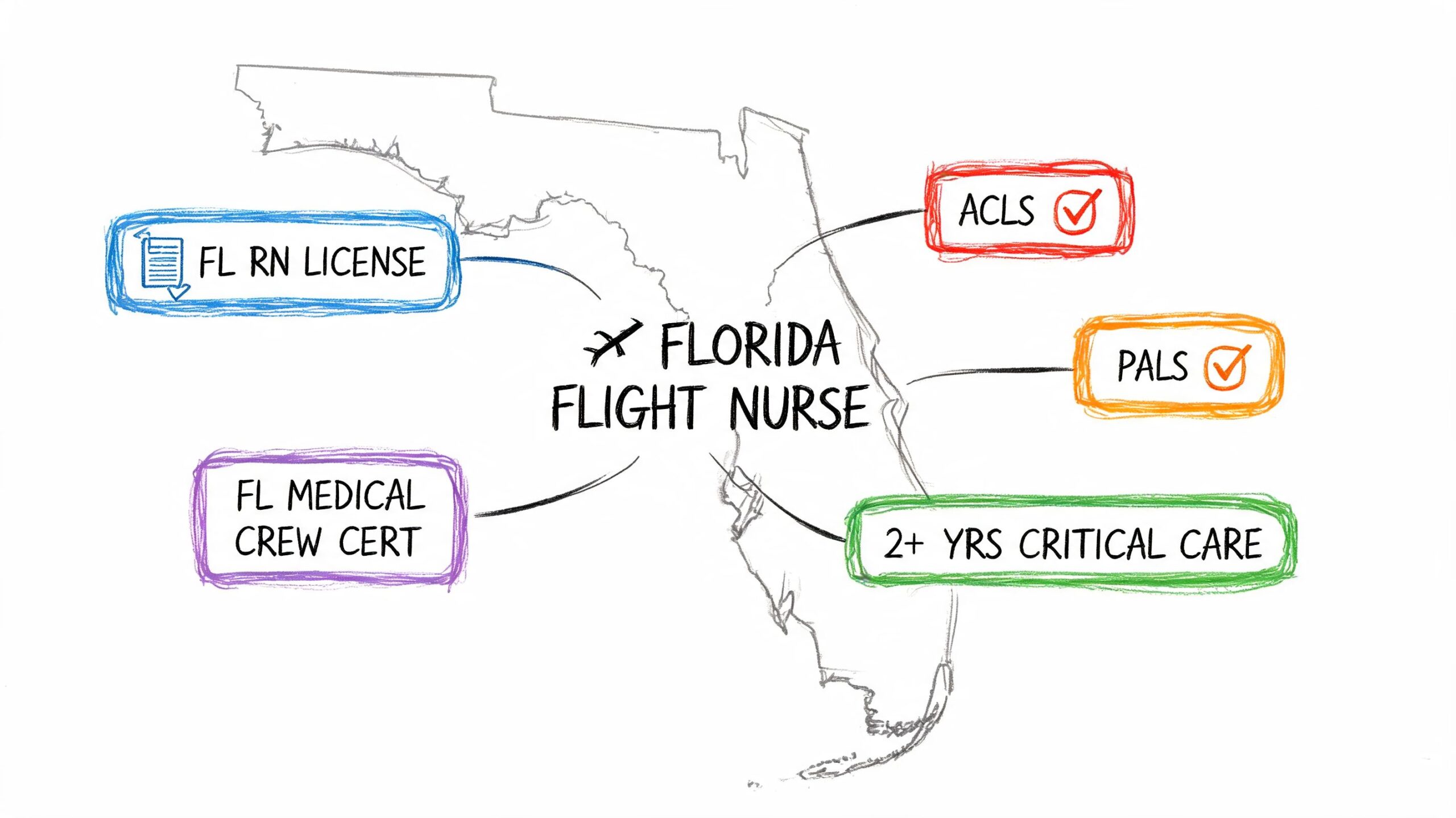
The starting point is simple. You need to be an RN with an active Florida license or eligibility to work under Florida requirements, and you need current high-acuity bedside experience that translates to transport medicine.
PHI Air Medical states that flight nurses must hold an active RN license in the state and typically need at least three years of current critical care or emergency experience, with five years preferred, as summarized by NurseJournal's flight nurse career guide. That's the threshold many applicants miss. They count any hospital experience as equal. Employers usually don't.
What counts as strong experience
A strong Florida candidate usually comes from an environment where rapid deterioration is normal and independent judgment matters. Think adult ICU, CVICU, high-volume ED, trauma, or another setting where you manage unstable patients without needing every next move handed to you.
That doesn't mean every ICU nurse is equally competitive. A nurse with solid ventilator management, vasoactive drip exposure, trauma resuscitation familiarity, and comfort with transfers across service lines will usually present better than someone whose unit has lower acuity or narrow patient variation.
Here's the self-check I'd use before applying:
- License status: Your RN license has to align with Florida practice requirements.
- Recency matters: Employers care about current critical care or emergency experience, not just something you did years ago.
- Acuity matters more than title: “ICU” on a resume helps, but recruiters want to see what you managed.
- Transport mindset: You need to function in a small team, limited space, noise, motion, and changing conditions.
Practical rule: If your current role doesn't regularly force you to prioritize airway, hemodynamics, and rapid escalation under pressure, you probably need more seasoning before a flight interview.
Required versus preferred in the Florida market
In this context, many nurses lose ground. Required and preferred are not the same thing, but in a competitive pool, preferred often becomes the practical filter.
Employers often prefer BSN-prepared nurses, and the common pathway described in this flight nurse career overview is RN licensure after an ADN or BSN, followed by 2 to 5 years of high-acuity ICU, ED, or trauma experience and then transport-focused certification. If you have an ADN, that doesn't disqualify you. It just means the rest of your profile needs to be stronger and cleaner.
What doesn't work
Three patterns show up over and over:
- Applying after only general med-surg or lower-acuity experience
- Assuming strong bedside skills automatically equal transport readiness
- Treating flight nursing like a next-step adventure instead of a specialty transition
Flight nursing in Florida isn't an entry point into critical care. It's a late-stage move for nurses who already perform well in it.
Mastering Key Certifications and Training
Once your bedside foundation is solid, certifications stop being resume decorations and start becoming proof that you can function in transport. Florida employers don't just want a smart ICU nurse. They want a nurse who can bring critical care judgment into an aircraft environment with a very small margin for error.
Job postings commonly expect BLS, ACLS, PALS, and trauma-focused certifications, and they often require CFRN within 24 months of hire, according to PHI Air Medical's flight nurse hiring information. The hidden part is the workload. Candidates have to plan for study time, renewals, class scheduling, exam prep, and the mental lift of doing all that while still working a demanding clinical job.
Build certifications in the right order
Don't chase every acronym at once. Sequence matters.
| Certification | What It Is | When to Get It | Pro Tip |
|---|---|---|---|
| BLS | Basic life support foundation for clinical emergencies | Early and keep current | Make sure renewal dates won't lapse during hiring season |
| ACLS | Advanced cardiovascular emergency management | As part of building critical care readiness | Interviewers may assume this is standard, so don't treat it as a standout item |
| PALS | Pediatric advanced life support | Before applying to broad transport roles | Helpful even if you mainly work adults, because many programs transport mixed populations |
| TNCC, ITLS, PHTLS, or similar trauma training | Trauma-focused assessment and intervention | After core life-support credentials | Pick the one most recognized by your target employers |
| CFRN | Certified Flight Registered Nurse credential aligned to transport practice | Pursue when your critical care base is mature, or show active progress if not yet certified | On a resume, “scheduled” or “in progress” can signal commitment if it's truthful |
The mistake most candidates make
They wait too long to think about CFRN.
The common pathway for flight roles is RN licensure, 2 to 5 years of high-acuity ICU or ED experience, and a transport-specific credential like CFRN. Employers use the CFRN as a key hiring signal, as described in this flight nurse pathway guide. Even when a program allows you to earn it after hire, serious candidates don't act like it's optional.
Start working backward from the application date you want. If you need multiple certifications, you'll need a calendar, a budget, and protected study time.
What the financial and time burden really means
I won't invent a dollar figure because reliable Florida-specific cost data isn't provided here. But the burden is real. Courses, renewals, exam prep materials, and travel time add up. So does fatigue.
What works is a practical schedule:
- Stack renewals together so you don't live in constant expiration anxiety
- Use one exam target at a time instead of enrolling in everything
- Tell your manager early if you need schedule flexibility for classes or testing
- Keep proof organized because recruiters will ask for dates, not just initials after your name
What doesn't work is collecting credentials without a clinical story behind them. A recruiter can tell the difference between a nurse who built certifications on top of real transport-relevant experience and one who built a certificate pile hoping it would replace experience.
Where to Find and Apply for Florida Flight Nurse Jobs
Florida isn't one job market. It's several overlapping ones. If you search “flight nurse jobs in florida” and only look at job boards, you'll miss the differences that shape fit, hiring speed, and long-term satisfaction.
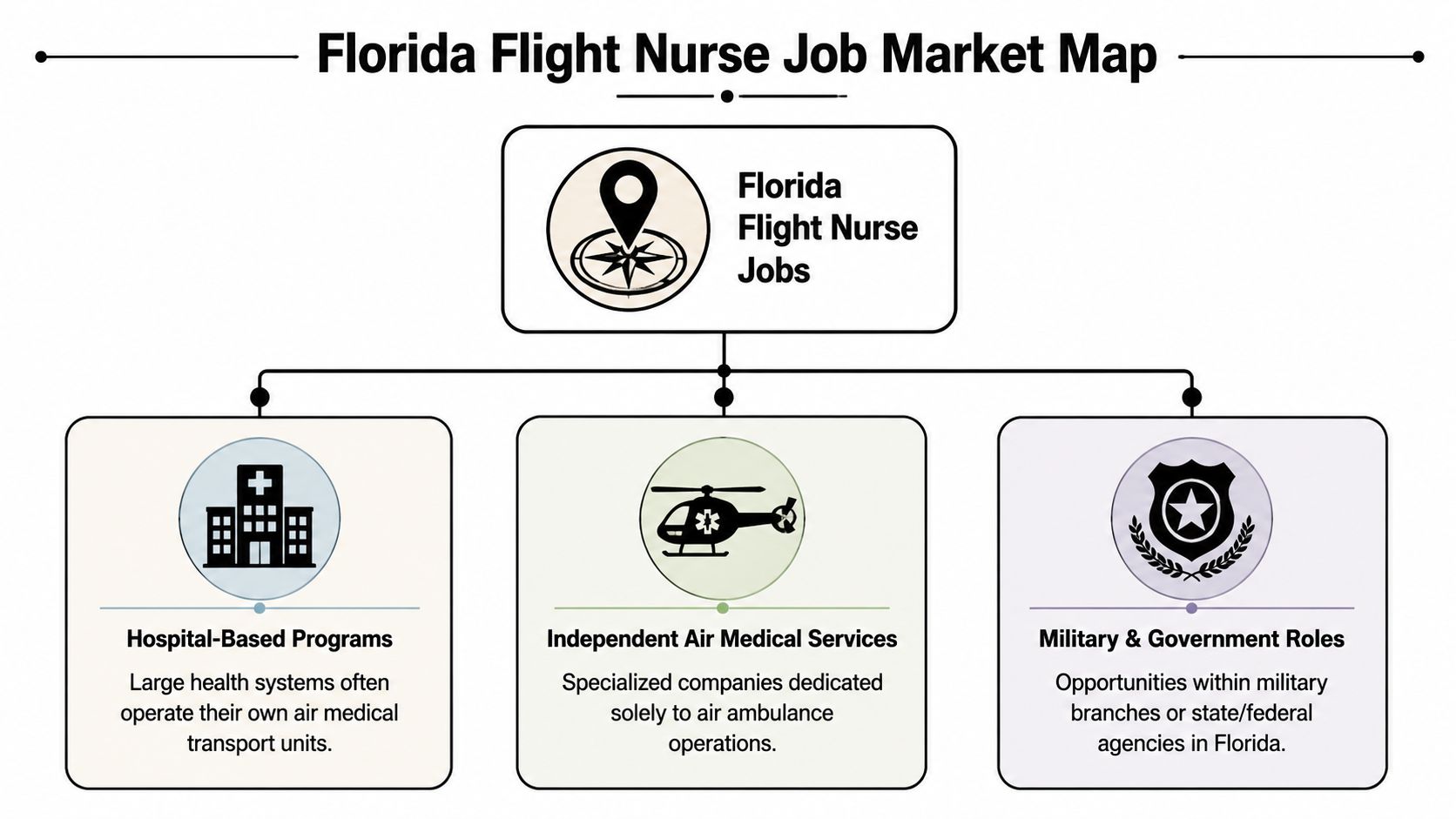
Hospital-based programs
Hospital-based teams often make the most sense for strong ICU or ED nurses trying to enter transport. They may value crossover experience from internal transfer workflows, trauma activation, pediatric specialty units, or tertiary-care systems. That can make the transition more natural than jumping straight into a standalone air-medical operator.
These programs also tend to appeal to nurses who like deeper integration with physicians, referral networks, and hospital protocols. The trade-off is that hiring can feel more structured and less forgiving if your background doesn't align neatly with the patient population they serve.
Independent air medical services
Independent operators can offer a very different environment. The work may feel more transport-centered from day one, with less identity tied to a single hospital system and more emphasis on mobility, logistics, and team autonomy.
For families and case managers, this category matters because some services are built around long-distance coordination, specialty movement, and practical transfer support. One Florida-based option in that space is Med Jets by Air Trek's regional office network, which supports medical transport operations across major Florida markets.
Military and government pathways
These roles fit a narrower group of candidates, but they matter. Nurses interested in military culture, mission structure, or government-linked transport may find a strong long-term path there. The bar for readiness is still high, and the hiring environment tends to favor candidates who already understand chain of command, operational discipline, and austere care conditions.
Specialized openings most applicants overlook
Florida's transport needs aren't always visible in general postings. Indeed job-market research on flight nursing in Florida highlights that neonatal flight teams may require 4,000 hours of NICU experience, including 2,000 in level II or III NICU, and it also notes a growing but poorly addressed need for nurses with bariatric transport capability.
That matters for two groups.
First, if you're a NICU nurse, don't assume general flight postings reflect your lane. Neonatal transport is its own specialty with its own standards.
Second, if you have experience moving larger, medically complex patients safely, that skill set may be more valuable than job ads make obvious. Aircraft configuration, loading realities, patient physiology, and team handling all change in bariatric transport.
A generic posting may say “critical care transport.” The actual need may be “Can this nurse safely care for a neonatal patient or a bariatric patient in a constrained aircraft environment?”
Crafting a Standout Resume and Nailing the Interview
Most flight nurse resumes fail because they read like general nursing resumes with a transport title pasted on top. Recruiters already assume you can chart, communicate, and work hard. They want evidence that you can function in a high-consequence, low-resource environment.
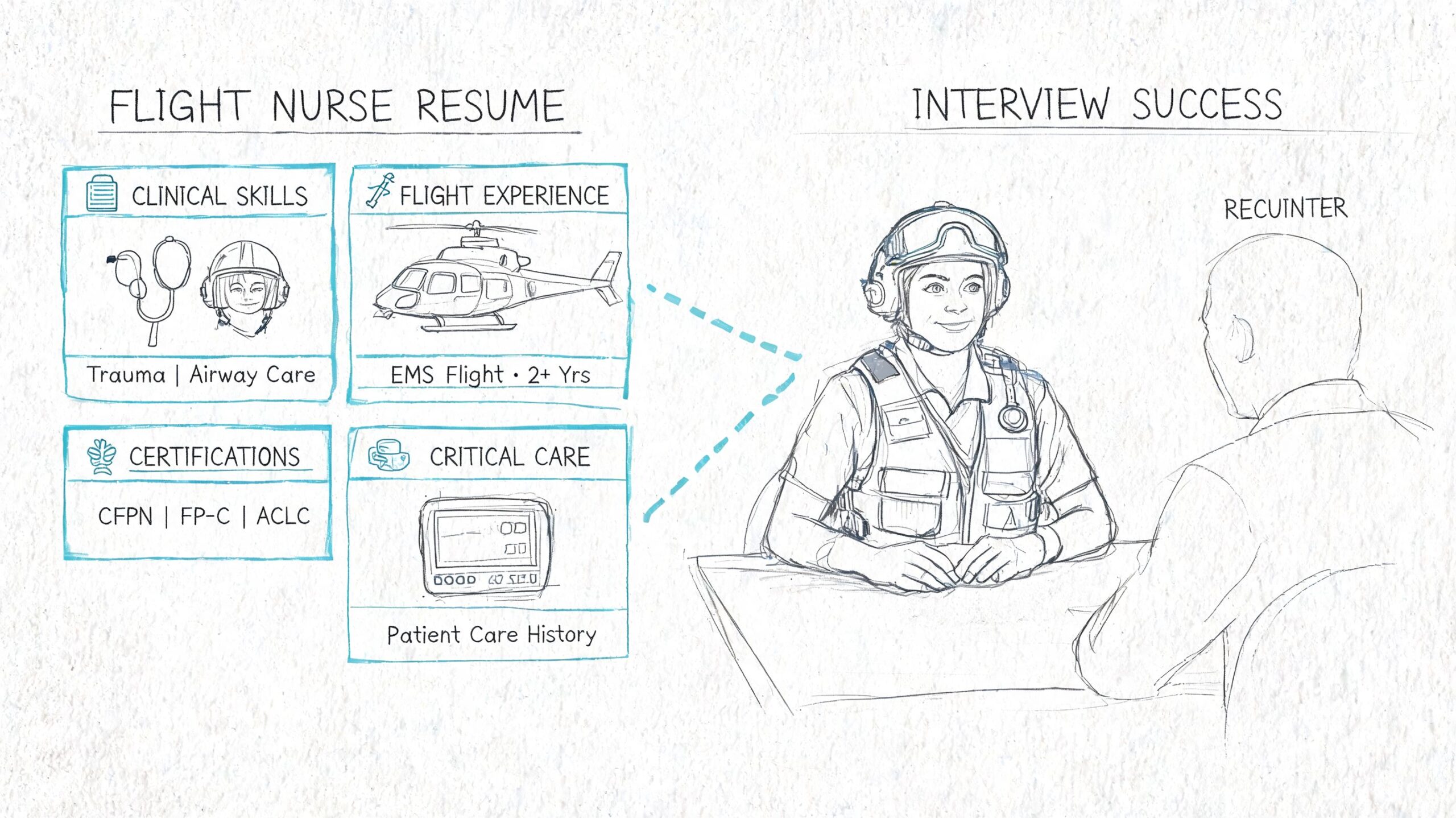
The common pathway into the role is RN licensure, 2 to 5 years of high-acuity ICU or ED experience, and transport-specific certification such as CFRN, and employers use progress toward CFRN as a meaningful hiring signal, according to ACE's flight nurse career guide. That should shape how your application reads.
Write the resume recruiters want to see
Don't just list your unit and dates. Translate your clinical work into transport-relevant language.
A stronger bullet says you managed ventilated patients, vasoactive drips, rapid deterioration, trauma handoff, interfacility transfers, or complex escalation decisions. A weaker bullet says you provided patient-centered care in a fast-paced environment. That phrase says nothing.
Good resumes for flight roles usually show these traits clearly:
- Autonomy: Times when you recognized decline and acted fast
- High-acuity decision-making: What kinds of unstable patients you handled
- Cross-disciplinary teamwork: Working with physicians, respiratory therapy, EMS, and specialty teams
- Transport adjacency: Any transfer center work, retrieval support, rapid response, or movement between facilities
- Credential trajectory: Current certifications and honest progress toward CFRN
If your resume still feels flat, a general guide on building a nurse resume with impact can help you tighten formatting and results-focused wording before you tailor it to transport roles.
What to say in the interview
Flight interviews often test composure as much as knowledge. You may get scenario questions that are less about the perfect textbook answer and more about your sequence, your communication style, and how you function when conditions get tight.
Expect prompts like:
- Clinical deterioration: How would you manage a patient who worsens during transport?
- Team conflict: What would you do if you and your partner disagreed on next steps?
- Resource limits: How do you adapt when you can't solve a problem the same way you would in the ICU?
- Readiness: Why flight, and why now?
What works is speaking in a calm, structured pattern. Assess. Prioritize. Communicate. Intervene. Reassess.
Here's a useful example to study before your own prep:
What strong candidates do differently
They don't try to sound fearless. They sound disciplined.
The best interview answer usually isn't dramatic. It's organized, clinically grounded, and team-aware.
They also know their weak spots. If your pediatric exposure is limited, say so plainly and explain how you've built around it. If your CFRN exam is scheduled, mention it. If you've supported transfers but haven't flown, frame that as transport preparation, not a substitute for flight experience.
Understanding Salary, Shifts, and Life in the Air
Anyone looking at flight nurse jobs in florida eventually asks the same question. Is the pay worth the lifestyle?
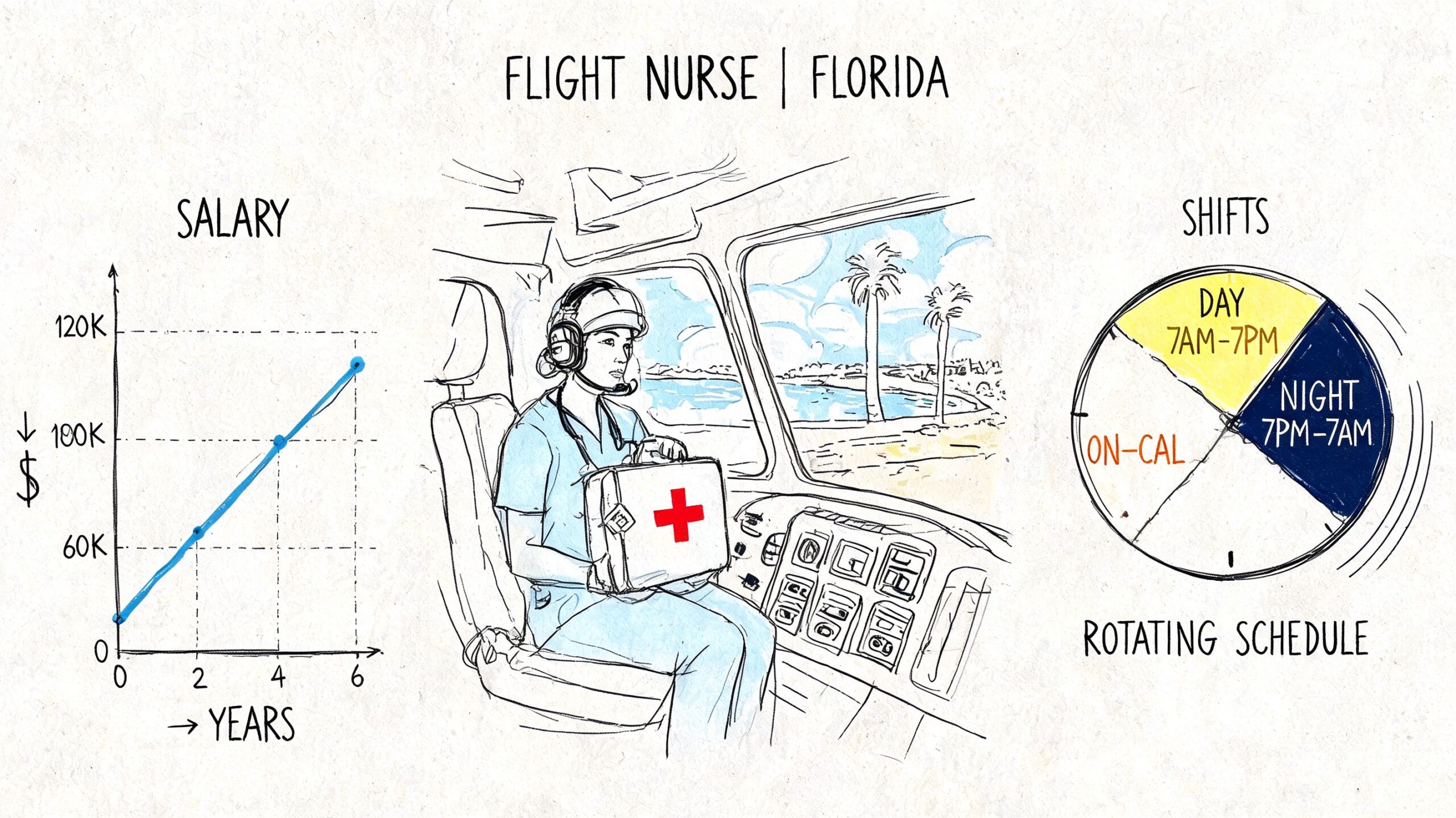
The honest answer is that compensation is real, but it's not standardized. PayScale's Florida flight nurse salary data reports an average of $72,500 in Florida for 2026, while Glassdoor lists $111,172 for flight nurses in Florida. The same source summary also notes 185 flight nursing job postings in Florida and points to a Florida Air Methods posting with a range of $63,747.84 to $77,925.12. That spread of nearly $38,700 tells you one thing clearly. You have to evaluate the specific employer, not just the title.
Why the range is so wide
Different sources measure different things. Some reflect self-reported base pay. Others appear to reflect broader total-pay estimates or a narrower employer mix.
Then there's the practical variation:
- Employer type: Hospital program versus private operator
- Experience level: A mature critical care nurse usually negotiates differently than a first-time transport hire
- Certification profile: Stronger credentialing can improve competitiveness
- Patient mix and mission profile: Some roles are more operationally demanding than others
If you're weighing flight against bedside leadership or other nursing tracks, broad comparisons like Go Hires' salary benchmarks for nurses can help frame where transport roles fit within the larger nursing pay environment.
What life in the air actually feels like
A lot of nurses focus on the aircraft and forget the workflow around it. Flight work includes waiting, briefing, checking equipment, lifting, loading, charting, coordinating, and staying ready for very high-acuity moments that arrive without much warning.
The shift structure depends on the employer. Some programs are built around longer duty periods and recovery days. Others look more like rotating hospital shifts with transport-specific demands layered in. The right question isn't just “How many hours?” It's “What level of readiness and fatigue management does this schedule require?”
Flight nursing also changes your personal life. Sleep can get choppy. Family plans may need flexibility. Some nurses love the rhythm. Others miss the predictability of hospital work.
Frequently Asked Questions for Aspiring Flight Nurses
Do I need a Florida RN license before I apply
If the role is based in Florida, assume you need to meet Florida licensure expectations before hire or very early in the process. Recruiters don't want uncertainty around legal practice status. If you're moving from another state, sort that out before you start mass-applying.
A clean application starts with a clean license path.
Is a BSN required for flight nurse jobs in florida
Not always. But many employers prefer BSN-prepared nurses, especially when they have enough applicants to be selective. If you have an ADN, make the rest of your file unusually strong. That means sharper acuity, stronger certifications, and a more transport-relevant resume.
How much ICU or ED experience is enough
Enough means more than time served. Florida employers commonly look for several years of current high-acuity emergency or critical care experience, and they care what you specifically managed in that time.
If your experience is narrow, low-acuity, or stale, you may not be ready even if your total nursing years look impressive.
Do I need CFRN before I get hired
Not in every program. But many employers treat it as a serious hiring signal, and some expect it within a set period after hire. If you're not yet certified, showing real progress toward it can strengthen your application. “I plan to get it someday” doesn't carry much weight.
Are there physical requirements
Yes, and applicants should ask directly. Aircraft environments are tight, patient loading can be demanding, and some operators may have physical or weight-related requirements tied to safety or aircraft limitations. This topic can feel awkward, but it's better to ask early than discover a mismatch late in hiring.
Can I specialize in neonatal or bariatric transport
Yes, but those paths are more specific than general flight nursing. Neonatal teams may require distinct NICU experience and specialty readiness. Bariatric transport is also a meaningful need in Florida, even though many public-facing job listings don't describe it well.
If you come from NICU, maternal-child transport, complex mobility, or larger-patient handling, don't bury that experience. Lead with it.
What comes after flight nursing
Some nurses stay in the role for years because they like the mix of autonomy, acuity, and mission focus. Others move into education, leadership, clinical coordination, or highly specialized transport pathways. Flight nursing tends to sharpen judgment and communication in a way that travels well across advanced roles.
If you're aiming for flight nurse jobs in florida, the best next move isn't sending more applications. It's closing the exact gap between where you are and what transport teams actually hire for.