

The call usually comes at the worst possible time. A parent is hospitalized in another state. A spouse needs a higher level of care that the local facility can't provide. A case manager is trying to line up a transfer while family members keep asking the same urgent question: who is coordinating this, and what happens next?
That's where good Aero customer service stops being about a phone number and starts being about orchestration. In air medical transport, customer service means someone can take a scattered situation, gather the right records, align the sending and receiving teams, confirm the transport plan, and keep every handoff clear enough that nobody guesses.
Families often expect the hardest part to be the flight. It usually isn't. The hardest part is the chain of decisions before wheels up: medical acceptance, documentation, ground coordination, family communication, and matching the aircraft and crew to the patient's condition. When that chain is handled well, the day feels organized. When it's handled poorly, delays and confusion pile up fast.
Navigating a Medical Crisis From a Distance
A daughter in Chicago gets a call from a hospital in Florida. Her father is stable enough to move, but he needs care closer to home. She's trying to answer questions she didn't expect to hear that morning. Which hospital can receive him? What records are needed? Can he tolerate flight? Can someone ride with him? Who arranges the ambulance on each end?
That's the reality of aero customer service in the medical world. It isn't a generic support desk. It's a coordination function that has to translate stress into action.
What families usually feel first
Individuals often arrive at this process carrying three separate worries at once:
- Medical worry: Is the patient safe to move right now?
- Logistics worry: Who handles the airport, ambulances, records, and timing?
- Communication worry: Will one person keep everyone updated, or will details get lost between hospitals and transport teams?
Case managers face a different version of the same pressure. They already know the transfer needs to happen, but they still need clean records, physician communication, insurance or payment clarity, and a transport plan that won't collapse because one document was missing.
Practical rule: If you feel overwhelmed, focus on the next handoff, not the entire trip. In air ambulance coordination, each clean handoff prevents the next problem.
What good aero customer service actually does
A strong coordination team brings order in a specific sequence. First, they identify the patient's current status and destination. Then they gather enough clinical and logistical detail to determine whether the trip is appropriate and how it should be staffed. After that, they align the bedside teams, the flight crew, and the ground legs.
The work sounds administrative until you see what happens without it. Families get conflicting times. Sending units don't know what paperwork the crew needs. Receiving facilities expect arrival before a bed is ready. A relative assumes they can accompany the patient without confirming cabin space. None of that is dramatic on paper, but each gap creates friction.
The partnership that matters
In practice, the smoothest transports happen when the family or case manager treats the coordinator as a working partner, not just a booking contact. Share changes quickly. Ask direct questions. Keep one decision-maker involved if possible.
That doesn't remove the stress. It does give the stress somewhere to go.
Making the First Call What to Ask and Expect
It is 9:40 p.m. A daughter is in one state, her father is in another, and the hospitalist says the transfer needs to happen soon. The first call to an air medical coordinator is where confusion either starts or gets contained.
A good call does not require perfect language. It requires the right facts, one decision-maker if possible, and a clear goal for the next hour. Families often come in focused on the aircraft. Coordinators usually need to confirm the patient, the receiving plan, and the clinical picture before aircraft type, departure timing, or escort options can be answered with confidence.

Before you dial
Put the basics in front of you on paper or in one note on your phone. Memory gets unreliable once the questions start coming quickly.
- Patient location: Current hospital, unit, room number, and the direct number for the nurse's station or bedside team.
- Receiving destination: Facility name, accepting physician if confirmed, and whether a bed is assigned or still pending.
- Current condition: Main diagnosis, oxygen use, mental status, mobility limits, recent procedures, isolation precautions, and any concern that could change transport staffing.
- Decision authority: The person who can approve the transport, discuss payment, and receive updates without delay.
- Special handling needs: Bariatric considerations, language support, hearing or cognitive limitations, family escort requests, service animals, and luggage limits.
Case managers should also identify one bedside contact who can answer same-day clinical questions. That step prevents a common stall, where transport review pauses because no one can confirm the latest status, weight, oxygen requirement, or code status.
Questions worth asking on the first call
Start with safety and feasibility. Then move to timing, cost, and logistics. That order saves time because it gets the medical review moving before the conversation drifts into details that depend on clinical acceptance.
Is this patient appropriate for fixed-wing transport right now?
This determines whether the request fits the aircraft and crew setup being discussed.What information do you need in the next 15 to 30 minutes to begin review?
Ask for immediate needs, not a full document wish list.Who is my point of contact for this case?
One coordinator reduces missed updates and conflicting instructions.What is included in bedside-to-bedside service?
Confirm whether ground ambulances, airport transfers, and receiving-facility coordination are included.What will affect timing today?
The answer often includes receiving-bed readiness, chart review, weather, aircraft position, and ground ambulance availability.What drives the price for this case?
Families who want a plain-language overview can review this guide to air ambulance cost and what you'll be asked when you call.Can a family member accompany the patient?
Ask early. Cabin space, patient acuity, weight limits, and infection-control issues can all affect that answer.What happens if the patient's condition changes before departure?
This tells you how reassessment works and who needs to be notified if the bedside team reports a decline.
A practical call script
Use plain language. Coordinators do not need polished wording. They need enough detail to start the right process.
“My family member is at [hospital name], in [unit/room], and the team wants a transfer to [receiving facility]. The main issue is [condition]. The patient currently needs [oxygen/monitoring/mobility support]. I need to know if air transport is appropriate, what information you need first, who will coordinate this case, and what the next step is today.”
For a bariatric or medically complex senior patient, add the detail early instead of waiting for the coordinator to discover it later.
“The patient weighs about [weight] and needs [two-person assist/special lift equipment/continuous oxygen/confusion support]. Please tell me if that changes aircraft, crew, or ground transport planning.”
That one sentence can prevent the wrong ground unit from being dispatched or the wrong loading plan from being assumed.
What to expect from the coordinator
Expect focused questions. Good coordinators will ask about diagnosis, stability, current interventions, sending and receiving contacts, and any issue that could change staffing or equipment. They may not give you an exact departure time on the first call, and that is normal. Timing often depends on clinical review and hospital readiness, not just aircraft availability.
Before ending the call, get one clear next action with an owner and a time target. Example: “The bedside nurse will send the medication list and latest vitals in the next 20 minutes,” or “The receiving hospital will confirm the accepting physician by 6 p.m.” That is how a high-stakes transfer starts to feel manageable.
Preparing Your Patient and Key Documentation
Once the first call is done, paperwork becomes the pace setter. A transport can't move cleanly if the bedside team, the receiving team, and the flight team are all working from incomplete information.
A common point of confusion is whether the transport company helps with continuity paperwork and hospital-to-hospital coordination. In this area, Med Jets by Air Trek says its process includes clear communication, documentation support, and hospital-to-hospital continuity from first contact to safe arrival, supported by EMS inspections and industry qualifications, as outlined in its service information. I'm keeping that mention here because documentation is where families and case managers usually need the most structure.
Medical documents that prevent delays
The flight team needs a current picture of the patient, not a vague summary. If the chart is large, prioritize what affects transport safety and handoff.
| Document Category | Specific Items Needed | Pro Tip |
|---|---|---|
| Medical status | History and physical, current diagnosis, recent progress notes | Send the most recent notes first, then add older records only if they change the transport plan |
| Orders and treatment | Medication list, active orders, oxygen requirements, isolation status | Confirm that the med list matches what the bedside nurse is actually administering |
| Imaging and tests | Relevant lab results, imaging reports, discharge or transfer summary if available | Flag abnormal findings that directly affect transport instead of forwarding a huge packet without context |
| Receiving coordination | Accepting physician details, receiving facility contact, confirmed bed information | Put these details on one cover sheet so nobody has to search the chart |
| Special care needs | Mobility needs, bariatric requirements, cognitive status, family accompaniment notes | State practical needs plainly, especially if loading or seating will be affected |
For hospitals, the fastest path is usually a focused packet, not a giant chart dump. A coordinator or clinical reviewer can ask for more if needed. What slows things down is receiving partial information in six separate transmissions with no clear owner.
Insurance and financial paperwork
Families often assume the hospital has already handled this piece. Sometimes it has. Sometimes it hasn't.
Gather these items early:
- Insurance cards and policy information: Front and back images help avoid transcription mistakes.
- Authorization contacts: Case management, utilization review, employer plan contact, or assistance company details.
- Responsible party information: Name, phone, email, and relationship to patient.
- Payment approval path: Who can sign, who needs an estimate, and who must be included before the move is confirmed.
If you need a practical reference on what transport teams generally look for, this resource on medical documentation standards is useful context.
A working checklist for the bedside team
Case managers can save hours by sending one concise email to the unit and copying the right parties. The request should include:
- Clinical packet needed now: Recent notes, medication list, oxygen or monitoring needs
- Receiving details: Facility, physician, bed status
- Nursing callback contact: One person who can answer current-condition questions
- Administrative items: Facesheet, insurance, legal decision-maker if relevant
“Please send the version of the chart that explains today's patient, not every day before today.”
That line tends to improve the first packet you receive.
One issue people overlook
Documentation isn't only about medical safety. It's also about continuity. If a family has to repeat the story to every handoff point, the process is already slipping. Good aero customer service reduces repetition by moving the right information forward before the patient moves.
Meeting Specialized Patient Needs
Not every patient can be treated like a standard transfer. Bariatric patients, seniors, and medically fragile travelers need a provider that can explain how the trip will work in physical and clinical terms, not just reassure you that “we handle cases like this.”
One concrete example of what to verify comes from Med Jets by Air Trek's published fleet information. The company says it operates Cessna Citation II, III, and V jets configured for one to two patients plus accompanying family members, with bariatric capability, advanced flight equipment, and a pet-friendly environment. Those details matter because they show what “specialized capability” sounds like when a provider gets specific.

Bariatric transport needs
When a family asks whether a provider has bariatric capability, they usually mean one thing: can you move my loved one safely and with dignity? The answer should address more than the aircraft name.
Ask these questions:
- Loading process: What equipment and staffing are used to move the patient from bed to stretcher to aircraft?
- Cabin fit: How is patient positioning handled if body size affects loading, comfort, or access for care?
- Ground coordination: Are both ground ambulance legs aware of the size and lifting requirements?
- Crew readiness: Has the team been briefed on mobility limits and pressure-point concerns?
If a provider answers only with “yes, we can do bariatric,” keep asking.
Senior and fragile patient concerns
Older patients often need more communication support than dramatic medical intervention. They may be stable but still vulnerable to confusion, pain from transfers, medication timing problems, dehydration, and fatigue.
What usually helps:
- Medication clarity: Ask who confirms which medications are given before departure.
- Mobility assistance: Confirm whether the patient can tolerate sitting up, transfers, and airport movement.
- Sensory support: Hearing aids, glasses, dentures, and comfort items should be accounted for before leaving the room.
- Family communication: One relative should receive updates so bedside staff aren't fielding duplicate calls.
The best specialized transport plans sound detailed. Vague confidence is a warning sign.
Matching the aircraft to the mission
The question isn't whether fixed-wing air ambulance is “better.” The question is whether it fits the route, urgency, and patient condition. For families comparing options, this overview of fixed-wing vs rotary-wing transport helps frame the trade-offs without oversimplifying them.
For medically complex cases, ask the provider to explain why the proposed aircraft and crew are the right match. That answer should connect the patient's needs to the transport plan. If it doesn't, you're still at the marketing stage, not the coordination stage.
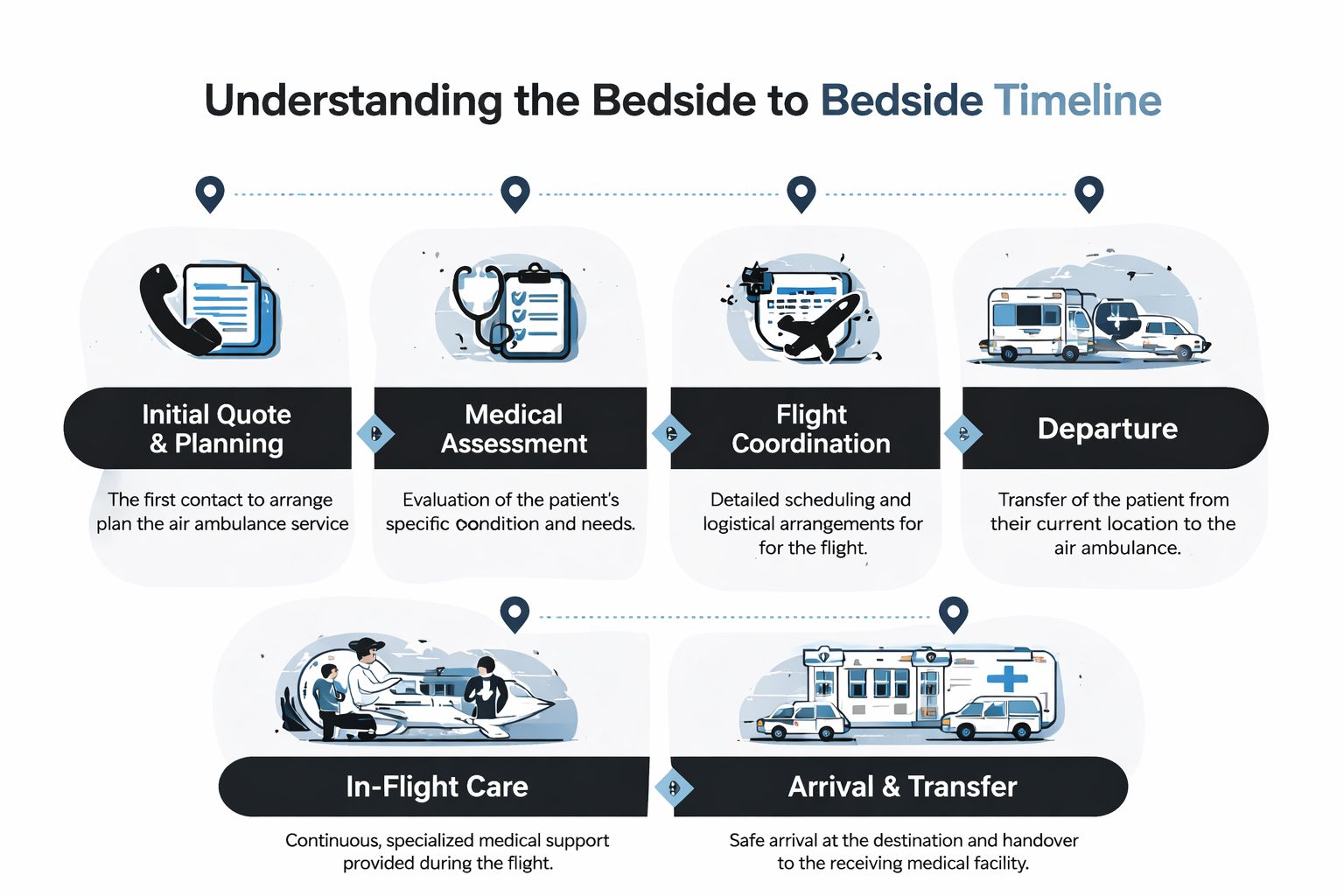
Understanding the Bedside to Bedside Timeline
On transport day, people often fear long periods where the patient is “in the system” but nobody knows what's happening. A true bedside-to-bedside model avoids that by making each phase visible.
The air ambulance field has good reason to rely on structured process. A standardized Patient-Centered Service Protocol reduced service failure rates by 42% compared with ad-hoc dispatch models, and 96% of families reported high satisfaction when clear communication, documentation support, and hospital-to-hospital continuity were integrated into the process, according to this air ambulance protocol case study.
A visual timeline helps families see where those handoffs happen.
Phase one through three
A transport usually begins with quote and approval, then quickly shifts into clinical review and scheduling. That sounds simple, but it is at this stage that many small details get locked in: patient suitability, staffing needs, departure options, and whether the receiving side is ready.
Then ground pieces start moving. The sending hospital prepares discharge or transfer paperwork. The ground ambulance aligns with the aircraft departure. The flight team gets the patient brief and confirms any special care issues.
Here's a short walkthrough you can expect:
- Initial quote and decision
- Medical review and acceptance
- Flight planning and ground coordination
The family often sees only the beginning of this. Behind the scenes, multiple teams are trying to make sure the patient never arrives at a closed door.
A short video can make the process less abstract for first-time families.
Departure and in-flight care
The departure phase begins at bedside, not at the airport. The patient is transferred from the room to the ground unit, then to the aircraft, with records and care instructions moving alongside the patient. If one of those pieces is missing, the crew has to stop and reconcile it.
In flight, the patient isn't merely being “flown somewhere.” The crew is monitoring, documenting, and preparing for the next handoff. Families are often surprised by how much of a transport team's work is communication, not motion.
A smooth flight usually reflects strong preparation on the ground.
Arrival and final handoff
The last leg matters as much as the first. On arrival, the receiving ground team takes the patient from airport to facility. Then the bedside report happens again, now with the destination team.
The transfer is only complete when the receiving facility has accepted the patient, the handoff is documented, and the family knows where their loved one is. That last point gets missed more often than it should. Good aero customer service closes the loop.
Your Advocacy Toolkit for a Smooth Transfer
Families often think advocacy means pushing harder. In medical transport, it usually means being clearer. Clearer about who decides, who receives updates, what the patient needs, and what would count as a problem worth escalating.
Start with one communication lane. Pick a lead family contact or one case manager contact, and route updates through that person. This cuts down on crossed messages and keeps bedside staff from having to repeat the same details to six different people.
What strong advocacy looks like
Use this approach during the transfer:
- Confirm the owner: Ask who is coordinating the case right now, by name.
- Restate the patient's essential requirements: Mobility limits, cognitive concerns, oxygen needs, accompaniment, or bariatric handling.
- Ask for milestone updates: Not constant calls. Key checkpoints.
- Escalate early when facts conflict: If the hospital says one thing and the coordinator says another, resolve it before movement starts.
A second issue is legitimacy. In any high-stress transport arrangement, people should verify they're speaking with the actual provider before sharing medical or financial details, especially when third parties or unfamiliar agents enter the conversation. Generic contact listings don't protect you from impersonation. Verification matters.
When to push harder
There are moments when calm persistence is the right move. If the receiving bed isn't confirmed, if the patient condition has changed, if a promised callback never comes, or if the transport plan no longer matches the patient's needs, don't assume it will sort itself out.
Say it plainly:
“I need to know what has been confirmed, what is still pending, and what could delay departure.”
That question usually resets the conversation around facts.
People also ask how a reputable provider supports safety and comfort in the air. Med Jets by Air Trek states that its dedicated crews operate a modern fleet configured for patient-centered care, with decades of positive reviews praising comfort, safety, and smooth flights. The broader lesson is simple: choose a provider that can explain its process clearly, respond directly under pressure, and support proper escalation when concerns arise.
Good advocacy doesn't create friction. It reduces it by making sure the right people are working from the same picture.
If you need a provider for bedside-to-bedside air medical transport, Med Jets by Air Trek coordinates emergency flights, medical escorts, documentation support, and ground transport with 24/7 availability at 1-800-MED-JETS.