
You're often meeting HIPAA at the worst possible moment.
A hospital case manager is trying to move a patient quickly. A spouse is answering calls while scared and exhausted. A son or daughter wants to know, “Who can you tell? What can I sign? Why are you asking for records again?” In medical air transport, privacy law doesn't sit off to the side. It travels with the patient, from bedside report to ambulance stretcher to aircraft cabin to receiving facility.
That's why understanding HIPAA compliance matters. It isn't just about avoiding legal trouble. It's about making sure the right people get the right information at the right time, while everyone else stays out of that loop.
In air transport, good HIPAA practice should feel a lot like good cockpit discipline. Clear roles. Tight communication. No unnecessary chatter. Written procedures. A record of what happened and why.
The Critical Role of HIPAA in Medical Transport
A typical transfer starts fast. A discharge planner sends a referral. A family member asks whether they can ride along. A flight coordinator requests records, medication lists, and contact details for the sending and receiving teams. At that point, people usually ask the same question in different ways.
“Why do you need all of this?”
The short answer is care. The longer answer is that medical transport teams have to move both the patient and the patient's information safely. If either one is mishandled, the transfer can suffer.
HIPAA is the rulebook that tells healthcare organizations how to protect Protected Health Information, or PHI. In air transport, that can include a face sheet, diagnosis, allergies, insurance details, physician orders, a patient care report, and updates passed by phone or radio during handoff. For families, HIPAA can feel like a wall. For experienced transport teams, it should function more like guardrails.
The reason this matters so much is simple. Since the Privacy Rule's compliance date in April 2003, the HHS Office for Civil Rights has received over 374,321 HIPAA complaints and initiated more than 1,193 compliance reviews. By January 31, 2026, reported healthcare data breaches had affected over 935 million individuals, according to HHS enforcement highlights. That isn't a niche issue. It's a long-running enforcement reality.
Practical rule: In a medical flight, privacy and continuity of care have to work together. If a team protects data so poorly that PHI leaks, that's a problem. If a team protects data so clumsily that clinicians can't get what they need, that's also a problem.
What families usually worry about
Most anxious family members aren't asking for a lecture on federal rules. They want plain answers:
- Who will see my loved one's records? Only people involved in treatment, operations, or authorized functions should have access.
- Can the crew talk to the hospital without my permission? Yes, for treatment purposes, healthcare teams can share PHI as needed for care coordination.
- Will my information travel securely? It should, through defined administrative, physical, and technical safeguards.
Case managers often need a more operational answer. They want to know what “compliance” looks like in motion. A useful companion resource on managing HIPAA safeguards and risks can help frame that bigger picture, especially when you're comparing policies, devices, vendors, and workflows.
Why transport raises the stakes
A hospital unit is controlled space. An aircraft isn't. Information moves across phones, tablets, dispatch platforms, nursing reports, and receiving-facility handoffs. The environment is louder, faster, and less forgiving.
That's why HIPAA in medical transport has to be practical, not theoretical. New case managers need a workflow they can trust. Families need confidence that privacy isn't getting lost somewhere between the runway and the receiving hospital.
HIPAA 101 The Three Core Rules Explained
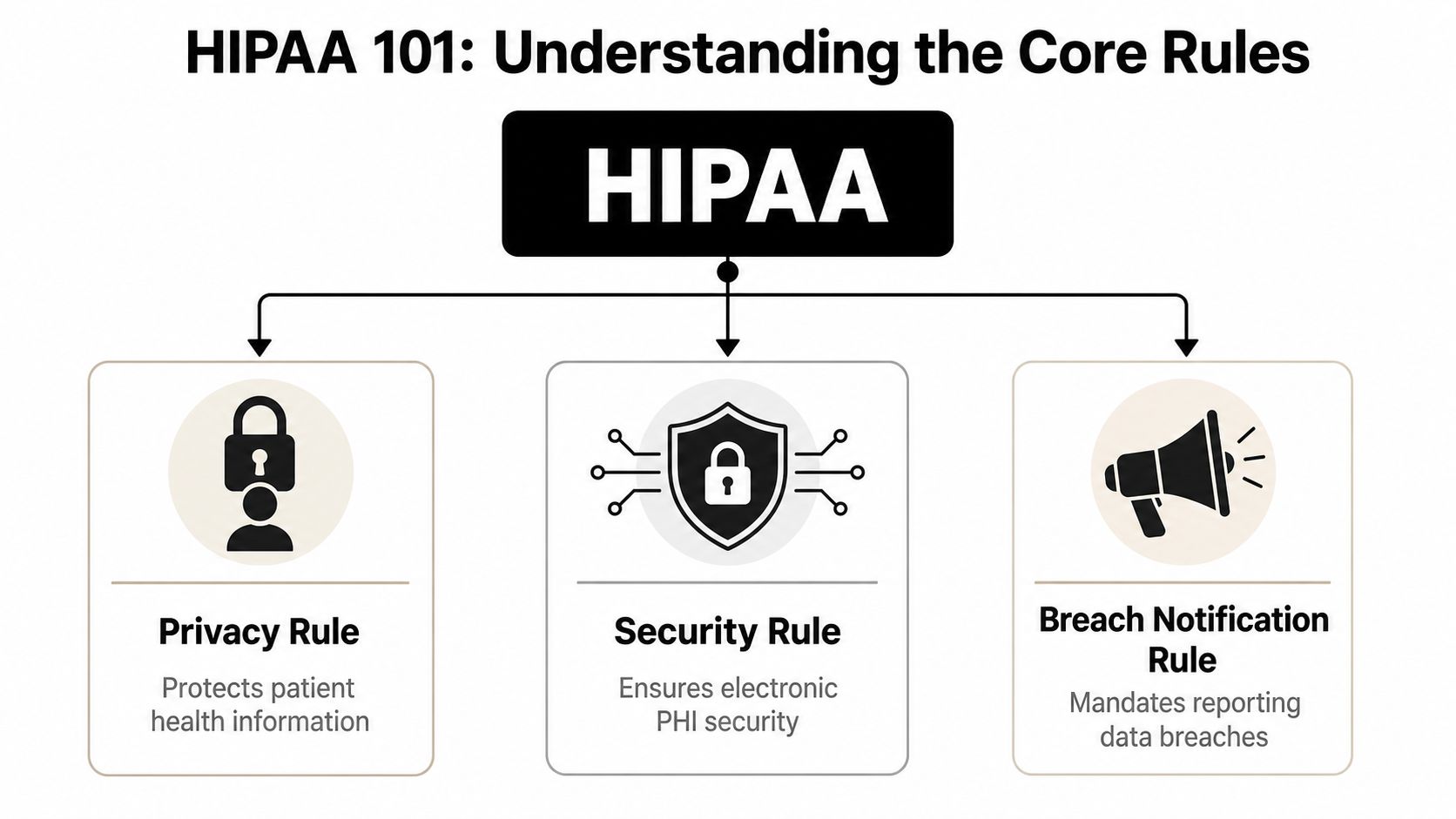
HIPAA gets easier once you stop treating it like one giant block of law. In day-to-day work, three core rules are typically critical to understand.
Think of them as three parts of the same system. One tells you what information is protected. One tells you how to protect it. One tells you what happens if protection fails.
A simple visual helps:
The Privacy Rule
The Privacy Rule is about who may use or disclose PHI, and for what reasons.
In plain language, this is the “what you can talk about” rule. It covers medical details, identifying information, billing information, and other health data tied to a person. It also gives patients important rights over their records.
For transport teams, the Privacy Rule shows up in everyday moments:
- Family updates: Staff need to know who is authorized to receive detailed information.
- Hallway conversations: Crews shouldn't discuss patient specifics where unrelated people can hear.
- Handoffs: Teams should share what the next provider needs, not every detail available.
A good analogy is a medication cabinet. Not everyone gets the key, and even the people who do only open it for the right reason.
The Security Rule
The Security Rule focuses on electronic PHI, often called ePHI.
This is the “how you lock the file cabinet” rule, except the file cabinet might be a dispatch system, charting tablet, billing platform, or cloud storage account. In medical transport, staff often work away from a fixed nursing station, so the Security Rule becomes highly operational.
A transport organization should think about security in three categories:
| Safeguard category | What it means in practice |
|---|---|
| Administrative | Policies, training, risk analysis, assigned responsibilities |
| Physical | Controlling access to vehicles, devices, printed records, and work areas |
| Technical | Unique user IDs, encryption, multi-factor authentication, audit logs |
That structure aligns with guidance for critical care transport organizations in HIPAA requirements and best practices for transport providers.
Here's a short explainer if you want the concepts in a different format:
The Breach Notification Rule
The Breach Notification Rule is the alarm system.
If unsecured PHI is exposed, accessed improperly, or lost in a way that creates reportable risk, the organization has duties to investigate, document, and notify as required. This rule matters because even strong systems can fail. A device gets misplaced. An email goes to the wrong recipient. A vendor mishandles data.
A calm response beats a defensive one. Good organizations don't improvise after a breach. They follow a written process.
Why people get confused
Most confusion comes from mixing these rules together.
- The Privacy Rule asks, “Should this information be shared?”
- The Security Rule asks, “How are we protecting it electronically?”
- The Breach Notification Rule asks, “What do we do if something goes wrong?”
If you keep those three questions separate, understanding HIPAA compliance becomes much more manageable.
Who Is Responsible Roles in Medical Transport
The question comes up all the time.
“Does HIPAA apply to an air ambulance?”
Yes, if the operation is functioning as a healthcare provider and handling PHI in the course of treatment and electronic billing. That point matters because many people confuse a medical flight with a charter flight. They are not the same thing.
Covered entities and business associates
A covered entity is typically the healthcare provider itself. In transport, that usually means the medical operation delivering care and transmitting health information in covered transactions.
A business associate is a separate company or vendor that handles PHI on behalf of that covered entity. That can include software providers, document storage vendors, billing partners, or other contractors who touch patient data as part of the service.
This distinction sounds technical, but it drives real decisions:
- A dispatch or charting vendor may need a Business Associate Agreement.
- A hospital sending records is acting under its own HIPAA duties.
- A family member doesn't become a business associate just because they're involved in planning.
Why an air ambulance falls under HIPAA
For air ambulance providers like Med Jets by Air Trek, HIPAA compliance is legally mandated because they function as covered entities. That status is triggered not by the aircraft type but by the operational reality of delivering medical treatment with licensed paramedics or flight nurses and electronically billing Medicare or private insurers, as explained in this air ambulance HIPAA overview.
That's the cleanest answer to the “Does HIPAA apply to an air ambulance?” question. If the operation is providing clinical care and conducting covered healthcare transactions, HIPAA isn't optional.
Where responsibility gets blurry
Transport teams also run into a less obvious problem. Not every company around a patient transfer is automatically covered by HIPAA in the same way. Some vendors sit outside the classic covered-entity categories until a contract or data-handling relationship triggers formal obligations.
That's why experienced programs pay attention to training, vendor review, and workflow design. A family may only see the aircraft and the crew. Behind the scenes, compliance also depends on software, storage, disposal practices, and staff preparation. For example, if equipment or old devices ever store PHI, organizations need a sound process for secure data destruction to prevent fines.
The aircraft doesn't create HIPAA duties. The care delivery model does.
What case managers should confirm
A case manager doesn't need to audit a transport company line by line. But they should know what responsible looks like.
Ask whether the provider has clinical crews, secure documentation practices, and defined staff training. It also helps to review how organizations prepare personnel for patient movement and communication workflows through resources such as patient transport training standards.
If a transport service talks only about speed and logistics, that's incomplete. In a real medical transfer, privacy, documentation, and treatment authority have to travel together.
PHI on the Move Securing Data During Air and Ground Transfers
PHI is most vulnerable during transitions.
Not because crews are careless, but because every handoff creates a chance for over-sharing, under-sharing, or simple confusion. A safe transfer depends on both clinical precision and information discipline.
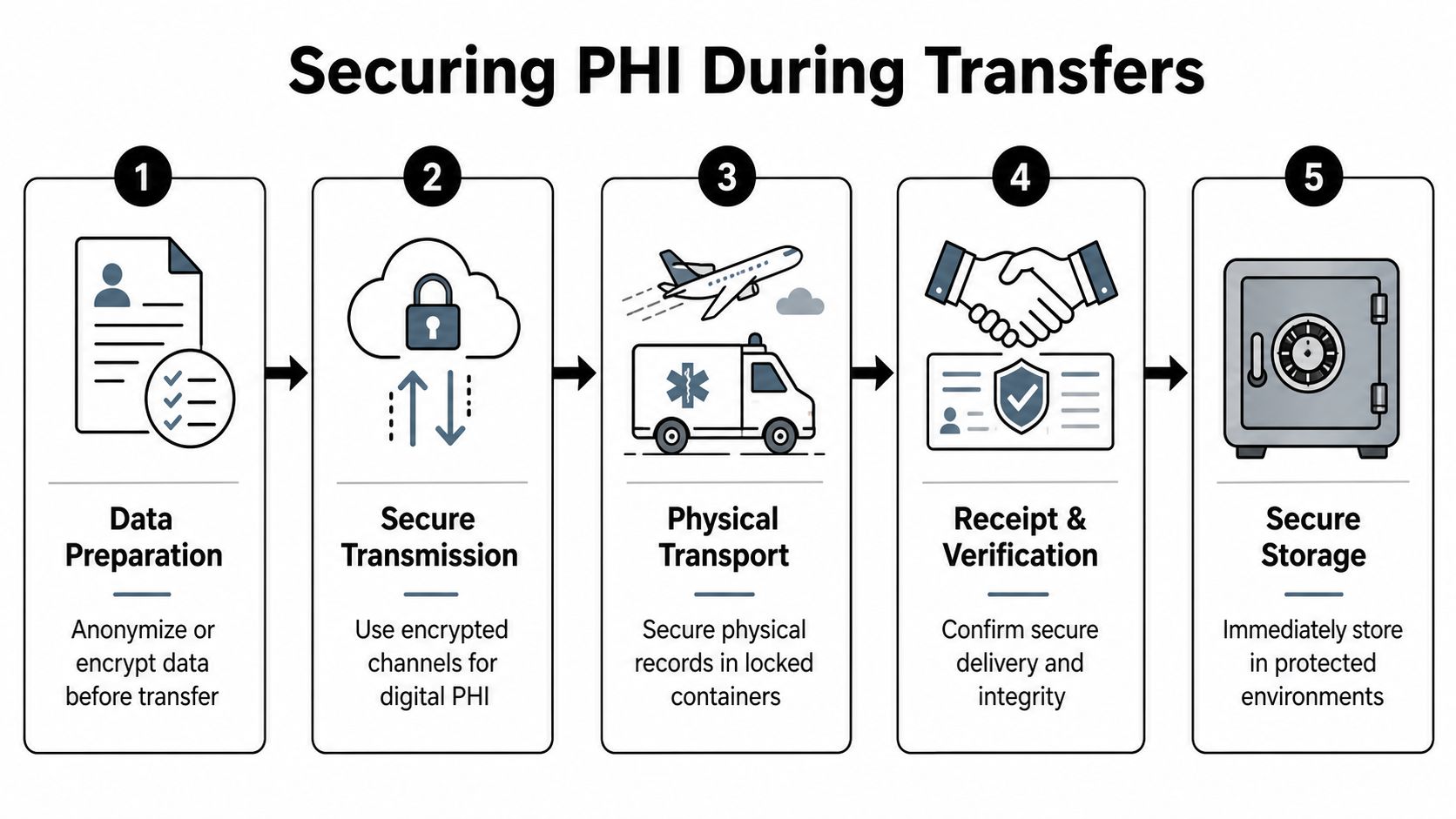
Here's the workflow many people don't see.
From the first call to the bedside
The process often begins with a referral call. A coordinator collects the patient's name, current location, diagnosis summary, level of care needed, and contact details for the sending team. That information shouldn't be sprayed across email chains or text threads. It should move through approved channels and to the people who need it.
Once the mission is accepted, the clinical crew reviews the chart, medication list, allergies, recent notes, and any transport-specific concerns. In this process, the minimum necessary principle matters. Billing staff may need demographics and payer information. The flight clinician needs medical detail. A driver or non-clinical scheduler may need less.
This flow graphic captures the basic idea:
What can be shared during transport
Families sometimes worry when they hear crews calling ahead to the receiving hospital or speaking over radio channels. In transport medicine, some disclosures are both lawful and necessary.
Ambulance services and EMS personnel are authorized under 45 CFR 164.506 to disclose PHI via radio or telephone to hospitals or dispatch centers for treatment and continuity of care without individual authorization, under the treatment exception described in this HIPAA advisory on treatment disclosures.
That means a clinician can say what the hospital needs to safely receive the patient. It does not mean sharing every detail casually.
Say enough for care. Don't say extra because the line is open.
The practical safeguards in transit
Air and ground transfers create four recurring risk points.
Device use in the field
Crews often document on tablets, laptops, or secure phones. Those devices should be encrypted, access-controlled, and managed so they can be wiped remotely if lost. Login sharing is a bad habit in any setting. In transport, it's especially dangerous because devices move constantly.
Verbal handoffs
A proper handoff sounds focused. Patient identifiers are confirmed. The diagnosis, stability concerns, medications, and immediate needs are relayed. Irrelevant personal details are left out.
A poor handoff usually fails in one of two ways. It tells the next team too little to act safely, or it tells them far more than they need.
Paper records and printed packets
Paper still shows up during transport. Face sheets, transfer forms, medication administration records, and signed consents may travel with the patient. Those records shouldn't sit loose on a counter, in an open bag, or on an unattended seat. They should be secured, tracked, and handed over deliberately.
Network and internal system security
The public sees the crew. They don't see the systems behind the crew. Dispatch software, shared drives, mobile documentation platforms, and communication tools all need protection. Organizations that want to pressure-test internal weaknesses often use deeper reviews such as MSP Pentesting internal security to examine how exposed internal environments really are.
Continuity without oversharing
A transfer is successful when the receiving team can pick up care smoothly. That takes timely information, not unlimited information. Patient summaries, medication updates, in-flight events, and arrival condition must be communicated clearly, then stored appropriately after handoff.
For case managers coordinating the bigger picture, patient continuity of care practices are often the best lens. Privacy isn't separate from continuity. Done properly, each supports the other.
Documentation Consent and Patient Rights
When people think about HIPAA, they often focus on secrecy. In practice, documentation is just as important.
A transport provider can have strong intentions and still fail compliance if it can't prove what staff were trained on, what the patient authorized, who accessed records, and how requests were handled. In healthcare, undocumented work is hard to defend. In HIPAA, it can be impossible.
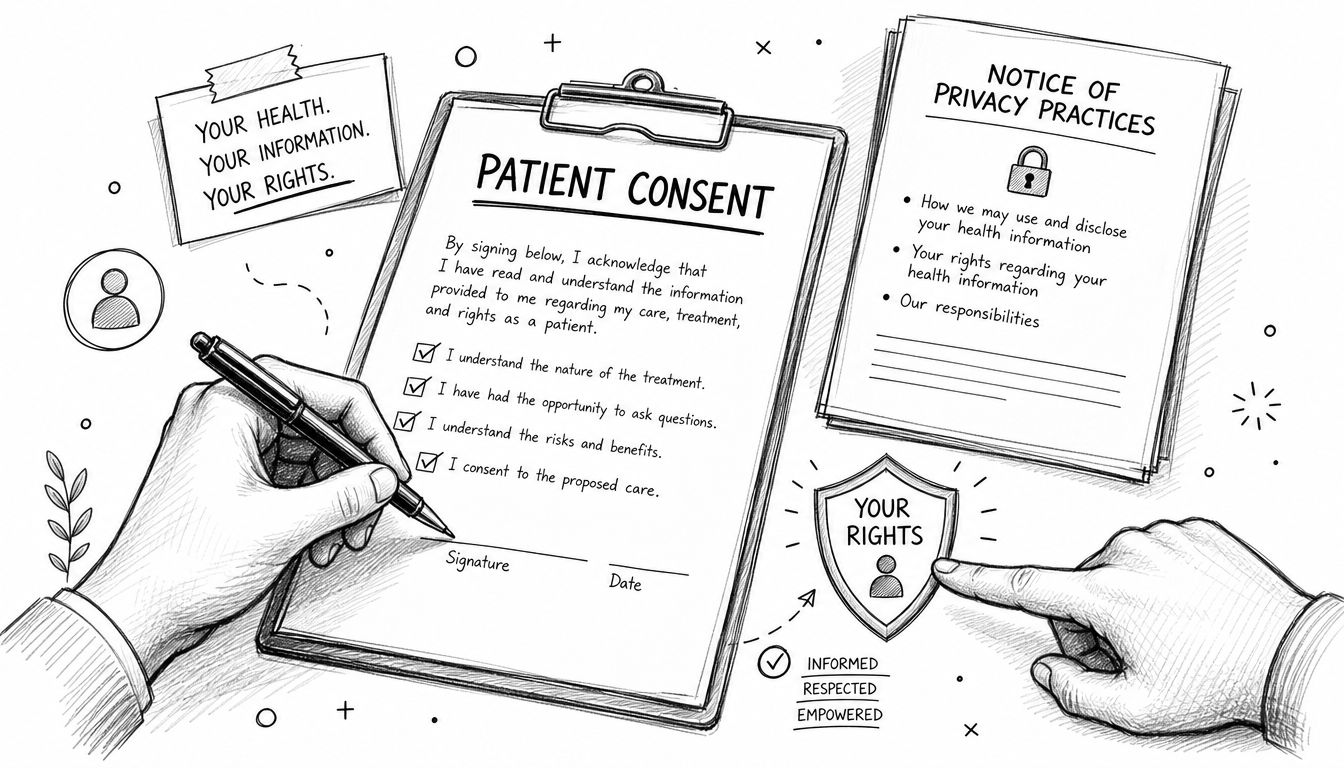
What patients and families are usually signing
Several documents can appear during a transfer, and they don't all mean the same thing.
- Consent for treatment: Permission for clinicians to provide care during transport.
- Transport paperwork: Operational documents covering the move itself.
- Financial or assignment forms: Documents tied to billing or insurance handling.
- Privacy materials: Notice of Privacy Practices and related acknowledgments.
People often ask, “If I sign this, am I giving permission for everything?” Usually, no. Each document has a narrower purpose. Good staff should explain that purpose in plain language.
The right to access records
Patients also have rights after the transport, not just during it. One of the most important is the Right of Access. Healthcare providers, including ambulance services, must respond to requests for access to PHI within 30 days, as explained in this EMS HIPAA FAQ.
That deadline matters because families often need records for continued treatment, insurance matters, legal review, or peace of mind. “We'll get to it eventually” isn't good enough.
Visible demonstrable evidence matters
Most generic HIPAA advice says, “Have policies.” That's incomplete. Regulators look for proof that policies were observed.
The overlooked concept here is Visible, Demonstrable Evidence (VDE). That means tangible proof that training occurred and precautions were taken. Documentation must be retained for six years in a centralized repository, a requirement many small transport vendors miss, as discussed in this analysis of documentation and enforcement evidence.
For a transport operation, VDE can include:
| Evidence type | What it might look like |
|---|---|
| Training records | Signed onboarding logs, annual refreshers, confidentiality acknowledgments |
| Access monitoring | Audit logs showing who opened patient records and when |
| Consent records | Signed forms, scanned documents, documented verbal permissions where allowed |
| Policy history | Current procedures plus archived prior versions |
| Request tracking | Logs showing when a patient asked for records and when staff fulfilled the request |
Good compliance isn't “trust us.” It's “here's the record.”
That's also why internal standards matter. If you're evaluating a transport provider, their approach to medical documentation standards tells you a great deal about whether privacy is operational or just promised.
Questions families often ask
“Can you tell me how my loved one is doing if I'm the spouse?”
Often yes, but staff still need to verify identity and follow the patient's instructions or applicable permissions.
“Why do you need another signature if the hospital already has our records?”
Because transport providers may need separate treatment, financial, or privacy acknowledgments tied to their own role.
“Why is the paperwork so detailed during an urgent transfer?”
Because clear documentation protects the patient, the family, and the care team. It reduces mistakes later, when stress is lower but memories are less reliable.
When Things Go Wrong A Breach Response Checklist
Even well-run organizations can face an incident. A misplaced device, a wrong recipient, an unauthorized access event, or an insecure vendor workflow can trigger a breach review.
The key is not panic. The key is sequence.
The financial stakes are real. The average cost of a healthcare data breach reached $10.93 million in 2025, and in FY2023 civil monetary penalties totaled $6.8 million, with 78% directly resulting from data breaches, according to these HIPAA compliance statistics. Those numbers are a reminder that breach response is part of risk management, not just legal clean-up.
A practical breach checklist
Contain the exposure first
Disable access, recover the device, stop the transmission, or shut down the compromised workflow. Don't keep operating as if nothing happened.Preserve the facts
Write down what was discovered, when it was discovered, who reported it, and what systems or records may be involved. Early notes matter.Notify internal leadership
The privacy officer, security lead, compliance lead, or designated management team should be alerted quickly. Frontline staff shouldn't decide alone whether something “counts.”Assess the scope
Determine what PHI was involved, who may have received or accessed it, and whether the information was viewed or only exposed.Follow notification duties
If the incident is a reportable breach, the organization must follow required notification steps for affected individuals and regulators.Mitigate and fix the process
Breach response isn't complete when the letter goes out. The workflow that allowed the incident has to be corrected.
What families should expect
A responsible provider won't hide behind vague language if an actual breach occurs. They should investigate, communicate appropriately, and explain next steps in language people can understand.
If an organization only talks about privacy when nothing has gone wrong, it doesn't have a mature compliance program.
What case managers should document
If a suspected breach intersects with a transfer, case managers should record whom they notified, what information was potentially involved, and what operational impact followed. That documentation helps patient care continue while the compliance team handles the incident path.
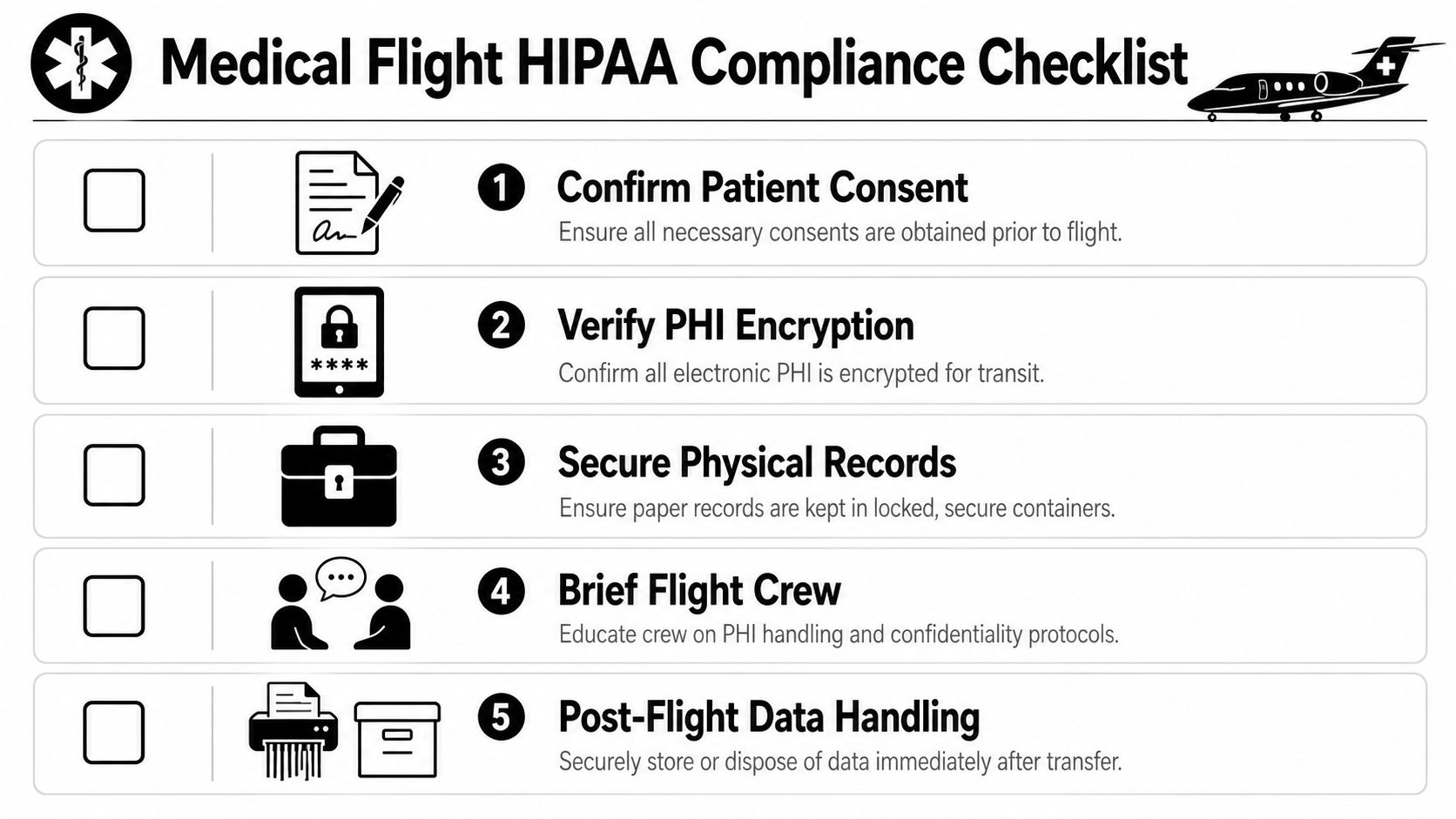
Quick Compliance Checklist for Your Medical Flight
Families and case managers rarely need a full legal manual. They need a fast list they can use before wheels-up, during handoff, and after arrival.
That's where understanding HIPAA compliance becomes practical. Not abstract. Not courtroom language. Just the handful of checks that prevent confusion.
Before transport
Confirm who may receive updates
Make sure the transport team knows which family members, guardians, or facility contacts are authorized for detailed communication.Review the privacy paperwork
Don't just sign quickly. Ask what each form covers, especially treatment consent, release language, and record handling.Send records through approved channels
If you're a case manager, avoid ad hoc forwarding habits. Use the provider's secure intake process.
During transport
Expect focused communication
Crews may call or radio ahead for treatment purposes. That's normal. What you want to hear is concise, need-to-know reporting.Limit side-channel sharing
Don't assume every person helping with travel logistics should receive medical detail. Separate operational updates from clinical updates.Keep paper under control
If you're carrying documents as part of the transfer, hand them directly to the designated team member. Don't leave packets unattended.
After arrival
Know how to request records
Ask who handles chart copies, where requests should go, and what identity verification is required.Ask about documentation retention and access
Mature providers can explain their process clearly.Watch for professionalism, not slogans
The strongest privacy programs are visible in behavior. Staff verify identities, explain forms, restrict conversations, and document actions.
A final question families often ask
“How do I know this transport company takes privacy seriously?”
Look for calm, specific answers. Staff should be able to explain who sees the record, how information is shared during treatment, how requests for records work, and what happens if something goes wrong. If every answer is vague, that's a warning sign.
If you're arranging a transfer and want a team experienced in coordinating care, communication, and documentation in a medical flight environment, you can learn more about Med Jets by Air Trek.