
Your phone rings before sunrise. A hospital case manager says your mother needs a transfer now. The local team can stabilize her, but she needs a higher level of care hours away. You say yes because of course you do. Then the transport bill shows up, or the insurer starts arguing about payment, and suddenly you're dealing with a second emergency: the price.
Most families think air ambulance pricing is fixed. It isn't. A billed charge is an opening position, not a law of nature. That's the mistake providers hope you make.
If you're trying to figure out how to negotiate rates for an air ambulance transfer, start with this mindset: challenge the bill, challenge the coding, challenge the assumptions, and document everything. The strongest negotiators aren't the loudest. They're the people with the cleanest paperwork, the clearest ask, and the best timing.
Introduction to Negotiating Air Ambulance Rates
The usual pattern is brutal. A transfer happens fast. The family is focused on survival, not finance. Days or weeks later, someone opens an explanation of benefits, sees an out-of-network charge, and freezes.
That reaction is normal. The bill is designed to feel untouchable.
Air ambulance pricing has been especially volatile. The median billed price for rotary-wing transport rose from $23,824 in 2016 to $36,400 in 2017, while fixed-wing transport rose from $24,344 to $40,600, a 53% and 67% jump respectively, according to HHS analysis of FAIR Health and GAO findings. Those numbers matter because they show why blind acceptance is a bad strategy. Historical charges moved fast, and many old assumptions about what a “normal” bill looks like don't hold up.
What families usually get wrong
Many people assume one of three things:
- The billed charge is nonnegotiable. It isn't.
- Only insurers can negotiate. They aren't the only party with negotiating power.
- If the transport was necessary, every line item must be valid. That's not how billing works.
The better approach is practical. Separate the medical need from the financial claim. The flight may have been necessary. That doesn't automatically make every code, mileage entry, standby fee, or supply charge correct.
The family that gets organized early usually does better than the family that waits for a final notice.
The goal isn't to “win”
The goal is to get the bill tied to something defensible. Sometimes that means a reduced settlement. Sometimes it means a corrected claim. Sometimes it means pushing the dispute into a formal process under federal law. If you're a case manager, your job is to protect the patient and leave a paper trail. If you're family, your job is to stop reacting emotionally and start negotiating deliberately.
Understanding Cost Components and Billing Terms
A family gets a five-figure air ambulance bill after an emergency transfer. The total looks final, the wording looks technical, and the billing office counts on that reaction. Slow down. Before you discuss discounts, payment plans, or hardship, figure out what you are being charged for and which parts can be challenged under ordinary billing rules or pushed toward a No Surprises Act payment dispute.
The charges you need to isolate
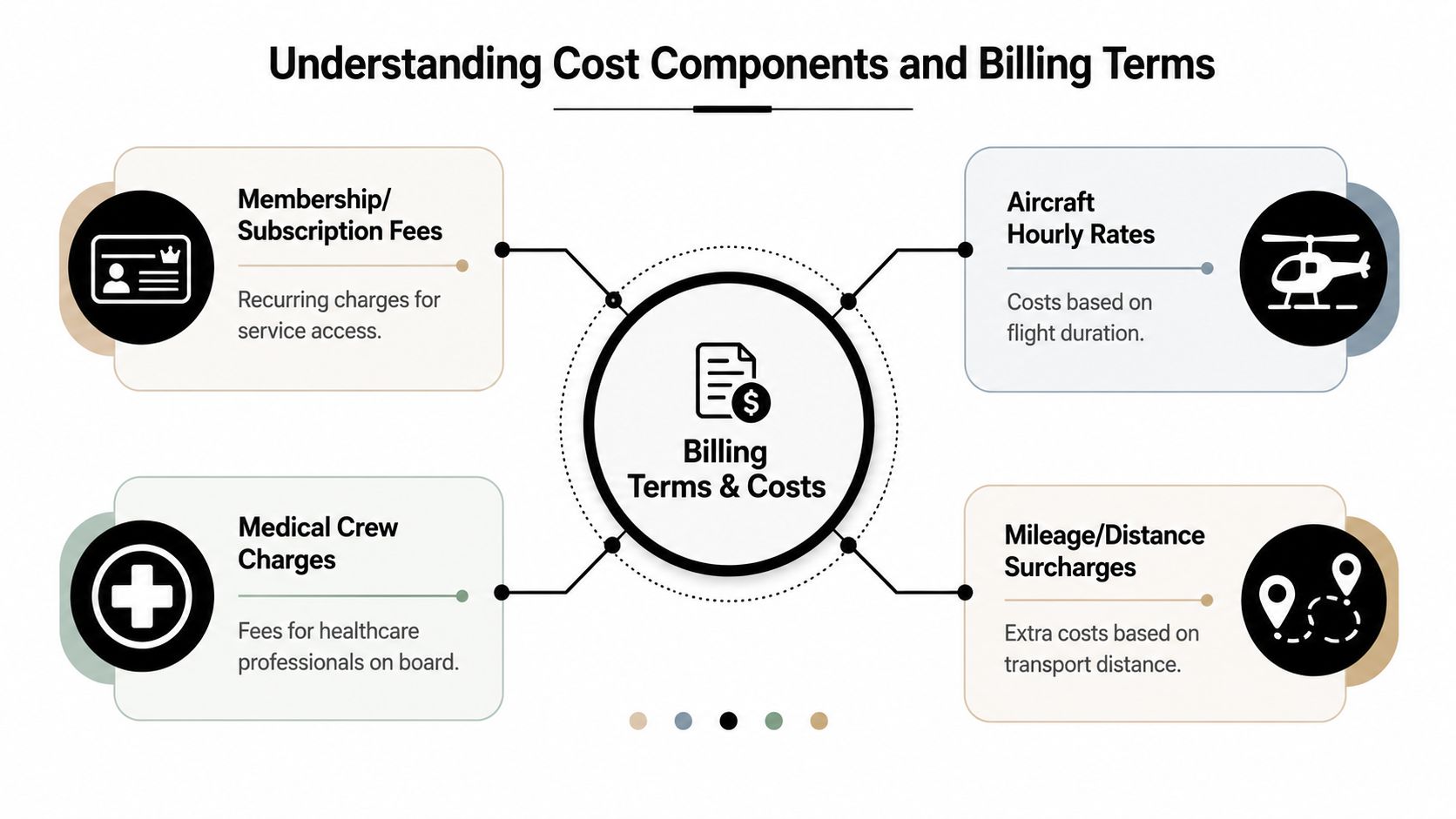
Air ambulance bills often blend four different categories into one intimidating total: aircraft deployment, mileage, clinical care, and add-on charges. That format hides weak spots. Your job is to break the bill back into parts and force the provider to justify each one with records.
Here are the cost buckets I tell families to identify first:
| Billing element | What it usually means | Why it matters in negotiation |
|---|---|---|
| Base rate | The starting charge for dispatching the aircraft and crew | This is usually the anchor number. If the provider cannot explain what is included, press for a breakdown |
| Loaded miles | Mileage charged while the patient is on board | Bills often overstate mileage or use a method the records do not support |
| Medical crew charges | Clinical staffing and onboard care | These charges need to match the level of service documented in the transport chart |
| Supplies and equipment | Medications, disposables, monitors, oxygen, specialty items | This is where duplicate, vague, and poorly documented charges often appear |
Do not stop at those four buckets.
Look for separate administrative or situational charges buried below them, including standby time, wait time, after-hours activation, ground coordination, oxygen, ventilator use, or specialty team fees. Some may be legitimate. Some are padding. If the bill uses broad labels instead of specific descriptions, make the provider define each term in writing.
Terms that confuse people on purpose
Air ambulance billing has a language problem. The wording sounds standardized even when the underlying pricing is not.
- Chargemaster. The provider's internal price list. It shows what they chose to charge, not what you must accept as reasonable.
- Standby fee. A charge tied to delay, readiness, or waiting time. Ask what event started the clock, what event stopped it, and where that timing appears in the records.
- Loaded miles. Miles with the patient on board. Ask for the departure point, destination point, and documentation used to calculate distance.
- Medical necessity. A clinical standard, not a blank check for every billing entry. A necessary flight can still contain bad coding or unsupported extras.
- Vehicle type. Rotary-wing and fixed-wing pricing should line up with the actual mission profile, transfer urgency, and facilities involved.
If you're comparing providers or trying to understand what drives a quote, this overview of what impacts the price and what you'll be asked when you call is useful because it frames the conversation around actual transport variables instead of broad sticker shock.
Practical rule: Negotiate the bill line by line before you negotiate the balance due.
Where hidden billing problems usually sit
Families often focus on the aircraft and miss the back-office choices that inflated the bill. That is a mistake. The provider may have coded the transport at a higher service level than the chart supports, billed supplies already included in the base rate, counted miles loosely, or added fees that never appear in the medical record.
This matters for another reason. Air ambulance disputes do not exist outside the federal payment framework. Under the No Surprises Act, out-of-network air ambulance claims are already part of a system that examines payment evidence, not just sticker prices. That creates a useful pressure point for families and case managers. If a provider wants full payment, they should be prepared to show how the billed amount relates to the transport details, documentation, and recognized payment benchmarks instead of repeating their chargemaster rate like it ends the discussion.
Air ambulance providers still run through revenue cycle systems with collection targets, write-offs, and dispute workflows. If you want context for how disciplined billing operations are usually measured, look at industry standards for RCM. That context helps because it reminds you that billing teams manage process and yield. They are not reading from a sacred price book.
Ask a simple question for every line item: where is this charge documented, and what makes it payable at this amount? If the answer is vague, that line belongs on your challenge list.
Gathering Documentation and Evidence
Negotiation gets real when you stop arguing opinions and start assembling records. Most families call too early with nothing in front of them. Don't do that. Build your file first.
The documents that actually matter
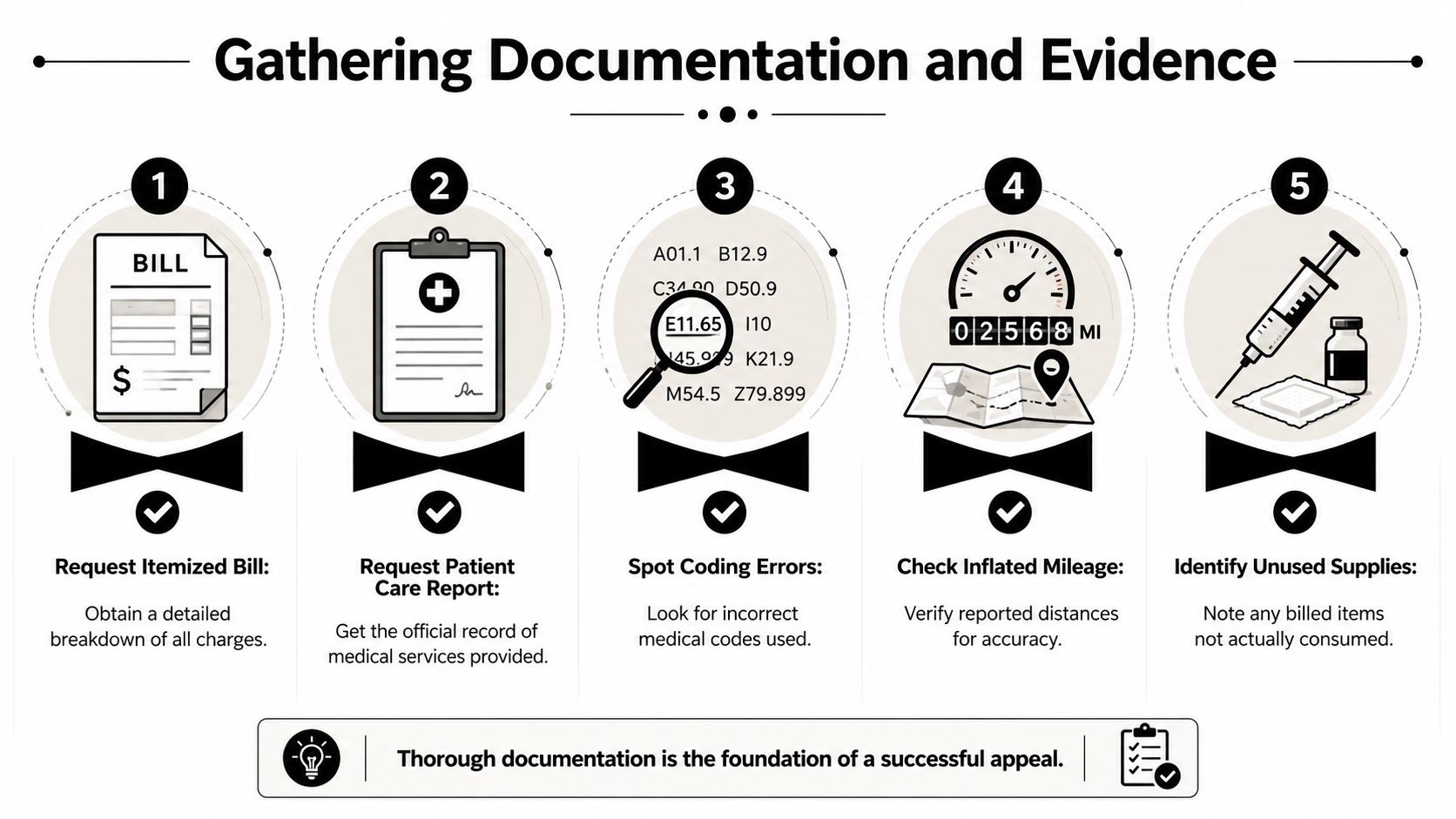
Request these in writing:
- An itemized bill with every charge broken out
- The Patient Care Report
- The face sheet and transfer records from the sending facility
- The physician's medical-necessity statement
- Any prior authorization, denial, or payer classification notes
- The explanation of benefits, if insurance is involved
During the negotiation process, many overcharges become apparent. Common coding and supply errors can inflate air ambulance bills by 20% to 35%, and providers often accept 40% to 50% reductions when a negotiator makes a prompt lump-sum offer tied to a benchmark, according to Careroute's guidance on lowering ambulance bills.
What you're looking for
Don't stare at the bill and hope something obvious jumps out. Compare records against each other.
Check for:
- Coding mismatches between the bill and the Patient Care Report
- Mileage problems that don't match the actual transport route
- Supplies billed but not documented as used
- Clinical level discrepancies where a higher level of care was billed than the records support
- Duplicate entries or unclear add-on charges
A lot of families lose their advantage because their files are scattered across text messages, portals, and email threads. If you need a simple system, this guide on how to organize family medical records is worth using. You don't need a perfect binder. You need one place where every document lives.
The medical necessity issue
One of the biggest mistakes in air transport disputes happens before billing even starts. Nobody locks down the medical necessity narrative. If the sending physician didn't clearly document why air was appropriate, you may end up fighting both coverage and price at the same time.
This resource on medical necessity documentation is a good reminder of what the record should establish. The key point is simple: the transport mode must match the patient's condition and the timing of the transfer.
If the chart doesn't explain why the patient needed air instead of another mode, the billing department has room to argue and the payer has room to deny.
Build one evidence packet
Don't drip documents out one by one. Send a clean packet.
Use this structure:
| Packet section | What to include | Why it helps |
|---|---|---|
| Clinical basis | Physician note, transfer summary, Patient Care Report | Supports necessity and transport level |
| Billing review | Itemized bill with questioned lines highlighted | Keeps the dispute focused |
| Insurance position | EOB, denial, underpayment notice, plan language if available | Shows where the payment conflict sits |
| Negotiation request | Your written summary and target resolution | Forces a direct response |
Once you have that packet, you're not “asking for help.” You're making a documented rate challenge.
Engaging Stakeholders and Timing Your Approach
Who you contact first changes the tone of the whole negotiation. Families often call the insurer in a panic, get transferred six times, and lose momentum. Start closer to the bill.
The contact order I recommend
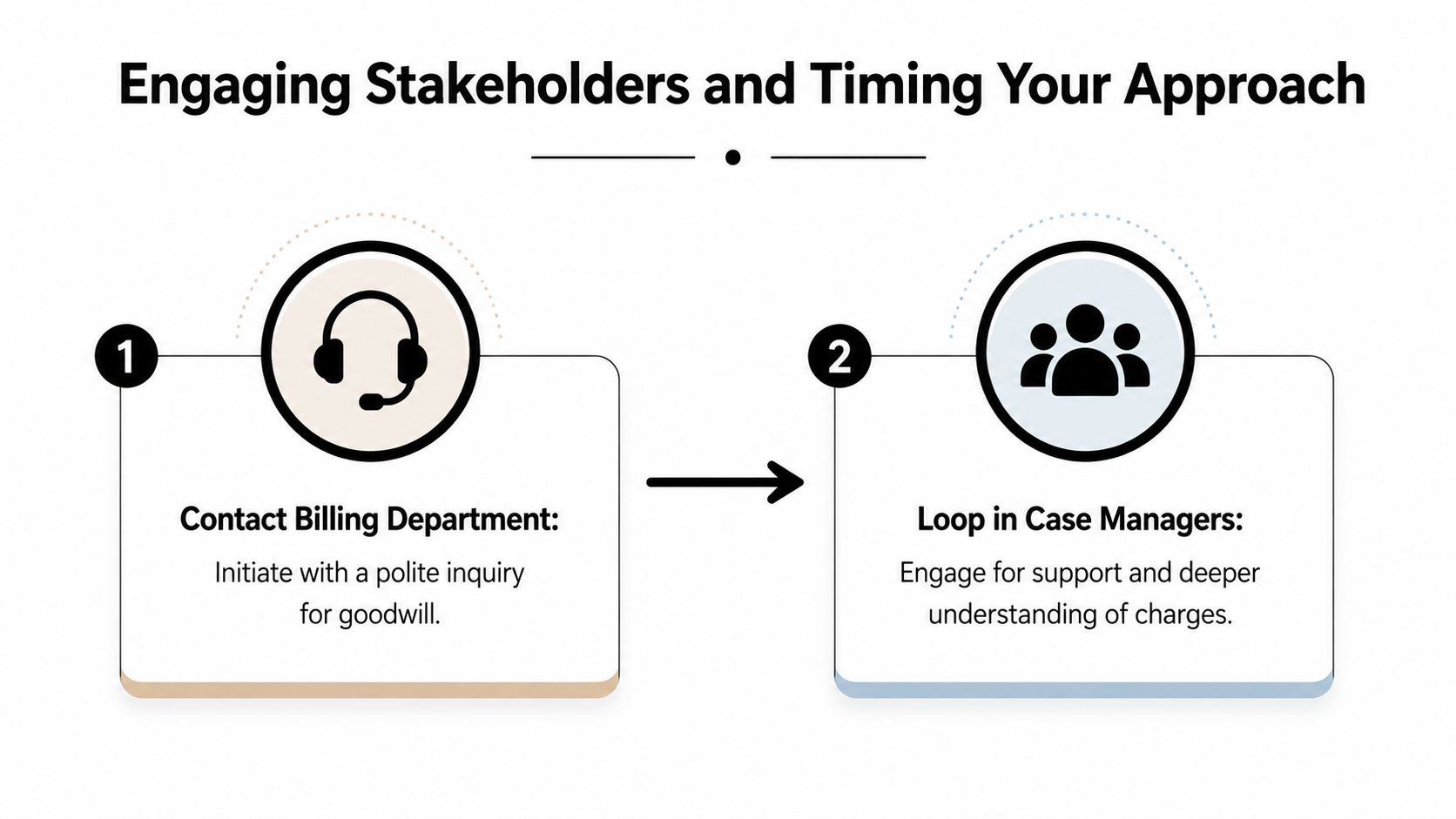
Begin with the billing department. Ask for the itemized statement, confirm whether the account is under review, and ask who has authority to discuss rate adjustments.
Then contact the hospital case manager or discharge planner if they were involved in the transfer. You're not asking them to negotiate price. You're asking them to confirm the clinical context and help close documentation gaps.
Call the payer after that. By then, you should know what was billed, what records exist, and where the obvious weaknesses are.
A simple contact log
Keep a running note with:
- Name and title
- Date and time
- Direct phone or email
- What they said
- What they promised
- When you will follow up
That log matters. People change shifts, vendors outsource billing, and memory gets fuzzy. Your notes keep the story straight.
Scripts that open doors
Use plain language. Don't overexplain.
“I'm reviewing this air ambulance bill for accuracy and rate reasonableness. I need the itemized bill, the Patient Care Report, and the name of the person authorized to discuss settlement or review.”
For a case manager:
“I need help confirming the clinical basis for the transfer. Was the patient's condition documented in a way that supports the transport mode and urgency level?”
For a payer:
“I'm trying to resolve this before it escalates. Please confirm how this claim was classified and whether there are internal appeal or negotiation steps still open.”
Timing matters more than people think
Early outreach works better than late outrage. Once an account hardens into collections workflow or a formal dispute track, flexibility drops. Be calm, but move fast. If you're figuring out how to negotiate rates, your position is strongest when everyone still has room to fix the problem without escalation.
Executing Negotiation Tactics with Sample Scripts
Negotiation can lead families to either save money or lose control. Good negotiation isn't about sounding tough. It's about making the other side believe that your offer is rational, documented, and easier to accept than continuing the fight.

Tactic one, anchor the conversation
One practical method is to pull the relevant Medicare reimbursement from CMS for the service and ZIP code, then make an offer at 150% to 200% of that Medicare rate. That method gives the discussion a benchmark instead of leaving you trapped inside the provider's chargemaster logic.
This tactic works best when you present it as a settlement framework, not a lecture.
Sample script:
“I've reviewed the bill and the supporting records. I'm not negotiating from the billed charge. I'm using the applicable Medicare benchmark as the starting point and offering a prompt lump-sum resolution at a multiple of that amount. If you can approve that, we can close this now.”
Keep your voice steady. Don't apologize for using a benchmark. You need a number rooted in something external.
Tactic two, use speed as leverage
Negotiators who anchor to Medicare rates and present lump-sum offers often achieve 40% to 50% reductions off original bills, as providers prefer fast cash settlement over prolonged collections, as noted earlier in the documentation strategy. The point isn't just the discount. It's the provider's incentive.
Your advantage comes from certainty.
Try this:
- Offer one clean number, not a payment range
- Tie it to a deadline, such as “good through Friday”
- State that the offer resolves the account in full
- Require written confirmation before payment
If they say the amount is too low, don't immediately move. Ask them to justify the difference with documentation.
Sample pushback response:
“If you're rejecting the offer, please identify the specific billed components you believe are fully supported by the record and explain why a prompt settlement isn't appropriate.”
Tactic three, challenge the provider type and pricing posture
Not all air ambulance services approach pricing the same way. Some families never ask whether the transport was hospital-owned or commercially operated, and that's a mistake. The negotiation style can change depending on ownership, existing agreements, and willingness to discount.
A lot of consumer advice tells people to rely on hardship language alone. For air transport, that's weak unless hardship is your only card. A stronger argument is operational and comparative: the records, the transport mode, the support for the charges, and the reasonableness of the ask.
Here's a useful way to frame it:
| If the provider says | You should say |
|---|---|
| “These are our standard charges.” | “Standard doesn't mean unreviewable. I need support for each billed component.” |
| “Insurance underpaid, so the balance stands.” | “I'm disputing the rate basis, not just the payment sequence.” |
| “We can't reduce the bill.” | “Then route this to the person who can approve a documented settlement.” |
A short reset helps when the call gets tense.
You're not accusing the transport team of wrongdoing. You're challenging the bill's final form.
Use the records, not emotion
Families often lead with the human story. That's understandable, but billing departments hear distress every day. What they respond to is a file that creates work if they ignore it.
After you've laid out the discrepancy, bring in this video if you need a consumer-friendly walkthrough of negotiation mindset and bill review basics:
Questions people ask during negotiations
Can I negotiate before the final bill arrives
Yes, and you should if you already know the transfer is likely to create a dispute. Early contact gives you more room to request records and frame the account as actively under review.
Should I mention financial hardship
Use it if it's true, but don't make it your only strategy. Documentation and benchmark-based offers usually carry more weight in air ambulance disputes.
What if they refuse to send records
Ask again in writing, note the date, and escalate to a supervisor. A provider asking you to accept a large charge while withholding the supporting detail is giving you a strong reason to keep disputing.
Should I make a partial payment
Not until you know how the provider will apply it. A careless partial payment can muddy whether the account is still disputed.
Managing Escalations Appeals and Regulatory Requirements
When informal negotiation stalls, move into formal process. Don't keep circling the same phone call.
Under the No Surprises Act, out-of-network air ambulance providers can't balance bill patients and must resolve rate disputes through a baseball-style arbitration process that looks at factors such as median in-network rates and case acuity, according to the U.S. Department of Transportation report on air ambulance consumer protections. That changed the power dynamic. The dispute is no longer supposed to land on the patient for the balance amount.
What that means in practice
In baseball-style arbitration, each side submits a final number. The arbitrator picks one. There's no custom middle ground created for them.
That structure rewards realistic offers. If a provider submits an inflated figure and a payer submits a supportable one, the provider risks losing outright. The reverse is also true.
Questions about plan rules can complicate the picture, especially when prior authorization and classification issues are involved. This overview of understanding prior authorization helps clarify why timing and payer labeling matter before the dispute reaches a formal stage.
A clean escalation path
Use this sequence:
- Submit a written appeal or written dispute summary
- Reference the records already gathered
- State your final requested resolution
- Ask for confirmation of the next review step
- Track any Open Negotiation Period or IDR-related deadlines if the dispute is moving under federal process
Families rarely use the formal negotiation framework well because they wait too long or send emotional letters. Keep it short.
“The transport may have been necessary. The billed rate is still disputed. My position is based on the available documentation, the claim classification, and the reasonableness of the final amount demanded.”
Provider and payer strategy look different
| Party | Strong argument | Weak argument |
|---|---|---|
| Provider | Clinical complexity, vehicle type, low-density pickup, prior contracting context | “These are just our charges” |
| Payer | Median in-network comparisons, classification analysis, documented market rationale | Blanket denial without claim-specific support |
If you're handling one of these disputes, write like you're preparing for review by someone who wasn't on the original call, because that's exactly what may happen.
Conclusion and Next Steps
Air ambulance bills feel overwhelming because they arrive after a crisis. That's exactly why you need a disciplined process. Get the records. Read the itemized bill against the clinical record. Make a benchmark-based offer. Put every conversation in writing. Escalate when the facts support you.
Your immediate checklist is simple:
- Request the itemized bill and Patient Care Report
- Secure the physician's medical-necessity documentation
- Confirm how the payer classified the claim
- Make a written settlement offer tied to defensible benchmarks
- Escalate fast if the provider won't engage seriously
Negotiating these rates is patient advocacy, not penny-pinching. If your family needs help arranging a medically appropriate transfer from the start, Med Jets by Air Trek can help coordinate air medical transport and documentation support so you're not trying to solve logistics in the middle of a crisis.