
When a loved one needs treatment far from home, the travel question can become its own crisis. You may be dealing with a cancer center in another state, a child's specialty appointment, or follow-up care that can't happen locally. Families often ask the same thing first: Is there any way to get help with the flight?
That's where Air Care Alliance enters the conversation. But many people get confused because they hear “medical flight” and assume it works like an air ambulance. It usually doesn't. The safest choice depends on one core question: Does the patient need transportation, or do they need medical care during transportation?
If you're a family member, discharge planner, social worker, or case manager, that distinction matters. It can save time, prevent a bad referral, and help you choose the right path calmly.
Understanding the Air Care Alliance and Its Mission
A common situation looks like this: a patient is well enough to travel for care, but the destination is too far to drive comfortably. Commercial airline travel may be exhausting, complicated, or unaffordable. The trip isn't an emergency, but it still feels overwhelming.
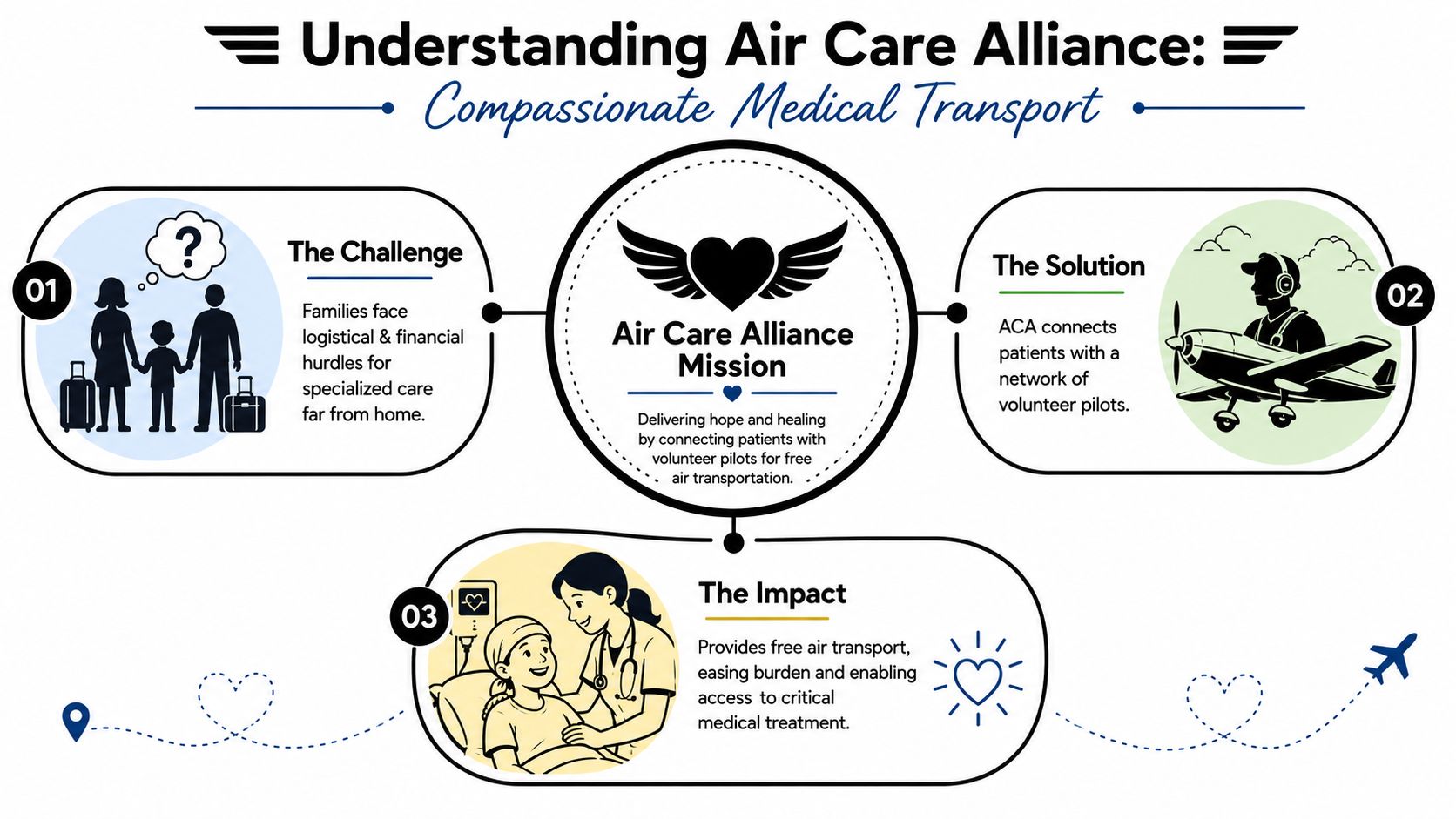
Air Care Alliance is often helpful in that kind of situation. It is a U.S.-based nonprofit umbrella organization founded in 1990 that connects volunteer pilots with public-benefit flying missions, and its network includes 19,500+ volunteer pilots according to the Air Care Alliance website.
What Air Care Alliance actually is
The easiest way to understand Air Care Alliance is to think of it as a matchmaker for charitable aviation, not as a direct airline or a hospital flight department. It connects people in need with independent nonprofit flight organizations and volunteer pilots.
That matters because many callers expect one central service with one fleet, one intake team, and one set of rules. Air Care Alliance doesn't work that way. Its structure is a network.
Historically, the organization grew from a conference of volunteer-based charitable flying groups held at the headquarters of the Aircraft Owners and Pilots Association, and its mission has remained focused on supporting public-benefit flying for more than 30 years. Air Care Alliance also says volunteer-pilot organizations collectively flew more than 50,000 charitable flights in the last year alone on its about page.
Air Care Alliance is best understood as a coordinating network for donated flights, not a standardized bedside medical transport provider.
What public-benefit flying means
“Public-benefit flying” includes several mission types. Medical transport is one of them, but not the only one. Member groups may also support disaster relief, humanitarian trips, animal relocation, and educational flights.
That broader mission helps explain why Air Care Alliance can be valuable for the right traveler. Its role is access. It helps connect available aviation resources to people and causes that need them.
If you're comparing this type of travel with more structured cross-border or medically managed transport programs, it can also help to review how organizations differ in scope and service model, including options discussed on Med Jets Air Care International.
The key takeaway for families
Before you fill out forms or make calls, hold onto this simple framework:
- If the patient is stable and needs help getting to care, a volunteer flight may be worth exploring.
- If the patient needs active monitoring or treatment during the trip, you're likely looking at a different category of service.
- If timing is urgent, volunteer aviation may not be the right fit.
That single distinction clears up most of the confusion around Air Care Alliance.
Who Qualifies for Volunteer Medical Flights
The most important eligibility question isn't financial. It's medical.
A key operational requirement for passengers using Air Care Alliance member flights is that they must be ambulatory and medically stable, which distinguishes this kind of travel from air ambulance transport for non-ambulatory or clinically unstable patients, as noted in the Air Care Alliance overview on Wikipedia.

Practical rule: If a patient cannot safely walk, board, sit upright, and travel without in-flight clinical support, a volunteer medical flight usually isn't the right referral.
What medically stable and ambulatory usually means
Families often ask, “My father is sick, but stable. Does that count?” Sometimes yes. The phrase matters because volunteer flights are designed for people who can tolerate the trip without onboard medical care.
A patient may be a possible fit if they can:
- Board the aircraft safely: They can get in and out with limited assistance.
- Tolerate the flight environment: They can remain seated for the duration and don't require intensive monitoring.
- Travel on a scheduled basis: The trip is planned ahead, not an emergency transfer between hospitals.
A patient is less likely to qualify if they need a stretcher, continuous hands-on medical management, or urgent transport after a sudden decline.
Why the rules may differ by organization
Another point that confuses families is variation between programs. Air Care Alliance includes many independent charitable groups, and each one may screen requests differently based on mission, region, aircraft, and volunteer availability.
That independence is one reason screening matters so much. Groups need clear information about the passenger's condition, mobility, and travel needs before they can say yes. For nonprofit programs that rely on volunteers, procedures like implementing volunteer background checks are part of the larger trust and safety picture, even though medical eligibility remains the first gate for patient trips.
Questions to ask before you apply
If you're trying to decide whether to submit a request, ask these questions first:
- Can the patient walk or transfer with minimal help?
- Has the medical team said the patient is stable for non-emergency air travel?
- Is the trip for scheduled care, consultation, or treatment rather than a crisis move?
- Can the patient travel without a medical crew onboard?
If your answer to any of those is “probably not,” pause there. It's better to sort that out before you spend time pursuing a volunteer option that doesn't match the patient's condition.
Volunteer Flights vs Professional Air Ambulance Services
This is the decision point most families need. Both options involve an aircraft. That's where the similarity ends.
A volunteer flight helps a stable passenger reach care. A professional air ambulance transports a patient whose medical condition may require specialized handling, equipment, or a clinical team.
The shortest way to decide
Use this if-then framework:
- If the patient is stable, ambulatory, and traveling for prearranged care, a volunteer flight may fit.
- If the patient is on a stretcher, medically fragile, or needs care during transport, use a professional air ambulance.
- If the trip must happen on urgent clinical timing, don't rely on volunteer availability.
That's the fork in the road.
Volunteer Flight vs Air Ambulance A Quick Comparison
| Feature | Air Care Alliance (Volunteer Flight) | Professional Air Ambulance (e.g., Med Jets) |
|---|---|---|
| Patient condition | Best suited for medically stable, ambulatory travelers | Used for patients who may be non-ambulatory, clinically fragile, or unable to travel safely without medical support |
| In-flight care | No onboard medical treatment team | Medical crew and clinical transport capability |
| Scheduling | Depends on volunteer pilot and mission availability | Coordinated as a professional transport service |
| Trip type | Non-emergency, planned travel | Emergency or non-emergency medical transport |
| Aircraft setup | Varies by participating organization and aircraft | Configured for patient transport and medical needs |
| Geographic consistency | Availability is local and varies by group | Service model is more standardized through the provider |
| Cost model | Charitable or donated flight assistance | Typically private pay, insurance-related, or arranged through assistance programs |
Why families mix them up
The confusion usually starts with language. People hear “medical flight” and think every aircraft carrying a patient works the same way. In practice, the difference is closer to the gap between a ride to treatment and a mobile care environment.
A hospital case manager might be arranging discharge for someone who still needs oxygen management, continuous assessment, or a stretcher. That patient needs a clinical transport plan, not only a seat on an airplane.
A volunteer flight solves an access problem. An air ambulance solves a medical transport problem.
Where service experience also matters
Clinical capability is the main issue, but coordination matters too. Families often underestimate how much communication is involved when a patient is moving between facilities, doctors, and ground transport providers. Broader discussions of customer service in aviation can help explain why clear handoffs, responsiveness, and expectation-setting make such a difference in medical travel.
For readers comparing aircraft types used in professional transport, this overview of fixed-wing vs rotary-wing medical flights can help clarify when long-distance airplane transport differs from helicopter use.
A realistic example
Suppose a patient needs to travel to a specialty cancer center next month for evaluation. She's weak, but she can walk slowly, sit upright, and doesn't need monitoring beyond routine support. That may align with a volunteer mission.
Now change the scenario. The patient is being discharged from one hospital to another, cannot walk, and requires close supervision during the trip. That is no longer a volunteer-flight situation. It requires a professional medical transport setup.
The point isn't that one option is better than the other. They serve different patients. Trouble starts when people try to use one in place of the other.
How to Request a Flight Through the ACA Network
Once you believe a patient may qualify, the next step is practical. You're not booking a ticket the way you would with a commercial airline. You're trying to find a charitable organization whose mission, geography, and volunteer capacity match the trip.
The biggest thing to remember is this: Air Care Alliance is a charitable access network rather than a standardized transportation service, and flight availability depends on the local member group rather than a universal national schedule, as described by Cancer and Careers in its Air Care Alliance resource.

Start with the right information
Before contacting a member organization, gather the details they're likely to need. Incomplete requests often slow things down.
Have these ready:
- Patient details: Full name, age, mobility status, and a plain-language medical summary.
- Travel basics: Departure area, destination, preferred dates, and whether a return trip may be needed.
- Medical contacts: Treating physician, case manager, clinic, or hospital contact information.
- Support needs: Whether a companion will travel, and whether ground transportation is already arranged.
A clear request helps the screening team decide faster whether the trip is feasible.
What the request process usually looks like
Most families move through the process in a few simple stages:
- Search for the right member group. Use the Air Care Alliance directory to find organizations serving your region or mission type.
- Submit an inquiry or application. Each group may have its own intake process.
- Complete medical and travel screening. The organization needs to confirm that the passenger fits the mission profile.
- Wait for mission matching. A flight depends on available volunteers, aircraft, routing, and weather.
- Confirm logistics. Once accepted, you'll review timing, pickup details, and any companion rules.
That screening step is important. A “maybe” at intake can still become a “no” if the patient's condition or timing doesn't fit the volunteer model.
A short video can help readers get familiar with the organization before making contact:
Set expectations early
Many families hear “free flight” and assume availability will be immediate. It often won't be. Volunteer pilots have schedules, aircraft limitations, and weather constraints. Some routes are easier to match than others.
Submit the request as early as you can. Volunteer aviation works best when there is time for screening and coordination.
If the patient has a firm treatment date, tell the organization that up front. If the trip is urgent, say that too, but understand that urgency doesn't create capacity. In urgent cases, you may need to pivot quickly to a professional transport option.
Safety Standards and Key Limitations to Know
Safety questions are reasonable. Families should ask them.
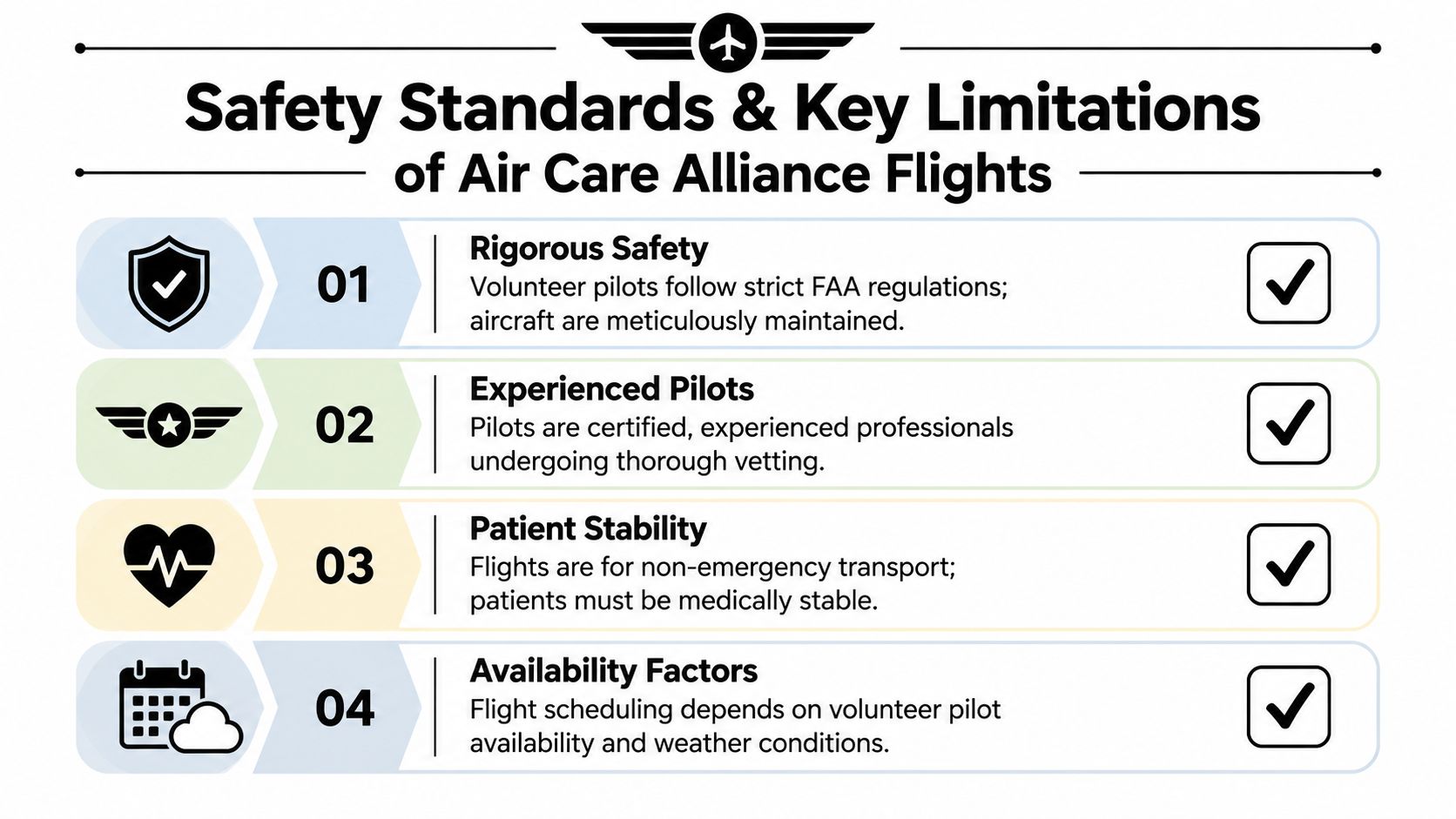
Air Care Alliance's model relies on distributed volunteer capacity. Its membership terms require each member group to be an independently administered nonprofit, and its annual conference focuses on training, regulatory updates, and networking, which suggests that service quality depends on the compliance and screening of individual organizations, according to the Air Care Alliance membership terms.
What to ask a volunteer flight organization
Because the network is decentralized, families should ask direct questions rather than assume every group operates the same way.
Ask about:
- Pilot qualifications: What experience standards does the organization require?
- Aircraft use and maintenance: How are aircraft maintained and what type of plane is typically used?
- Mission screening: Who decides whether a passenger is medically appropriate for the trip?
- Weather policies: How are delays or cancellations handled?
Those questions aren't confrontational. They're part of basic due diligence.
Limits that matter in real life
Volunteer flights have boundaries. They aren't set up for emergency response, bedside medical interventions, or guaranteed immediate launch. They may also be affected by weather and volunteer availability in ways that families find frustrating if expectations weren't clear from the start.
Resources that discuss aviation safety systems, including approaches to reducing cockpit workload for safety, can give helpful context about why operational discipline matters so much in any flight environment.
The safest plan is the one that fits the patient's actual condition, not the one that sounds most convenient.
If you're evaluating higher-acuity transport, it may also help to review broader safety considerations discussed in articles about medical flight crash risks and preparedness. The purpose isn't to create fear. It's to remind families that medical aviation decisions deserve careful matching, not guesswork.
Frequently Asked Questions About the Air Care Alliance
Is Air Care Alliance an air ambulance service
No. It's a charitable network that connects people with volunteer public-benefit flying organizations. That's different from a professional air ambulance that provides medical transport capability.
Are flights free
The flight itself may be donated through the participating organization. Families should still ask about non-flight costs such as getting to and from the airport, lodging, meals, and other travel support.
Can a family member travel with the patient
Sometimes, but it depends on the organization, aircraft, weight limits, and mission details. Ask this early so you can plan safely.
Can Air Care Alliance handle urgent hospital-to-hospital transfers
That usually isn't the right use case. Volunteer flights are generally better suited to scheduled, non-emergency travel rather than urgent transfers needing strict medical timing.
Can the patient use a wheelchair or stretcher
Many referrals fall apart under specific conditions. If the patient is non-ambulatory or needs a stretcher, a volunteer flight usually isn't the correct option. The same caution applies if the patient needs close medical supervision during the trip.
How far in advance should I ask
As early as possible. Volunteer matching takes time, and availability varies by region and mission type.
What if the patient doesn't meet the requirements
If the patient can't walk safely, isn't medically stable, needs onboard care, or must move on a clinical timeline, ask for a professional air ambulance evaluation instead. That gives the case manager or family a transport plan built around the patient's medical needs rather than around volunteer availability.
If you're trying to decide which kind of flight fits your patient, start with the medical condition, not the aircraft. Stable and ambulatory points toward charitable volunteer travel. Clinically fragile, non-ambulatory, or urgent points toward professional medical transport. That one distinction helps families make safer decisions, faster.