
You're probably reading this after another long shift, somewhere between pride and fatigue. Maybe you're a paramedic who's tired of being excellent on the ground but feeling stuck. Maybe you're an ICU or ER nurse who wants more autonomy, more challenge, and work that asks for every bit of judgment you've built over the years.
Air medical transport pulls at people in exactly that stage of their career.
It's hard to ignore the appeal. The patient is sicker. The environment is tighter. The margin for sloppy thinking disappears. You're not just moving someone from one place to another. You're taking ICU-level care into a cabin where noise, vibration, altitude, space, and time all change how you work.
That's why people ask questions like: What are the main air medical transport jobs? How do you become a flight nurse or flight paramedic? What certifications do employers require? Is the pay worth the lifestyle? And how do you avoid burning out after finally getting hired?
Those are the right questions.
A lot of career content about air medical transport jobs stops at titles and checklists. It tells you what a flight nurse is, what a pilot does, and which acronym to add after your name. It doesn't spend enough time on the trade-offs that decide whether you'll last in this field. Skills matter. Credentials matter. But the people who build sustainable careers usually get one more thing right. They choose the right program, the right crew culture, and the right pace for the long haul.
Your Next Call Is at 30000 Feet
A common turning point looks like this. You've become the person everyone trusts on a bad day. In the ED, you're the one who gets the crashing patient settled. On the truck, you're the medic newer partners watch when the room gets loud. The work still matters, but the learning curve has flattened, and the burnout is no longer subtle.
That's when air medicine starts to look less like a fantasy and more like the next honest step.
In this field, your patient might be a ventilated interfacility transfer, a fragile neonatal case, or a medical patient who doesn't look dramatic but can unravel fast once you're airborne. You're expected to think ahead, manage equipment without fuss, and communicate clearly with a pilot, dispatch, sending staff, and receiving team. The appeal isn't adrenaline alone. It's precision.
Why people move into this work
Air medical crews sit at a demanding intersection of medicine and aviation. The work rewards clinicians and pilots who already know how to stay calm, organize a scene, and make decisions without needing constant supervision. It also attracts people who want their scope, judgment, and teamwork tested at a higher level.
The field is large enough to offer real opportunity. The air medical transport industry in the United States supports approximately 21,000 dedicated professionals and demand is tied to the nation's 400,000 annual medical flights, according to the AAMS rotary-wing economic impact report.
Air medicine isn't a shortcut out of burnout. It's a move into a role where your habits, discipline, and judgment matter even more.
What makes it rewarding
The respect this work gets is earned. You don't bring average preparation into a pressurized cabin and hope it sorts itself out. You prepare before launch, think in contingencies, and carry yourself like a professional whose small mistakes can become large ones quickly.
That's also why many experienced clinicians find it deeply satisfying. You're part of a small crew. Everyone's contribution is visible. There's no hiding behind shift noise or a crowded unit. If you like accountability, high standards, and meaningful teamwork, air medical transport jobs can feel like a natural fit.
The Core Roles Onboard an Air Ambulance
An air ambulance works best when each person knows their lane and understands the other two. That matters more in the air than it does in many hospital settings because there's less room for redundancy, less room for personality friction, and almost no room for vague communication.
Here's the quick visual breakdown.
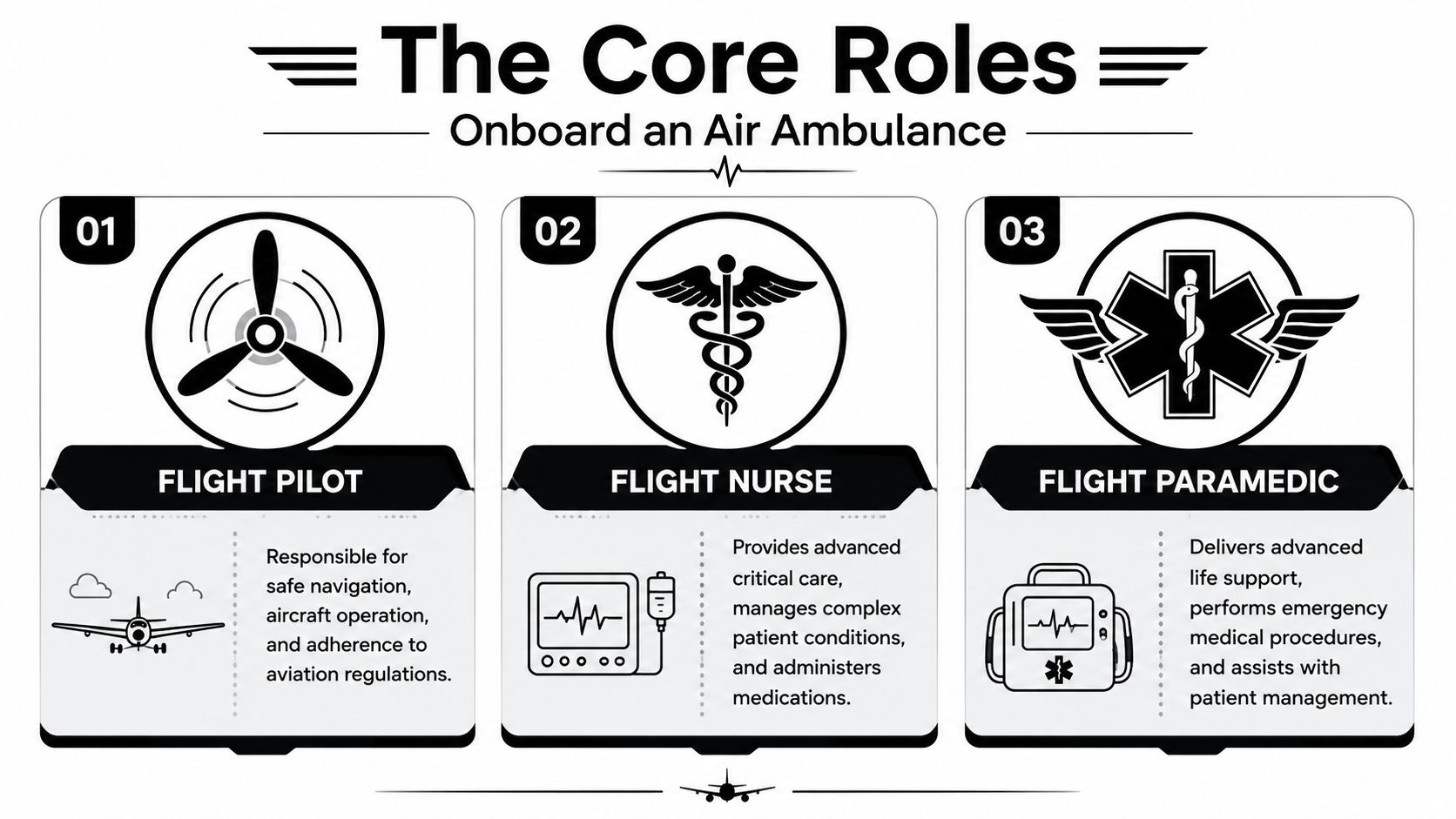
The pilot
The pilot owns the aircraft, the route, the weather decisions, and the final safety judgment. Clinical crew members may feel urgency around the patient, but the pilot has to weigh urgency against aircraft limits, visibility, fuel, terrain, and alternates. That's not a supporting role. It's mission-critical command.
For fixed-wing VFR programs, published requirements can be steep. One benchmark posting requires 2,000 total flight hours, including 1,000 hours as Pilot-in-Command and 500 hours of rotor-wing turbine experience, with starting annual salaries around $82,900 to $93,251, as shown in the Air Methods pilot job listing. If you're exploring that path, this overview of air ambulance pilot careers is a useful place to compare expectations.
The flight nurse
The flight nurse usually brings strong critical care structure to the mission. That often means medication management, hemodynamic thinking, ventilator oversight, and a constant eye on where the patient is trending instead of where they are right this second. Good flight nurses don't just react well. They anticipate.
In fixed-wing work especially, the nurse often helps organize the broader clinical picture. Which drips matter most if something changes in flight? What will be hardest to troubleshoot once the doors close? What needs to be clarified with the sending physician before departure? The best flight nurses ask those questions early.
The flight paramedic
A strong flight paramedic brings speed where speed helps and restraint where it doesn't. Airway management, emergency procedures, scene-style adaptability, and practical stabilization are all part of the role. But the medic who thrives in flight isn't just a ground paramedic in a smaller room. The environment changes the tempo.
Confined space, equipment limits, patient packaging, and cabin ergonomics all affect what you can do and how cleanly you can do it. The flight paramedic who does well onboard is usually excellent at prioritizing. Not every intervention needs to happen now. The right one does.
Crew rule: The mission goes well when the pilot protects safety, the nurse protects the care plan, and the paramedic protects execution under pressure.
How these roles work together
The biggest mistake outsiders make is assuming the aircraft merely adds drama to normal transport. It doesn't. It compresses teamwork. Every handoff, every piece of gear, every medication question, every weather-related adjustment becomes more important because there are fewer spare hands and fewer easy corrections.
A simple comparison helps.
| Role | Primary focus | What the crew depends on most |
|---|---|---|
| Pilot | Aircraft safety and navigation | Judgment, restraint, regulatory discipline |
| Flight Nurse | Complex critical care management | Planning, medication control, trend recognition |
| Flight Paramedic | Advanced life support and procedural support | Adaptability, prioritization, clean execution |
If you're trying to decide where you fit among air medical transport jobs, ask yourself a blunt question. When conditions tighten, do people rely on you most for safety command, complex clinical planning, or hands-on stabilization? That answer usually points toward the role you should pursue first.
Certifications and Experience You Must Have
Many applicants find this aspect frustrating. They assume enthusiasm for flight medicine will carry some weight. It won't. Programs hire people who can already perform at a very high level before they ever step near the aircraft.
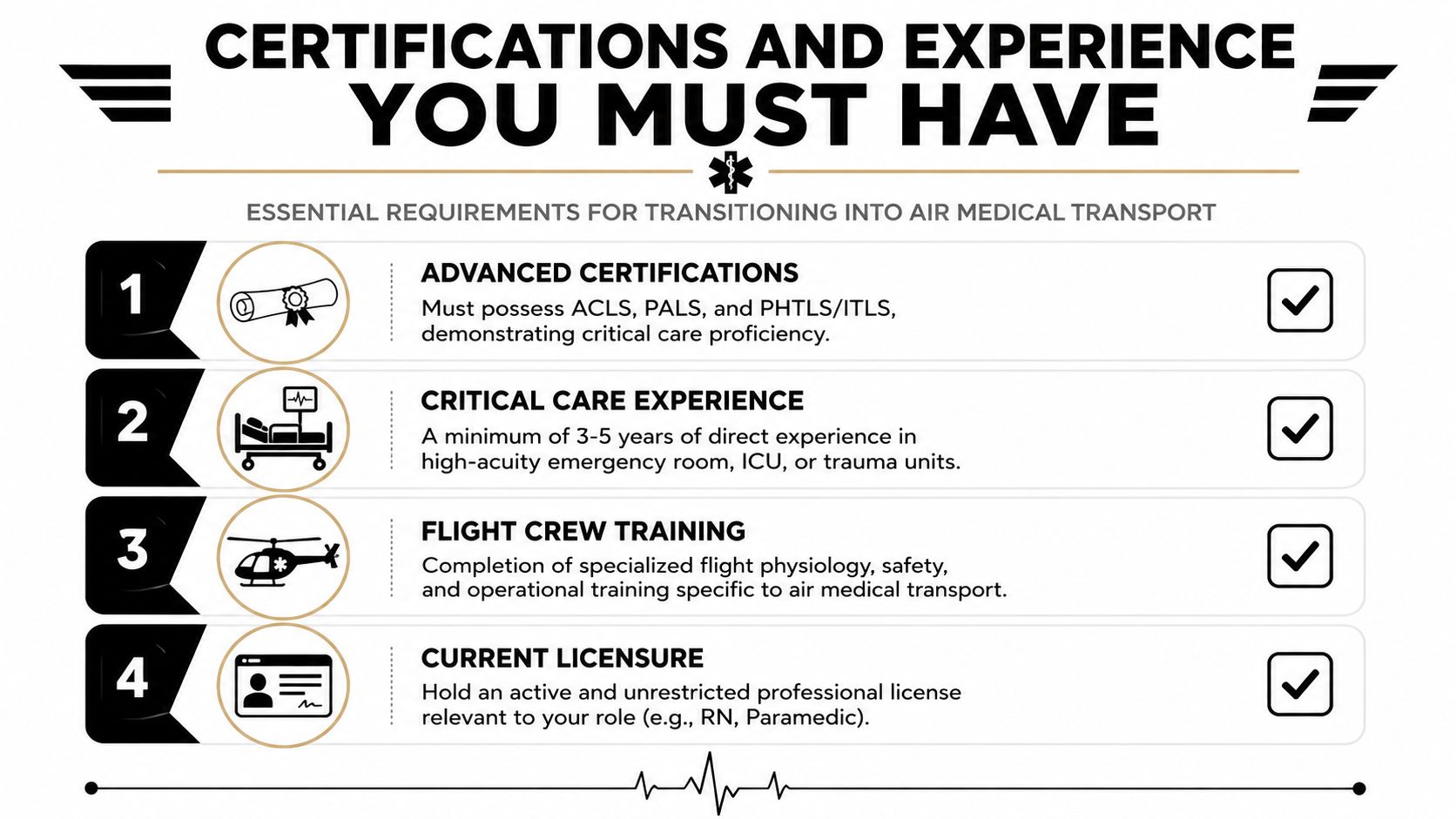
The first gate is certification. The second gate is experience that proves you can use those credentials under pressure.
The non-negotiable clinical credentials
Air medical transport clinicians need more than standard ground credentials. Paramedics are expected to pursue FP-C, and nurses are expected to pursue CFRN, because those credentials show competency with ICU-level equipment in the flight environment, as outlined in this review of air medical transport qualifications and daily realities.
You'll also see programs expect current advanced resuscitation training relevant to the patients they carry. Employers want proof that you can work through cardiac, pediatric, and neonatal complications without a long runway for help.
What experience actually counts
The unwritten standard is straightforward. Programs look for clinicians who have already managed unstable patients, not clinicians who hope flight will teach them how. Busy ICU, ER, trauma, and high-acuity EMS environments usually build the habits that transfer well.
What helps most:
- High-acuity decision-making: You've managed deterioration in real time, not just observed it.
- Equipment fluency: Ventilators, cardiac monitors, pumps, defibrillators, and documentation systems don't slow you down.
- Calm communication: You can give a concise report, clarify an order, and challenge bad assumptions without creating chaos.
- Strong fundamentals: Airway, hemodynamics, sedation, transport packaging, and reassessment all need to be second nature.
For role-specific preparation, a structured look at patient transport training can help you compare what medical transport programs tend to expect before they invest in onboarding.
What applicants get wrong
A lot of candidates overbuild the résumé and underbuild the foundation. They collect courses, conference badges, and broad claims about passion, but they can't describe a complicated patient in a way that shows mature thinking. Hiring teams notice that fast.
A cleaner approach looks like this:
- Tighten your base specialty first. Become the person your current unit already trusts with difficult assignments.
- Add the flight-specific credential that matches your role. Don't treat FP-C or CFRN like decorative letters.
- Get honest feedback. Ask senior clinicians whether your assessment, reporting, and prioritization are flight-ready.
- Train for the environment. Flight physiology, safety culture, packaging, and confined-space work all change patient care.
Credentials open the door. Judgment is what gets you invited to stay.
Salary Life Shifts and Career Outlook in 2026
Those interested in air medical transport jobs want a direct answer to two things. What does it pay, and what does it do to your life?
The honest answer is that compensation can be solid, sometimes very solid, but the lifestyle fit matters just as much as the paycheck. Shift work, base time, call readiness, and the emotional load all shape whether a role feels sustainable.
This image captures the career crossroads well.

What flight nurses can expect
Flight nursing remains one of the clearest examples of how specialization changes earning potential. Nationally, flight nurses earn about $102,000 to $110,000 annually in 2025, with senior independent air medical roles in high-cost states exceeding $145,000 annually, according to this breakdown of flight nurse salary ranges.
That spread tells you something useful. Program type, independence level, and geography all matter. A nurse moving from a hospital role into air transport should compare total compensation, not just base pay.
Broader job outlook and pay questions
For clinical crew members coming from EMS, the outlook is favorable. The U.S. Bureau of Labor Statistics projects 5 percent growth for EMTs and paramedics from 2024 to 2034, with 19,000 annual openings over the decade. The same BLS page lists median annual wages of $41,340 for EMTs and $58,410 for paramedics as of May 2024. That's all in the BLS outlook for EMTs and paramedics.
People also ask, “What's the typical hourly rate for air medical transport jobs overall?” A national snapshot from ZipRecruiter lists an average hourly rate of $19.69 as of July 11, 2025, with most wages falling between $12.98 and $20.67, according to the air medical transport salary overview.
For leadership roles, compensation rises with responsibility. A Chief Flight Nurse or Medical Program Manager role can pay $110,000 to $150,000 annually and may include benefits such as 401(k), dental, health, vision insurance, and paid time off, as shown in this Indeed listing for medical transport leadership roles.
Lifestyle fit matters more than candidates think
The work rhythm can suit some personalities extremely well and wear others down fast. Some clinicians love station time, readiness, and concentrated responsibility. Others miss the movement and social energy of a busy hospital or urban EMS system.
Before you change lanes, run the numbers against your current life. A practical way to compare possibilities by specialty and region is a healthcare salary calculator. Use it as a planning tool, not a promise.
Questions worth asking yourself:
- Can you tolerate waiting well? Some shifts involve readiness, not constant action.
- Do you recover well from disruption? Sleep, family routines, and holidays may get irregular.
- Do you want clinical advancement or title advancement? They're not always the same path in air medicine.
How to Land Your First Air Medical Transport Job
The candidates who get hired aren't always the ones with the longest list of credentials. They're the ones who make a program believe they'll be safe, teachable, steady, and good to work beside in a confined cabin at the end of a hard day.
That last part matters more than many applicants expect.
JEMS highlights a harsh reality in flight programs. There's a 30 to 40 percent attrition rate in the first two years tied to dual-license burnout, and 80 percent of air medical calls are non-trauma, which means crews spend a lot of time doing prolonged stabilization rather than dramatic hero work. That's why top programs look for emotional resilience and partnership, not just speed, as discussed in this JEMS article on becoming a flight paramedic.
Build a résumé that sounds like flight, not generic medicine
A weak résumé says you're passionate, hardworking, and committed to excellent patient care. Every hiring manager has read that a thousand times.
A strong résumé shows that you've handled unstable patients, difficult handoffs, and equipment-heavy care without losing your structure. If you need help tightening the format, this guide to medical resume creation is useful for turning broad experience into hiring language.
Focus on evidence like:
- High-acuity patient work: Show the type of instability you routinely manage.
- Critical equipment use: Name the tools you handle confidently.
- Transport relevance: Highlight interfacility transfers, scene discipline, or independent decision-making.
- Team behavior: Include examples that show reliability, not ego.
If you're reviewing active openings, this page for Reach air medical jobs is the kind of resource that helps you compare how transport roles are described in the market.
Prepare for culture questions, not just clinical questions
A lot of candidates practice only medication math and scenario answers. They should also prepare for questions that expose how they function with another clinician and a pilot when stress rises.
Expect some version of these:
- Tell us about a time you had to slow a team down.
- How do you handle a partner who works differently than you do?
- What do you do when the patient is stable, but the family is not?
- How do you respond when a pilot makes a safety decision that delays care?
The interview isn't only testing whether you can care for the patient. It's testing whether people want to share a small aircraft with you for a long shift.
What usually works
Candidates tend to do well when they speak plainly, own mistakes, and describe teamwork without trying to sound heroic. Programs know you can learn local protocols. They care more about whether you can be coached, whether you panic, and whether you make the crew stronger.
Three habits usually help:
- Answer with structure. Situation, assessment, action, result. Keep it clean.
- Show restraint. Not every strong answer ends with a dramatic procedure.
- Be honest about fit. If you need constant activity or hate close teamwork, this field may frustrate you.
A Career with Med Jets by Air Trek
When clinicians talk about sustainable air medicine careers, they usually start with aircraft, compensation, and call types. Those matter. But the employer itself matters just as much. A program can have good equipment and still wear good people out if the culture is thin, the communication is poor, or the expectations are all urgency and no support.
That's why serious candidates should look closely at how a company is built.
Here's the public-facing snapshot.

What to look for in an employer
A stable air medical employer usually shows its values in operational details, not slogans. You can often tell what kind of place it is by asking practical questions.
Look for signs like:
- Clear mission profiles: Are they honest about what kinds of transports they do most often?
- Crew support: Do they talk concretely about qualifications, onboarding, and expectations?
- Fleet transparency: Do they tell you what aircraft they operate and how missions are configured?
- Communication discipline: Do dispatch, flight, and clinical operations sound coordinated or improvised?
Those details matter because they shape your day-to-day quality of work. They also shape how quickly burnout arrives.
Why company culture is not a soft issue
The dual-license reality in this field makes culture operational, not cosmetic. When clinicians and pilots are maintaining technical standards, shift readiness, and patient-facing composure all at once, a crew culture built on respect and patience is a protective factor. The wrong culture turns every hard day into an exit ramp.
Med Jets by Air Trek is a family-operated air ambulance program that has provided medical transportation since 1978. According to the company's published information, it operates company-owned Cessna Citation II, III, and V jets, coordinates end-to-end patient transfers, and supports emergency medical flights, medical escorts, and ground transport through a patient-centered model.
That kind of setup won't fit every candidate, but it does illustrate what to screen for when you evaluate air medical transport jobs. Experience in operation. A clearly defined fleet. Mission clarity. Qualified crews. Organized coordination from first call to handoff.
Questions to ask before you sign anywhere
Don't leave the interview without answers to these:
| Question | Why it matters |
|---|---|
| What does a typical mission mix look like? | It tells you whether the work matches your strengths |
| How are new hires oriented and mentored? | It reveals whether the company expects growth or instant perfection |
| How does the program handle crew fatigue and support? | It shows whether they understand retention in real terms |
| What does communication between dispatch, pilots, and clinicians look like? | It predicts whether your shifts will feel smooth or chaotic |
A good employer doesn't remove the pressure from air medicine. It organizes the pressure so crews can do the work well.
If you're comparing programs, look past branding and focus on whether the operation seems built for long careers, not just short-term staffing.
Navigating Relocation and International Transfers
A lot of people qualify for flight work before they live anywhere near the right opening. That's normal. Air medical transport jobs often require you to widen the map and think in terms of licensure, aviation rules, and hiring logistics, not just where you'd prefer to live.
The process is manageable if you handle it in the right order.
If you're relocating to another state
Start with your clinical license. Nurses and paramedics need to know whether the destination state recognizes current credentials directly, requires endorsement, or expects added documentation. Don't wait until after the interview to sort this out. Hiring timelines can move faster than licensing paperwork.
A clean relocation approach looks like this:
- Verify your license path first. Check what your destination state requires for nursing or paramedic reciprocity.
- Gather every core document early. License verification, education records, certifications, and identification delays are common.
- Match your address and employment timeline realistically. Don't promise a start date that depends on paperwork you haven't initiated.
- Ask about local orientation requirements. Some employers can hire contingent on licensure progress, others won't.
Florida draws a lot of interest because of its transport activity and geography. If you're targeting jobs there, treat state licensure as a front-end task, not an afterthought.
If you're moving from another country
International transfers add another layer. Clinicians may need credential evaluation and immigration planning before they can even compete fairly for a role. Pilots may also face FAA-specific conversion requirements depending on their training history and license background.
What to focus on first:
- Credential evaluation: Nursing and other clinical credentials may need formal review through recognized evaluators.
- Work authorization: Visa status can decide whether an employer can realistically move forward.
- Terminology differences: Your experience may be excellent but described in a way U.S. hiring teams don't immediately understand.
- Aviation alignment: Pilots need to confirm how foreign ratings or licenses translate into FAA expectations.
Keep the sequence practical
Candidates get into trouble when they chase jobs before they understand the transfer path. It's better to know exactly what can move quickly, what will take time, and what depends on employer sponsorship or state approval.
Use this order:
- First, clarify your role path. Nurse, paramedic, pilot, dispatcher, or support role.
- Second, map the regulatory steps. Licensure and aviation compliance come before relocation logistics.
- Third, build a U.S.-ready application. Rewrite your experience in terms a hiring team can assess quickly.
- Finally, target employers with realistic onboarding windows. That reduces frustration on both sides.
Relocation doesn't make this career impossible. It just rewards people who plan like professionals. In air medicine, that's a good sign from the start.
If you're considering air medical transport jobs, don't judge the field by the title alone. Judge it by the role, the standards, the crew, and the employer's culture. The work can be highly satisfying for people who like precision, accountability, and small-team trust. It can also burn people out fast when they enter for the wrong reasons or land in the wrong program.
The best next move is a practical one. Compare your current experience to real flight expectations, close the certification gaps, and look hard at whether the company you're considering is built to help good people stay.