
You're probably looking at flight medic jobs in florida from one of three positions. You're either a street paramedic trying to figure out whether you're even close to competitive, a newer medic hoping there's a shortcut into air medical, or an experienced transport clinician trying to sort out which credentials move the needle.
The short answer is that Florida does have flight openings, but this is not an entry-level lane. Hiring managers usually aren't looking for someone whose sole interest is working on an aircraft. They're looking for a paramedic who already performs well in unstable, time-compressed patient care, follows safety procedure without being reminded, and can function inside a transport system where clinical decisions and operational discipline matter equally.
A lot of online advice misses that point. It treats air medical hiring like a job-board problem. In practice, it's a preparation problem. The candidate who gets hired usually built the right foundation years before the application went out.
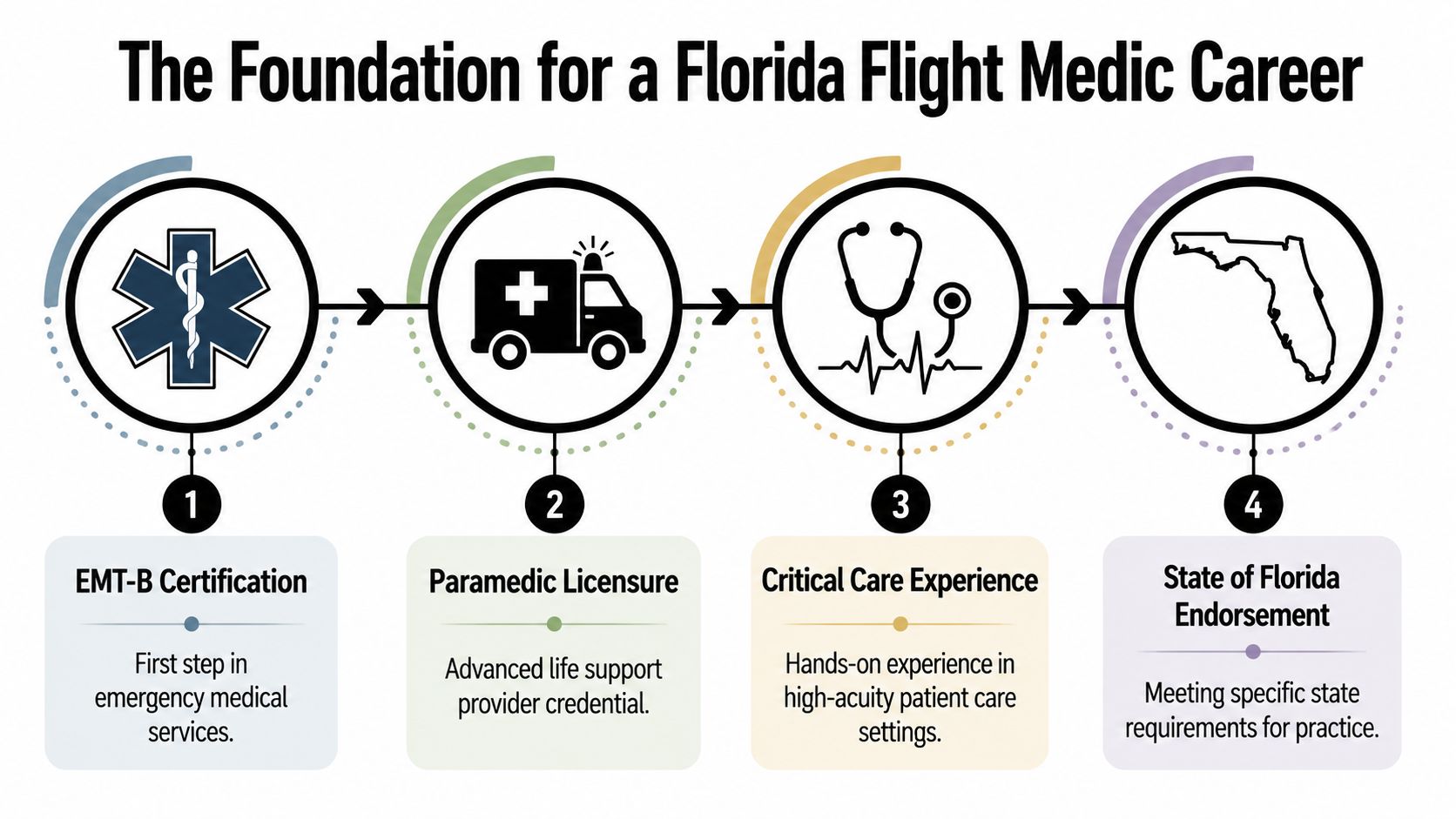
The Foundation for a Florida Flight Medic Career
The first reality check is simple. You need to be a paramedic first, and a strong one. Florida flight roles usually require paramedic licensure plus several years of recent advanced life support experience. Employers commonly specify 3 to 5 years in a high-volume ALS or EMS environment, and many postings also require or strongly prefer BLS, ACLS, PALS, and trauma credentials such as PHTLS or ITLS, as outlined in Impact EMS guidance on becoming a flight paramedic.
What counts as non-negotiable
If your Florida paramedic license isn't current, nothing else matters yet. The same goes for baseline certs. BLS, ACLS, and PALS are table stakes in this hiring lane. Trauma credentials matter because air programs routinely screen for candidates who can work trauma, medical, pediatric, and interfacility patients without needing a lot of hand-holding.
Hiring managers also notice the small things. A lapse in ACLS might look administrative to you. To an air program, it can signal poor professional upkeep.
Practical rule: If a certification is required for your current role, renew it early anyway. Air medical teams notice patterns of readiness.
What high-volume experience really means
“High-volume” doesn't just mean busy. It means repeated exposure to sick patients, scene management, complex handoffs, and ALS decision-making under pressure. A medic who has worked in a system with regular cardiac, respiratory, trauma, stroke, and critical transfer volume usually arrives more prepared than someone whose experience is technically long but clinically narrow.
That's why trying to jump too early usually fails. A year or two as a paramedic may build confidence, but it often doesn't build enough range. Flight work compresses time and options. You need enough patient contact behind you that your assessment and treatment choices feel automatic, not rehearsed.
The practical path that works
Most candidates who become competitive follow a path like this:
Get and keep your paramedic license clean
Stay current, stay organized, and make sure there are no avoidable documentation or compliance issues.Build recent ALS experience
Focus on environments where you're making decisions often, not sitting for most of the shift waiting for the rare critical call.Add flight-relevant certifications
Baseline certs come first. Specialty certs matter later, but they matter more when paired with real clinical depth.Learn the operational side
Air medical jobs screen for mission readiness, pre-mission discipline, and documentation habits, not just treatment knowledge.
A common mistake is chasing the aircraft before mastering the ambulance. In Florida, flight positions are senior clinical jobs. If your foundation is thin, the interview usually exposes it fast.
Building High-Value Clinical and Transport Experience
Not all paramedic years carry the same weight. If you're aiming at flight medic jobs in florida, the strongest experience usually comes from work that forces you to think independently, manage deterioration early, and move patients safely between levels of care.
One Florida example makes that standard pretty clear. An AdventHealth flight paramedic posting in Wesley Chapel required 5+ years of continuous experience in an EMS or critical care transport system and preferred 1+ year in fixed-wing or rotor aircraft, according to the AdventHealth Wesley Chapel flight paramedic posting.
The experience employers value most
A busy 911 system can build excellent instincts. You learn scene control, communication, and rapid intervention. But dedicated critical care transport experience often carries extra weight because it teaches prolonged management, not just rapid stabilization.
That difference matters. In the air, you don't just package and go. You manage the patient through movement, noise, limited access, and changing conditions. The medics who adapt best have already handled complex transfers on the ground.
Here's the rough distinction hiring teams care about:
| Experience type | What it tends to build | Why it matters for flight hiring |
|---|---|---|
| Busy 911 ALS | Fast assessment, scene leadership, acute intervention | Strong base for unstable patients and rapid decisions |
| Critical care transport | Ventilator familiarity, medication titration, detailed handoff management | Closer match to interfacility and high-acuity air transport |
| Slower low-acuity EMS | General field experience | Useful, but usually not enough on its own |
Rotor-wing and fixed-wing preparation aren't identical
Rotor programs often favor medics who are strong in scene response, trauma rhythm, and short-window intervention. Fixed-wing operations often lean harder on interfacility transport skills, longer patient contact, and comfort with more complex equipment setups.
That doesn't mean one path is better. It means your resume should match the mission profile. If you want fixed-wing work, your transport history should show that you can inherit a complex patient from a facility team, verify equipment, manage the trip, and hand off cleanly at destination.
For clinicians trying to understand the gear side of transport medicine, it also helps to stay familiar with the kinds of aeromedical equipment and supplies used in medical transport operations. You don't need to become a mechanic or inventory specialist, but you do need to show that you understand how transport medicine depends on reliable equipment, space management, and preparation.
The best ground experience for air medical isn't the loudest assignment. It's the one that repeatedly forces you to manage sick patients with limited margin for error.
What doesn't work
Some candidates assume any five-year paramedic history is enough. It isn't. Hiring teams usually look for pattern and relevance.
Weak applications often share the same problems:
Broad but shallow experience
Plenty of time in EMS, but little evidence of high-acuity practice.No transport differentiation
The resume reads like standard ambulance work, even if the candidate has done more.Minimal critical care exposure
Little comfort with advanced monitoring, prolonged reassessment, or complex receiving-facility communication.
If you're early in your path, choose assignments that sharpen judgment. In this niche, the right year of experience can matter more than several comfortable ones.
Advanced Certifications That Open Doors
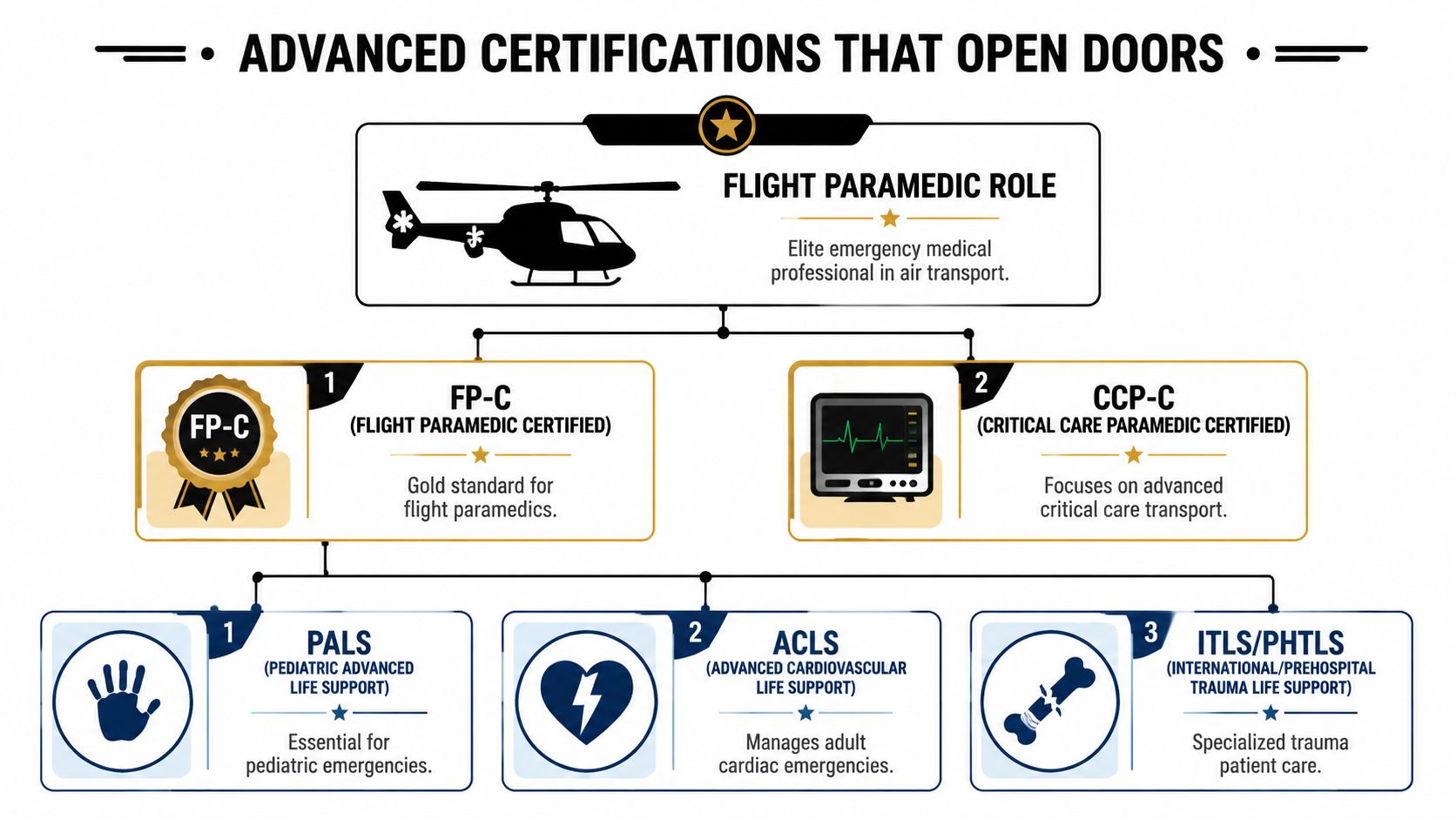
At some point, everyone asks the same question. Do I really need FP-C, or is good field experience enough? In Florida, strong experience gets you into the conversation. Advanced certifications often decide whether you stay there.
That's because flight hiring managers need a way to separate a capable paramedic from a candidate who has deliberately prepared for the air medical environment. Specialty credentials do that. They show commitment, technical study, and familiarity with the standards of critical care transport.
Flight medic and flight paramedic usually mean the same hiring lane
Florida job listings often use flight medic and flight paramedic interchangeably, but the requirements can still vary by employer. Some programs prefer FP-C at hire, while others may require it after hire. PHI Air Medical is one example where FP-C may be required within 24 months, which makes it an important credential for mobility across employers, as reflected in Florida flight medic job listings on Indeed.
That's the practical takeaway. Don't get stuck on the title. Read the credential language.
Which certifications matter most
If you already hold the foundational certs, these are the ones that usually carry the most signal:
FP-C
This is the certification many clinicians treat as the clearest marker of serious flight intent.CCP-C
Especially useful if your background is more transport-heavy and you want to demonstrate critical care depth.PHTLS or ITLS
These support trauma credibility and often appear in Florida postings.PALS and ACLS
These may feel basic once you've been practicing a while, but they remain part of the expected package.
A lot of candidates spend money in the wrong order. They collect low-impact certificates and skip the hard ones. Hiring managers notice. A focused credential set beats a crowded one.
Here's a helpful overview before you invest more training time:
Why these credentials change hiring outcomes
Air programs can't interview everyone in depth. Certifications become an early filter. They aren't a substitute for clinical maturity, but they tell a hiring team that you understand the specialty well enough to prepare for it on purpose.
If two applicants have solid field backgrounds, the one with the stronger flight-relevant certification profile usually looks like less of a hiring risk.
That matters even more if you want options later. A candidate with strong transport experience plus FP-C or CCP-C usually has an easier time moving between programs than someone whose qualifications only fit one narrow opening.
Navigating Florida's Air Medical Employer Landscape
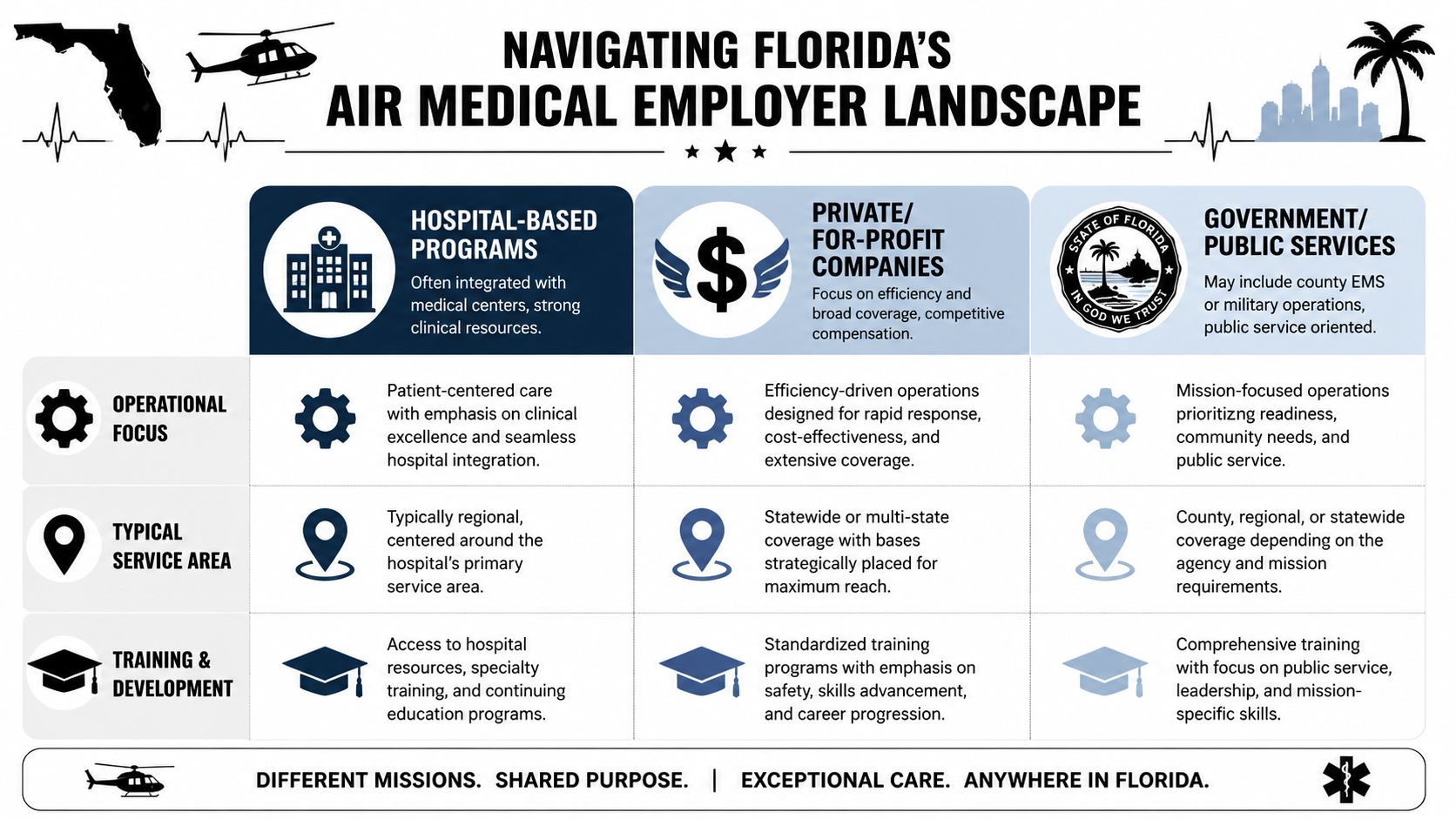
Florida's flight market is broad enough to create opportunity and small enough to stay selective. One useful way to understand it is to stop thinking in terms of “air medical” as one employer type. It isn't. The clinical work, schedule, and expectations can feel very different depending on where you apply.
The labor context helps. Florida's largest EMS workforce survey captured responses from more than 49,000 EMTs and paramedics, while the flight segment remains much smaller. In May 2026, Glassdoor showed 16 flight medic openings in Florida, and Indeed showed 341 flight paramedic jobs in Florida, according to Glassdoor's Florida flight medic listings and the labor context summarized there. That spread suggests a niche market with broad statewide demand, but also one where titles and staffing models vary.
Three employer models to understand
The easiest way to target your search is to compare employers by mission profile, not branding.
| Employer type | Typical focus | What candidates should expect |
|---|---|---|
| Hospital-based programs | Often tied closely to medical centers and specialty referral networks | Strong clinical oversight, structured protocols, mission profiles shaped by hospital system needs |
| Private operators | Coverage across broader transport needs, often including interfacility work | Operational efficiency matters a lot, and hiring may favor transport versatility |
| Government or public-service programs | Public mission orientation and agency-specific operational requirements | Strong emphasis on procedure, compliance, and agency culture |
Rotor versus fixed-wing in real life
Many applicants find themselves confused. They apply to every air opening as if the work is the same.
Rotor-wing jobs often attract medics who like scene work, trauma response, and shorter but very intense patient contact. Fixed-wing jobs usually favor clinicians comfortable with handoff-heavy transports, long-distance coordination, and sustained patient management.
If you're evaluating the aviation side of the field, it's useful to understand how employers structure pilot and crew roles across transport models. This overview of air ambulance pilot careers gives context for how aviation operations and medical missions align in fixed-wing programs.
How to choose the right target
Don't ask only, “Who's hiring?” Ask better questions:
What mission mix fits my background
If your strongest work is ICU transfer and prolonged care, fixed-wing may fit better than a scene-heavy rotor program.How much autonomy do I want
Some programs run with very mature clinicians and expect immediate operational comfort.What kind of partner dynamic suits me
Team chemistry matters. A medic who thrives in a tightly structured environment may struggle in a looser one, and vice versa.
The smartest applicants don't shotgun resumes. They match their clinical history to the employer's mission profile, then interview as if they already understand the operation.
Crafting Your Resume and Acing the Interview
Most flight resumes fail before the clinical interview. Not because the medic is weak, but because the document reads like generic EMS experience instead of transport-ready experience.
Your resume should show judgment, complexity, and consistency. If you've managed ventilators, advanced drips, high-risk transfers, or difficult handoffs, say that plainly. If you've participated in quality improvement, training, precepting, or safety reporting, include that too. Air programs want to know whether you can operate inside a disciplined system.
Write your resume for flight screening, not for pride
A hiring manager scanning applications is looking for evidence of fit. Make that easy.
Lead with licensure and critical credentials
Put paramedic licensure and your most relevant current certs where they're immediately visible.Describe the work, not just the employer
“Paramedic” is a title. “Managed high-acuity ALS responses and critical interfacility transports” tells the reviewer more.Show operational reliability
If you've held field training, charge, CQI, or transport-specific responsibilities, include them.Use clean formatting
Many applicants get screened by software before a person ever reads the file. It helps to review practical guidance on ATS resume formatting and keywords so your resume is readable both by systems and by recruiters.

Expect safety questions as much as clinical questions
A typical Florida flight paramedic role includes pre-mission checklists, aircraft safety checks, and strict documentation, and many employers make aviation safety discipline and operational readiness a major interview screen, as described in this Florida flight paramedic job description example.
That means your interview prep should include more than treatment algorithms. Be ready for questions like:
- Tell us about a time you stopped a process because something wasn't safe
- How do you handle disagreement with a partner during a transport decision
- What do you do when the sending report doesn't match the patient in front of you
- How do you organize yourself before movement and after handoff
Good answers sound calm, specific, and procedural. Weak answers sound dramatic or ego-driven.
A strong air medical interview answer shows clinical skill, crew awareness, and respect for process at the same time.
If you walk in talking only about adrenaline, you'll look unprepared. If you talk about checklist discipline, communication, reassessment, and documentation accuracy, you'll sound like someone who understands the job.
Your Next Steps and Florida Employer Spotlight
The path into flight medic jobs in florida is demanding, but it's not mysterious. Get your paramedic foundation solid. Build experience that proves you can manage unstable patients and clean handoffs. Add certifications that signal serious transport intent. Then apply to programs that match the kind of work you've been doing.
A lot of applicants improve their odds by being more strategic. They stop chasing title alone and start matching their background to mission type. That's how you move from interested to interviewable.
One fixed-wing example worth reviewing is Med Jets by Air Trek, a Florida-based air ambulance program that handles end-to-end patient transport using Cessna Citation aircraft as part of its medical transport operation. If your long-term interest leans toward interfacility transport, longer-distance missions, and working alongside a broader aeromedical team, it can also help to compare adjacent roles such as flight nurse jobs in Florida, because those job tracks often overlap in hiring standards and transport expectations.
If you're serious about this career move, your next action should be specific. Audit your certs. Tighten your resume. Look at the mission profile behind each posting. Then ask the only question that matters in this niche.
Not “Do I want to fly?”
“Have I built the kind of career that a Florida air medical program trusts in the aircraft?”