

When a hospital tells you your loved one needs to move now, the first question usually isn't logistics. It's safety. Can they tolerate the flight, who will care for them in the air, what happens if weather changes, and how do you know the operator is built for a medical mission instead of a routine charter?
Those are the right questions.
In West Palm Beach, flight safety isn't just about getting a plane off the ground and back down again. For medical transport, it means combining aviation discipline, clinical judgment, dispatch coordination, and transfer planning so the patient is protected at every handoff. That matters even more in South Florida, where operational complexity can affect timing, routing, and bedside decisions.
Your Guide to Safe Medical Flights in West Palm Beach
A lot of families start in the same place. They have discharge paperwork open on one screen, a phone in hand, and a dozen unanswered questions. A parent needs to transfer to another hospital. A spouse has to get home after a serious illness. A case manager needs a transport option that won't create new risk during the move.

The mistake people make is comparing an air ambulance to a regular airline trip. The safety model is different. Airline travel focuses on moving many passengers through a standard system. Medical air transport focuses on one patient with a specific diagnosis, a defined set of risks, and a plan for what the crew will do if that patient's condition changes before takeoff, during the flight, or during the ground transfer on either end.
That also changes what "flight safety West Palm" really means. It isn't just airport security lines, turbulence, or whether flying is generally safe. It means asking whether the provider can manage oxygen, monitoring, medication timing, stretcher loading, pressure points, infection control, family coordination, and diversion decisions without losing sight of the patient's medical needs.
Safety starts before the aircraft door closes. If the bedside report, loading plan, and receiving-facility handoff are weak, the flight is already less safe.
For some families, the planning also includes mobility issues after arrival. If the patient or caregiver will need equipment for the next leg of the trip, practical preparation helps. A guide on choosing the right travel scooter can help you think ahead about size, portability, and airport handling once the medical portion of the move is complete.
What families usually want to know first
- Can this patient fly safely: The answer depends on current condition, not a generic rule.
- Who makes the go or no-go decision: It should involve medical staff, flight crew, and dispatch, not sales language.
- What happens if plans change: Strong operators build contingencies before launch, not after a problem develops.
West Palm Beach Aviation An Ecosystem of Excellence
West Palm Beach isn't just a local airport market. It sits inside a professional aviation environment where training, regulation, and specialized operations intersect. That matters for families because safe medical flying depends on the ecosystem around the mission, not only the aircraft assigned to it.
FlightSafety International's West Palm Beach Learning Center has operated there since 1983, serving operators of business, regional, and commercial aircraft, which ties the local aviation environment to a broader safety training infrastructure rather than an isolated airport setting (FlightSafety West Palm Beach Learning Center).
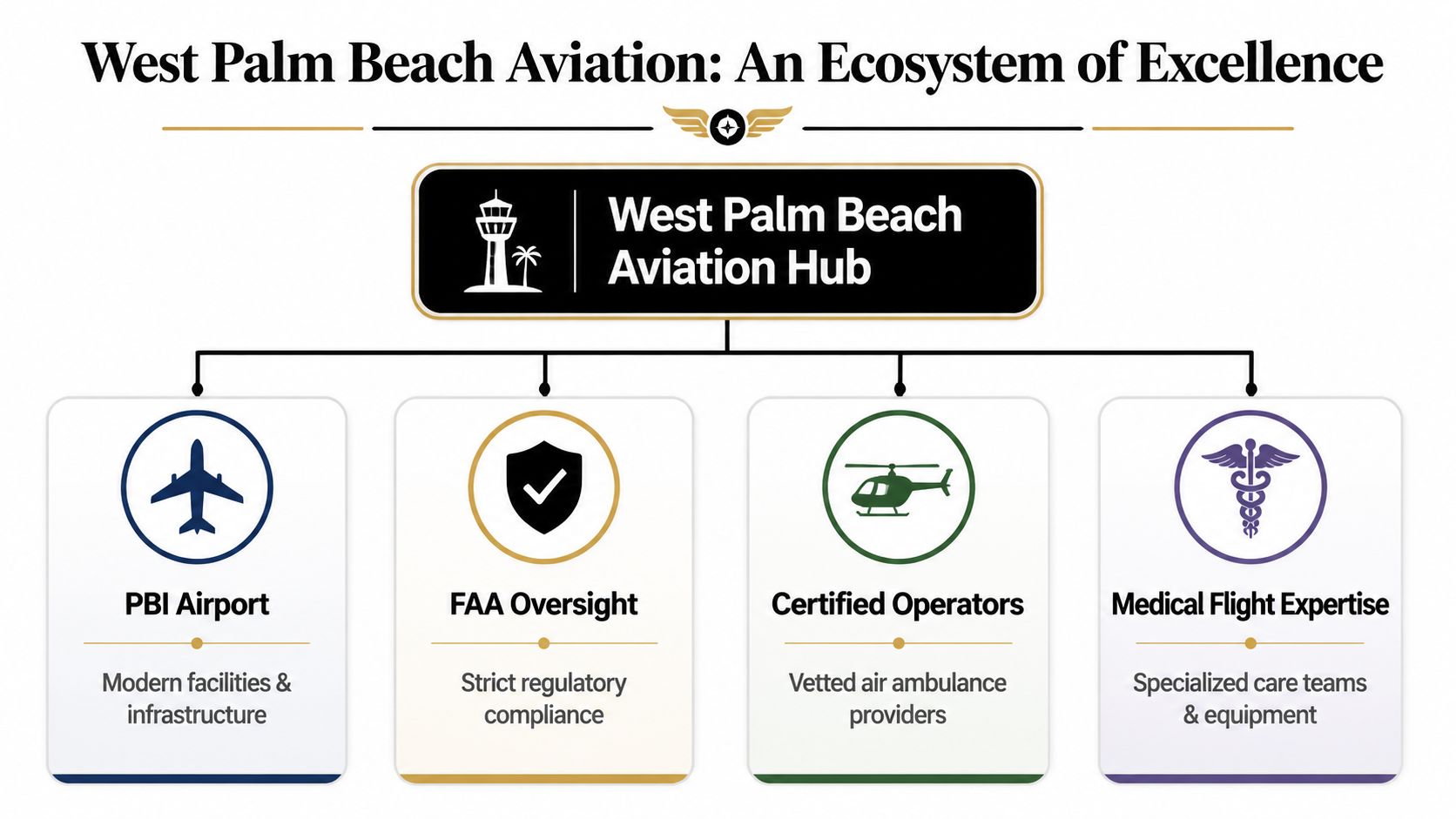
That may sound abstract, but it isn't. In practice, a region with serious recurrent training infrastructure tends to produce a stronger safety culture. Pilots, operators, and support teams work in an environment where standardization, simulator work, checking, and procedural discipline are part of normal operations.
Why that matters to a medical flight
A medical mission adds pressure. The patient may be unstable. The sending hospital may want a narrow departure window. The receiving facility may be coordinating a bed, specialist, or procedure. Under those conditions, you don't want a casual operation. You want one shaped by repeatable standards.
Three local realities support that mindset:
- Training depth: West Palm Beach is associated with structured professional instruction, not just point-to-point flying.
- Regulatory presence: Operators in this environment function under active oversight and procedural discipline.
- Mission familiarity: South Florida crews and dispatch teams are used to balancing time sensitivity with operational limits.
One useful way to think about airport operations more broadly is to look at systems built around risk control, ground handling, and airside coordination. Resources like Enhance airport safety with Safety Space help illustrate how structured handling processes support safer operations beyond the cockpit.
The hidden advantage of a strong local base
Families often focus on the aircraft cabin, and they should. But location matters too. A provider with established operational presence in the area can usually coordinate more smoothly with airports, hospitals, and ground transport partners than an operator dropping in cold.
If you're evaluating local options, it helps to review a provider's regional footprint, such as Med Jets' West Palm Beach regional office, because regional presence can affect communication flow, local familiarity, and transport coordination.
A safe mission isn't built by one excellent pilot. It's built by a system that keeps everyone working from the same playbook.
Decoding Air Ambulance Safety Standards
If you want a practical way to judge an air ambulance, break the question into three parts. Aircraft. Crew. Medical operations. If any one of those is weak, the mission becomes less predictable.
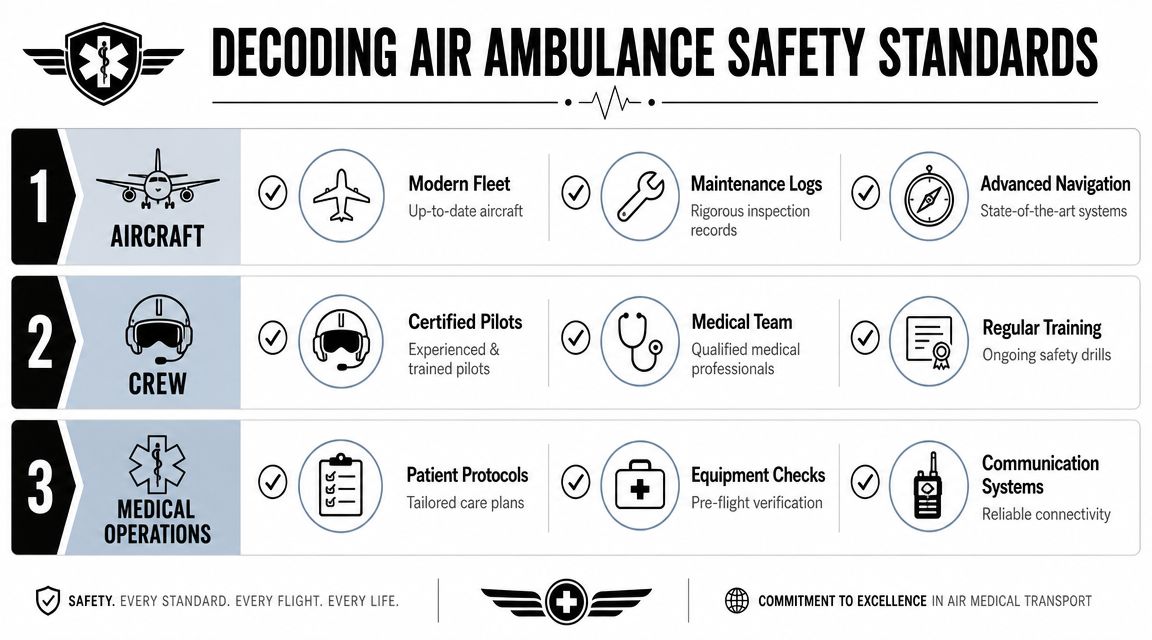
Aircraft standards that actually matter
Start with the airplane itself. A medical aircraft isn't just a jet with a stretcher installed. The cabin layout, loading setup, oxygen arrangement, electrical support for medical devices, and maintenance discipline all affect patient safety.
Ask how the operator handles:
- Maintenance control: You want documented inspection and maintenance processes, not vague reassurance.
- Cabin configuration: The aircraft should support patient access, monitoring, and secure equipment placement.
- Mission fit: Some patients need a jet environment with enough room for active clinical care, not a cramped workaround.
A dedicated medical fleet usually works better than trying to adapt a general charter setup to a critical-care mission on short notice. Consistency in aircraft setup helps crews work faster and with fewer surprises.
Crew qualifications beyond the brochure
The crew side gets oversimplified all the time. Families hear "experienced pilots" and assume that covers it. It doesn't. You want to know how pilots are trained, checked, and kept current for demanding operations.
FlightSafety's West Palm Beach training environment includes structured curricula with FAA type-certification pathways and recurrent proficiency checks under 14 CFR 61.58 and 61.57, which are core mechanisms for reducing pilot skill decay (Vertical Mag on FlightSafety training in West Palm Beach).
That matters because recency and recurrent checking aren't paperwork exercises. They help determine whether a pilot is ready to perform under workload, in changing conditions, and with the extra coordination medical missions require.
Here's a useful principle for families and case managers:
Practical rule: Don't ask only whether the pilots are licensed. Ask how the operator keeps them current, checks them, and staffs the cockpit for medical missions.
For readers who want a broader look at how accident thinking applies to medical aviation, this overview of medical flight crash considerations is a helpful starting point for understanding why systems and standards matter more than slogans.
A short visual explainer can also make these standards easier to picture before you start calling providers.
Medical operations are part of flight safety
The safest aircraft in the world won't protect a patient if the medical side is sloppy. The transport team needs to know the diagnosis, current stability, medication schedule, airway status, mobility limits, and what could deteriorate during transport.
A strong medical operation usually shows up in ordinary details:
| Area | What to look for | Why it matters |
|---|---|---|
| Clinical handoff | Clear communication with the sending hospital | Reduces missed information during transfer |
| Equipment prep | Preflight verification of monitors, oxygen, and supplies | Prevents in-flight surprises |
| Ground coordination | Planned ambulance and receiving-facility timing | Protects the patient during handoffs |
One provider model in this space is Med Jets by Air Trek, which describes complete medical transportation using dedicated aircraft, two co-captains, clinical crews, and end-to-end coordination. That's the kind of integrated setup families should look for from any operator, regardless of brand.
Navigating South Florida Operational Challenges
South Florida flying requires judgment. The challenge isn't only weather or traffic by itself. It's the way several moving parts can stack up around one mission, especially when the patient can't sit through long delays or unnecessary transfers.
Operational pressure points in the West Palm area
Weather is the obvious factor. Dispatch and flight crews have to monitor not just departure conditions, but the whole route, alternate options, arrival timing, and whether the patient can tolerate a delay or diversion. For a medically fragile traveler, that isn't a simple scheduling inconvenience. It can change oxygen planning, medication timing, and handoff coordination at the receiving side.
Airspace complexity is the next issue. South Florida has dense aviation activity, and that means careful planning, sequencing, and coordination. On a medical mission, the right response isn't to force the schedule. It's to build margin where possible and adjust early when conditions point toward a better departure time or routing choice.
Security rules can shape the mission
West Palm Beach operations can also be affected by federal security restrictions. The FAA has issued a Temporary Flight Restriction for West Palm Beach stating that flight operations within a 10 nautical mile radius that aren't otherwise covered must be security screened by TSA at a gateway airport before arriving or departing, which directly affects time-sensitive planning (FAA West Palm Beach TFR detail).
For families, the key point is simple. A delay doesn't always mean poor coordination. Sometimes the operator is working through a legal and security requirement that changes route planning, airport choice, or launch timing.
What experienced operators do differently
Strong providers don't wait for the weather to turn bad or for a restriction to create a scramble. They plan around likely friction points.
That usually includes:
- Continuous dispatch monitoring: Watching conditions, airport status, and coordination windows.
- Diversion thinking before departure: Deciding in advance what happens if the original plan stops working.
- Hospital communication: Keeping sending and receiving teams informed so the patient isn't left in limbo.
The safest answer in South Florida is rarely "go fast." It's "go prepared."
Patient Centered Safety Protocols for Every Need
A flight can be technically safe and still be wrong for the patient. That's why patient-centered planning matters as much as aviation standards. The mission has to fit the person in the stretcher, not just the route on the screen.

Generic flight advice usually misses this point. It doesn't address how South Florida operational risk changes for medically fragile travelers, or how safety decisions differ when the mission is a medical transfer rather than routine travel (FlightSafety locations network context).
Bariatric and limited mobility transport
Bariatric patients need more than extra manpower. They may require specific loading methods, better transfer surfaces, safer lift techniques, and cabin space that allows the crew to work without creating avoidable strain or instability during boarding.
Problems usually start during transitions, not in cruise flight. Bed to stretcher. Stretcher to aircraft. Aircraft to ground unit. Each move has to be planned so the patient stays supported, aligned, and monitored.
For families managing equipment questions in advance, it helps to understand what medical gear and support items may be involved during transport. A practical overview of aero medical supplies can help clarify what operators prepare for and how onboard care is supported.
Older adults and medically fragile patients
Seniors often need a quieter, steadier approach. The major risks may include fatigue, confusion, skin breakdown, pain with movement, oxygen needs, and difficulty tolerating repeated repositioning.
Good crews account for that by slowing down the transfer process where needed, padding pressure points, confirming medication timing, and reducing unnecessary handoffs. Families should listen for that kind of detail when they speak with a provider. It shows whether the operator is thinking clinically or just talking about transportation.
The right plan often looks less dramatic than families expect. Fewer transfers, fewer rushed movements, and clearer handoffs usually create the safer trip.
Critical care continuity
For higher-acuity patients, continuity is everything. The transport team needs a clean handoff from the hospital, an onboard care plan, and a receiving-side transition that doesn't break the chain of treatment.
That means asking practical questions such as:
- What is the patient's likely point of instability: Airway, circulation, pain, agitation, or oxygenation?
- Which hospital treatments must continue during transport: Monitoring, medication, suction, or positioning?
- How many handoffs can be eliminated: Every extra transfer creates one more chance for error.
"Bed-to-bed" service matters because it reduces those vulnerable gaps. The safer operation is usually the one that controls the whole movement, not just the flight segment.
Essential Questions to Ask Your Provider and Hospital
When families feel pressured, they often ask broad questions like "Is this safe?" That usually gets a broad answer. Better questions produce better information.
Provider safety checklist
| Safety Category | Question to Ask | Why It Matters |
|---|---|---|
| Aircraft | What aircraft will be used for this patient, and why is it the right fit? | Confirms the mission is matched to the patient's condition and loading needs |
| Aircraft | How is medical equipment secured, checked, and powered before departure? | Prevents equipment problems in flight |
| Crew | How is the cockpit staffed for medical flights? | Helps you understand redundancy and workload management |
| Crew | What recurrent training or proficiency checking do your pilots complete? | Shows whether skills are maintained through structured review |
| Medical Operations | Who will care for the patient during transport? | Clarifies the clinical capability onboard |
| Medical Operations | What information do you need from the sending hospital before launch? | Reveals whether the operator plans carefully or improvises |
| Patient Needs | How do you handle bariatric, geriatric, or high-acuity transfers? | Tests whether the provider adapts to the patient instead of using one standard script |
| Operations | What is your plan if weather, routing, or airport access changes? | Shows whether contingency planning is built into the mission |
| Handoffs | Do you provide bed-to-bed coordination? | Reduces risk during ground and hospital transfers |
Questions for the hospital team
The hospital side matters just as much. Ask:
- Who is giving the final fit-to-fly assessment: You want a named clinician, not a vague assumption.
- What treatments must continue without interruption: Oxygen, medications, monitoring, and positioning should be spelled out.
- Who is receiving the patient on arrival: A safe transfer ends with a confirmed receiving plan.
Listen for specificity
A strong provider answers with process. A weak one answers with reassurance alone.
If the answer sounds polished but not specific, keep asking. Safety should be explainable in plain language.
FAQ Your West Palm Flight Safety Questions Answered
Can a family member fly with the patient
Often, yes, but it depends on the aircraft, the patient's condition, weight and balance limits, and the amount of medical space the crew needs. Ask early, because family seating can affect the overall mission plan.
How are pets handled during a medical transfer
Some operators can accommodate pets, but only if doing so doesn't interfere with patient care, infection control, or cabin safety. Bring this up at the start instead of treating it as a last-minute request.
How is pricing determined
Cost usually reflects aircraft type, medical staffing, route complexity, ground coordination, and how much bedside support is required. The safest choice isn't to chase the lowest quote. It's to understand what level of planning and care is included.
Will insurance cover the flight
Insurance involvement varies. Some transports receive partial coverage, some require preauthorization, and some are arranged through assistance companies or private pay. Families should ask both the provider and the insurer what documentation is needed before the mission starts.
Why does West Palm Beach matter in a safety discussion
Because the area connects to a serious aviation training environment. FlightSafety's West Palm Beach Learning Center offers multiple helicopter training paths, including a two-week VFR initial course, a one-week prior-experience course that can lead to an FAA type rating with VFR limitation, plus recurrent proficiency checks and recent-flight-experience endorsements, all of which reflect the kind of training infrastructure associated with mission-critical flying (AOPA on FlightSafety in West Palm Beach).
What's the main takeaway for families
Don't judge flight safety in West Palm Beach by airport appearance or generic airline assumptions. Judge it by the operator's training culture, operational planning, clinical coordination, and ability to tailor the mission to the patient.
If you're arranging a medical flight and need a clear discussion of aircraft, crew, patient needs, and transfer logistics, talk with an air ambulance provider that can explain the process in plain language before the mission begins.