
When families call for an air ambulance, they're rarely calm. A discharge is moving fast, a patient may be unstable, an insurer wants documents, and someone is texting photos of records from a hospital hallway. In that moment, few consider 'What's our data handling protocol?' Instead, the question is 'What do you need right now, and who else has to see it?'
That's exactly where mistakes happen.
Knowing how to handle sensitive information in medical transport means making good privacy decisions under pressure. It starts with intake, continues through scheduling, clinical review, flight coordination, insurer communication, and final handoff. The hard part isn't knowing that privacy matters. The hard part is deciding what to share, with whom, and by what method when every minute feels urgent.
Families, case managers, and insurers all touch patient data during an air medical transfer. Each role carries a different risk. A family member can overshare because they want to help. A case manager can forward a full chart when only a transport summary is needed. An insurer can ask for broad documentation before confirming coverage. The safest teams build discipline into each step, so privacy isn't left to improvisation.
What Patient Data Is Considered Sensitive in Medical Transport
A case manager arranging a same-day flight often receives a flood of details at once: patient name, date of birth, hospital room, diagnosis, mobility limits, medication list, insurance card, and family contacts. Not all of that information carries the same sensitivity, and treating it all as identical creates confusion.
The cleanest way to handle it is to think in layers. At the outer layer is personally identifiable information, or PII. Deeper inside is protected health information, or PHI. Then there are highly sensitive financial and biometric elements that require even tighter discipline.
Use a layered view of patient data
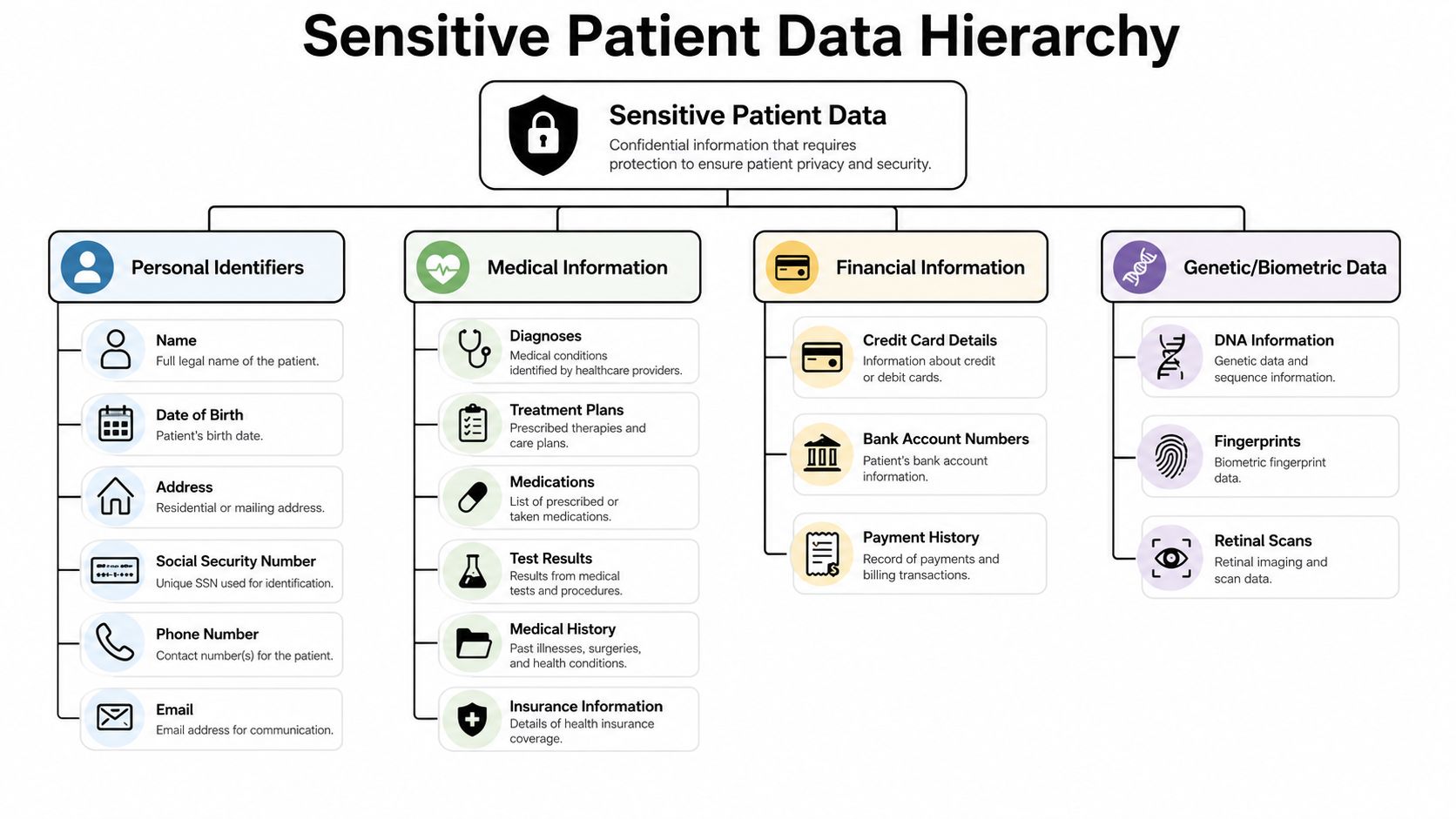
A practical hierarchy looks like this:
- Basic identifiers such as name, phone number, email address, and home address
- Transport-linked details such as pickup location, receiving facility, travel date, and companion name
- Clinical information such as diagnosis, medications, oxygen needs, infection status, treatment plan, and medical history
- Financial and high-risk identifiers such as policy details, payment information, Social Security number, and account numbers
- Biometric or genetic data when collected or transmitted as part of records
The reason this matters is simple. Different data points create different levels of exposure if mishandled. The National Institute of Standards and Technology states that organizations should evaluate the sensitivity of each PII field, and that items like Social Security numbers, medical history, and financial account information are generally more sensitive than a phone number or ZIP code, as summarized in this discussion of NIST guidance on protecting sensitive data in analytics.
What families and case managers often misunderstand
A destination airport or receiving hospital can be sensitive because it reveals movement and care context. But it isn't equivalent to a full diagnosis or treatment history. A driver may need to know mobility status. That doesn't mean the driver needs the patient's specific diagnosis.
That distinction is where good coordination starts.
Practical rule: classify each item before you send it. Ask, “Does this person need identity details, logistics details, clinical details, or billing details?” Then send only that layer.
This is one reason healthcare teams investing in building digital health solutions focus on structured data collection rather than free-form email chains. Structured intake reduces accidental oversharing because the form itself limits what each participant sees and submits.
A useful checkpoint for families is to ask for the provider's privacy workflow before sending records. A transport provider's process for patient privacy protection in air medical transport should make clear who reviews clinical records, who handles logistics, and who receives billing information.
A quick way to classify what you have
Ask these questions before you share anything:
- Does this identify the person? If yes, treat it as sensitive.
- Does this describe the person's health or care? If yes, treat it as PHI.
- Could this enable financial fraud or identity theft? If yes, restrict it more tightly.
- Does the recipient need this exact detail to do their job right now? If not, hold it back.
That's the foundation. Most privacy failures in transport don't start with bad intent. They start with poor classification.
Navigating Patient Consent and Authorization for Transport
In transport coordination, people often use “consent” and “authorization” as if they mean the same thing. They don't. If you blur them together, you end up with gaps in your documentation and confusion about what can be shared.
Consent is tied to care and transport decisions. Authorization is tied to releasing information beyond what's already permitted for operations, payment, or treatment. In the field, that difference matters most when an insurer, employer, assistance company, or non-treating third party asks for records.
When consent is enough
A patient may consent to transport, clinical assessment during the trip, and routine care coordination between the sending and receiving medical teams. That usually covers the operational basics needed to move the patient safely.
Examples include:
- Clinical handoff details needed by the flight crew
- Mobility or equipment needs needed by ground teams
- Receiving facility information needed to coordinate arrival
- Family contact details when used for transport updates and planning
If the patient is alert and capable, get consent directly and document the date, time, and scope. If the patient can't act for themselves, the person with legal authority should be identified clearly before instructions are accepted.
When you need authorization
The moment information is being shared with a third party for a purpose outside immediate treatment coordination, a formal authorization question usually appears. A common example is an insurer asking for broader records than the transport team needs to complete the move.
Ask practical questions instead of broad ones:
- Who is asking for the information
- What exact documents are they requesting
- Why do they need those documents
- Is the request tied to payment review, medical necessity review, or another purpose
- Has the patient or authorized representative signed for that disclosure
Don't accept “send everything” as a normal request. Broad disclosure is convenient for the requester, not necessarily appropriate for the patient.
A workable documentation trail
In a high-stress case, the safest approach is a simple documentation chain:
| Item | What to record |
|---|---|
| Decision-maker | Patient or authorized representative |
| Scope | What was approved for sharing |
| Recipient | Specific company, hospital, or contact |
| Method | Secure portal, secure email, phone confirmation, or handoff |
| Time | Date and time of permission and transmission |
Families should ask, “Who will you be sharing this with?” and “Can I see the authorization form?” Case managers should ask the same questions internally before forwarding records.
One more real-world complication matters. Emergency situations often compress decision-making, and privacy laws don't always provide clean scenario-based guidance. That's why teams need prebuilt workflows rather than improvised approval chains. If you're coordinating under pressure, clear forms, named recipients, and documented scope are what keep a necessary disclosure from becoming a careless one.
Secure Methods for Transmitting and Storing Patient Information
Privacy isn't just a paperwork issue. It's a systems issue. If the intake is careful but the transmission is sloppy, the patient is still exposed.
In air medical coordination, I've seen teams obsess over who may access records while ignoring how those records move. That's backwards. Data is most vulnerable in motion, on personal devices, in mixed-use inboxes, and in paper packets riding through multiple handoffs.
To reduce that risk, use layered controls instead of a single safeguard.
Build a defense in depth workflow
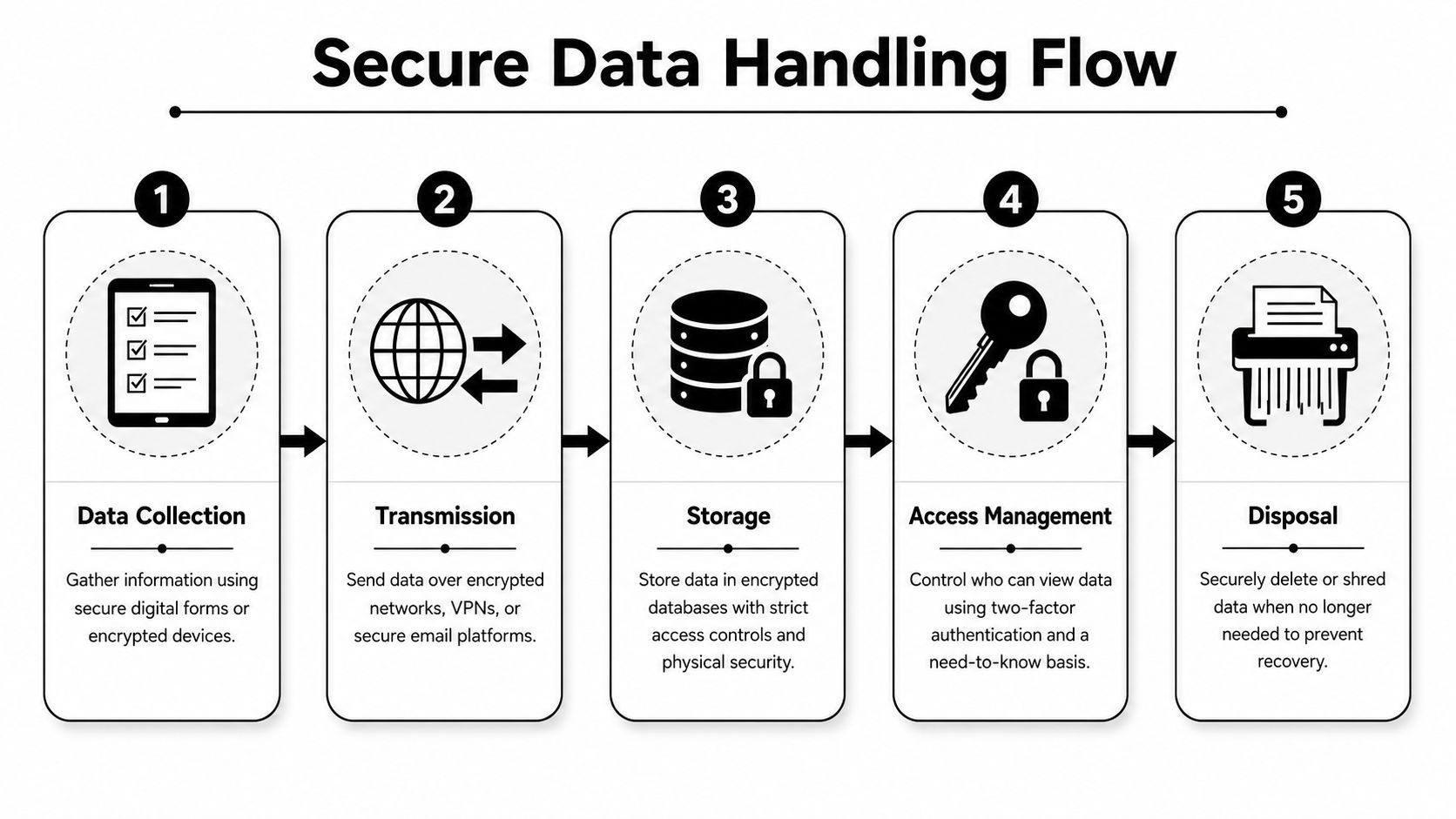
A strong process has multiple checkpoints:
- Secure collection through controlled forms, encrypted devices, or restricted portals
- Protected transmission over approved channels rather than casual texting or open email
- Encrypted storage so data at rest remains protected
- Access controls that limit who can open, edit, or forward records
- Secure disposal when documents are no longer needed
To handle sensitive information in air ambulance operations, the core technical standard is AES-256 encryption for data storage and TLS 1.3 for data transmission, combined with role-based access controls and FIDO2 security keys for multi-factor authentication, according to guidance summarized by Censinet on patient data protection best practices.
A short explainer helps nontechnical stakeholders understand what that means in practice:
Digital security and physical security are the same job
Teams sometimes separate “cybersecurity” from “field operations.” In transport, that split doesn't hold up. A password-protected tablet angled away from public view is doing the same job as encrypted storage. It's reducing unauthorized access.
Use these habits consistently:
- Lock paper records in vehicle compartments rather than clipboards or seat pockets
- Angle screens away from patients, visitors, and bystanders
- Protect mobile devices with passwords or biometrics
- Use mobile device management so a lost company tablet can be locked or wiped
- Document handoffs for paper packages and sealed containers
The FTC's long-standing Scale Down principle is still one of the best operational rules for transport teams. Keep only the personal information you need, limit access to employees with a need to know, and dispose of records securely when the business need ends, as outlined in the FTC guide on protecting personal information for business.
What works and what fails under pressure
What works is boring by design. Approved devices. Named roles. Locked storage. No casual screenshots. No forwarding to personal accounts. No mixed threads where logistics, billing, and clinical records all sit together.
What fails is convenience dressed up as urgency.
A rushed transfer doesn't justify a weak channel. It means the secure channel has to be ready before the rush starts.
Even outside healthcare, logistics teams know chain-of-custody discipline matters. The same mindset appears in fleet operations and asset security tools such as trailer tracking devices UK, where visibility, control, and documented handoff reduce avoidable loss. Patient information deserves at least that level of operational discipline.
If you want a transport-specific privacy lens, this overview of HIPAA compliance for medical air transport is a useful companion to the technical safeguards above.
Best Practices for Secure Communication and Documentation
A transport can go from intake call to wheels up in a very short window. During that time, the patient's information moves through dispatch, clinical review, pilot coordination, ground crew communication, and hospital handoff. Every one of those moments creates a chance to say too much in the wrong place.
The safest crews don't rely on memory alone. They build communication habits that protect privacy automatically.
Follow the trip from dispatch to handoff
Start with dispatch. A coordinator confirms pickup details, mobility needs, and timing. Over radio or cellular networks, the rule is simple. Use the trip ID or first name only when possible, not full names and not detailed medical information. That's how the minimum necessary standard is applied in real movement operations, as described in guidance on HIPAA compliance and client communication in NEMT.
Then the crew gets a clinical briefing. Discipline is essential. The pilot may need operational details, but not the complete medical history. The medical crew needs the clinical picture. The driver needs mobility, loading, and safety information. Those aren't interchangeable roles.
At pickup, documentation often shifts from digital to spoken communication. A nurse gives report. Family members ask questions. Bystanders are nearby. In such situations, experienced teams lower their voices, reposition themselves, and avoid reading full details aloud unless the setting is reasonably private.
A simple communication split by role
| Role | What they usually need |
|---|---|
| Dispatch | Schedule, trip ID, locations, timing |
| Driver or ground team | Mobility status, loading needs, destination logistics |
| Flight medical crew | Clinical condition, treatment needs, meds, equipment |
| Billing or insurer contact | Approved payment-related documentation only |
If a sensitive point comes up while other passengers or bystanders can hear, stop and move the conversation. In vehicle environments, that may mean waiting until the space is empty or stepping outside to complete a private call. That small pause prevents a routine update from becoming an unnecessary disclosure.
Documentation habits that protect patients
A good chart note is clear and sparse. It records what the next responsible professional needs. It doesn't become a running narrative copied into multiple channels.
Use habits like these:
- Keep operational notes separate from detailed clinical records when possible
- Finish documentation discreetly instead of leaving open screens visible during loading
- Confirm recipient identity before speaking freely by phone
- Avoid repeating diagnoses aloud when a code, transport status, or documented handoff will do
The strongest privacy practice in transport is often restraint. Say less. Send less. Still deliver exactly what the next person needs.
One point causes confusion in air travel. Commercial airline crews aren't HIPAA-covered entities in the same way healthcare providers are during routine inflight events, but air ambulance providers still need reasonable safeguards to avoid incidental disclosures. That includes practical steps like private conversations, careful screen positioning, digital documentation, secure disposal of paper, and protected remote access through VPNs, as discussed in this article on HIPAA on commercial flights and air ambulances.
Managing Data Sharing with Insurers and Transport Partners
Most privacy advice sounds clean until a transfer turns urgent. Then the critical question arises. How much patient information must be shared with the insurer, the ground ambulance team, the receiving facility, or an international partner right now?
The common assumption is that emergencies justify broad disclosure. In practice, that assumption causes avoidable exposure. Urgency changes timing. It doesn't erase judgment.
The pressure point nobody likes to admit
A patient may be unconscious. A foreign ground ambulance crew may be waiting. An insurer may be holding authorization. A family member may be pleading for speed. In that moment, “least privilege” access can feel unrealistic because clinicians want the complete picture.
That tension is real. It's also where disciplined organizations stand apart from improvised ones.
A 2025 HIMSS study found that 43% of healthcare organizations share more data than necessary with third parties during crisis responses because emergency exemptions are unclear, as cited in this discussion of sensitive data examples and protection gaps. That finding matches what many coordinators already suspect. Under pressure, people default to oversharing.
What to pre-vet before the crisis
You can't solve third-party data minimization at the bedside if you've never solved it at the contract stage.
Pre-vet partners by checking for:
- Defined points of contact so records don't get sent to general inboxes
- Documented secure channels for records exchange
- Business Associate Agreement requirements when they apply
- Clear role definitions for what each partner needs to receive
- A minimum necessary workflow for emergency and after-hours situations
Insurers and assistance companies should also understand the transport authorization pathway before the patient is ready to move. A clearer intake reduces broad requests for “all available records.” This overview of understanding prior authorization helps frame the administrative side without turning every request into a full-chart disclosure.
A better emergency sharing question
Don't ask, “Can we share this?”
Ask:
- Who exactly needs this now
- What is the smallest useful packet
- What can wait until identity, authority, or secure channel is confirmed
- How will we document why this disclosure was necessary
That produces better decisions than sending a full chart to everyone involved in the transfer chain.
A practical minimum packet for a transport partner may include patient identity, movement logistics, infection precautions, mobility limitations, and immediate clinical concerns relevant to transport safety. It may not require the patient's entire history, unrelated specialist notes, or broad billing records.
The teams that handle sensitive information well aren't slower. They're more prepared. They've already decided what “necessary” looks like before the emergency call comes in.
Your Step-By-Step Patient Data Breach Response Plan
Even careful teams can have a privacy incident. A tablet goes missing. A document reaches the wrong recipient. A crew member opens the wrong attachment in a mixed email thread. The mistake matters, but the next few hours matter more.
Panic wastes time. A sequence protects patients and the organization.
Start with containment and assessment
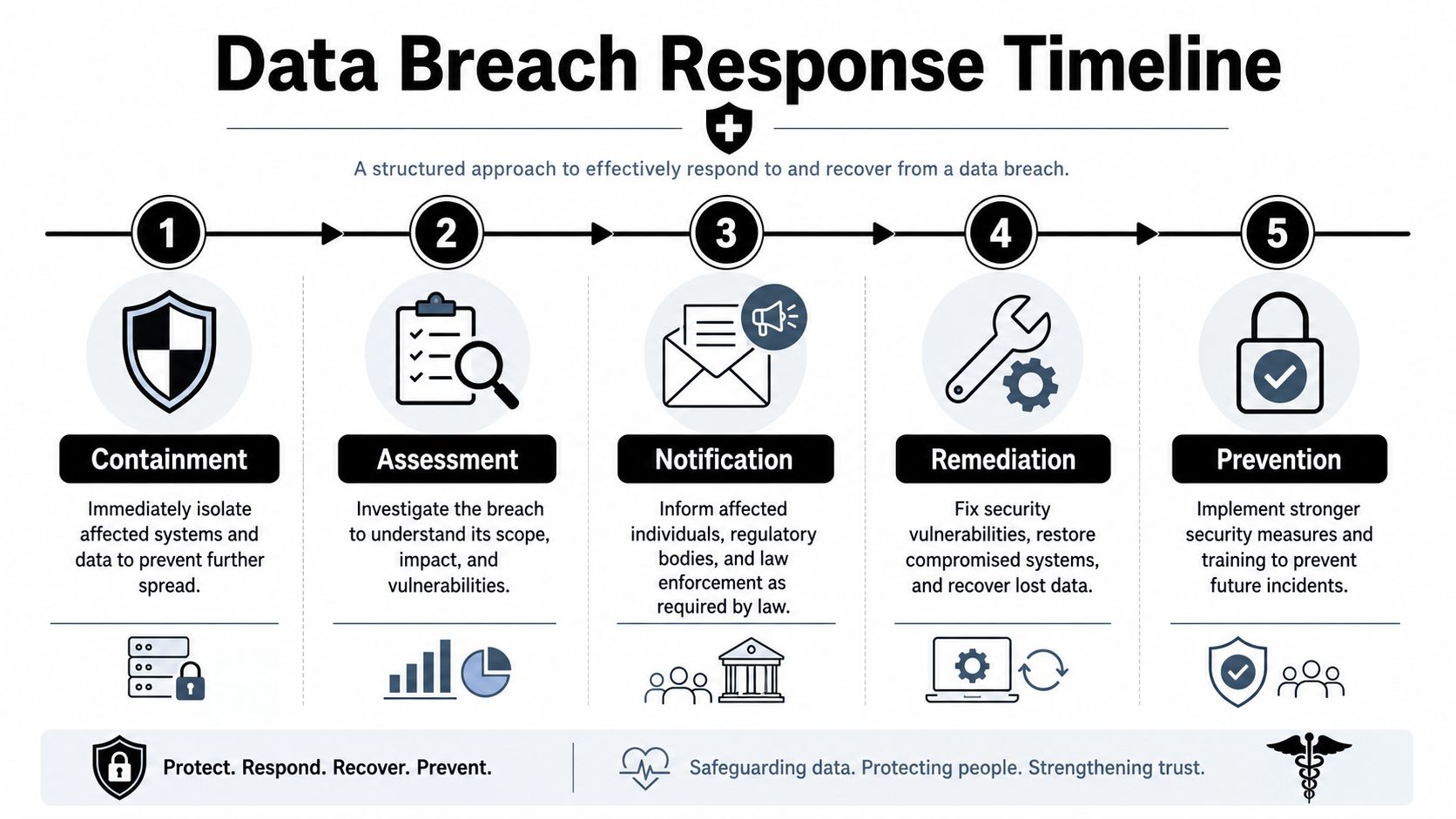
When you suspect a breach, do these first:
- Contain the exposure. Revoke access, recover the device if possible, disable compromised credentials, and stop further forwarding or downloading.
- Preserve facts. Save timestamps, recipient details, screenshots if appropriate, and system logs. Don't let cleanup destroy the audit trail.
- Assess scope. Identify what information was involved, who received it, whether it was accessed, and how many individuals may be affected.
For healthcare entities and business associates, breaches affecting 500 or more individuals must be reported to the Office for Civil Rights within exactly 60 days of discovery, according to guidance summarized in this resource on HIPAA compliance steps in medical transportation. That federal deadline overrides the temptation to wait for a perfect internal investigation.
Document discovery carefully
“Discovery” isn't just when leadership hears about the issue. It's when the organization knows, or reasonably should know, that a breach may have occurred. That's why frontline escalation rules matter.
Create one incident file and keep these basics together:
- Date of discovery
- Nature of the compromised data
- Systems, devices, or documents involved
- Estimated number of affected individuals
- Containment actions already taken
- Notification decisions and dates
Fast reporting starts with early escalation. If your staff waits to be certain before they report internally, you lose precious response time.
Notify, remediate, and tighten the process
After initial assessment, move into notification and repair. Patients need clear, direct communication about what happened and what information was involved. Regulators may need timely notice. Internal leaders need a single source of truth so the response stays consistent.
Then fix the conditions that allowed the incident:
- Tighten access permissions if too many users had visibility
- Retrain staff if the issue came from misdirected communication
- Correct workflow design if systems encouraged mixed-use sharing
- Review retention and disposal if old records stayed available longer than needed
A breach response plan should live where staff can use it during a shift, not buried in policy binders. If the sequence requires too much interpretation, people will improvise. In privacy work, improvisation is expensive.
Actionable Checklists for Families and Case Managers
In a stressful transfer, people don't need abstract policy language. They need a short list they can use on a phone while calls are happening. These checklists are built for the actual workflow: family members trying to protect a loved one, hospital staff coordinating movement, and insurers trying to process necessary documentation without creating extra exposure.
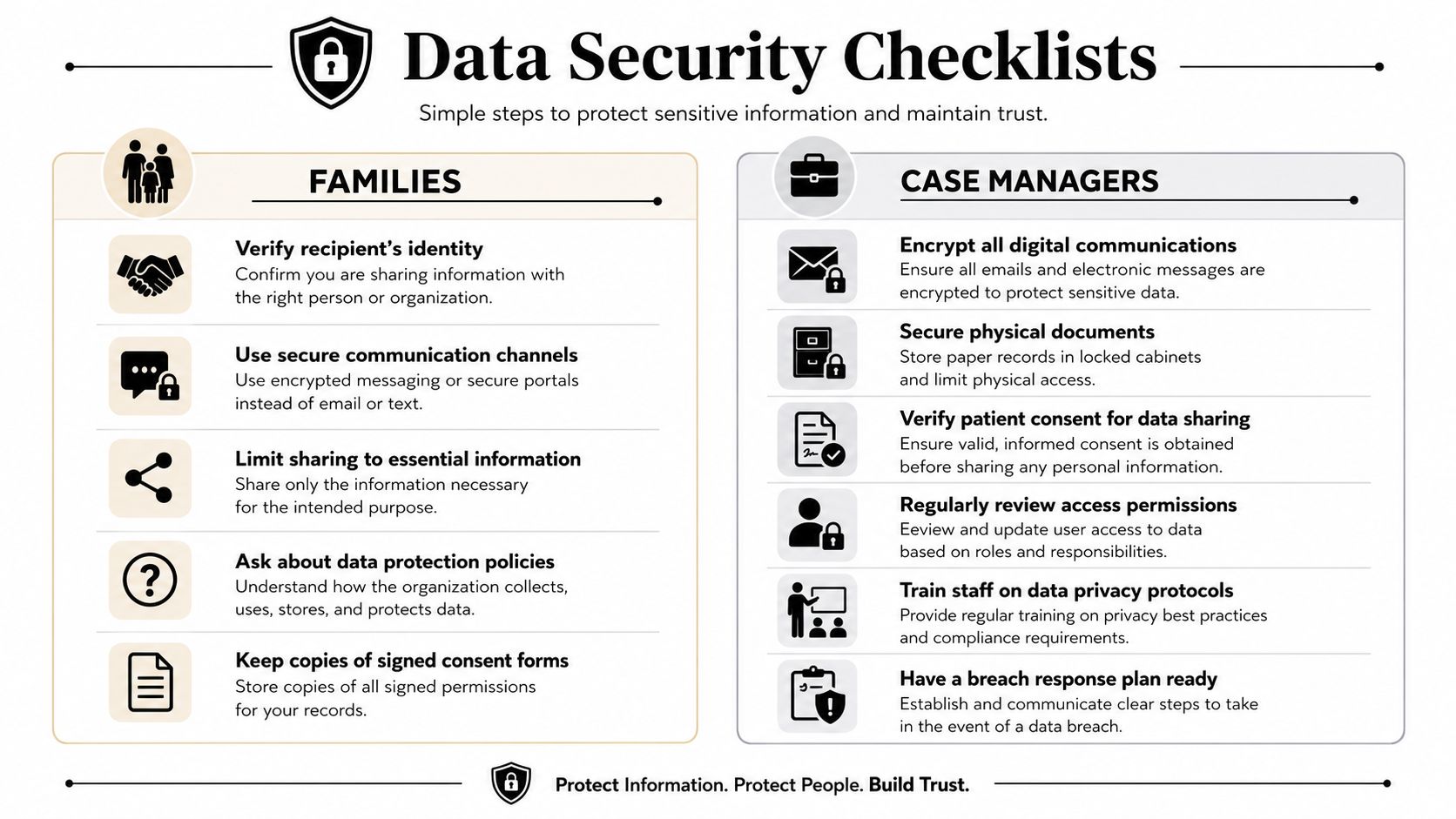
Checklist for families arranging air medical transport
When a family is coordinating quickly, the most common problem is oversharing with whoever sounds helpful. Slow down just enough to verify before you send.
- Confirm who you're talking to. Ask for the person's full name, role, company, and callback information before sending records.
- Share only what the next step requires. If they're arranging logistics, they may not need a full medical history.
- Ask how information should be sent. Use the secure method the provider gives you rather than texting documents by default.
- Keep copies of signed forms. Save consent and authorization documents in one folder so you can refer back to them.
- Ask who else will receive the information. Ground transport, flight crew, receiving hospital, and insurer may each need different pieces.
- Pause before sending IDs or payment details. Those items are highly sensitive and should go only to the appropriate recipient.
Here's a simple tracker families can use:
Family Checklist for Protecting Patient Information
| Verification Step | Status |
|---|---|
| Confirmed recipient identity | ☐ |
| Asked what exact records are needed | ☐ |
| Used approved secure communication channel | ☐ |
| Kept copy of consent or authorization | ☐ |
| Confirmed who else will receive data | ☐ |
| Limited financial and identity documents to necessary recipients | ☐ |
Checklist for hospital case managers and discharge planners
Case managers are often the privacy control point for the entire move. If you send a broad packet early, that packet tends to travel everywhere.
Use this discipline:
- Segment the packet. Keep logistics, clinical summary, and billing-related documents separate.
- Verify legal authority. If someone other than the patient is directing disclosures, make sure that authority is documented.
- Match documents to role. A driver doesn't need the same information as the flight nurse.
- Use approved channels only. Avoid personal email, open texting, and mixed group threads.
- Review access permissions. Remove people from the thread once their piece of the job is complete.
- Document every handoff. Note what was sent, to whom, when, and why.
Checklist for insurers and assistance coordinators
Insurers often become accidental drivers of overcollection. The fix is better scoping.
- Request the minimum packet first. Ask for the specific documents needed to review coverage or medical necessity.
- Name the recipient clearly. Don't ask providers to send records to generic inboxes if a secure contact is available.
- Separate payment review from operational coordination. Those workflows should not force broad redisclosure.
- Clarify urgent exceptions in advance. If emergency handling differs, define that process before a crisis.
- Keep an audit trail. Record the request scope, the reason, and the documents received.
Good privacy practice doesn't slow transport. It removes confusion, duplicate requests, and preventable rework.
If you're responsible for medical transport coordination at scale, turn these checklists into your standard operating rhythm. Intake, consent, transmission, communication, partner sharing, and breach response should all feel connected. That's how to handle sensitive information when the situation is moving fast and critical outcomes depend on it.
If you need help coordinating a patient transfer with experienced clinical and logistics support, Med Jets by Air Trek provides air ambulance and medical transport services with 24/7 coordination for families, case managers, and insurers.