

When a family calls about treatment at MD Anderson, the first problem usually isn't medical. It's logistical. Someone has to figure out flights, where to stay, how long the visit might last, whether a spouse can come, what happens after the first consult, and what to do if the patient is too weak for a normal airport day.
That's where md anderson travel services matter. They don't remove the stress of a cancer diagnosis, but they do give families and case managers a structure. And structure helps. A workable trip plan lowers the odds of missed appointments, last-minute hotel changes, and exhausting transfers that leave the patient worse off before treatment even starts.
The hard part is knowing which level of support fits the situation. Some patients only need discounted commercial travel and a nearby hotel. Others need international coordination, visa support, wheelchair-accessible transport, or a medically staffed transfer. The right answer depends on the patient's condition, timeline, and tolerance for travel friction.
Navigating Your Journey to MD Anderson
A common scenario looks like this. You've just been told the next phase of care should happen in Houston. The appointment date feels urgent, your inbox is full of records requests, and every practical question lands at once. Who books the trip. Which airport is easier. How close should lodging be. Can the patient handle a layover. What if treatment plans change after arrival.
That pressure is normal. MD Anderson sees a large traveling patient population, and that scale is part of why its support system matters. MD Anderson attracts approximately 45,000 out-of-state patients annually, representing over 25% of its total patient volume, according to Houstonia's reporting on MD Anderson. Families aren't improvising in a vacuum. The institution handles this kind of travel every day.

What families usually need first
The first useful shift is to stop treating the trip as one booking. It's really four linked decisions:
- Clinical timing: confirm what must happen in person and what can wait.
- Travel mode: decide whether commercial air, assisted travel, or medical transport is realistic.
- Local stay plan: match lodging to expected appointment density and the patient's stamina.
- Ground continuity: make sure airport pickup, clinic arrival, and return transport all connect.
When one piece is weak, the whole trip gets harder. I've seen families spend hours comparing airfare, then overlook the fact that a long hotel-to-clinic commute can be the most punishing part of the week.
Good travel planning for cancer care isn't about finding the cheapest route. It's about protecting the patient's energy.
If the patient also needs support after landing, local coordination can matter as much as the flight itself. For families who need help beyond the terminal, Houston ground medical transport support can be part of that larger planning picture.
The decision that calms everything down
Ask one question early: Can this patient safely complete a standard airport day?
If the answer is yes, start with MD Anderson's built-in travel resources. If the answer is no, or even maybe, build the plan around medical limitations first and fares second.
That one decision prevents a lot of bad trips.
What MD Anderson Travel Services Include
The term “travel services” often brings to mind only airfare. At MD Anderson, the support is broader. It usually falls into three buckets: lodging, local transportation, and commercial flight coordination. Understanding those categories helps you decide what to use and what still needs outside help.
Lodging close to campus
For cancer care, distance matters. A hotel that looks fine on a map can still be a poor fit if the patient is fatigued, immunocompromised, or moving between multiple appointments in one day.
MD Anderson's support includes proximity lodging such as the Rotary House, and it also integrates airport transit from Hobby and Bush Intercontinental. That close-in setup can keep travel time to under 45 minutes, which is particularly important for patients who need to limit exposure and conserve energy, as described in this overview of travel and housing solutions for MD Anderson patients.
In practice, the best lodging choice depends on the visit pattern:
- Single consult or short evaluation: prioritize simplicity and same-day access.
- Multi-day workup: stay as close as possible to reduce repeated transit.
- Longer treatment blocks: look for laundry, reliable food options, and room layout that works for recovery.
Ground transportation in Houston
Ground transport is often underestimated. A patient may tolerate the flight, then struggle with curb transfers, baggage, rideshare confusion, or long walks from drop-off to clinic entry.
The built-in model works well for many patients because it connects the airport arrival to nearby lodging and campus access. For routine cases, that's enough. It's efficient, familiar, and easier than having family invent a transportation plan from scratch.
What doesn't work well is assuming every patient can use the same setup. Patients with severe weakness, balance issues, or complex equipment needs may need a different handoff plan than a standard shuttle or rideshare arrangement.
Practical rule: If the patient needs hands-on assistance getting in and out of a vehicle, address that before the flight is booked.
Commercial flights through Patient Travel Services
MD Anderson's Patient Travel Services, often shortened to PTS, help patients access negotiated travel arrangements for commercial air. This is the part many families need most when they're traveling repeatedly for consults, treatment changes, or follow-up visits.
PTS is especially useful when schedules are likely to move. Oncology travel often changes after scan review, lab delays, treatment response, or trial screening. A self-booked budget itinerary can become expensive fast if it's rigid.
A simple way to think about the service is this:
| Travel need | What PTS helps with |
|---|---|
| Frequent trips | Coordinated airline booking options |
| Uncertain return timing | Fare structures that are easier to modify |
| Airport planning | Alignment with Houston arrival logistics |
| Cost control | Access to negotiated rates rather than standard public pricing |
For stable patients, this setup covers a lot of ground. It gives families a real toolkit instead of a pile of disconnected reservations.
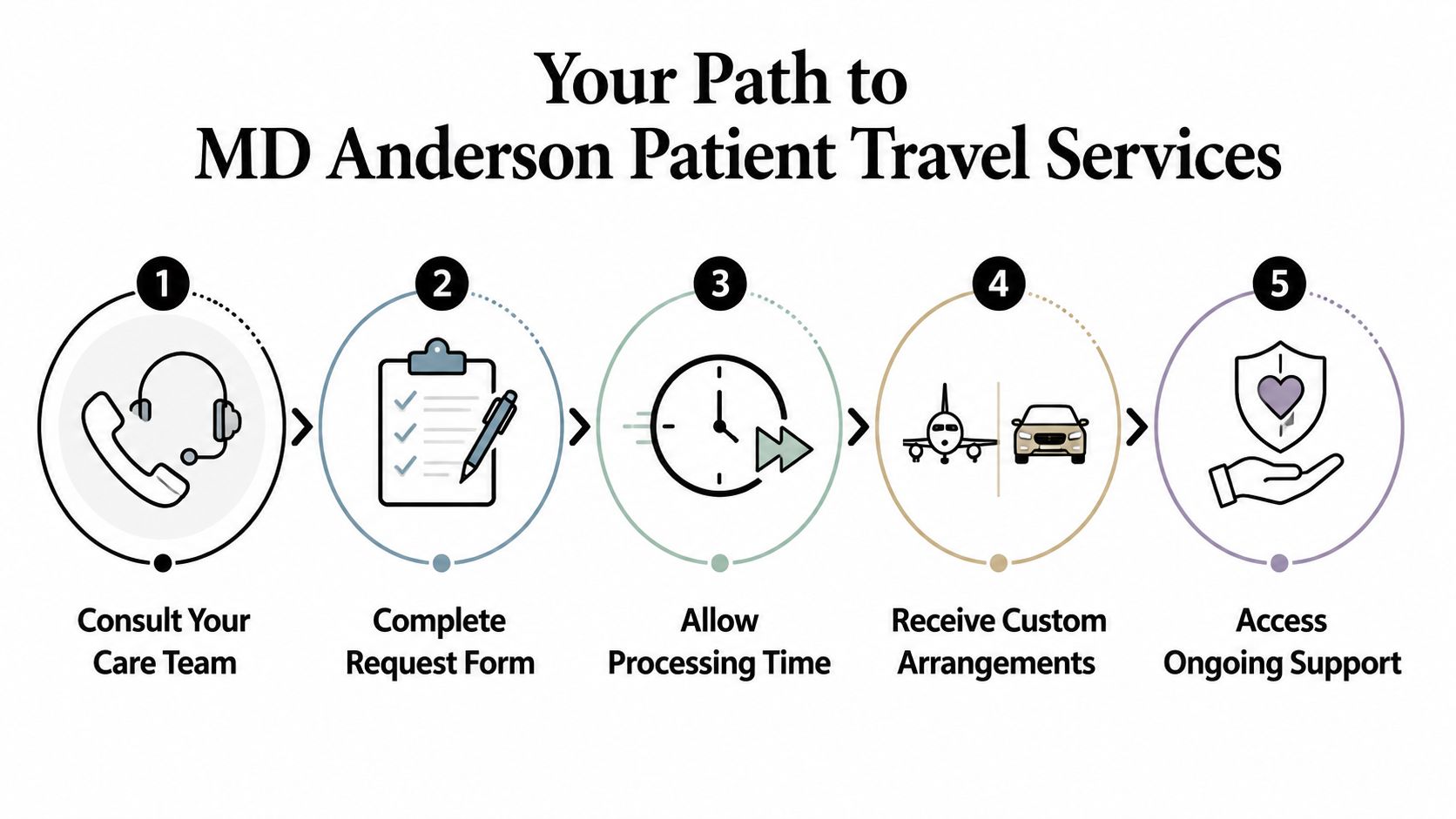
How to Request and Use Patient Travel Services
The most efficient families don't call PTS first. They confirm the medical visit first. Once there's a real appointment pathway, PTS becomes much easier to use well.
What to have ready before you call
Before contacting Patient Travel Services, gather the basics in one place. Don't make the travel coordinator pull details out of three people on speakerphone.
Have these ready:
- Patient identifiers: full legal name and MD Anderson patient information if already assigned.
- Clinical timing: appointment dates, departments, and whether this is consult, treatment, or follow-up.
- Traveler details: who's flying, whether a companion is coming, and any mobility limits.
- Flexibility window: whether the return date is known, uncertain, or likely to shift.
- Airport preference: the departure city and any strong reason to prefer one routing over another.
MD Anderson's PTS can be reached at 888-848-9992 or 713-745-2300. If you're speaking for the patient, make sure you're authorized to discuss the trip.
The roundtrip rule that surprises people
One of the most important details is also the one families resist at first. PTS often books roundtrip flights even when the return date isn't firm, because that structure helps lock in negotiated discounts and still allows later changes. According to MD Anderson Patient Travel Services guidance discussed here, this approach can save 15 to 25% compared with booking one-way legs separately.
That matters because oncology travel rarely follows a perfect script. The patient may need to stay longer. They may be cleared to leave earlier. The airfare strategy needs room for that.
What works:
- Tell PTS the return is uncertain. Don't guess a fake date and hope it holds.
- Ask about change rules. The fare savings only help if you understand the modification limits.
- Match the fare to the treatment reality. A rigid ticket can be a bad bargain if the care plan is fluid.
What doesn't work:
- Booking two unrelated one-way flights on your own because it feels simpler.
- Letting different relatives book pieces of the itinerary.
- Waiting until after the first appointment to think about the return plan.
The easiest way to avoid preventable problems
Families usually get in trouble when they separate the travel booking from the care schedule. Keep one person responsible for the itinerary and one written plan that includes:
- Flight details
- Hotel details
- Ground pickup instructions
- Clinic dates
- Emergency contacts
If the patient's energy is limited, protect every transfer. The handoff from home to airport, airport to hotel, and hotel to clinic is where most travel days fall apart.
If the patient may not tolerate a standard airport process, don't force a commercial plan just because it's familiar. That's the point where the trip needs to be reassessed, not pushed through.
Specialized Support for International Patients
International travel to MD Anderson isn't just a longer flight. It's a layered coordination problem. The medical piece sits alongside visas, admissions, language access, payment planning, arrival logistics, and often a family member who's trying to manage all of it in a new country.
MD Anderson has dedicated infrastructure for that. Each year, it supports approximately 2,000 new international patients from over 90 countries, and its International Patient Center is staffed by 22 experts who handle admissions, clinical coordination, visa support, and transportation, as noted in qualitative terms by MD Anderson's published patient-support materials.
Where international cases usually get complicated
The difficult parts usually aren't dramatic. They're administrative. A patient arrives with incomplete records. A family assumes a hotel confirmation is enough for a longer stay. Someone forgets that interpretation needs to be arranged across multiple appointments, not just the first one.
A stronger international plan usually includes:
- Visa and entry preparation: align the travel timeline with the actual appointment path.
- Language support: arrange interpretation early if the patient wants medical discussions in their preferred language.
- Local lodging strategy: pick housing that works for treatment duration and patient stamina.
- Family logistics: decide who needs to travel and what support they'll need on arrival.
For families bringing animals because separation would create real hardship during a prolonged treatment stay, it helps to review understanding pet relocation requirements before tickets are issued. That kind of issue is easier to solve before departure than after arrival.
Financial and cultural planning matter too
International patients often need a more deliberate plan around deposits, self-pay expectations, and communication across time zones. That's one reason the International Patient Center matters. It serves as a coordination point instead of leaving the family to negotiate each piece separately.
Some families also need help deciding when commercial international travel is still reasonable and when it's not. A patient who can manage a long-haul trip with wheelchair support is different from a patient who needs monitoring, oxygen management, or stretcher-level transport. When the condition is fragile enough that the travel method itself becomes part of the care decision, international medical transport coordination may be relevant.
Cross-border oncology travel works best when the family treats documentation, language, and arrival planning as clinical support, not side tasks.
The smoother the non-medical side runs, the easier it is for the patient to focus on treatment.
When Standard Travel Services Are Not Enough
Standard travel support works well for many MD Anderson patients. It doesn't work for all of them. That distinction matters because families often try to make a commercial plan fit after the patient has already outgrown it.
A patient can be “well enough for treatment” and still not be well enough for a normal airport sequence. Security lines, sitting upright for long periods, walking to gates, managing pain during delays, or recovering from a connection can be too much. That's especially true after hospitalization, during respiratory compromise, after a major procedure, or when the patient needs close observation.

Signs the usual plan may be the wrong plan
These situations should make you pause before defaulting to a standard flight:
- The patient can't tolerate prolonged sitting without major pain, distress, or symptom worsening.
- They require continuous medical oversight that family members can't provide in transit.
- They need significant lift or transfer help, including bariatric handling or specialized loading.
- They are being transferred between hospitals, not merely traveling for a clinic visit.
- Recent instability exists, such as acute respiratory issues, uncontrolled symptoms, or a difficult discharge.
This isn't a criticism of md anderson travel services. It's a reminder of scope. Patient Travel Services are designed around commercial travel support. They are not a substitute for in-transit medical care.
The assumption that causes trouble
The most common bad assumption is this: if the patient can technically board an airplane, a regular trip is fine. That's too narrow.
The real question is whether the patient can complete the entire travel chain safely. That includes getting out of bed, reaching the airport, tolerating check-in, handling delays, staying stable in flight, deplaning, riding to lodging or hospital, and repeating the process later.
A quick screening framework helps:
| Travel question | If yes | If no |
|---|---|---|
| Can the patient manage an airport day without hands-on medical support? | Standard services may fit | Consider higher-acuity transport |
| Can symptoms remain controlled during delays or long ground times? | Commercial may still work | Reassess travel mode |
| Is the transfer hospital-to-hospital rather than home-to-clinic? | More coordination needed | Medical transport may be more appropriate |
Don't choose the lowest level of transport the patient might survive. Choose the level they can complete without predictable deterioration.
That decision protects both the patient and the receiving care team.
Medical Flight and Escort Transportation Options
When commercial travel is too demanding, the next step is to match the patient to the right level of transport. In practice, there are three broad options: a regular commercial flight with PTS support, a medical escort, or a dedicated air ambulance.
The difference isn't luxury. It's clinical tolerance, supervision, and handoff quality.
How the options differ
A medical escort usually works for patients who can still travel commercially but shouldn't do it alone. The escort manages the airport process, stays with the patient in flight, and helps monitor for decline. For families comparing that model to a regular itinerary, medical escort services for patient travel are one example of the category.
An air ambulance fits a different profile. It's generally used when the patient needs a medically managed transfer, a stretcher configuration, more direct routing, or closer coordination from bedside to bedside. That's often the right lane for high-acuity transfers, post-discharge moves, or patients whose condition makes terminals and commercial cabins unrealistic.
One provider families may encounter in this space is Med Jets by Air Trek, which offers air ambulance flights, medical escorts, and coordinated ground transport for hospital-to-hospital or higher-support moves.
Comparing patient travel options to MD Anderson
| Feature | Commercial Flight with PTS | Medical Escort | Air Ambulance (e.g., Med Jets) |
|---|---|---|---|
| Best fit | Stable patient traveling for appointments or treatment | Patient can fly commercially but needs trained assistance | Patient needs medically managed transfer |
| Airport experience | Standard commercial process | Standard process with escort support | Coordinated medical transfer rather than routine passenger travel |
| Monitoring in transit | Family or none | Escort observes and assists | Medical team manages transport |
| Equipment flexibility | Limited to commercial rules | Limited by airline and cabin conditions | Built around patient transport needs |
| Transfer type | Home to clinic or hotel | Home to clinic or hotel, with support | Often hospital to hospital or bed to bed |
| Good option for urgent instability | Usually no | Sometimes not enough | Often the more appropriate choice |
| Family involvement | Common | Common, depending on itinerary | Varies by mission and aircraft setup |
What choice usually works best
If the patient is stable, ambulatory enough for the airport, and mainly needs cost control, PTS is usually the cleanest starting point.
If the patient is fragile but still can sit up, follow directions, and tolerate a cabin environment, a medical escort may bridge the gap between independence and full medical flight.
If the patient needs oxygen management, close clinical supervision, specialized loading, or a direct hospital transfer, an air ambulance is often the safer fit. Trying to “make do” with a lower level of support usually creates more stress, more delays, and harder handoffs on arrival.
Practical Tips and Your Questions Answered
The best md anderson travel services plan is the one that matches the patient's actual condition, not the one that looks simplest on paper. Start with the medical reality, then choose the travel tool. That's how families avoid preventable setbacks.
Common questions
Can family members travel too?
Usually yes, but decide early who needs to be there. Extra travelers can help, but they also add booking complexity, lodging pressure, and airport coordination.
What about getting around Houston after arrival?
Keep it simple. The closer you stay to campus, the fewer local transport problems you'll have. Long daily cross-city rides wear patients down fast.
Is there help for airfare and hotel coordination?
Yes. MD Anderson's Patient Travel Services can help with commercial travel arrangements and negotiated options. Use them before self-booking if the schedule may change.
How do I know if seat comfort matters enough to pay attention to it?
For patients with pain, stiffness, swelling, or limited mobility, it matters a lot. A practical guide to seat pitch for premium travel can help families compare cabin space before they commit to a long flight.
Can patients travel with a pet or service animal?
Policies depend on the travel method, housing choice, and the animal's role. Confirm every leg separately. Don't assume the airline, hotel, and local transportation provider use the same rules.
What's the biggest mistake families make?
Treating the trip like ordinary travel. Cancer travel is care logistics. The plan has to protect the patient's strength from departure to arrival.
If your patient can't safely complete a standard airport day, or you need hospital-to-hospital transfer planning for treatment in Houston, contact Med Jets by Air Trek at Med Jets by Air Trek or call 1-800-MED-JETS for 24/7 coordination.