
A family is waiting for a transfer update. A case manager is trying to confirm whether the patient can fly with a ventilator, infusion pumps, suction, and continuous monitoring. The aircraft is ready. The care team is ready. The question that decides whether the mission runs safely often comes down to equipment.
If a monitor loses power, if a ventilator hasn't been configured correctly for transport, or if a pump alarm starts for a preventable reason, the problem isn't just technical. It becomes a patient care problem immediately.
That's where a medical equipment specialist matters. In hospitals, clinics, and medical transport, this role protects continuity of care by making sure devices are installed properly, maintained on schedule, documented correctly, and ready when the patient needs them most. For hospital case managers and families arranging an air ambulance, understanding this role helps you ask better questions and avoid dangerous assumptions.
The Unseen Expert Behind Patient Safety
A patient on an air ambulance stretcher isn't relying on one device. They're often relying on a chain of devices working together. A transport ventilator supports breathing. A cardiac monitor tracks rhythm and vital signs. Pumps deliver medication. Suction may be needed at any point. In that environment, there is no room for a device that is overdue for service, missing an accessory, or configured for the wrong use case.
The person who helps prevent those failures is often invisible to the family and only partly visible to the clinical team. That person may be called a medical equipment specialist.
Why this role matters in real operations
In day-to-day hospital life, equipment can feel like background infrastructure. Staff expect the infusion pump to turn on, the monitor to read accurately, and the bed scale to work. During transport, especially air transport, that expectation gets sharper. Equipment has to perform outside the comfort of a fixed care unit, under motion, time pressure, and handoff risk.
A good specialist doesn't just fix broken equipment. They help build reliability into the system before the patient ever arrives.
Practical rule: If a device failure would change the care plan during transfer, that device needs more than a quick battery check. It needs verified readiness, compatible accessories, and clear documentation.
The broader labor market tells you this isn't a niche concern. The U.S. Bureau of Labor Statistics projects 13% employment growth from 2024 to 2034 for medical equipment repairers, with about 7,300 openings per year and a median annual wage of $62,630 in May 2024. The same BLS profile also notes that the occupation typically requires at least an associate's degree or certificate in biomedical technology or a related field, reinforcing that this is specialized technical work, not general maintenance (BLS medical equipment repairers profile).
What families and case managers often miss
Equipment is often considered only after a problem appears. Experienced operators think earlier. They ask who last serviced the device, whether the transport team has matching consumables, and whether the setup fits the patient's condition and transport environment.
That same mindset applies across healthcare settings, from transport stretchers to procedure rooms using chairs for precision surgical work, where proper support equipment helps clinicians work safely and accurately for extended periods. The lesson is simple. Reliable care depends on more than the headline device. It depends on the full equipment ecosystem around it.
Core Duties and Essential Skills
On a strong team, the medical equipment specialist is the pit crew for patient care. Clinicians drive treatment decisions. The specialist makes sure the machines behind those decisions are ready, traceable, and dependable.
What they actually do each day
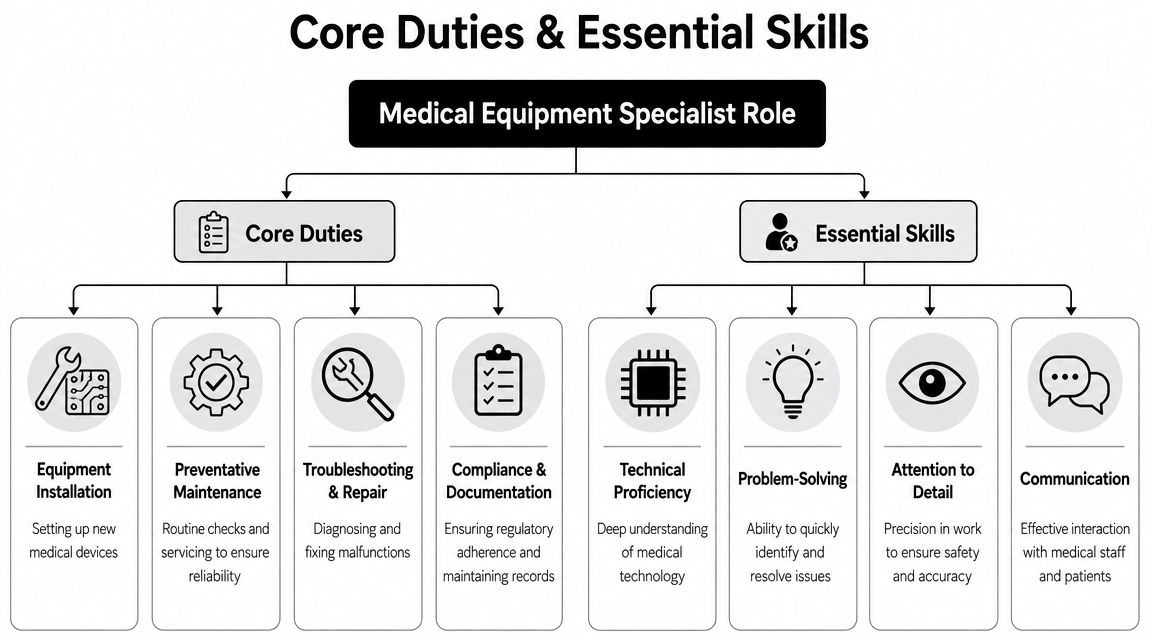
The work usually starts long before anything breaks. A key operational skill set is preventive maintenance plus documentation control. Routine calibration, cleaning, and adjustment reduce malfunction risk, while installation records and service history create traceability for compliance. Specialists also train clinical staff and coordinate with manufacturers for parts and upgrades, according to this medical equipment specialist job description overview.
In plain language, that means they do things like:
- Install devices correctly: They set up new monitors, pumps, beds, suction units, and other devices so they function as intended in the actual care environment.
- Calibrate and test performance: A number on a screen isn't helpful if it isn't accurate. Calibration helps confirm the device is reading and delivering correctly.
- Maintain service records: If a unit is due for inspection or had a recent repair, someone needs that information immediately.
- Support the users: Nurses, respiratory therapists, and transport crews need quick instruction when a device is new or configured differently.
- Escalate to vendors when needed: Some problems require manufacturer support, parts replacement, or software-related guidance.
For transport-specific planning, it also helps to review practical information on flight equipment used in medical transport, because transport devices often differ from standard inpatient equipment in form factor, mounting, and portability.
The skills that separate average from excellent
A case manager usually sees the result of this work, not the work itself. But the difference between an average specialist and a strong one becomes obvious under pressure.
A reliable specialist brings several capabilities together:
| Skill | Why it matters in care delivery |
|---|---|
| Technical proficiency | They understand device functions, compatibility, alarms, accessories, and failure points. |
| Problem-solving | They don't stop at "it's not working." They isolate the cause and identify the safest next option. |
| Attention to detail | Small oversights, such as a missing cable, expired battery, or undocumented service event, can become major disruptions. |
| Communication | They explain technical limits clearly to clinicians, procurement staff, and families when appropriate. |
The best specialists don't just restore equipment. They reduce surprises for everyone touching the patient journey.
Equipment types they may manage
The exact inventory depends on the setting, but common examples include:
- Bedside support devices such as infusion pumps, suction units, and monitors
- Respiratory equipment such as ventilators and oxygen delivery systems
- Diagnostic tools ranging from vital-signs equipment to larger imaging systems
- Transport-ready devices designed for mobility, rapid setup, and compact footprint
If you're arranging a discharge or transfer, that's the practical takeaway. A medical equipment specialist helps turn a list of machines into a safe, usable care setup.
Specialist vs Biomedical Technician A Key Distinction
One reason this field confuses people is that the title medical equipment specialist isn't standardized. Some organizations use it for a technical repair and maintenance role. Others use it for a sales, consulting, or procurement-facing position. Industry commentary has pointed out that this title variation can blur what the person does on the job, especially when compared with the more clearly technical installation, maintenance, and repair focus associated with the related occupation described in labor data (analysis of the title distinction).
Why the title causes problems
A hospital case manager may hear "specialist" and assume deep technical ownership. A vendor may use "specialist" for someone whose main job is product guidance and account support. Both uses exist.
That matters when you're coordinating a transfer, opening a service ticket, or evaluating a candidate. You need to know whether the person can personally verify equipment readiness, troubleshoot operational issues, and manage maintenance records, or whether they mainly advise on selection and purchasing.
Side by side comparison
| Aspect | Medical Equipment Specialist | Biomedical Equipment Technician (BMET) |
|---|---|---|
| Typical meaning | Can refer to a broad role that may include equipment support, procurement guidance, consulting, or specialized operational oversight | Usually refers to a technical professional focused on equipment installation, maintenance, inspection, and repair |
| Scope | Often varies by employer, setting, and equipment category | Usually more defined around hands-on technical service |
| Common environment | Hospitals, vendors, transport programs, consulting teams, supply organizations | Hospitals, healthcare systems, service departments, repair organizations |
| Procurement involvement | May be involved in evaluating, selecting, or standardizing equipment | Usually less focused on purchasing decisions |
| Transport relevance | May oversee fit-for-mission questions, special configurations, and equipment planning for movement between sites | May support the technical serviceability of the actual devices being used |
| Best hiring question | "What functions do you personally own?" | "What equipment do you service and document directly?" |
The practical way to avoid confusion
Don't hire by title alone. Hire by function.
Ask questions that uncover the scope of work:
- Hands-on responsibility: Do you inspect, maintain, and repair equipment yourself?
- Documentation ownership: Do you manage service history, calibration records, or compliance logs?
- Transport experience: Have you supported equipment used outside a fixed facility?
- Training role: Do you teach staff how to use or troubleshoot devices safely?
If you're a case manager, this distinction can save time. It helps you route requests to the right person the first time, especially when the patient is moving between hospital care and transport care.
Common Workplaces from Hospitals to Transport Services
A medical equipment specialist doesn't work in only one kind of environment. The core responsibility stays similar, keeping devices safe, functional, and ready for care, but the daily pressures change depending on where the work happens.
Inside a hospital
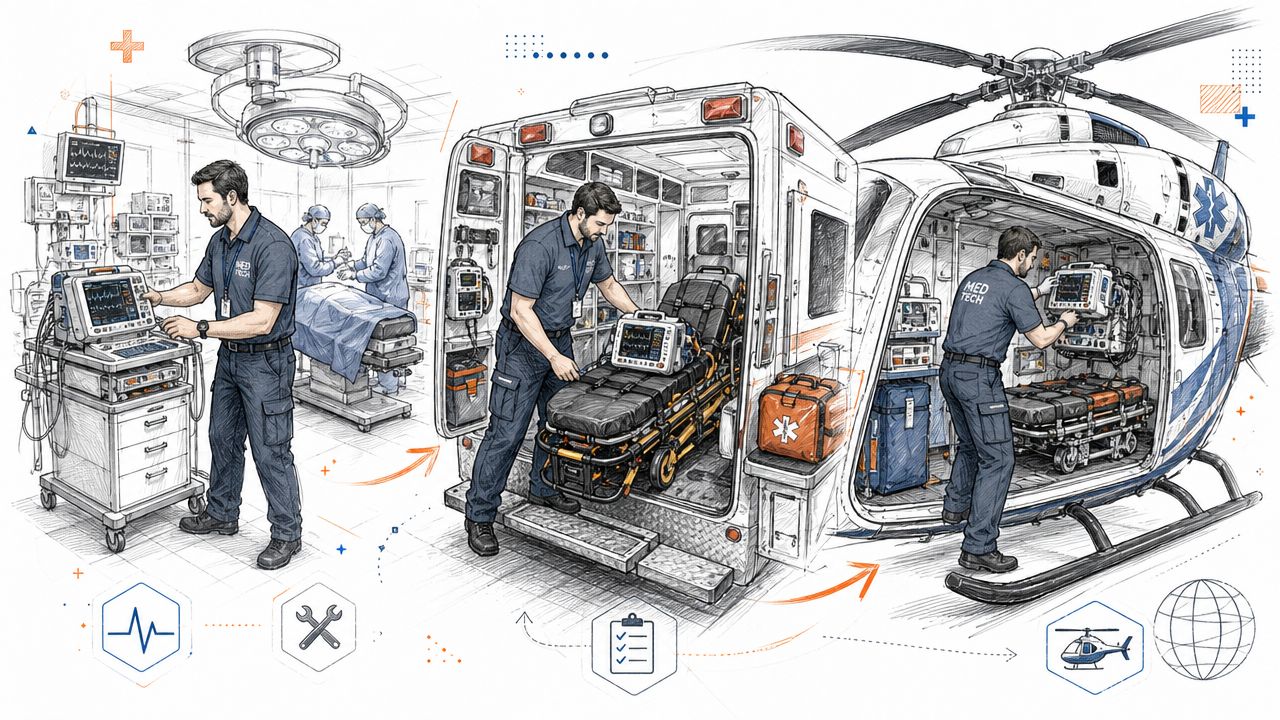
In a hospital, the challenge is scale. There may be hundreds or thousands of devices spread across emergency, ICU, med-surg, imaging, surgery, and specialty units. The specialist has to balance preventive service schedules with urgent calls from staff who need an immediate fix or swap.
One hour may involve checking a monitor in the ICU. The next may involve tracing an alarm issue in a step-down unit or confirming a device is ready for discharge equipment coordination. In this setting, speed matters, but so does documentation. If service records are incomplete, compliance and patient safety both suffer.
In outpatient and procedural settings
Clinics and ambulatory centers usually have a smaller inventory, but not a simpler job. Equipment turnover is fast, rooms stay busy, and staff may not have on-site technical backup all day.
That means the specialist often acts as both technician and educator. They help make sure equipment is set up consistently, accessories are available, and staff know what normal operation looks like before a patient encounter starts.
A device can be fully functional and still be operationally unusable if the right cable, mount, battery, or user training is missing.
In vendor, depot, and manufacturing support roles
Some specialists work outside the care site entirely. They may inspect returned equipment, manage refurbishment, coordinate upgrades, or support field service teams. Their work affects hospitals indirectly but significantly. If turnaround is poor or service quality slips, bedside operations feel it later.
These roles are also where procurement and technical knowledge often overlap. Someone may help evaluate whether a device line is practical to maintain over time, not just whether it looks good in a sales demonstration.
In ground and air medical transport
Transport adds a different layer of difficulty. Equipment must be portable, secure, durable, and ready for movement through elevators, ramps, ambulance loading, aircraft cabins, and receiving facilities.
A specialist supporting transport has to think about the journey, not just the machine. Is the device compact enough? Is it mounted properly? Can staff access controls while the patient is strapped in? Can the setup move smoothly through handoffs without losing continuity?
For case managers, that's the key difference. In transport, equipment isn't just supporting treatment. It's part of the transfer plan itself.
The Specialist's Role in Air Ambulance Transfers
Air ambulance transfers are unforgiving environments for weak equipment processes. The cabin is compact. Handoffs are time-sensitive. Patient condition can change mid-mission. A device that was merely inconvenient on a hospital floor can become a serious transport risk in the air.
Before wheels up
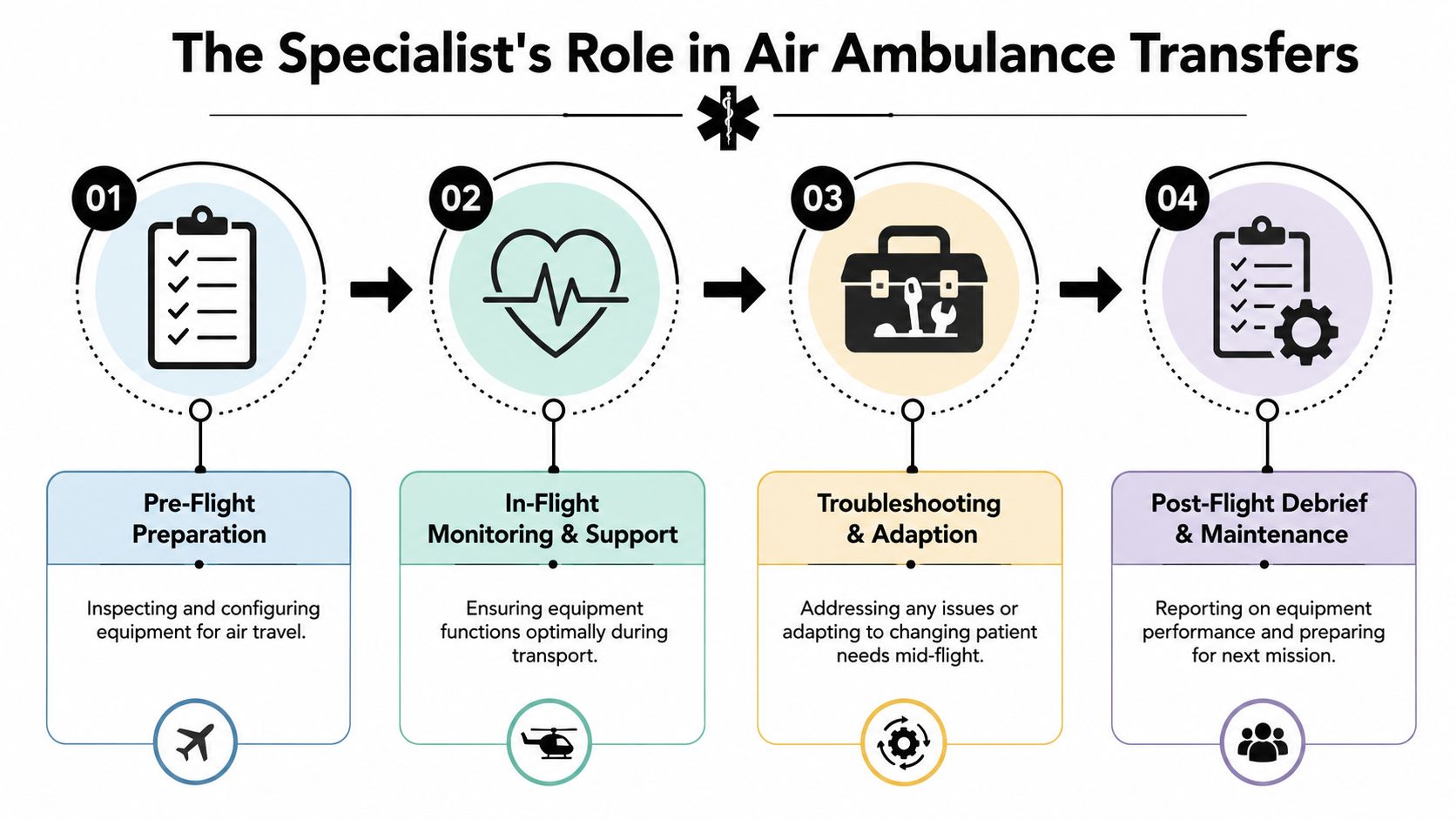
The specialist's work often begins before the transport crew even sees the patient. They help make sure required onboard devices are available, configured, and physically ready for the mission. In practical terms, that includes matching equipment to the patient's needs and checking that all related components travel with it.
For an air transfer, the checklist usually goes beyond "does it power on?" It includes whether the device can be secured properly, whether the right cables and disposables are packed, whether batteries and backup options are ready, and whether the equipment setup supports safe clinical access during the flight.
If you're coordinating a transfer, resources on aero medical supplies used in air ambulance operations can help you understand why aircraft-ready equipment planning is different from ordinary inpatient equipment planning.
During the flight
Once airborne, the specialist may not be physically present in every operation, but their preparation is still on display. Good preparation reduces avoidable alarms, setup delays, accessory mismatches, and last-minute substitutions.
Think about a patient requiring respiratory support, medication infusion, and continuous monitoring. The transport crew needs equipment that is familiar, dependable, and easy to access in a confined cabin. Every connector, mounting choice, and backup component affects how smoothly care continues from bedside pickup to receiving facility arrival.
After landing
The work doesn't end at arrival. Devices need to be inspected, cleaned, restocked, and returned to ready status. Any irregularity, even if it didn't interrupt care, should feed into maintenance follow-up and future planning.
A mature transport program treats each mission as feedback. If a cable length was awkward, if a battery window felt too tight, or if a monitor placement complicated access, the specialist helps turn that operational lesson into a better next mission.
In air ambulance work, equipment readiness isn't a separate technical task. It's part of clinical risk management.
What case managers and families should ask
When a transfer is being arranged, these questions are worth asking:
- Patient-device fit: Will the transport team use equipment matched to the patient's current therapy needs?
- Redundancy planning: If one device fails or needs replacement, what's the backup approach?
- Handoff continuity: How will equipment support stay consistent from sending facility to aircraft to receiving team?
- Special handling: Does the patient need bariatric, pediatric, mobility-support, or respiratory-specific equipment considerations?
Those questions don't require technical training. They require awareness that equipment planning is part of safe transfer planning.
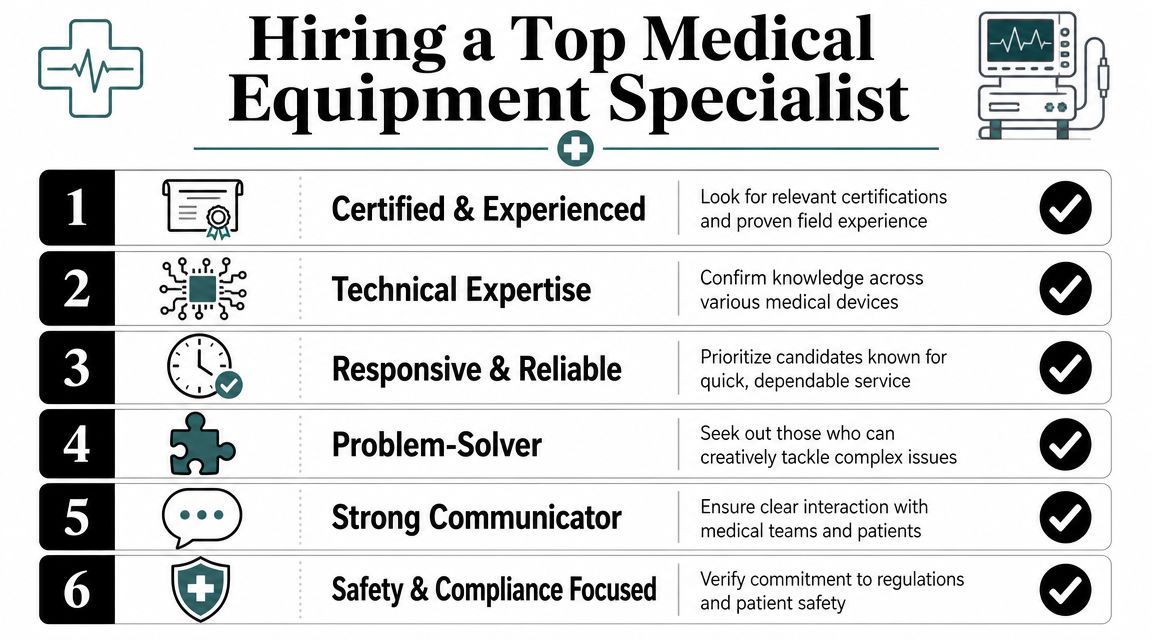
A Checklist for Hiring a Top Medical Equipment Specialist
When you're evaluating a medical equipment specialist, don't focus only on whether they can fix devices. Focus on whether they make clinical operations safer, clearer, and more reliable. That's what strong teams need.
Hiring criteria that actually matter
A good interview should test judgment as much as technical comfort. For roles that touch patient movement, discharge planning, or transport operations, I would use a checklist like this:
Relevant credentials and role clarity
Ask what training and certifications they hold, but also ask what they personally do. Titles vary. Responsibilities matter more.Device-specific experience
A candidate may be excellent with general biomedical equipment and still have limited experience with transport ventilators, compact monitors, suction systems, or specialized mobility equipment.Documentation discipline
Ask how they track calibration, service events, installation history, and follow-up actions. If their answer is vague, that's a warning sign.User training ability
They should be able to explain a device to nurses, respiratory therapists, transport clinicians, and nontechnical staff without confusion.Calm troubleshooting under pressure
Give them a scenario. A critical monitor starts alarming during a transfer preparation. What do they check first, and how do they decide whether to swap the unit?
Accessibility is not optional
One hiring point gets overlooked too often. Ask about accessible and inclusive equipment knowledge.
The U.S. National Council on Disability reported that people with disabilities face significant barriers because accessible diagnostic equipment is often unavailable, and it noted that enforceable standards were published in 2017. That makes a specialist's understanding of compliant and inclusive equipment a practical hiring issue, not just a policy topic (National Council on Disability report on accessible medical equipment).
This matters for far more than clinic exams. It affects transfers, loading, positioning, and evaluation of whether equipment is usable for wheelchair users, bariatric patients, or people with limited mobility.
Hiring insight: Ask candidates to describe a time they had to adapt equipment selection or setup for a patient with mobility limitations. Their answer tells you whether they think beyond the standard patient model.
For a broader view of provider standards and operational expectations, it's helpful to review medical transport qualifications and readiness factors, especially if the specialist will support transport-facing workflows.
Questions I'd ask in the interview
| Interview question | What a strong answer should show |
|---|---|
| "How do you decide a device is transport-ready?" | Technical testing, accessory checks, documentation, and user practicality |
| "What records do you maintain after service?" | Clear traceability and compliance mindset |
| "How do you train clinical staff on unfamiliar equipment?" | Plain language, safety focus, and repeatable instruction |
| "How do you account for accessibility needs?" | Awareness of inclusive equipment use, not just device availability |
Frequently Asked Questions About Medical Equipment Specialists
Is this a strong career field?
Yes. The field has visible demand and a meaningful role in healthcare operations. A 2025 industry report noted that medical equipment repair was ranked 22nd on U.S. News & World Report's list of the 100 best jobs of 2025, and it also stated that BMET programs graduate only about 400 students a year against an estimated 7,300 annual openings, which helps explain why employers continue to need trained people in this space (industry report on job ranking and workforce gap).
What does the career path usually look like?
Many people start in technical support, biomedical equipment service, or related hands-on maintenance roles. Over time, they may move into senior technical positions, specialty equipment support, field service, fleet standardization, procurement advisory work, or transport-specific operations. In larger systems, some grow into leadership roles that oversee device programs, documentation standards, and replacement planning.
The path isn't identical everywhere because the title isn't identical everywhere. That's why function matters more than job label.
Do medical equipment specialists work directly with patients?
Usually, not in the same way a nurse or respiratory therapist does. But their work still affects patient experience directly. If a stretcher scale fails, if a transfer monitor isn't ready, or if an accessible exam device isn't available, the patient feels the consequence immediately.
In transport settings, their indirect impact becomes even more visible. A family's confidence often rises or falls based on whether the equipment setup looks organized, appropriate, and ready.
What should families ask before an air medical transfer?
Keep it simple and practical:
- What equipment will travel with the patient?
- Is that equipment appropriate for the patient's current condition?
- How is equipment checked before departure?
- What happens if something needs replacement during the transfer?
- Are there special accommodations for mobility, size, or positioning needs?
Those questions won't replace clinical judgment, but they help families and case managers confirm that equipment safety is being treated as part of the care plan, not as an afterthought.
If you're arranging a complex patient transfer and want a team that understands how equipment readiness affects every stage of air medical care, Med Jets by Air Trek can help you coordinate the next step.