
Medical flights cost $12,000 to $50,000 without insurance in many U.S. cases, and international trips can climb far beyond that depending on distance, aircraft, crew, and medical needs. If you're trying to figure out what your family might pay, the ultimate cost comes from the full transfer, not just the time in the air.
Most families start this search at a hard moment. A parent is in a hospital far from home. A spouse had a medical emergency while traveling. A discharge planner says the patient can move, but not on a regular airline. Then the practical questions hit all at once. How much will this cost? What kind of aircraft is needed? Will insurance help? Who handles the hospital paperwork, the ambulance on each end, and the handoff after landing?
Those are the questions that matter, because a medical flight isn't just a plane ride. It's a coordinated bedside-to-bedside transfer with clinical, aviation, and logistics decisions happening at the same time. When families don't realize that, quotes can feel confusing or even alarming.
This guide is written the way I would explain it to a family member on the phone. Plain language. No jargon unless it helps. And clear examples of what drives medical flights cost from the first call through arrival.
Facing a Medical Transfer A Guide for the Unprepared
You may be reading this with your phone in one hand and a hospital case manager's name in the other. That usually means time matters, but so does getting the decision right.
Families often think the main choice is whether to fly. In reality, the first question is what level of transport is medically appropriate. A stable patient recovering after treatment may qualify for a commercial medical escort. A fragile patient on oxygen, with monitoring needs, or unable to tolerate a standard cabin may need a dedicated air ambulance. The difference affects both safety and cost.
A transfer also has more moving parts than people expect. Someone has to collect records, speak with the sending doctor, confirm acceptance at the receiving facility, line up airport access, arrange ground ambulances, and make sure the medical crew has the right equipment before the aircraft ever starts its engines.
What families usually worry about first
Most calls start with some version of these questions:
- Can my loved one safely travel right now: The treating team and transport provider have to assess stability, oxygen needs, monitoring requirements, and whether the patient can tolerate loading, flight time, and unloading.
- How fast can this happen: Timing depends on aircraft availability, medical readiness, hospital paperwork, and whether the route is domestic or international.
- What will the final bill include: Families often focus on the aircraft and miss the rest of the transfer. Ground ambulances, medical crew, airport handling, and special equipment can all affect the total.
- Will someone help with the details: Good coordination reduces confusion because one team can manage the chain from hospital room to receiving bed.
The most expensive mistake isn't always choosing the wrong aircraft. It's moving too slowly on the paperwork or choosing a transport level that doesn't match the patient's condition.
If you're overwhelmed, that's normal. The useful next step is to understand the broad price ranges first, then look at what changes the quote.
The Bottom Line Typical Medical Flight Cost Ranges
Families usually want a number first, even if it's a rough one. That's fair. The typical U.S. range for a Life Flight or air ambulance trip is $12,000 to $50,000 without insurance, with helicopter transports often falling between $12,000 and $30,000 and fixed-wing airplane transports averaging $20,000 to $50,000 according to BetterCare's overview of Life Flight costs.
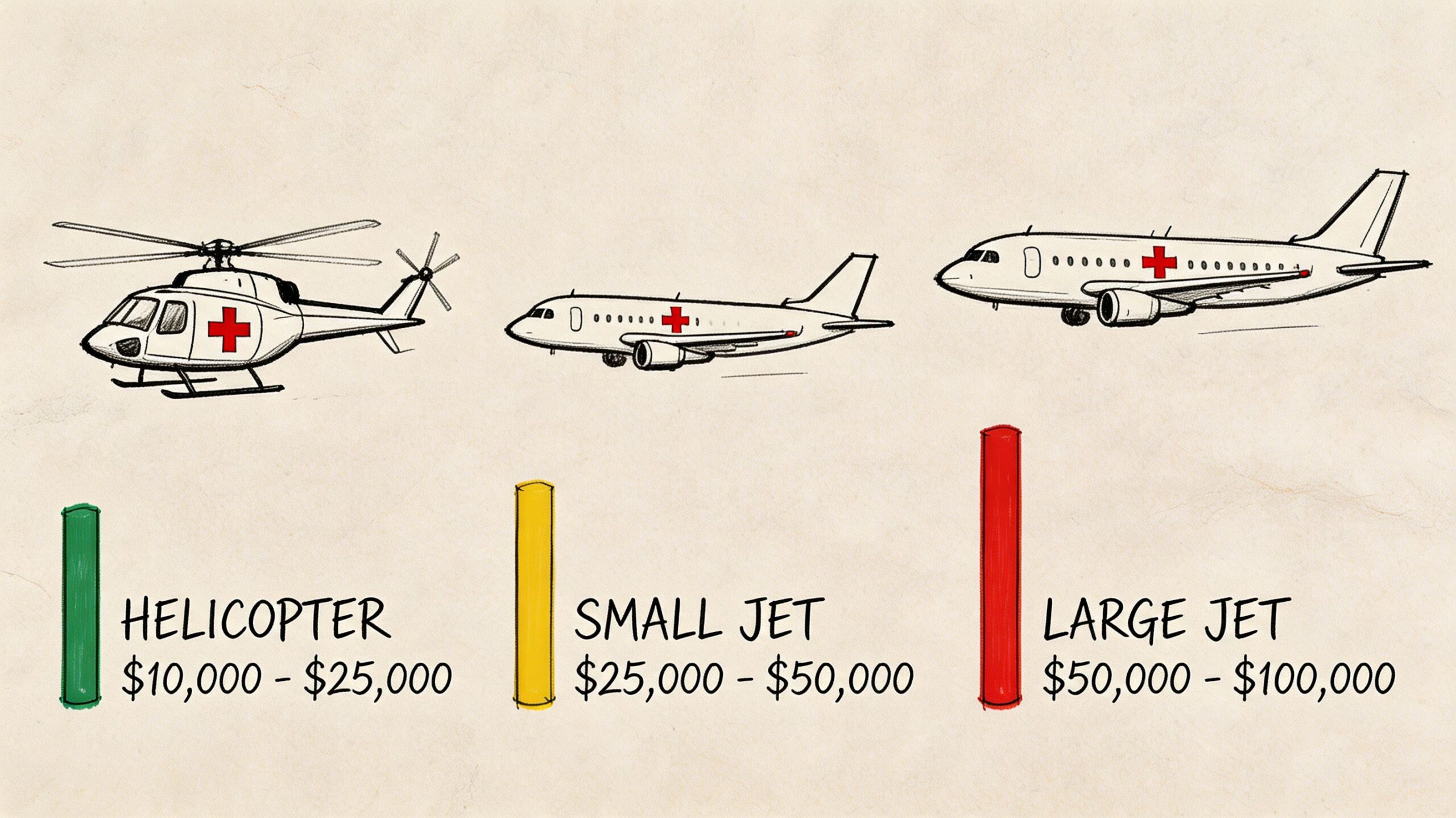
That range is wide because the transport itself can look very different from one case to the next. A short helicopter pickup from a remote area isn't priced the same way as a fixed-wing interstate transfer. A stable patient who needs basic monitoring won't cost the same as someone requiring higher-acuity care.
A simple way to think about the range
Here is the broad picture:
| Transport type | Typical cost range |
|---|---|
| Helicopter or rotary-wing | $12,000 to $30,000 |
| Fixed-wing airplane | $20,000 to $50,000 |
Those figures are useful as a starting point, not a final quote. They also don't automatically include every related service a family might need.
One common point of confusion is that the aircraft charge and the total transfer charge aren't always the same thing. Ground ambulance fees at the departure or arrival side can add more to the bill, and some missions need additional medical support or route planning that changes the final number.
Why families see such different quotes
Two patients can travel on the same day and receive very different estimates because the pricing reflects the mission, not just the mileage. The sending location, receiving hospital, urgency, patient size, required crew, onboard equipment, and airport access all matter.
A short visual explanation often helps before you compare options:
If you're looking at a quote and wondering why it seems higher than a simple charter flight, that's because a medical aircraft functions more like a flying treatment space than standard private travel. The next step is to decode exactly what you're paying for.
Decoding Your Quote The 5 Key Drivers of Medical Flight Costs
A quote usually feels overwhelming because it arrives as one large number during a stressful moment. It becomes easier to understand when you separate it into the parts that shape the mission from bedside pickup to bedside arrival.
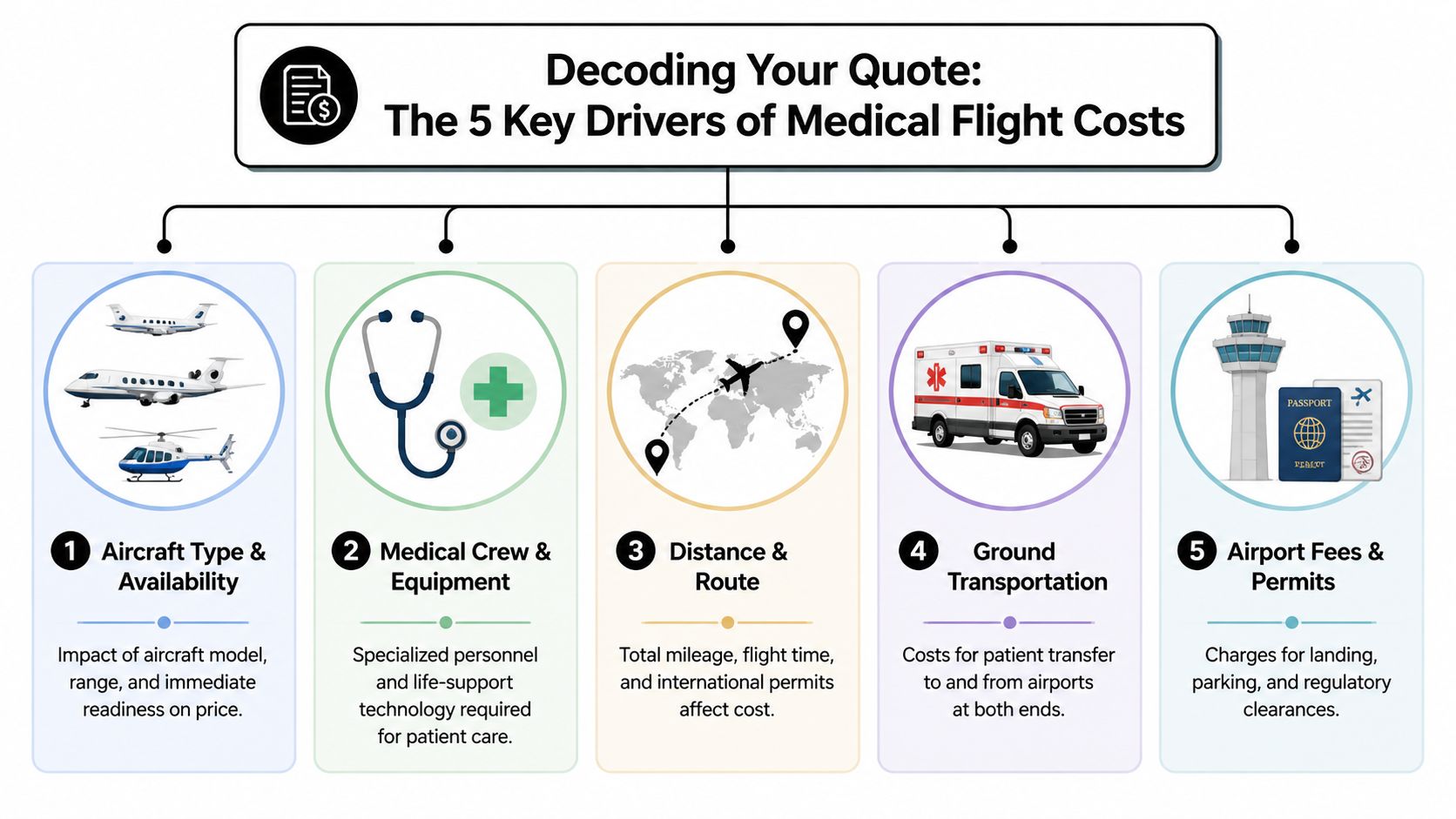
Families often assume they are paying for a plane and a medical crew. In practice, they are paying for a coordinated transfer. That includes matching the right aircraft, building the clinical team, arranging ground ambulances, confirming hospital acceptance, timing the handoffs, and making sure nothing falls apart between discharge and admission.
Aircraft type and availability
The aircraft sets the limits for the whole transfer. Cabin size, range, airport access, loading method, and equipment capacity all affect the quote. A patient who is stable on basic monitoring may fit safely on a smaller jet. A patient who needs extra space for a ventilator, multiple pumps, or a bariatric stretcher may require a different aircraft with a different operating cost.
Availability matters too.
If the closest appropriate aircraft is already committed to another mission, the provider may need to position a plane from another city. Families do not always see that step, but it affects timing and price because the mission starts before your loved one is even onboard.
Distance and route
Mileage matters, but route planning matters almost as much. A short flight between major cities is usually simpler than a similar-distance transfer involving a rural airport, mountain weather, or an international border crossing.
Here is the part that often causes confusion. The patient only travels one route, but the aircraft may have its own logistics before and after that leg. The crew may need to reposition to the sending airport, stop for fuel, wait for a hospital discharge delay, or coordinate customs and medical entry paperwork. Those are real operating steps, not padding.
A medical flight works more like a moving treatment room than a direct charter. The route has to support the patient, the crew, and the handoff schedule at both ends.
Medical crew and patient condition
This factor has one simple question behind it. What level of care must continue without interruption from one bedside to the next?
Some patients need a flight nurse and standard equipment. Others need critical care clinicians, respiratory support, advanced cardiac monitoring, or a specialty team trained for neonatal, pediatric, or higher-acuity cases. The more serious the condition, the more planning goes into crew selection, equipment checks, medications, and contingency planning for takeoff, landing, and any change in status during flight.
Families sometimes worry that a higher-acuity crew means they are being oversold. Usually, the opposite is true. A careful provider builds the staffing plan around the risk of the transfer, not around filling seats.
Specialized equipment
Equipment costs are tied to what the patient needs to stay stable in transit. That can include a ventilator, infusion pumps, cardiac monitoring, suction, oxygen systems, isolation setup, or loading equipment for a patient who cannot be transferred in a standard way.
Each item affects more than the packing list. It can change power requirements, cabin layout, weight planning, and sometimes the aircraft choice itself. A good coordinator should be able to explain each item in plain language, including what it does for the patient and whether it is required for safety or added for convenience.
That explanation matters. Families deserve to know why something is in the quote.
Ground transportation and coordination
This is the cost driver many families miss at first, and it is often the difference between a stressful transfer and a controlled one. The flight is only the middle segment. Before takeoff, someone has to confirm the sending unit is ready, collect clinical updates, arrange bedside pickup, secure records, and coordinate the airport timing. After landing, someone has to make sure the receiving ambulance is there, the hospital is expecting the patient, and the handoff happens cleanly.
That bedside-to-bedside coordination is where hidden problems usually appear. A delay on the hospital floor can create crew wait time. A receiving facility that is not fully confirmed can stall the arrival. A ground ambulance mismatch can force a last-minute change in equipment or staffing. Providers that manage the entire chain, including details covered in this air ambulance cost guide explaining what coordinators ask when building a quote, help families avoid extra friction and surprise costs that have nothing to do with the aircraft alone.
If you read a quote with those five drivers in mind, the number starts to feel less mysterious. You can see what is paying for medical safety, what is paying for logistics, and what questions to ask before you approve the transfer.
Medical Flight Costs in Action Three Real-World Scenarios
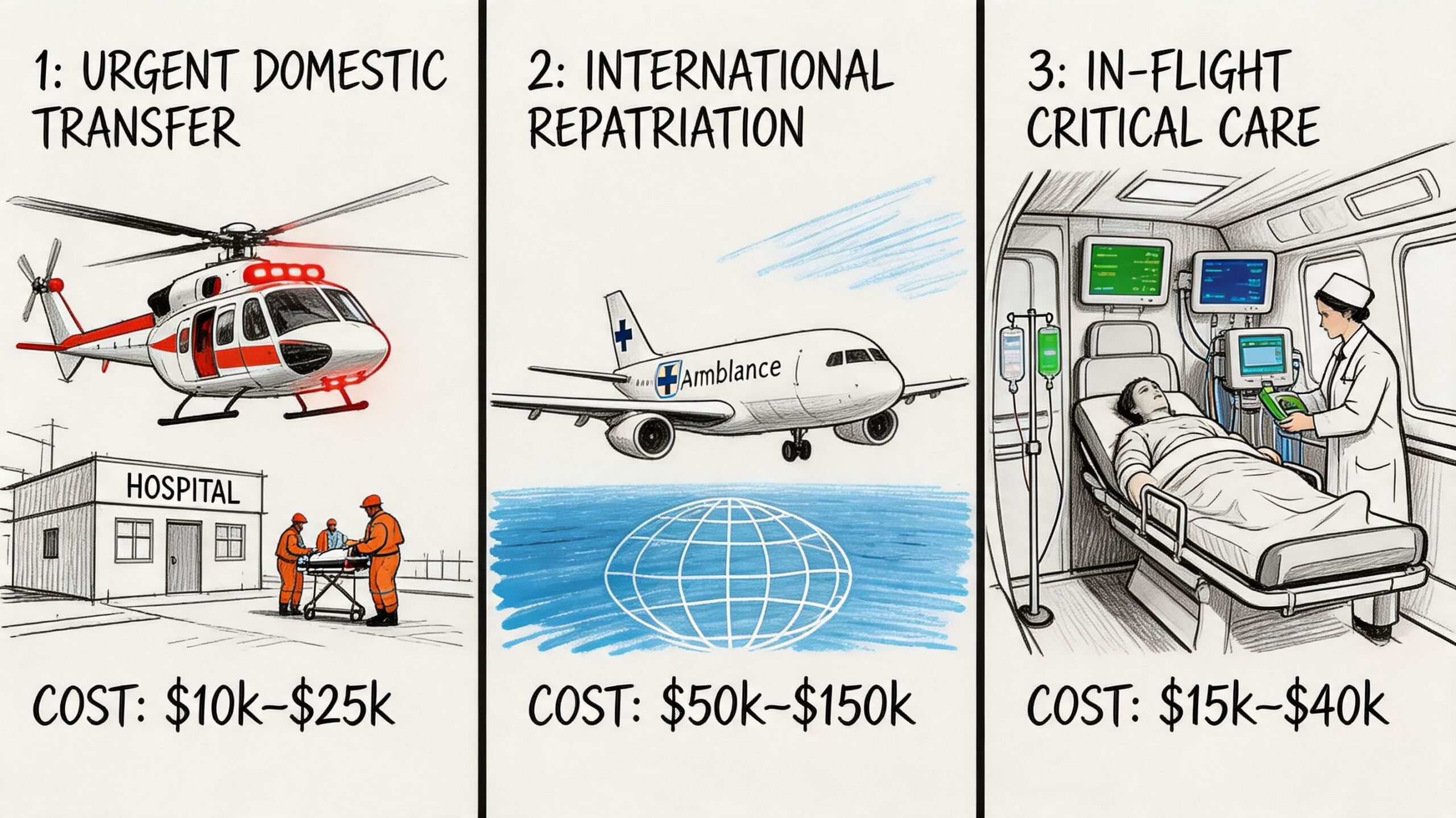
A family often sees the flight first because it is the most visible part of the transfer. The harder part is everything wrapped around it. Bedside pickup, medical review, hospital acceptance, airport timing, ground ambulances, and the final handoff all shape the actual cost and the stress level.
That is why examples help.
A state-to-state transfer for an elderly parent
A daughter is trying to bring her father closer to home after a long hospital stay. He is stable, but he still needs oxygen, monitoring, and a stretcher, so a regular airline seat is not a safe option. The family is usually asking two questions at once. How much will this cost, and who is going to organize all of it?
For this kind of transfer, the quote usually reflects the full chain of care, not only the aircraft. The coordinator confirms the sending hospital is ready, gets the latest clinical notes, checks whether the receiving hospital has accepted the patient, arranges ground ambulances on both ends, and matches the aircraft to the medical needs. A shorter interstate trip may sound straightforward, but a delay in any one link can change timing, crew hours, and airport arrangements.
Families also compare this option with a commercial medical escort. That can be appropriate for some patients. If the patient cannot sit upright, needs continuous monitoring, or may deteriorate in transit, a dedicated air ambulance is often the safer choice because the whole transfer is built around the patient instead of fitting the patient into an airline schedule.
An emergency return from the Caribbean
A traveler becomes seriously ill on vacation. The local hospital wants the patient moved. The family is in one country, the treating team is in another, and the receiving hospital at home still has to review the case. At that point, the number on the quote can feel abrupt unless someone explains what is being coordinated behind it.
International medical flights cost more because the job is bigger. Flight distance matters, but so do overflight permissions, customs planning, airport handling, medical records transfer, language issues, timing with the receiving physician, and ground transport after landing. A standard charter only moves a passenger. A medical repatriation moves a patient, equipment, records, crew, and a care plan from one bedside to another.
This is also where coverage questions start early. Families often ask whether Medicare, travel protection, or individual medical insurance might help with part of the transport. For readers trying to sort out one common piece of that puzzle, this guide on whether Medicare covers air ambulance transport explains what Medicare usually looks at and where limits often appear.
A coordinated provider such as Med Jets by Air Trek reduces pressure here by managing the whole sequence. The family is not left calling the overseas hospital, a charter broker, a ground ambulance company, and the receiving facility one by one.
A bariatric patient who needs special loading and cabin space
Some transfers become more complex before the aircraft ever leaves the ground. A bariatric patient may need a wider cabin, reinforced loading equipment, added crew planning, and a ground team that can move the patient safely from the hospital room to the aircraft and from the aircraft to the receiving facility.
That changes cost because it changes the mission setup. The provider may need a different aircraft, different stretcher hardware, more time on the ground, and carefully matched ambulances at both ends. Families sometimes assume this is a larger seat or extra room issue. In reality, it is a safety and handling issue from the first lift to the final handoff.
These are often the transfers that feel the most fragile. The route may not be long, but the coordination has to be precise.
Across all three scenarios, the pattern is the same. Medical flights cost what the full transport requires. Aircraft type matters, but bedside-to-bedside planning often decides whether the transfer feels controlled or chaotic, and whether hidden logistical costs stay hidden or get prevented before they start.
Will Insurance Cover This? Navigating Payment and Benefits
Insurance is where many families feel the most exposed. They assume the hard part is choosing the flight, but the payment side often creates just as much stress.
The first issue is medical necessity. Insurers usually look at whether the patient needed this level of transport, whether a lower-cost option could have worked, and whether pre-authorization was required. Even when a transfer is medically appropriate, coverage can still depend on network rules, policy language, and how the documentation was submitted.
Why the bill and the payment don't match
The gap between charges and reimbursement is real. From 2017 to 2020, average charges for fixed-wing air ambulances rose 27.6% to $24,507, while allowed amounts for private insurance rose 76.4%. Medicare reimbursement for fixed-wing transports increased only 4.7%, from $3,071 to $3,216, creating a gap that can leave patients exposed to balance billing, according to AJMC's analysis of rising air ambulance costs.
For families, that means one sentence matters more than almost any other: approval does not always equal full payment.
Questions to ask before the transfer
If insurance is involved, ask these early:
- Is the transport pre-authorized: If yes, ask what service level was approved and whether the approval includes both air and ground segments.
- Is the provider in network or out of network: Network status can affect what the insurer pays and what remains the family's responsibility.
- What documentation is required: Missing physician notes, transfer justification, or receiving-facility acceptance can delay payment decisions.
- How will Medicare apply: Medicare often pays far less than the billed charge in this category, so families need to understand the likely gap before the transport happens.
A second helpful step is to review the patient's broader individual medical insurance options and policy structure if long-distance transport or major post-acute care needs may continue beyond this one event.
Where coordination saves money indirectly
Good coordination doesn't guarantee coverage, but it does reduce avoidable mistakes. When one team handles records, insurer communication, flight logistics, and the transfer timeline, fewer details slip through.
If you're specifically sorting out Medicare questions, this Medicare air ambulance explainer from Med Jets can help frame what to ask before you assume a transport will be paid in full.
Ask for the clinical reason behind the aircraft choice in writing. That explanation often matters later when an insurer reviews whether the transport level was justified.
The practical goal isn't just getting a plane approved. It's reducing the chance of a bad surprise after the patient is already home.
Are There Cheaper Alternatives? Exploring Your Options
Not every patient needs a private medical jet. Sometimes the safer financial choice is also the medically appropriate one.
The key is matching the transport method to the patient's condition, not to the family's fear or to the first option mentioned. That means comparing private air ambulance, commercial medical escort, and ground transport.

Side-by-side choices
| Option | Best fit | Cost notes |
|---|---|---|
| Private air ambulance | Critical, fragile, or stretcher-bound patients | Highest cost, but direct medical control |
| Commercial medical escort | Stable patients able to tolerate airline travel | Verified data places domestic escort costs at $5,000 to $25,000 |
| Long-distance ground ambulance | Regional transfers when flight isn't necessary | Usually chosen for shorter, non-urgent moves |
The commercial escort option is often misunderstood. It isn't a downgrade in care when used correctly. It's a different tool for a different patient.
When an escort can work
A commercial medical escort may be appropriate if the patient is stable enough for scheduled travel and can meet airline physical requirements. The verified data notes that this option can cost $5,000 to $25,000 domestically, far below chartered medical aircraft ranges, though exact eligibility depends on the patient's condition and trip details.
That doesn't mean every family can choose it. Some patients need stretcher loading, cabin privacy, continuous monitoring, or care that isn't feasible on a regular airline.
For families trying to understand aircraft choices, this overview of fixed-wing vs rotary-wing transport helps clarify when helicopters make sense and when longer-range jets are the better tool.
What to ask when comparing options
- What is the least intensive transport that is still medically safe: This is the right first question.
- Can the patient sit upright for takeoff and landing: That often affects whether commercial service is even possible.
- Will the lower-cost option create more handoffs or delays: A cheaper route can become harder if the patient needs too many transitions.
- Who is coordinating the full trip: Savings disappear fast when families have to arrange every segment separately.
A careful provider should be willing to say, "You don't need the highest-cost option." That usually signals a medically grounded recommendation rather than a sales-first one.
Frequently Asked Questions from Families and Case Managers
These questions usually come up after a family hears the quote, speaks with a doctor, and realizes the transfer is no longer theoretical. At that point, people are not just asking about an airplane. They are trying to understand who will call the hospital, who will arrange the ambulance, who can ride along, and what details could change the plan at the last minute.
That is why bedside-to-bedside coordination matters. A well-run transfer works like one connected chain. If one link is missed, the family often feels the strain immediately.
Can a family member travel with the patient
Often, yes.
Whether a companion can come depends on the aircraft cabin, the patient's medical setup, and how much room the clinical crew needs to work safely. On some fixed-wing medical aircraft, there is space for one family member. On others, the stretcher, oxygen, monitors, and crew positions take priority.
Tell the coordinator early if a companion is part of the plan. That request can affect aircraft selection, seating, baggage, and even ground transportation on both ends.
What happens after I call
The first call usually covers five basics. Where the patient is now, where the patient needs to go, the current medical condition, the treating team’s contact information, and the timing.
From there, the coordination work begins. The transport team requests records, confirms the receiving facility is ready, reviews bedside needs, matches the mission to the right aircraft and medical crew, and arranges ground transportation at pickup and arrival. If the sending hospital is delayed, the receiving bed changes, or discharge paperwork is still in process, the coordinator keeps those pieces aligned so the family is not left making a dozen separate calls.
This is the part many families do not see at first. The flight itself may be only a few hours. The planning around it often determines whether the transfer feels controlled or chaotic.
Why do bariatric flights cost more
The transport usually requires different equipment, different loading procedures, and more planning time.
A bariatric transfer may call for a stretcher with higher weight capacity, additional staff for safe loading, and an aircraft cabin that can comfortably and safely accommodate both the patient and the medical setup. Ground ambulances on each end may also need special capability. Those factors can raise the price because the mission is no longer a standard setup.
The best way to avoid surprises is to share weight, mobility limits, and equipment needs at the start. Accurate details help the provider quote the trip correctly the first time.
Can pets, mobility devices, or extra personal equipment travel too
Sometimes they can, but each item has to be reviewed in advance.
Wheelchairs, scooters, oxygen equipment, CPAP machines, and other personal medical items take up space and may affect loading plans. Battery type, dimensions, and whether the item is needed during transport all matter. If part of the trip involves a commercial airline, this guide to understanding airline scooter rules can help families avoid common problems at the airport.
Small details are rarely small in medical transport. A scooter that cannot be loaded, a pet without clearance, or extra equipment that was not listed on the first call can delay departure or force a change in vehicle type.
How can case managers help families get cleaner quotes
Complete clinical and logistical information makes the biggest difference.
A strong quote starts with diagnosis, current oxygen needs, recent vital trends, infection precautions, patient weight, mobility limits, sending and receiving contacts, and confirmation that the destination facility has accepted the patient. That gives the provider a realistic picture of the whole mission, not just the air segment.
Case managers also help by asking one practical question early. Who is coordinating every handoff? When a provider such as Med Jets by Air Trek manages the trip from bedside to bedside, families usually get a clearer cost picture because the quote reflects the aircraft, medical crew, ground transport, and timing realities together.
If you are comparing providers, ask for the full journey in writing. That is often the clearest way to understand real medical flights cost without missing the logistical pieces that create stress later.