
When a hospital room phone is ringing, a family is asking whether their loved one can survive the trip, and a case manager is trying to line up accepting physicians, records, and transport timing, one question sits underneath everything else. Will the patient stay stable from this bedside to the next one?
In air medical transport, that answer depends heavily on the monitor. Not the paperwork. Not the aircraft paint scheme. Not a generic promise of “advanced equipment.” The monitor is what tells the flight team, second by second, whether the patient is holding, slipping, compensating, or crashing.
I've seen this concern from both sides. Families want reassurance that the flight won't create a dangerous gap in care. Case managers want to know whether the aircraft can support the same level of vigilance the hospital team has now. Good patient monitoring systems are what make that continuity possible. In a jet cabin, they become the crew's eyes and ears when every minute matters.
Your Lifeline at 30,000 Feet
A common call starts with uncertainty. A spouse is trying to move a critically ill partner closer to home. An adult child has been told the receiving hospital is ready, but the patient still needs oxygen, blood pressure support, and constant observation. The case manager is doing the hard work of coordinating the handoff, yet everyone is worried about the same thing. What happens in the air?
That's where families often picture transport as a gap between two hospitals. In reality, a properly equipped air ambulance should function as a moving critical care environment. The aircraft is only the platform. The patient monitoring system is what allows the medical crew to keep evaluating the patient without interruption.

What the monitor is doing during flight
A professional crew doesn't rely on a single visual check or an occasional manual blood pressure. Critical care air ambulances utilize multi-parameter monitoring systems that continuously track heart rate, blood pressure (both non-invasive and invasive), and oxygenation levels (pulse oximetry) in real-time during flight, serving as the primary life-line for critically ill patients, as described in air ambulance equipment guidance.
That matters because patients don't declare trouble politely. They drift. Oxygenation trends down. Blood pressure narrows. Rhythm changes appear before skin color changes. A monitor catches that progression early enough for a flight team to act.
Practical rule: In a jet, the safest monitor is the one that tells the crew what's changing before the patient looks dramatically worse.
Why this matters to a case manager
For discharge planners and case managers, the monitor answers a coordination problem as much as a clinical one. If the patient leaves a unit that has constant surveillance, the transport leg can't become a blind spot. The flight team needs to receive the patient, connect quickly, confirm baselines, and continue the same clinical story in motion.
That's why experienced teams talk about continuity of care, not just transport. The monitor isn't a nice add-on. It's the equipment that turns a risky relocation into an organized bedside-to-bedside transfer.
Understanding a Patient Monitor's Core Functions
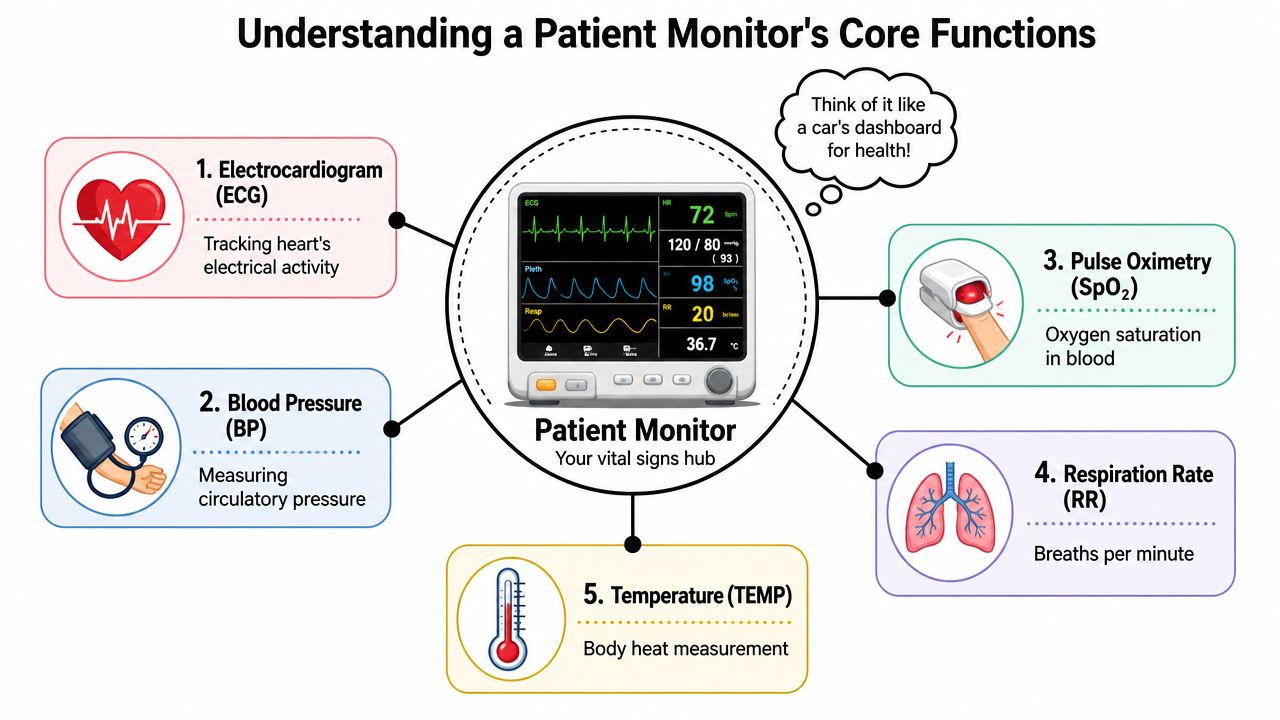
Think of the monitor like a car dashboard. A driver doesn't stare at one gauge and ignore the rest. Speed, fuel, engine temperature, and warning lights all matter because each tells part of the story. Patient monitoring systems work the same way in medical transport.
A multiparameter monitor pulls several vital signs into one real-time view. The crew isn't just collecting numbers. They're watching how those numbers move together.
The five signals that matter most
Heart rhythm and ECG. ECG shows the heart's electrical activity. In transport, it helps the crew spot rhythm changes, ischemic patterns, or deterioration that a pulse check alone won't reveal.
Blood pressure. Blood pressure tells you whether the patient is perfusing adequately. A cuff gives intermittent readings. An arterial line gives beat-to-beat detail, which is far more useful when a patient is unstable or on vasoactive medication.
SpO2. Pulse oximetry estimates oxygen saturation. It's one of the fastest ways to recognize a respiratory problem, tube issue, worsening lung function, or a circulation problem affecting oxygen delivery.
Respiration. Breathing rate and pattern often change before a patient fully decompensates. If the rate rises, falls off, or becomes erratic, the crew pays attention immediately.
Temperature. Temperature matters more than families usually expect. It shapes the clinical picture, especially for infection, neurologic injury, and fragile patients who don't tolerate stress well.
According to the WHO technical specifications for multiparameter monitors, modern systems can simultaneously track 12-lead ECG, SpO2 (0–100% with ±3% accuracy), noninvasive and invasive blood pressure (10–300 mmHg), respiration (0–200 breath/min), and temperature, enabling real-time detection of critical deterioration.
Non-invasive versus invasive monitoring
Case managers often ask whether a patient “needs invasive monitoring” for the flight. That usually comes down to current acuity, not preference.
- Non-invasive monitoring includes tools like a blood pressure cuff, pulse oximeter, skin temperature probe, and standard ECG leads. It's appropriate for many patients who are stable enough for periodic checks and trending.
- Invasive monitoring includes devices such as an arterial line for continuous blood pressure. It's used when the team needs tighter surveillance because small changes could matter clinically.
- The key decision point is whether intermittent snapshots are enough. If they aren't, the crew needs continuous data.
A stable-looking patient can still be trending in the wrong direction. Trend data matters more than a single “acceptable” set of vitals.
Why understanding the basics helps
When you know what the monitor is tracking, transport questions get easier to answer. You can ask better handoff questions. You can identify whether the patient needs ICU-level transport rather than basic movement. You can also judge whether a transport provider is describing real capability or just listing equipment.
For broader insights into patient monitoring, it also helps to understand how monitoring has expanded beyond bedside care and become central to modern clinical decision-making.
Meeting a Higher Standard for In-Flight Medical Gear
Hospital monitors are built for controlled spaces. Aircraft cabins aren't controlled in the same way. They introduce motion, vibration, tight quarters, noise, power transitions, and the operational pressure of moving a critically ill patient through multiple handoff points without losing situational awareness.
That's why flight teams care about standards, not just features. A screen that looks impressive in a sales sheet means very little if the device can't perform consistently in transport conditions.
Why compliance matters in the aircraft
The most important standards sit in the IEC 60601 family. These aren't paperwork exercises for manufacturers. They define how patient monitoring devices are expected to perform safely and reliably.
As outlined in Intertek's review of compliance in modern patient monitoring devices, compliance is governed primarily by the IEC 60601 family of standards, with specific norms for ECG (IEC 60601-2-27) and SpO2 (ISO 80601-2-61) ensuring essential performance and interoperability, which is critical for telemetry during air transport.
What those standards mean in practice
Here's the practical translation for a case manager:
- Electrical safety matters: The crew can't risk equipment behavior that becomes unpredictable when multiple devices are in use.
- Signal integrity matters: ECG and SpO2 readings have to remain clinically useful while the patient is moving through transport phases.
- Interoperability matters: Monitoring equipment has to work cleanly with the broader transport setup, especially when data is being shared ahead.
A transport provider that takes compliance seriously is usually taking the whole chain seriously. That includes acquisition, setup, testing, maintenance, and crew familiarity.
Standards become visible only when something goes wrong. Good providers make sure you never notice them because the equipment simply performs as expected.
The trade-off people miss
A general-purpose monitor may be fine in a quiet room. In a jet, reliability beats novelty. The crew needs controls they can operate quickly, alarms they can trust, and a display that remains readable during a busy leg of care. Fancy extras don't help if the device is awkward, fragile, or prone to nuisance issues.
That is the higher standard in flight medicine. The monitor has to work every time, under pressure, with no drama.
Essential Monitor Features for Air Ambulance Transport
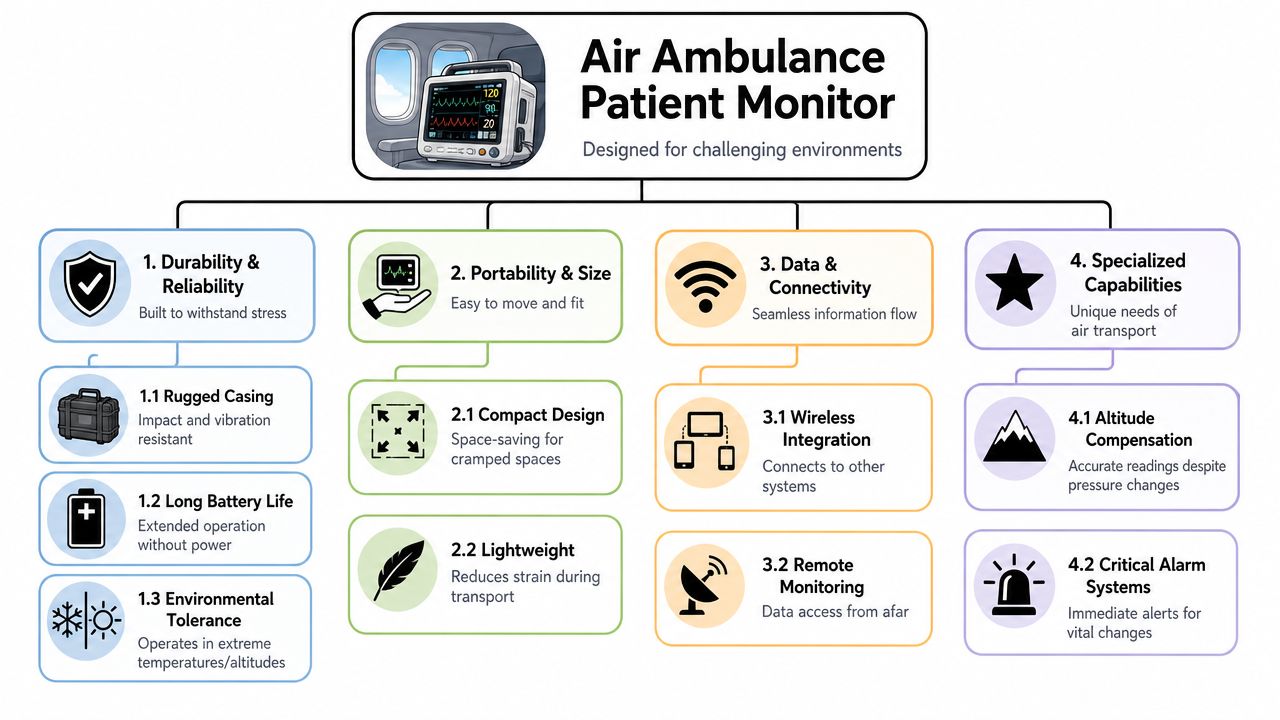
Not all patient monitoring systems belong in an aircraft. A monitor can perform well in a hospital and still be a poor choice in a jet cabin. Air medical transport compresses space, adds motion, limits access to the patient, and punishes equipment that isn't built for transport reality.
The easiest way to judge a monitor for flight is to ask what happens if one key feature fails. In this setting, every design choice has a clinical consequence.
Portability is a safety feature
In a hospital room, a bulky monitor is inconvenient. In an aircraft, it can interfere with access to the airway, medication pumps, or emergency movement.
A flight monitor has to be compact enough to position intelligently and rugged enough to be moved repeatedly. Crews disconnect from one environment, roll through hallways, load into the aircraft, secure gear, and reconnect without losing critical oversight. Equipment that's too large, too delicate, or too awkward creates risk at every transition point.
Battery redundancy can't be optional
Crews never assume one power source will carry the whole trip. They think in layers. Ground phase. Loading phase. Flight phase. Receiving facility phase.
If a monitor has weak battery endurance or clumsy power management, the team spends energy babysitting equipment instead of caring for the patient. The right system lets the crew move across those phases without scrambling.
A practical question for any provider is simple: what's the backup plan if external power isn't available exactly when expected?
Shielding and environmental tolerance matter more than most people realize
Aircraft are full of systems operating in close proximity. The monitor has to deliver trustworthy data despite the transport environment. That includes motion, vibration, and changing conditions that can challenge sensors and cables.
The danger isn't always a total equipment failure. Sometimes it's worse. A bad monitor gives readings that look plausible enough to distract the crew. In flight medicine, false reassurance is dangerous.
For families and planners comparing providers, it's worth reviewing how serious teams think about aero medical supplies and transport equipment standards because airworthy gear isn't just smaller hospital equipment.
Here's a look at one aircraft-based monitoring setup in action:
Alarm quality separates useful monitors from noisy ones
An alarm system has to be immediate, specific, and credible. If the monitor alarms constantly for artifact, crews can become desensitized. If alarm thresholds are rigid or poorly configured, early deterioration may be harder to recognize.
The best systems support meaningful alarms without overwhelming the cabin. In transport, the team is listening through engine noise, headsets, and competing tasks. Alarm design matters.
Crew perspective: A useful alarm doesn't just make noise. It points the team toward the problem fast enough to change the outcome.
Connectivity has become operationally important
Modern transport isn't limited to what the crew sees on one screen. Data sharing can support better receiving-hospital preparation, tighter handoffs, and less information loss. That doesn't replace clinical judgment in the cabin, but it makes the next team better prepared.
The strongest systems fit into a larger transfer process, not just the aircraft interior.
Don't overlook patient fit
One detail planners sometimes miss is physical fit. The monitor setup has to work around lines, ventilator tubing, drips, body habitus, and access needs without becoming its own obstacle. That matters even more in bariatric transports or complex ICU moves where positioning and reach are already challenging.
A capable air ambulance monitor doesn't just collect vitals. It supports clinical movement, decision-making, and safe handling under transport conditions that punish weak design.
A Case Manager's Patient Transfer Checklist
Case managers do better work when the transport conversation is structured. The fastest way to lose time is to make the air ambulance provider guess what level of monitoring the patient needs. A clean handoff starts with specifics.
Use the checklist below as a working tool, not just a document. If these items are answered clearly, dispatch, flight crew, and receiving teams can prepare with fewer surprises.
Air Medical Transport Handover Checklist
| Verification Point | Information to Provide / Question to Ask | Status |
|---|---|---|
| Current monitoring level | Is the patient currently on ECG, pulse oximetry, non-invasive blood pressure, invasive blood pressure, or another continuous bedside setup? | ☐ |
| Airway status | Is the patient breathing spontaneously, on supplemental oxygen, or mechanically ventilated? | ☐ |
| Vascular access | What lines are in place now, and which must remain uninterrupted during transfer? | ☐ |
| Hemodynamic stability | Are blood pressure and heart rate stable, or does the patient require close trending during movement? | ☐ |
| Neurologic concerns | Is there seizure risk, altered mental status, sedation, or a need for frequent reassessment? | ☐ |
| Infusions and medications | Which drips must continue in transport, and are there any titrated medications? | ☐ |
| Recent changes | Has the patient had any deterioration, escalation, or significant monitor alarms in the recent hospital course? | ☐ |
| Isolation and infection control | Are there precautions the transport team must plan for before bedside pickup? | ☐ |
| Size and mobility needs | Does the patient require bariatric handling, special positioning, or extra loading considerations? | ☐ |
| Receiving facility readiness | Who is the accepting physician or service, and what bedside destination is confirmed on arrival? | ☐ |
| Family communication | Who needs updates during the move, and is a companion traveling? | ☐ |
| Equipment question | Ask directly which monitor configuration will be used during flight and how continuity from the current bedside setup will be maintained. | ☐ |
Questions worth asking out loud
Some of the most useful transport questions aren't technical. They're practical.
- What can't be interrupted? This usually reveals the true acuity of the transfer.
- What trend worries the sending team most? A falling oxygen reserve and a labile pressure problem are very different transport pictures.
- What will the flight crew need to recreate from the ICU room? That frames the monitor requirement properly.
A case manager who wants stronger planning tools can also review case manager resources for complex transports, especially when the patient's monitoring profile is only one piece of a larger transfer puzzle.
Ensuring Continuity of Care From Bedside to Bedside
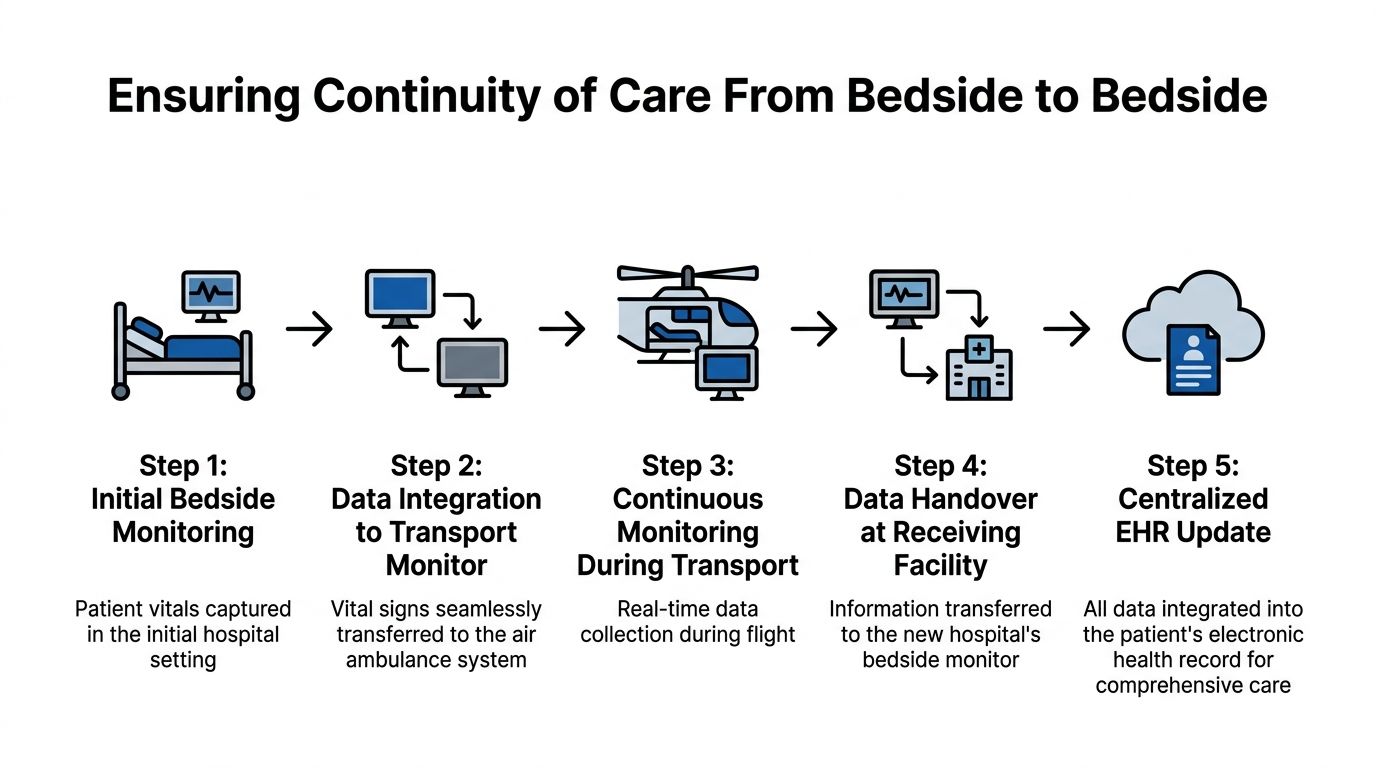
A monitor only solves part of the problem. The rest is process. Data has to move with the patient, the receiving team has to understand what happened in transit, and the handoff has to preserve the clinical picture instead of resetting it.
That's where transport programs distinguish themselves. Good patient monitoring systems don't operate as isolated screens. They support a continuous chain of information from departure through arrival.
Telemetry changes the handoff
Modern mobile monitoring systems in medical transport automatically livestream patient status data to hospitals, enabling real-time communication between the aircraft and the receiving medical facility, and that telemetry capability allows hospitals to prepare specific resources before the patient arrives, according to CardioView's overview of ambulance monitoring systems.
That changes arrival in a meaningful way. The receiving team doesn't have to wait for a verbal summary to begin preparing. If the patient is trending toward respiratory trouble, hemodynamic instability, or another issue, the hospital can line up the right destination and equipment sooner.
Continuity is also about equipment discipline
The public usually focuses on what the monitor can display. Flight crews also focus on whether the monitor has been cleaned correctly, checked properly, and maintained consistently.
Continuity of care depends on routine habits such as:
- Preflight function checks: Cables, sensors, alarm settings, battery status, and display performance should be confirmed before the patient is loaded.
- Calibration and service discipline: A monitor that hasn't been maintained can create bad data at exactly the wrong moment.
- Infection control between patients: Sensors, surfaces, and accessories have to be handled with the same seriousness as the rest of the transport environment.
The cleanest handoff is one where the receiving team can trust both the patient assessment and the equipment that produced it.
Why this matters after landing
The patient doesn't experience transport as separate chapters. From their perspective, it's one continuous episode of care. Families feel that too. They want to know the patient wasn't “off the grid” between hospitals.
That's why continuity in transport should be evaluated the same way hospitals evaluate any other clinical process. Did monitoring remain active? Did relevant changes get recognized? Did the next team receive a usable picture of the transport course?
Those questions sit at the center of patient continuity of care in medical transport. The strongest programs answer yes before the aircraft doors even open.
Common Questions About In-Flight Patient Monitoring
Families and case managers usually ask the same questions, and they should. The right answers reduce anxiety because they tell you whether the transport team is prepared for reality, not just routine transfers.
Can an air ambulance transport a patient on a ventilator
Yes, if the service is operating at a professional critical care standard. One of the most common questions is whether air ambulances carry ventilators for ventilated patients. According to guidance on monitoring during medical flights, all professional air ambulances carry ICU-grade equipment, including ventilators and multi-parameter monitoring systems specifically designed to function during long-distance medical flights, with alarms set to detect any deviation in vital signs immediately.
Do the monitors still work on long flights
They should, and that's a basic expectation. Long-distance transport is exactly where durable power planning, alarm reliability, and transport-ready equipment matter most. A serious provider plans for the full mission, not just the cruise segment.
What happens if the patient's condition changes in the air
The monitor is there to catch that change early, and the crew is there to respond. The system doesn't replace clinical judgment. It supports it by showing deterioration as it develops, not after it becomes obvious to everyone in the cabin.
Is transport monitoring the same as bedside ICU monitoring
Not exactly. The goal is continuity of critical observation, but the environment is different. Flight monitors have to support movement, limited space, and transport-specific operations while still giving the crew actionable data.
What should a case manager ask before booking transport
Ask what level of monitoring will be used, whether invasive lines and ventilation can be supported, how alarms are managed, and how the receiving team will get in-transit information. Those questions tell you a lot about the provider's depth.
Can families feel confident during the transfer
They can, when the provider uses transport-appropriate patient monitoring systems and experienced medical crews. Reassurance shouldn't come from slogans. It should come from equipment, process, and a team that can explain both clearly.
If you're coordinating a complex transfer and need bedside-to-bedside support from an experienced air ambulance program, Med Jets by Air Trek can help arrange the flight, clinical coordination, and transport logistics.