

When a hospital team says your loved one may need to be flown, the room can go quiet fast. Families usually have the same first thoughts. Is this an emergency helicopter ride, a medical jet, or both? Who arranges it? Can insurance help? How do we know whether the service is the right fit?
Those questions are normal. In Charlotte, one of the names families hear most often is medcenter air charlotte, the hospital-affiliated air medical program connected with Atrium Health. If you're a spouse, adult child, case manager, or discharge planner, you don't need marketing language right now. You need a practical explanation of how these transports work, what MedCenter Air does well, where families get tripped up, and when it makes sense to compare other options.
Your Guide to Air Ambulance Options in Charlotte
A common situation looks like this. A patient has stabilized enough to move, but not enough to travel on a commercial flight or by long-distance ground ambulance. The receiving hospital is far away. The doctors need a faster, medically controlled transfer. The family is trying to answer questions while also calling relatives, finding paperwork, and keeping up with the bedside team.

In Charlotte, MedCenter Air is often part of that conversation because it's a long-established hospital-based program. According to the North Carolina Association of Air Medical Services profile for MedCenter Air, the service has been affiliated with Atrium Health and serving the Charlotte Metro Region since May 1986, growing from a single helicopter to a broader transport program. The same source says its FlightWatch Communications Center handles nearly 65,000 transport requests annually, coordinating with medical facilities, EMS, and the public.
That matters because families usually aren't choosing from a blank slate. The sending hospital may already know which program can respond quickly, which one matches the patient's clinical needs, and whether the trip calls for a helicopter, a jet, or a mix of ground and air. If you want a broader primer on how these services are typically coordinated, this overview of emergency medical transport services can help frame the big picture.
What families usually want to know first
- Is this the safest way to move the patient? If the care team recommends air transport, it's usually because speed, monitoring, equipment, or distance make it the better choice than standard travel.
- Who makes the decision? Usually the sending physician, receiving physician, transport team, and hospital coordinators all play a role.
- Will we have choices? Sometimes yes. Sometimes the patient’s condition, location, weather, aircraft availability, or hospital relationship narrows the options.
The best first question isn't “How much is a helicopter?” It's “What level of transport does this patient medically require?”
Families often feel pressure to decide instantly. In reality, the process is urgent but structured. Once you understand who MedCenter Air serves and how its system is built, the decision starts to feel less mysterious.
What is MedCenter Air and Who Do They Serve
MedCenter Air is a hospital-based air medical transport program affiliated with Atrium Health. That hospital connection shapes almost everything about how it operates. It is not just a charter aircraft with medical gear. It's part of a broader clinical transport system designed to move patients who need advanced monitoring and direct coordination between medical teams.
Who usually calls MedCenter Air
In many cases, the first call doesn't come from the family. It comes from:
- A hospital physician who needs a patient transferred for a higher level of care
- A case manager or discharge planner coordinating a medically necessary transfer
- An EMS agency requesting transport from a scene or smaller facility
- A specialty team involved in organ transplant logistics or neonatal transport
Families may still be closely involved, especially in planned inter-facility transfers, but the request often starts inside the healthcare system.
The patients they are built to move
MedCenter Air serves patients whose needs go beyond ordinary travel. That can include people with severe injuries, critically ill medical patients, neonatal patients who need specialized support, transplant-related transports, and patients requiring ICU-level equipment during flight.
Its broader program profile describes capability for complex transports involving equipment and support such as neonatal isolettes, burns, ECMO, intra-aortic balloon pump support, Impella devices, ventricular assist support, and FEMA-related missions. It also includes ground critical care transport as part of the system. That tells families something important. The service isn't limited to one kind of emergency.
Here’s the practical translation for a family at bedside:
- If your loved one needs rapid access to a trauma center, the program may use rotor-wing transport.
- If the patient needs a longer inter-hospital transfer, especially over greater distance, fixed-wing transport may be considered.
- If the patient is medically fragile and needs continuous ICU-style care in transit, the transport mode is chosen around that clinical need, not convenience.
What can confuse people
A lot of families hear “air ambulance” and think only of helicopters. In Charlotte, medcenter air charlotte includes more than that. It’s a coordinated transport program that may involve helicopters, jets, communications staff, medical crews, and ground resources depending on the case.
A hospital-based program often works best when the transfer is tightly connected to hospital teams on both ends.
Another point of confusion is who the “customer” is. In a practical sense, the system is serving the patient. Operationally, though, it often works through hospitals, physicians, EMS, insurers, and transplant teams. That’s why a family may not be asked to arrange every detail themselves. The hospital team may already be working behind the scenes.
A Closer Look at MedCenter Air Fleet and Services
The easiest way to understand medcenter air charlotte is to separate it into helicopters, fixed-wing aircraft, and ground support. Each piece solves a different problem.
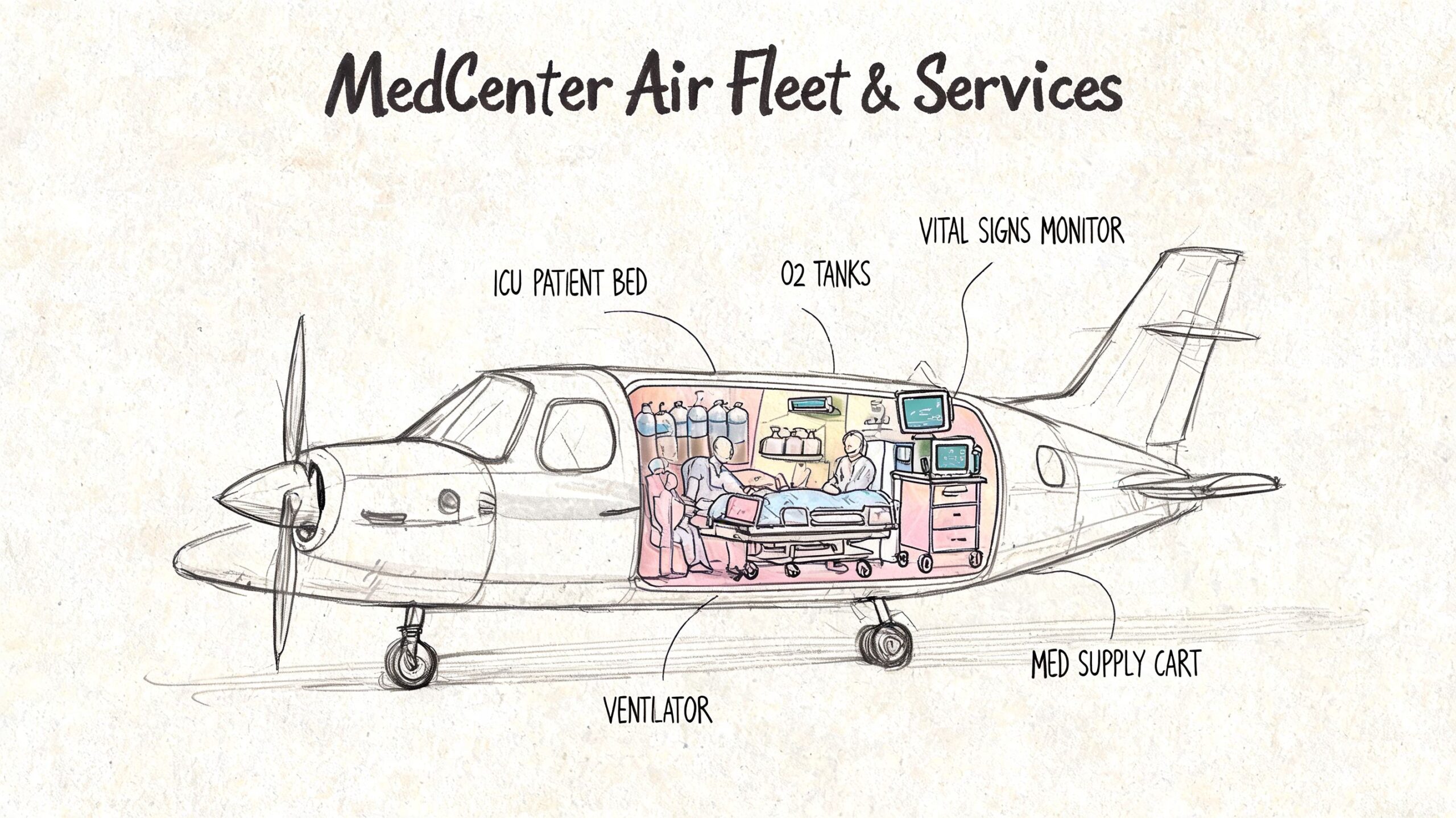
Rotor-wing service for urgent regional response
MedCenter Air operates four helicopter bases using Airbus EC135 P2+ aircraft, and each base covers a 150-mile radius with 24/7 availability, according to Metro Aviation’s MedCenter Air project profile. The same source notes that these helicopters carry LP-15 monitors and LTV1200 ventilators and maintain constant radio contact with ER physicians.
For families, that means the helicopter side of the program is geared toward speed and access. Helicopters help when a patient is at a scene, a smaller hospital, or a place where a short, direct lift can save time getting to definitive care.
A quick way to think about it:
- Best fit for helicopters: scene responses, urgent regional hospital transfers, places where road transport would be too slow
- Less ideal for helicopters: longer distance moves where a jet can cover more ground efficiently, or cases needing more cabin space than a rotor-wing setup allows
If you want to compare aircraft types used in medical transport more broadly, this overview of air ambulance fleet options is useful context.
Fixed-wing service for longer distance and complex care
MedCenter Air’s fixed-wing fleet includes Pilatus PC-24 jets and Cessna Citation aircraft. Atrium Health’s fixed-wing transport page states that the PC-24 can exceed 440 knots and operate at 45,000 feet, while the Citation can also access shorter 5,000-foot runways, which helps crews reach regional airports that larger aircraft may not use. The same page describes support for complex transports including ECMO, Impella, and multi-patient or isolette-capable missions on the PC-24 platform.
That detail matters because not every patient can be moved on the same aircraft configuration. A patient on advanced cardiac or respiratory support needs enough cabin room, the right loading setup, and a crew prepared to manage specialized equipment throughout the flight.
Here’s a short look at how families can think about the difference:
| Transport type | Typical use | What families should know |
|---|---|---|
| Helicopter | Faster regional response | Good for shorter urgent segments and direct access |
| Medical jet | Longer distance transfers | Better for cross-state or national trips and more complex onboard setups |
| Ground unit | Bed-to-bed continuity | Often handles pickup or final leg between airport and hospital |
A look inside this type of transport can help make the equipment less abstract:
Ground support is part of the real service
Families sometimes focus only on the aircraft and miss an important point. Safe transport usually starts and ends on the ground. MedCenter Air’s broader program includes ambulances and specialty critical care units, which is what makes “hospital bed to hospital bed” transfer possible in many cases.
The aircraft is only one part of the handoff. Good transport depends on every transition being coordinated well.
That’s why the strongest programs don’t think in terms of a flight alone. They think in terms of the whole patient movement.
The Patient Transfer Process Step by Step
When families hear “we’re arranging air transport,” it can sound like a black box. It isn’t. The process follows a sequence, even when the timeline is fast.
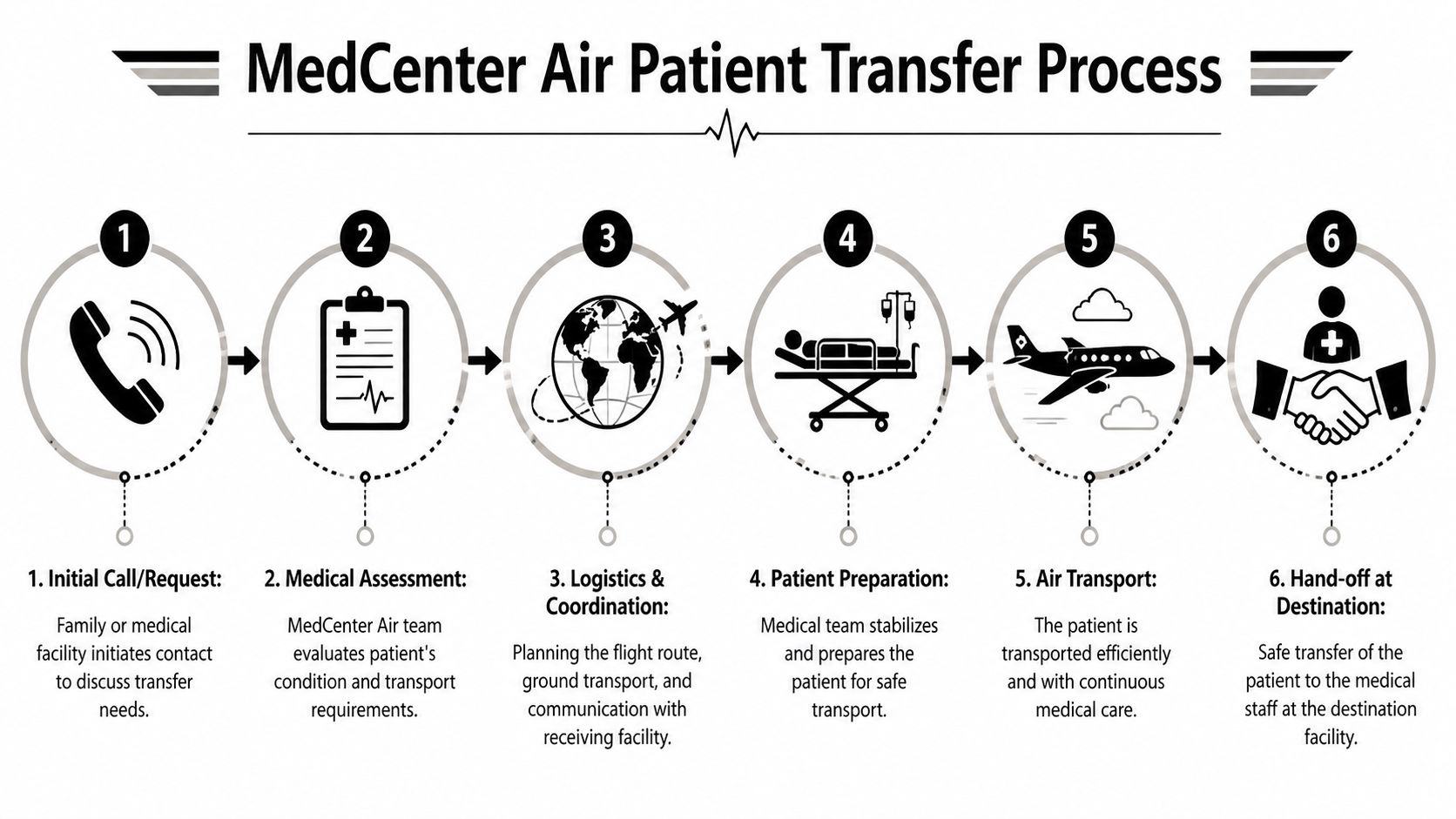
Step 1 starts with a clinical request
A sending hospital, physician, or coordinator contacts the transport center and explains the patient’s condition, current location, destination, and urgency. There, the team decides whether the patient needs a helicopter, fixed-wing aircraft, ground support, or some combination.
The first questions are usually clinical, not administrative. What support is the patient on right now? Is the airway secure? Does the receiving facility accept the patient? What equipment has to travel with them?
Step 2 matches the patient to the right aircraft
Atrium Health’s fixed-wing transport information notes that MedCenter Air uses Pilatus PC-24 jets capable of 440 knots at 45,000 feet and Cessna Citation jets that can use 5,000-foot runways, helping crews reach regional airports and move complex cases including ECMO, Impella, and multiple patients when appropriate, as described on the MedCenter Air fixed-wing critical care transport page.
That’s why families may hear the answer, “A helicopter isn’t the best option for this case.” The aircraft is chosen around patient condition, distance, airport access, weather, and medical equipment needs.
Step 3 covers paperwork and communication
The transport team coordinates acceptance with the receiving facility, confirms the route, arranges any ground segments, and gathers patient documents. Families should expect questions about identity, insurance, emergency contacts, and consent.
If the patient or family speaks a language other than English, clear interpretation matters. Misunderstandings during transfer can create real safety problems, especially around medications, allergies, and consent. This explainer on the risks of medical mistranslation is worth reviewing if language access is part of your situation.
Step 4 prepares the patient for departure
At bedside, the crew stabilizes the patient for movement. That may mean moving the patient onto a transport stretcher, securing lines and tubes, checking medication infusions, and confirming that all monitoring equipment is ready for flight.
Families often want to help in this moment. Usually the most useful thing you can do is stay available for questions, keep one phone on, and avoid bringing extra bags into the room unless a nurse asks for them.
Practical rule: Ask one staff member to be your point person. Too many parallel conversations create confusion.
Step 5 is the flight itself
During transport, the crew continues the level of care the patient needs. For some patients that means routine monitoring. For others, it means ventilator management, medication drips, cardiac support, or other advanced interventions while in transit.
Step 6 is the handoff
At arrival, the crew gives report to the receiving team and transfers the patient into the new unit or department. A clean handoff includes the patient’s condition, treatments given during flight, current medications, and any changes that happened en route.
A useful family checklist:
- Ask who will call you with arrival confirmation
- Confirm the receiving hospital unit or department
- Request copies or transfer details if you’ll need them for insurance
- Clarify whether you should travel separately or wait for the receiving team’s update
Navigating Air Ambulance Costs and Insurance
This is the part families worry about, even when no one wants to talk about it out loud. Air ambulance billing can be complicated because the final cost depends on the patient’s condition, level of care, route, aircraft type, staffing, and whether ground segments are needed.
What usually affects the bill
Several factors can change the financial picture:
- Clinical intensity: A patient on advanced support usually requires more resources than a stable patient.
- Distance and route: Longer trips or more logistically complex transfers may involve more coordination.
- Aircraft selection: Helicopter and jet transports solve different problems, and the medical setup matters.
- Ground coordination: Bed-to-bed service may involve ambulance segments before or after the flight.
That’s why it helps to treat any online estimate cautiously. Family members often search for a number when they should be gathering variables. If you want a plain-language overview of the issues that shape pricing, this guide to medical flight costs is a reasonable starting point.
Insurance questions to ask before the flight if time allows
If the transfer is urgent, the hospital may move first and work details after. If there’s time to check, ask these questions:
- Is the transport medically necessary under the policy?
- Does the insurer require pre-authorization for non-emergency transfer?
- Is the provider considered in network or out of network?
- Will ground segments be billed separately?
- Who receives the claim first, the patient or the insurer?
Write down the name of the person you speak with, the date, and any reference number. Families under stress often remember the conversation but not the details. The details matter later.
The case manager’s role matters
Hospital case managers and discharge planners can be strong advocates here. They often help gather clinical justification, communicate with insurers, and coordinate with the receiving facility. They may also know whether a hospital-affiliated program is the most practical option or whether an independent provider should be explored.
If a transfer isn't emergent, ask for a written summary of why this level of transport is being recommended.
That question does two things. It helps with insurance, and it helps your family understand the decision in medical terms rather than emotional ones.
Comparing Alternatives Med Jets by Air Trek
A family choosing medcenter air charlotte may not always need an alternative. In other cases, comparing providers is smart, especially for planned transfers, long-distance moves, repatriation, or situations where the family wants a different service model.
One of the biggest practical differences is program structure. MedCenter Air is tied to a hospital system. Some independent providers operate with a more direct family-facing model. That difference can affect communication style, flexibility, and how the transport feels from the first phone call onward.
Why some families compare provider models
A hospital-based program often works very well when the transfer is linked tightly to regional hospital operations. An independent program may appeal more when the family wants one company handling the process from initial quote through bedside transfer with a more personalized coordination approach.
Operator consistency also matters. According to the source material provided, operator transitions can impact service reliability. The same source notes that, unlike MedCenter Air’s use of multiple aviation partners over time, Med Jets by Air Trek is one of the nation’s oldest family-operated programs with continuous, EMS-inspected service since 1978, as described in this Airshare department spotlight reference.
That doesn’t mean one model is automatically better. It means families should ask a sharper question: Who is responsible for every part of this transport, and how consistent is that operating setup over time?
Service Model Comparison MedCenter Air vs. Med Jets by Air Trek
| Feature | MedCenter Air Charlotte | Med Jets by Air Trek |
|---|---|---|
| Service model | Hospital-affiliated transport program connected with Atrium Health | Independent, family-operated air ambulance program |
| Primary orientation | Strong fit for hospital-coordinated regional and specialty transfers | Strong fit for direct family coordination and planned long-distance transport needs |
| Operating continuity | Multiple aviation partners have been associated with operations over time | Continuous family-operated service since 1978 |
| How families may experience coordination | Often routed through hospital teams, physicians, and transfer centers | Often more direct company-to-family coordination |
| Best question to ask | How does the hospital want to coordinate this transfer? | Can your team manage the full trip from bedside to destination? |
What to ask any provider before you say yes
Try these questions:
- Who owns the coordination? Ask whether one team handles the flight, medical crew, and ground segments.
- Can a family member accompany the patient? Policies vary by aircraft and patient condition.
- What cases are not a fit? A good provider will tell you where its limits are.
- How are updates given during the trip? Families need one clear line of communication.
For many families, the right answer depends less on brand recognition and more on fit. The safest and least stressful transfer is the one matched closely to the patient’s medical needs, route, timing, and communication preferences.
Frequently Asked Questions About Medical Flights
Can a family member fly with the patient
Sometimes, yes. It depends on the aircraft, the patient’s condition, space limitations, safety restrictions, and crew judgment. Ask early, but be prepared for the answer to change if the patient needs more equipment or staffing.
What should we pack
Keep it light. Bring identification, insurance information, a medication list if available, the patient’s phone and charger if appropriate, and one small bag for essentials. Don’t assume there will be room for extra luggage.
Are these flights medically supervised the whole time
Yes. Medically necessary air ambulance transport is built around continuous patient care during movement, not simple travel assistance. Crews use onboard monitoring and treatment equipment appropriate to the mission.
How safe are these programs
Families can ask whether the transport service meets recognized aviation and medical transport standards. The verified background information for MedCenter Air notes CAMTS accreditation across its transport system and Part 135 dual-pilot fixed-wing operations in the fixed-wing program description. Those details are worth asking about with any provider you consider.
Can pets travel too
Policies vary. Some programs may not allow it, especially in urgent hospital-to-hospital transfers. If this matters to your family, ask directly instead of assuming.
What if we need a slower, less intensive option
Not every patient needs a full air ambulance. In some cases, a medical escort on commercial travel or a critical care ground transfer may be more appropriate. The right level of transport depends on the patient’s condition and physician recommendation.
Ask the team, “What is the least intensive transport this patient can safely use?” That question often leads to the clearest answer.
If you're weighing options for a medically supervised transfer, including fixed-wing air ambulance service, bedside coordination, and family-focused support, Med Jets by Air Trek offers 24/7 help for hospital-to-hospital and long-distance patient transport.