

If you're reading this, there's a good chance someone you care about needs to be moved safely, and fast enough to matter, but not in a 911 emergency. Maybe a hospital is discharging your parent to rehab in another city. Maybe your spouse had a medical event while traveling and now needs help getting home. Maybe you're a case manager trying to line up a transfer that has to work the first time.
People often get stuck. They hear terms like air ambulance, medical escort, stretcher van, ALS, BLS, and private pay, but no one explains how those pieces fit together in real life.
Private medical transport services fill that gap. They help move patients between homes, hospitals, rehab centers, nursing facilities, airports, and specialty programs with the right level of supervision for the patient's condition. When the service is chosen well, the trip supports care continuity instead of interrupting it.
What Are Private Medical Transport Services
Private medical transport services are planned patient transportation services arranged outside a 911 emergency response. The key word is planned. The patient still may need skilled help, oxygen, monitoring, lifting assistance, or a stretcher, but the situation isn't an uncontrolled emergency requiring immediate dispatch.
A common example is a patient who is stable enough to leave one hospital, but not well enough to ride in a family car. Another is a senior who needs a wheelchair-capable vehicle for specialist appointments. In longer-distance situations, the right answer may be a medical escort on a commercial flight or a private aircraft configured for patient care.
This isn't a tiny corner of healthcare. The U.S. non-emergency medical transportation market was valued at US$6.58 billion in 2023 and is projected to reach US$13.43 billion by 2031, according to U.S. non-emergency medical transportation market analysis. That growth reflects something families and discharge teams already know firsthand. Reliable transport isn't a convenience. It's part of access to care.
What makes it different from calling 911
Private medical transport services are used when a patient needs a coordinated trip, not emergency scene response. The transport is usually scheduled after someone reviews the patient's condition, mobility, equipment needs, destination, and timing.
That review helps answer practical questions like these:
- Can the patient sit upright safely: If not, a stretcher option may be needed.
- Will oxygen be required during the trip: That affects the vehicle, equipment, and crew.
- Is the patient traveling locally or across the country: Distance changes the transport mode.
- Does someone need to accompany the patient: Family involvement often needs to be planned in advance.
Practical rule: The safest transport is the one matched to the patient's condition, not the one that simply seems fastest or cheapest.
People also get confused because "transport" can mean very different levels of assistance. For a medically stable person, a non-medical ride service may be enough. For someone who needs supervision during travel, private medical transport services are more appropriate. If you're comparing broader transportation options for a family member who doesn't need clinical support, a service like rent car driver Australia may be useful in a different context, but it isn't a substitute for medically coordinated patient transfer.
Understanding the Four Main Types of Medical Transport
Some readers arrive assuming there are only two choices: ambulance or not ambulance. In practice, private medical transport services are more nuanced than that. The right option depends on the patient's stability, the distance involved, and what kind of care may be needed during movement.
Air ambulance
An air ambulance is a medically equipped aircraft used when distance, urgency, or clinical complexity makes ground travel impractical. This is often the right fit for interfacility transfers, repatriation after illness or injury, and patients who need a controlled medical environment during a long trip.
The cabin is set up around patient care, not ordinary passenger travel. Depending on the mission, that may include a stretcher setup, oxygen, monitoring equipment, and a medical crew such as a flight nurse or paramedic.
Air ambulance is commonly considered when:
- Time matters across long distance: The receiving hospital may be far from the sending facility.
- The patient can't tolerate routine travel: Commercial airports, long layovers, or public terminals may be too stressful.
- Continuous monitoring is needed: The patient may be stable, but not independent.
Families often ask whether helicopter or airplane transport is used. The answer depends on range and mission profile. A concise comparison of those aircraft types appears in this guide to fixed-wing vs rotary-wing medical transport.
Commercial medical escort
A commercial medical escort places a qualified medical professional with a patient on a standard commercial airline itinerary. This option is usually for patients who are stable enough to fly commercially but still need supervision, medication support, mobility help, or medical judgment during the trip.
This can work well for someone recovering from surgery, an older adult who fatigues easily, or a traveler returning home after hospitalization abroad. The escort helps bridge the gap between independent travel and full air ambulance service.
Ground stretcher transport
Ground stretcher transport is used for patients who cannot safely ride seated in a standard car or wheelchair vehicle. It is common for hospital discharges, transfers to skilled nursing or rehab, and regional moves between facilities.
The trip is non-emergency, but that doesn't mean casual. A good team still plans loading, securing the patient, managing comfort, and coordinating handoff on both ends.
Stable doesn't mean simple. A patient can be non-emergency and still need careful positioning, oxygen planning, or lift support.
Specialized bariatric solutions
Bariatric transport is for patients whose size, weight distribution, mobility limits, or equipment needs require modified vehicles, trained crews, and safer transfer methods. This isn't just about a larger stretcher. It may involve wider loading systems, reinforced equipment, extra personnel, and a different route plan from bedside to destination.
This is one area where families often underestimate the planning involved. The right provider will ask detailed questions about bed width, doorway clearance, mobility assistance, oxygen, and destination setup before confirming the trip.
A quick way to compare them
| Transport type | What it is | Best fit for | Typical care level |
|---|---|---|---|
| Air ambulance | Private medical aircraft | Long-distance or higher-acuity transfer | Advanced onboard medical support |
| Commercial medical escort | Medical professional on airline travel | Stable patient needing supervision | Clinical oversight during commercial trip |
| Ground stretcher transport | Non-emergency ground vehicle with stretcher setup | Local or regional transfer for non-seated patients | Basic to moderate transport support |
| Bariatric transport | Specialized ground or air setup for larger patients | Patients needing size-specific equipment and handling | Customized support based on need |
When to Consider Private Medical Transport
The need usually becomes clear in the middle of a larger problem. A discharge is approaching. A family member is far from home. A receiving facility says yes, but only if transport is properly arranged.
One common situation involves specialty care. A patient may start in a community hospital, then need transfer to a center with deeper expertise in cancer care, neurology, cardiac recovery, or complex rehabilitation. The patient isn't crashing, but the move still has to be safe, documented, and coordinated.
Another frequent scenario is aging in motion. An older parent may no longer drive, may not manage airports well, or may need help moving closer to adult children. In those cases, transport isn't only about travel. It's about preserving medication schedules, reducing confusion, and avoiding a physically punishing journey. If that describes your situation, this resource on medical transport for seniors can help frame the options.
Situations families often face
- Hospital to rehab transfer: The patient has been discharged from acute care but still needs assistance and a structured handoff.
- Vacation injury or illness: A loved one is medically stable now, but commercial travel alone isn't realistic.
- Cross-country relocation: A senior or medically fragile adult is moving to be closer to family support.
- Repeated treatment needs: Ongoing dialysis, wound care, behavioral health visits, or specialty follow-up require dependable transportation.
These situations are more common than many people realize. Between 2018 and 2021, the NEMT benefit was used by 3 to 4 million Medicaid beneficiaries annually in the U.S., most often for preventive care, chronic condition management, and behavioral health services, according to Milliman's analysis of non-emergency medical transportation. That tells us something important. Transport isn't separate from treatment. For many patients, it is part of treatment access.
Signs you shouldn't just "figure something out"
Families sometimes try to improvise with a personal vehicle because the patient seems "mostly okay." That's where trouble starts.
Ask yourself:
- Can the patient sit safely for the full trip
- Can they transfer in and out of a car without injury risk
- Will they need oxygen, suction, repositioning, or medication support
- Will fatigue, confusion, pain, or weakness worsen during transit
If any of those answers raise concern, private medical transport services are worth discussing with the sending team.
What to Expect During a Medical Transfer
The process feels less overwhelming once you know the sequence. A well-run transfer doesn't begin when the vehicle arrives. It begins with information, clinical review, and coordination between people who need to agree on the same plan.
A typical transfer follows a bedside-to-bedside chain. Each link matters.
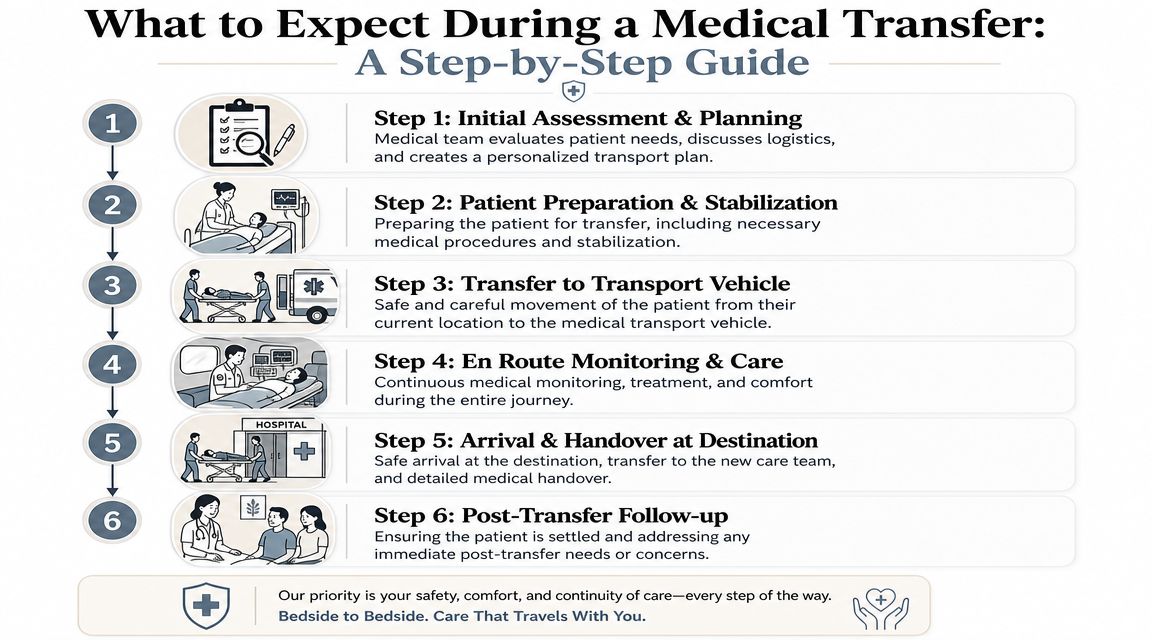
The first call and clinical intake
The first conversation usually covers the basics: where the patient is, where they need to go, how soon the transfer is needed, and what the current medical condition looks like. After that, the coordinator asks more targeted questions about mobility, diagnosis, oxygen use, recent procedures, mental status, and whether the patient can tolerate sitting upright.
This is also when families and case managers should bring up practical details that can derail a trip if missed, such as bariatric needs, isolation precautions, language support, or whether a family member hopes to accompany the patient.
Planning and patient preparation
Once the clinical picture is clearer, the transport team works out the safest mode of travel and confirms logistics with the sending and receiving locations. That may involve timing around discharge paperwork, airport access, ground pickup, or facility acceptance.
Before departure, the patient may need stabilization steps such as pain control, line management, dressing reinforcement, or medication review. Documents also need to travel correctly. The receiving team needs enough information to continue care without guesswork.
Good transport teams don't just move a patient. They transfer responsibility cleanly from one care environment to the next.
A provider such as Med Jets by Air Trek may coordinate this across air, escort, and ground segments when the itinerary calls for more than one mode of transport.
Here is a visual overview of the flow many families find helpful before travel day:
During the trip and at arrival
During transport, the crew's job is to monitor the patient, manage comfort, and respond if the condition changes. Depending on the service level, that may include vital sign monitoring, oxygen management, repositioning, or communication back to the destination team.
When the patient arrives, the handoff is one of the most important moments of the entire transfer. The transport crew does more than unload and leave. They relay the patient's recent status, what happened during the trip, and any immediate concerns to the accepting staff.
A reliable transfer usually includes these handoff elements:
- Patient identity confirmation: The receiving team confirms the right patient and destination.
- Clinical summary: The crew reports the patient's condition during transit.
- Documentation exchange: Relevant records travel with the patient through the proper channel.
- Equipment continuity: Oxygen, mobility devices, or specialty items remain accounted for.
- Family communication: Someone tells the family the patient has arrived and is settled.
Understanding the Cost of Private Medical Transport
For many families, cost is the first question they ask out loud and the fifth question they're still worrying about privately. That's reasonable. Private medical transport services can range from relatively modest local support to complex, high-touch transfers involving clinical staff, specialized vehicles, and multiple handoffs.
The clearest starting point is this: clinical level drives price. According to medical transportation service pricing examples, ALS ground trips typically range from $600 to $1,200, BLS runs from $400 to $800, and non-emergency stretcher trips can be $100 to $400. The reason is straightforward. More intensive care requires more staff capability, more equipment, and a different vehicle setup.
What changes the quote
Distance matters, but it isn't the only factor. A short trip can cost more than expected if the patient needs a stretcher, extra crew help, oxygen, or careful loading from a difficult environment.
The main variables usually include:
- Clinical support level: ALS, BLS, escort support, or basic non-emergency transport
- Transport mode: Ground, private aircraft, or escorted commercial travel
- Mobility and equipment needs: Wheelchair, stretcher, bariatric setup, oxygen, or specialty devices
- Route complexity: Bedside pickup, stairs, rural access, long-distance coordination, or multiple segments
- Timing: Same-day arrangements can be harder to staff and schedule than planned transfers
Medical Transport Options at a Glance
| Transport Type | Typical Cost | Clinical Capability | Best For |
|---|---|---|---|
| ALS ground | $600 to $1,200 | Higher-level onboard medical care | Patients needing more active clinical support |
| BLS ground | $400 to $800 | Basic life support transport | Patients needing supervised medical ground transfer |
| Non-emergency stretcher | $100 to $400 | Lower-acuity transport support | Stable patients who can't ride seated |
| Commercial medical escort | Varies by itinerary and care needs | Medical supervision during airline travel | Stable long-distance travelers who need assistance |
| Air ambulance | Varies by distance, aircraft, crew, and medical setup | Highest transport capability in this comparison | Longer-distance or more medically demanding transfers |
What insurance may or may not cover
Coverage is where families often hit the most confusion. Medicaid recognizes NEMT as an important benefit, but coverage rules vary by state, and that doesn't answer every private-pay question. In real life, approval often turns on whether the insurer sees the transport as medically necessary and whether the service level matches the patient's condition.
That means two questions matter early:
- Is this trip covered at all
- If it is covered, which type of transport is covered
If you're also comparing broader care expenses around a move or discharge, practical guides on related topics such as Arlington senior home care costs can help families understand the larger budget picture around recovery and support.
For air transfer planning, this overview of medical flight transport cost considerations is a useful next step.
Ask for the financial pathway in plain language. Is this private pay, insurance billed, Medicaid arranged, or partly reimbursable after the fact?
How to Choose the Right Medical Transport Provider
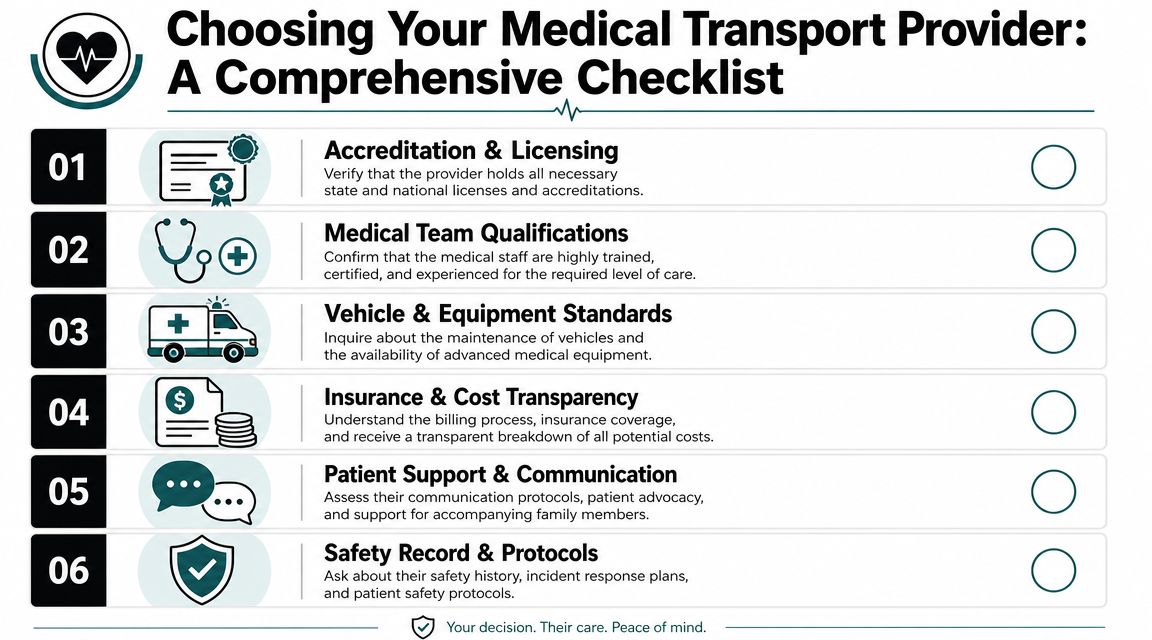
The right provider doesn't start by selling you a vehicle. They start by asking careful questions about the patient. That's because the hardest part of arranging private medical transport services is often choosing the correct clinical level, not choosing the brand name on the side of the aircraft or van.
A key challenge for families and case managers is matching the transport type to the patient's stability, mobility, and oxygen requirements, as explained in this overview of medical transportation options. If a company doesn't ask about those things in detail, that's a warning sign.
Questions worth asking before you book
Use these questions as a screening tool:
- Who reviews the patient's condition: Ask whether a clinician helps determine the appropriate service level.
- What licenses and accreditations apply: The answer should be specific, not vague.
- Who will perform the trip: Some companies operate vehicles directly, while others broker the job to another provider.
- What equipment is available: Confirm oxygen capability, stretcher configuration, monitoring, bariatric equipment, or escort credentials as relevant.
- How is bedside-to-bedside coordination handled: A good provider should explain who manages pickup, receiving contact, and handoff.
- How are families updated: You want a clear communication plan, especially for longer trips.
- What exactly is included in the quote: Ask about ground segments, wait time, documentation coordination, and accompaniment.
What matters more than the lowest price
Price matters, but price without fit can create medical and logistical problems. If a patient needs a stretcher and the company is nudging you toward seated transport, that's not efficiency. That's mismatch.
Look for a provider that is willing to slow the conversation down enough to verify:
- The patient can tolerate the proposed trip
- The destination is ready to receive
- The required equipment will be on board
- The family understands what the day will look like
That kind of clarity usually predicts a smoother transfer than a fast quote alone.
Frequently Asked Questions About Medical Transport
Can a family member travel with the patient
Sometimes yes, sometimes no. It depends on the transport mode, the patient's condition, space limits, and safety rules. Ask this early, especially if the family member helps with communication or reassurance.
How do I know if my loved one is stable enough for private transport
The provider should review the medical record and ask direct questions about oxygen needs, mobility, recent changes in condition, and whether the patient can tolerate the trip. If no one is doing that review, pause the process and ask for it.
Is private medical transport only for emergencies
No. Many trips are scheduled and non-emergency. The patient may still need assistance, supervision, a stretcher, or a coordinated handoff, but the transport is planned rather than dispatched through 911.
What if the patient is frail but doesn't need intensive care
That often points to a middle-ground solution, such as ground stretcher transport or a medical escort. Frailty alone doesn't always require the highest level of care, but it does affect safety during transfers, bathroom planning, fatigue, and monitoring.
Are bariatric patients handled differently
Yes. Bariatric transport often requires different equipment, more transfer planning, and confirmation that the route from bedside to vehicle is workable. Families should bring this up immediately rather than assuming a standard setup will do.
Can pets or personal belongings travel too
Sometimes, but it must be arranged in advance. Medical equipment, essential medications, ID documents, and receiving paperwork take priority. Personal items and companion animals depend on the provider's policies and the transport mode.
What should a case manager have ready
The smoother handoffs usually happen when the sending team has diagnosis information, medication details, oxygen requirements, mobility status, discharge timing, contact names, and receiving acceptance lined up before final booking.
Private medical transport services can feel complicated at first, but the decision usually becomes clearer when you focus on three things: how stable the patient is, what level of help the trip requires, and how the cost will be handled. If those three pieces are answered clearly, families and case managers can move from panic to planning.