
When a family is arranging an air ambulance flight, the questions usually come fast and all at once. Is the patient stable enough to travel. Who will handle the ground transfer. Can a spouse come along. How quickly can the aircraft launch.
One question often stays in the background, even though it matters to every person on board. How do we know the pilot is medically fit to fly this mission safely?
That's where pilot medical certification comes in. It isn't a decorative credential or a one-time physical from years ago. It's part of the safety framework that supports every legal flight operation where a pilot serves as pilot in command or as a required crew member under FAA rules. For families and hospital case managers, that matters because the patient in the cabin may be fragile, time-sensitive, or dependent on a smooth, uneventful transfer.
The Invisible Guardian on Your Medical Flight
A transfer can look calm on the surface while a lot is happening underneath. A patient is being moved between hospitals. Monitors are attached, medications are timed, the receiving team is waiting, and the family is trying to keep up with a dozen decisions at once.
In moments like that, attention goes to the parts everyone can see: the stretcher, oxygen, weather, ground transport, and departure time.
One safety layer is much less visible. The pilot has to be medically fit to carry out the flight.
For passengers, families, and hospital case managers, pilot medical certification works like a quiet checkpoint built into the system. It exists to reduce the chance that a pilot will be flying while dealing with a medical problem that could affect judgment, alertness, vision, coordination, or the ability to handle a fast-changing situation in the air. That may sound abstract until you picture what an air ambulance mission asks of a pilot. The job is not just to take off and land. It includes workload management, communication, weather decisions, route changes, and steady performance while a medically vulnerable person is in the cabin.
A patient may be the focus of the mission, but the pilot's fitness is part of the patient's safety.
The FAA treats medical certification as part of the operating safety framework for flight crews. It is not just a form that gets filed away. It is a recurring review process tied to the kind of flying a pilot is allowed to do, with follow-up procedures when a health issue needs closer evaluation.
That distinction helps families ask better questions. The primary concern is usually not, “Did the pilot pass a physical once?” The better question is, “Is there a system in place to check whether the pilot is fit for this kind of mission?”
Why families should care
If your loved one is traveling by air ambulance, the goal is a smooth transfer with no avoidable complications. Pilot fitness is part of that goal for a simple reason. Patients being moved between facilities often have less room for error than an ordinary traveler. A lapse that might be manageable on a routine personal flight can carry more weight when the cabin contains a patient, medical crew, equipment, and a time-sensitive care plan.
A useful comparison is a hospital credentialing process. A family may never see the paperwork behind a nurse's license renewal or a physician's privileges, but those checks still matter because they help confirm that the people providing care are able to do the job safely. Pilot medical certification plays a similar role in flight operations.
The concern behind the concern
Families often ask the same underlying question in different ways:
- “What if the pilot has a heart condition?” The certification system is designed to review medical conditions that could interfere with safe flight.
- “Can a pilot still fly with a diagnosis?” In some cases, yes. What matters is whether the condition is stable, documented, and acceptable under FAA review.
- “Is this reviewed again or just once?” It is reviewed on a recurring basis, with timing that depends on the certificate and the pilot's circumstances.
That is why this subject deserves a place alongside questions about bedside-to-bedside logistics. The patient may never meet the pilot for more than a brief greeting. Even so, the pilot's medical qualification remains one of the protective layers that helps the whole transport work the way families need it to work: safely, predictably, and without preventable surprises.
Understanding FAA Medical Certificate Classes
For a family member waiting on a medical flight, the letters on a pilot's certificate can feel abstract. They are not abstract in practice. The class of medical certificate helps define what kind of flying that pilot is medically cleared to perform, and that matters when the mission involves a patient, a clinical team, and no room for avoidable risk.
A pilot certificate shows that a person has the training and skill to fly. A medical certificate answers a different question. Is this pilot medically qualified for the level of responsibility involved in a given operation?
The three classes in plain language
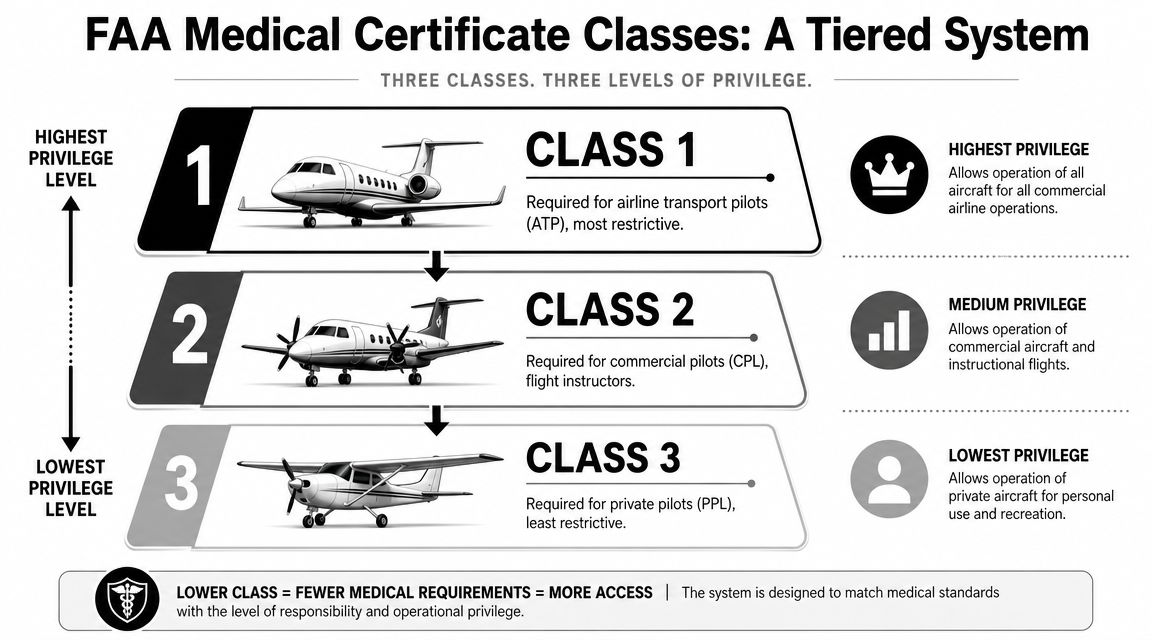
The FAA uses three main medical classes, and the simplest way to understand them is by matching each class to the type of flying it supports.
First-class medical certificate. This is the highest medical standard in the FAA system. It is required for airline transport pilot privileges. You can read more about the professional path behind these standards in this overview of air ambulance pilot careers.
Second-class medical certificate. This supports commercial pilot privileges. If a pilot is being paid to conduct certain flight operations, this class is often part of the legal requirement.
Third-class medical certificate. This is generally used for private, recreational, and student flying. It fits personal or training flights, not the higher-responsibility commercial work families usually associate with patient transport.
A hospital comparison helps here. A medical student, a registered nurse, and a surgeon all work in patient care, but they do not hold the same credentials because they do not carry the same scope of responsibility. FAA medical classes work in a similar way. Higher operational privileges come with a higher medical standard.
Which class matters for air ambulance flying
Air ambulance flying is commercial flying. It is also structured, regulated, and mission-specific. For passengers, patients, and case managers, the practical question is not whether the pilot has some form of FAA medical certificate. The practical question is whether the pilot holds the class required for that operation.
In many air ambulance settings, families will hear about captains, first officers, commercial pilots, or airline transport pilots without knowing how those terms connect to medical certification. The connection is straightforward. The pilot's job, certificate level, and operating role must line up with the FAA medical class that permits that work.
That alignment is one of the quiet checks built into safe transport planning.
A quick comparison
| Certificate Class | Common Use | Typical Validity |
|---|---|---|
| First Class | Airline transport privileges | Shortest validity period |
| Second Class | Commercial operations | Mid-range validity period |
| Third Class | Private, recreational, and student flying | Longest validity period |
Validity periods vary by class, age, and the privileges the pilot is exercising. The broad pattern is easy to remember. Higher-level privileges are reviewed more often.
Practical rule: If the flight is carrying a patient as a commercial medical transport mission, ask whether the pilot holds the medical class required for that role, not just whether the pilot has a medical certificate.
Inside the Pilot Medical Examination
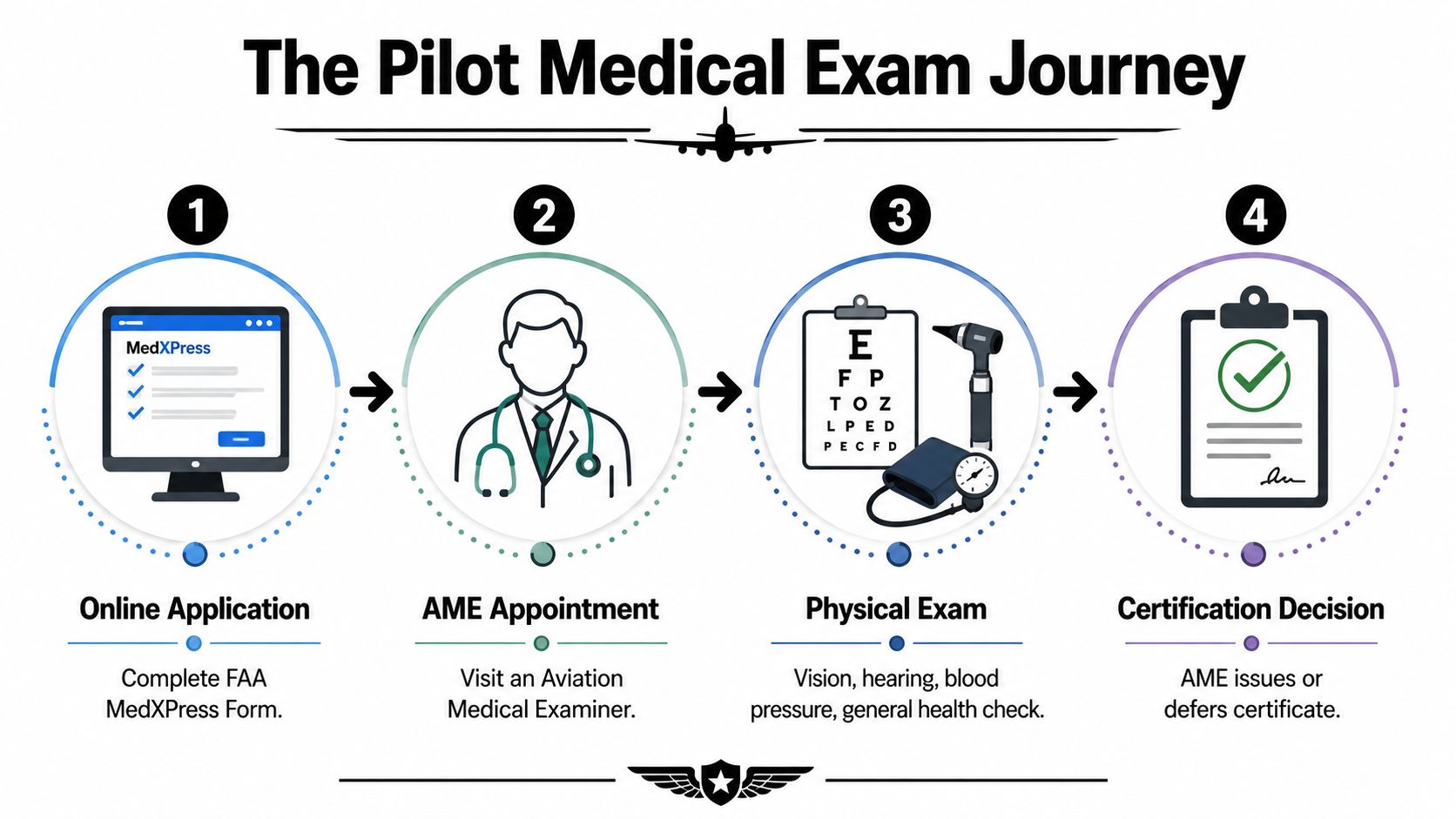
Before a pilot ever sits down with the examiner, there's paperwork. The FAA requires the pilot to complete the MedXPress application before the appointment, and the examination must be finished within 60 days of that submission, according to the FAA medical certification application page.
That requirement sounds administrative, but it has a safety function. It forces the process to use current information and puts responsibility on the pilot to arrive prepared.
Who performs the exam
The exam is conducted by an Aviation Medical Examiner, usually called an AME. This is a physician designated to perform pilot medical exams under FAA standards. The AME isn't there to offer a casual wellness check. The examiner applies aviation-specific criteria to decide whether the pilot can safely exercise flying privileges or whether the case needs more review.
For anyone curious about the professional path behind the cockpit, Med Jets also offers a useful look at air ambulance pilot careers, which helps explain why operator standards go beyond holding a pilot license.
What the exam is screening for
The FAA's medical certification process is a risk-screening system. It is designed to identify conditions that could lead to sudden incapacitation or impaired decision-making in flight. The areas of attention often include vision, hearing, cardiovascular history, neurological concerns, medications, and overall functioning.
This is why people sometimes get confused. They expect a pilot medical exam to work like an annual employee physical. It doesn't. The core question isn't “Is this person generally healthy?” The question is closer to “Is there any condition, treatment, or unresolved issue that could make this person unsafe in the cockpit?”
A simple example helps. A pilot with stable health and complete records may move through the appointment efficiently. A pilot with an unresolved fainting episode, changing medication, or incomplete specialist follow-up may face delay or deferral because the risk picture isn't clear yet.
Here's a short explainer that gives a visual sense of the process and why each stage matters:
Why document readiness matters
Families usually think delay means weather or aircraft availability. Sometimes delay starts much earlier, at the documentation stage of crew certification.
- Medical history must be current. The MedXPress timing rule prevents stale applications from lingering.
- The AME needs a complete picture. Missing reports can turn a routine exam into a deferred case.
- Dispatch readiness depends on legal readiness. A pilot can't decide to fly first and sort out certification later.
If a pilot's records aren't in order, the problem isn't bureaucratic trivia. It's a flight safety issue expressed through paperwork.
Navigating Disqualifying Conditions and Waivers
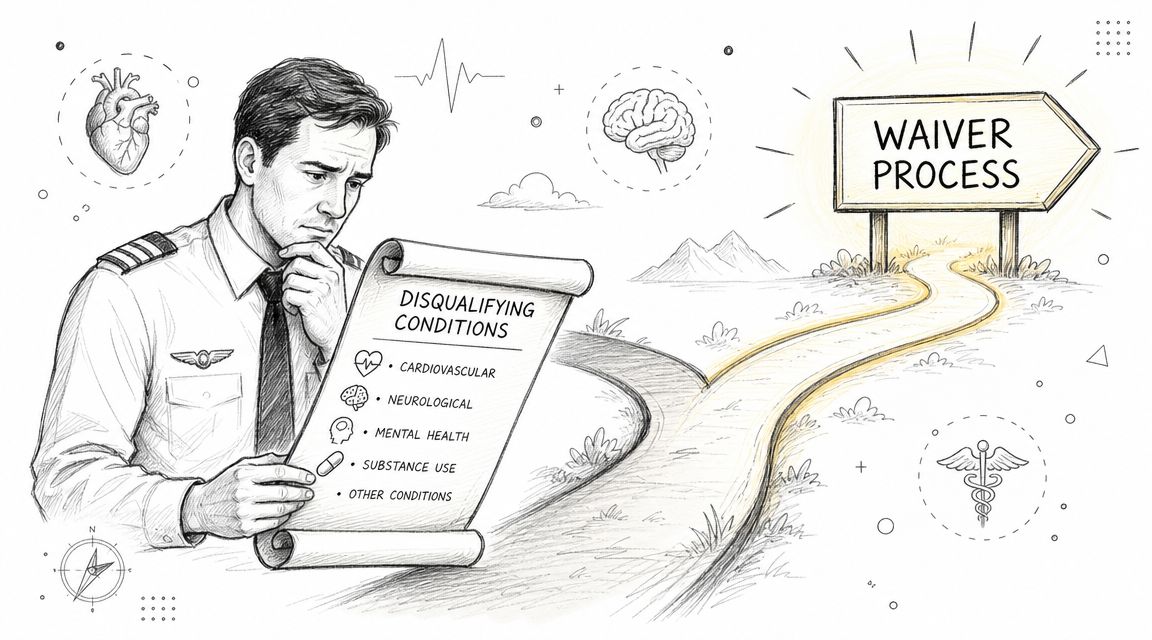
A family may hear that a pilot has a “disqualifying condition” and picture an immediate safety failure. The FAA process is more careful than that. It sorts medical issues into two very different categories: conditions that create an unacceptable cockpit risk, and conditions that may be acceptable if the pilot can show stability, treatment compliance, and current medical follow-up.
That distinction matters in air medical transport. Patients in fixed-wing air ambulance operations are already depending on a tightly controlled chain of safety. Pilot medical review is one part of that chain. It exists to reduce the chance that a health problem could interfere with judgment, alertness, coordination, or consciousness during flight.
The FAA pays close attention to conditions linked to sudden incapacitation or unreliable performance. Examples can include certain heart conditions, seizure disorders, unexplained loss of consciousness, and some forms of diabetes. The concern is not the label alone. The concern is what the condition could do in the cockpit, how predictable it is, and whether the available records show a stable, well-documented picture.
A diagnosis is not always the final answer
Families often assume the system works like a single red stamp. In practice, it works more like a risk filter. Some medical histories lead to denial. Others lead to further review. Many lead to certification once the FAA has enough evidence to see that the condition is controlled and the pilot can perform safely.
As noted earlier in the article, a meaningful share of FAA medical cases require added review or special authorization. That is why it is better to think of the process as evidence-based screening rather than a simple pass-fail gate.
What a Special Issuance really means
A Special Issuance is FAA authorization for a pilot with a condition that needs closer oversight. The agency may allow certification, but only under defined terms and with updated medical proof.
It works much like a hospital credentialing file that stays open for closer monitoring. The person is not waved through casually, and they are not rejected automatically. They are reviewed against specific safety standards, often with periodic updates.
That review may include:
- Current physician records that explain diagnosis, treatment, and present status
- Proof of stability such as controlled symptoms, reliable follow-up, and no recent events of concern
- Ongoing surveillance if the FAA wants repeat reports, testing, or time-limited certification
For a passenger or case manager, that can be reassuring. A pilot flying under Special Issuance has usually been examined in greater detail, with clearer conditions attached to continued certification.
Why cases get delayed
Many delayed cases are not delayed because the FAA has already decided the pilot is unsafe. They are delayed because the file does not answer the safety question clearly enough.
For some complex histories, the FAA may require a current, detailed clinical progress note from the treating physician that is no more than 90 days old before the AME exam. That requirement reflects a plain safety principle: recent facts are more useful than old summaries when the agency is judging flight risk.
A missing cardiology note, an unresolved neurological episode, or incomplete medication history can slow the process for the same reason missing lab results can slow a hospital discharge plan. The system needs enough current information to separate manageable risk from unacceptable risk.
A careful waiver process protects passengers by asking a harder question than “Does the pilot have a diagnosis?” It asks whether the condition is stable, documented, and compatible with safe flight.
Why Pilot Certification Is Critical for Air Ambulance Safety
A family agrees to an air ambulance flight because time matters, the patient needs close monitoring, and the ground route is no longer the safest option. In that moment, attention naturally goes to the aircraft, the medical team, and the receiving hospital. One more safeguard is working in the background. The pilot has to be medically fit to carry a medically fragile passenger.
An air ambulance mission places unusual demands on the crew. Flights may launch at night, weather can change, and destination plans may shift as hospitals update bed status. The patient in the cabin may not tolerate delay, rough handling, or an unplanned diversion well. That raises the importance of every layer of safety, including the pilot's medical certification.
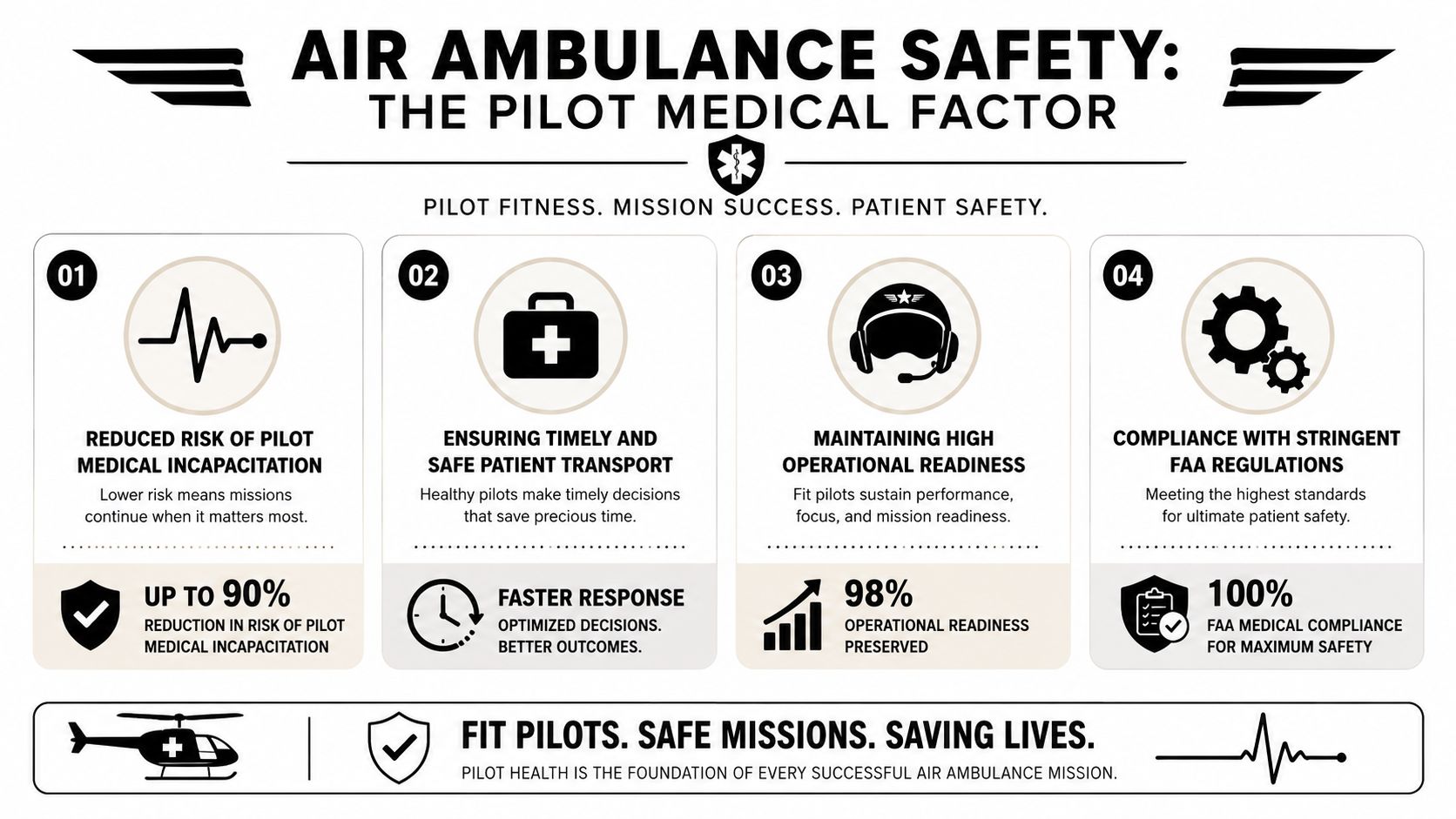
The air ambulance context changes the stakes
For a passenger or case manager, pilot medical certification is not paperwork for its own sake. It is a screening system meant to reduce the chance that a pilot develops a disabling medical problem in flight or operates with a condition that has not been adequately reviewed. That matters on any flight. It matters more when the person in back is already depending on careful timing, stable transport, and a clean handoff at the destination.
A good comparison is the final safety check before a hospital transfer. You do not want surprises after the patient is already in motion. The same principle applies in the cockpit. Medical certification helps catch concerns before they become airborne problems.
Why it belongs in a larger safety system
Medical certification is one layer, not the whole wall. A responsible operator also relies on training, operational control, maintenance, crew readiness checks, and sound go or no-go decisions. Families should see pilot fitness as part of that bigger patient-safety system.
Aircraft choice fits into that conversation too. If you are comparing mission profiles, it helps to understand what fixed wing air ambulance transport involves, because these flights depend on close coordination between flight operations and clinical care.
Here is the point in plain language:
- Medical certification lowers the risk of pilot impairment during a patient flight.
- Regular review helps identify health concerns before they affect cockpit performance.
- Current medical oversight supports better decision-making during long, complex, or time-sensitive transports.
- Operators that treat crew fitness seriously usually show the same discipline in other parts of safety.
Passengers and families often judge safety by what they can see: the aircraft, the equipment, the stretcher setup, the professionalism of the medical crew. Those signs matter. So do less visible protections, including pilot certification and basic cabin restraint practices. Even a general consumer article like Seat Belt Extenders on airplane safety reflects the same larger truth. Safe air travel depends on systems that work together, not on one visible feature alone.
The patient's illness explains why the flight is needed. The pilot's medical fitness helps determine whether the flight remains safe from departure to handoff.
How to Verify an Operator's Safety Standards
You probably won't be able to see an individual pilot's private medical file, and you shouldn't expect to. Medical privacy still matters. But you can ask smart questions that reveal whether the operator takes pilot medical certification and overall safety seriously.
Questions worth asking
Start with the operator, not the individual health record.
- “Are your operations FAA Part 135 certified?” That tells you you're dealing with a commercial framework, not an informal arrangement.
- “What medical certificate class do your pilots hold for these missions?” The answer should align with the operation.
- “How do you handle recurrent training and currency?” Safety depends on more than the pilot's medical status.
- “How do you evaluate crew readiness before launch?” Good operators have internal processes, not assumptions.
A practical benchmark is to review a provider's published air ambulance qualifications and safety standards. You're looking for evidence of systems, oversight, and disciplined operations.
Safety clues people often overlook
Families sometimes focus only on price or aircraft speed. Those matter, but they're not the whole picture. Cabin accessibility, restraint systems, and patient securement also shape safety in transport. For readers who want a plain-language overview of restraint design and fit, this article on Seat Belt Extenders on airplane safety is helpful background.
You don't need to become an aviation auditor overnight. You just need to ask questions that reveal whether the company thinks like one.
Frequently Asked Questions for Families and Case Managers
Some concerns don't fit neatly into a checklist. They show up as short, worried questions asked at the end of a call or during discharge planning. Those questions are reasonable.
Common questions in one place
| Question | Answer |
|---|---|
| Does a pilot need a medical certificate for every kind of flying? | No. The required class depends on the operation. For commercial medical transport, the pilot must meet the medical standard that fits that mission. |
| If a pilot has a medical condition, are they automatically grounded forever? | Not necessarily. Some conditions require more review, documentation, or a Special Issuance rather than an automatic permanent loss of flying privileges. |
| Is BasicMed the same as a regular FAA medical certificate? | No. BasicMed can be useful in some circumstances, but it isn't a universal substitute and comes with its own eligibility rules, including a valid driver's license, a prior FAA medical certificate held on or after July 14, 2006, a physical every 48 months, and an online medical course every 24 months, as explained by Pilot Institute's overview of FAA medical certificate requirements. |
| Does a past diagnosis automatically disqualify a pilot? | No. Stability, treatment compliance, and safe functioning matter. The FAA looks at current risk, not just labels in the chart. |
| Can older pilots still be medically certified? | Yes, if they meet the applicable standard. Some certificate validity periods change with age, which is why regular follow-up matters. |
| What should a hospital case manager listen for on a safety call? | Clear answers about certification, training, operational standards, and how the provider manages readiness before flight. |
The reassuring bottom line
Pilot medical certification exists for the moments when no one can afford guesswork. It gives structure to a question families rarely know to ask until they're already under pressure.
When you're moving a vulnerable patient, the safest answer is never “trust us.” The safest answer is a system with standards, exams, documentation, review pathways, and regular renewal.
If you're comparing providers and want to speak with a team experienced in coordinated medical flights, Med Jets by Air Trek offers round-the-clock support for families, hospitals, and case managers arranging air ambulance transport.