

A hospital room far from home can make everything feel urgent and unfamiliar. Your loved one may be stable enough to travel, but not well enough for a commercial flight, a long car ride, or the delays that come with trying to piece together transport on your own.
That’s often when you first hear the phrase fixed-wing air ambulance.
If you’re wondering what is fixed wing, the short answer is simple. It means an airplane or jet with wings that stay still during flight. In medical transport, that usually means a jet equipped for long-distance patient care, staffed by a clinical crew, and coordinated from one bedside to another.
For families, case managers, and discharge planners, that definition matters because it answers a practical question. Not “what kind of aircraft is this?” but “is this the right way to get my patient safely across the country?”
When a Medical Crisis Requires Crossing the Country
A common call starts like this. A parent is hospitalized after a sudden illness while traveling. Or an older adult moved out of state to be near family, then needs to return to a specialty hospital. Sometimes a patient has completed treatment at one facility and needs to continue care closer to home, but can’t sit upright in a regular airline seat or manage the stress of airport lines and layovers.
In those moments, families usually aren’t looking for an aviation lesson. They want to know three things.
- Can my loved one travel safely
- How soon can it happen
- Who handles the details
A fixed-wing medical jet is built for exactly this kind of transfer. It isn’t a sightseeing plane or a charter flight with a stretcher added as an afterthought. It’s an aircraft used for planned or urgent medical transport over longer distances, with room for a patient, medical equipment, and trained clinicians.
When distance is part of the medical problem, the aircraft becomes part of the care plan.
That’s why this topic matters. The type of aircraft affects how far a patient can go, what weather may delay the trip, how much equipment can travel onboard, and how comfortable the patient will be along the way.
Situations where families hear about fixed-wing transport
Some of the most common examples include:
- Hospital-to-hospital transfers: A patient needs a higher level of care at a specialty center in another state.
- Return-to-home transport: Someone was injured or became sick while away and now needs monitored travel home.
- Senior transport: An older adult needs continuous attention during a long trip that would be too difficult on a commercial airline.
- Complex care coordination: A patient needs ground transport, airport transfer, and clinical handoff arranged as one continuous move.
This is also why the phrase what is fixed wing comes up so often in stressful searches. People don’t just want the technical meaning. They want to understand why a jet might be recommended instead of a helicopter, a medical escort on an airline, or ground transport.
Understanding the Fixed-Wing Aircraft Concept
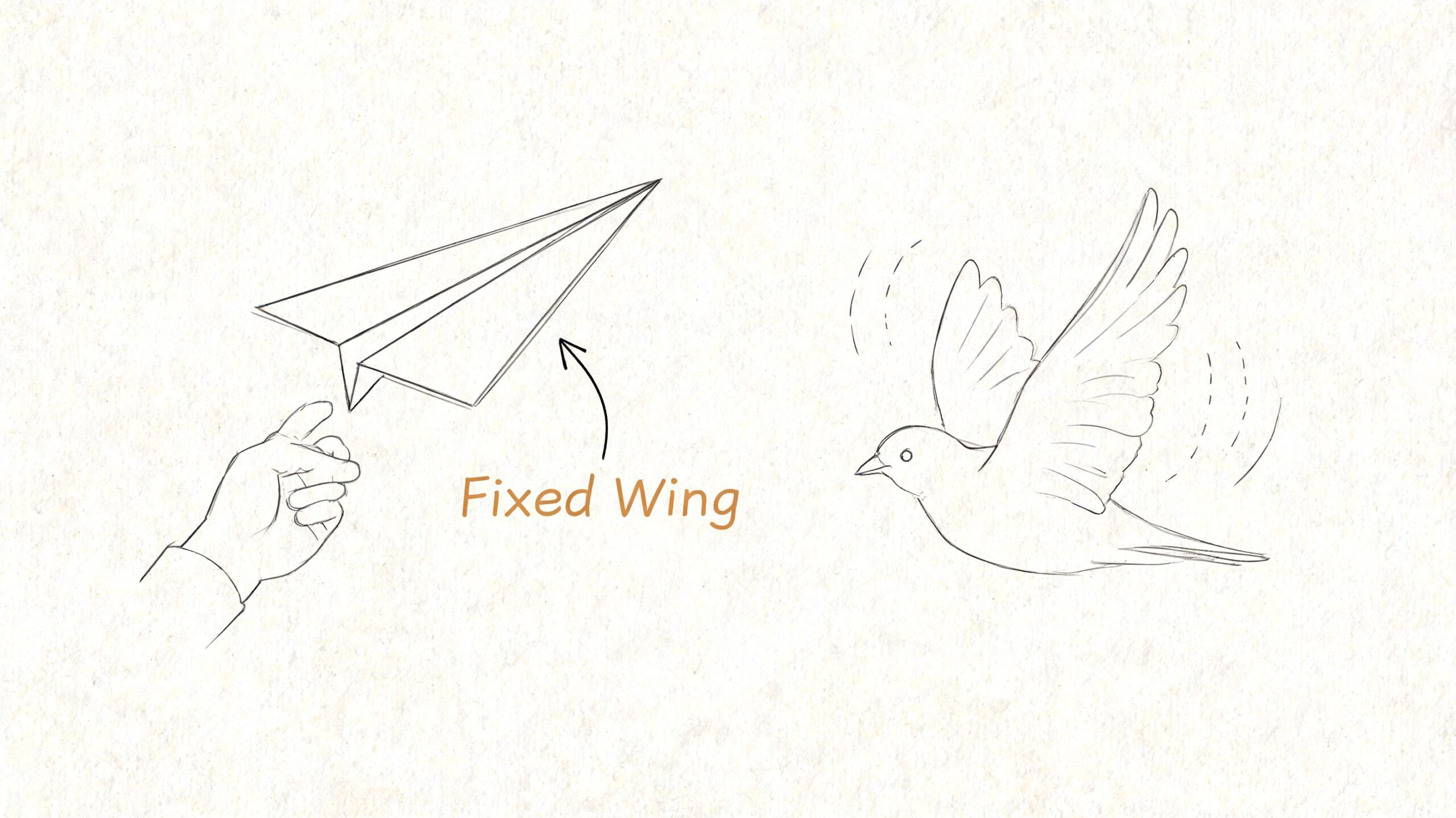
The term fixed-wing sounds technical, but the idea is straightforward. A fixed-wing aircraft flies because air moves over wings that stay in place. Those wings create lift as the aircraft moves forward.
A helicopter works differently. Its blades spin to create lift. That’s why helicopters are called rotary-wing aircraft.
A simple way to picture it
Think of a paper airplane. It glides because its wings stay still while the whole aircraft moves forward. Now think of a pinwheel spinning in the wind. That spinning motion is closer to how a helicopter rotor works.
That basic difference helps explain a lot.
Fixed-wing aircraft, including airplanes and jets, are designed to move efficiently through the air over longer distances. Their shape supports steady forward flight. In plain language, they’re built to go farther with less effort than an aircraft that has to keep spinning blades for lift.
Why the term matters in real life
In aviation, a fixed-wing aircraft is a heavier-than-air aircraft that flies using aerodynamic lift from stationary wings, which sets it apart from rotary-wing aircraft like helicopters, as outlined in the fixed-wing aircraft overview. That category is central to modern aviation, from passenger jets to cargo aircraft to medical transport. The same source notes that the global fixed-wing turbine aircraft market was valued at USD 29.12 billion in 2025 and is projected to reach USD 48.41 billion by 2034, with North America holding a 34.64% market share.
For a family arranging a medical flight, those market numbers aren’t the main story. What matters is what fixed-wing design gives you in practice:
- Longer reach: Jets are suited to trips that would be unrealistic by road or difficult by helicopter.
- More usable cabin space: The aircraft can be configured around a stretcher, equipment, and caregiver access.
- Stable forward flight: That supports a smoother transport environment for patients who need monitoring.
Practical rule: If the trip involves crossing regions or states and the patient needs continuous care, the question usually isn’t whether a fixed-wing aircraft is “an airplane.” It’s whether that airplane is medically configured for the patient’s condition.
People also get confused by the word “jet.” Not every fixed-wing aircraft is a jet, but most long-distance air ambulance flights for adult patients use fixed-wing jets because they fit the mission well.
Fixed-Wing Jets vs Helicopters for Medical Transport
Families often assume a helicopter is the fastest medical aircraft for every situation. That’s understandable. Helicopters are highly visible in emergency response, and they’re often shown landing at trauma scenes or hospital helipads.
But for longer medical transfers, a fixed-wing jet is often the more practical tool.
The biggest difference is mission type
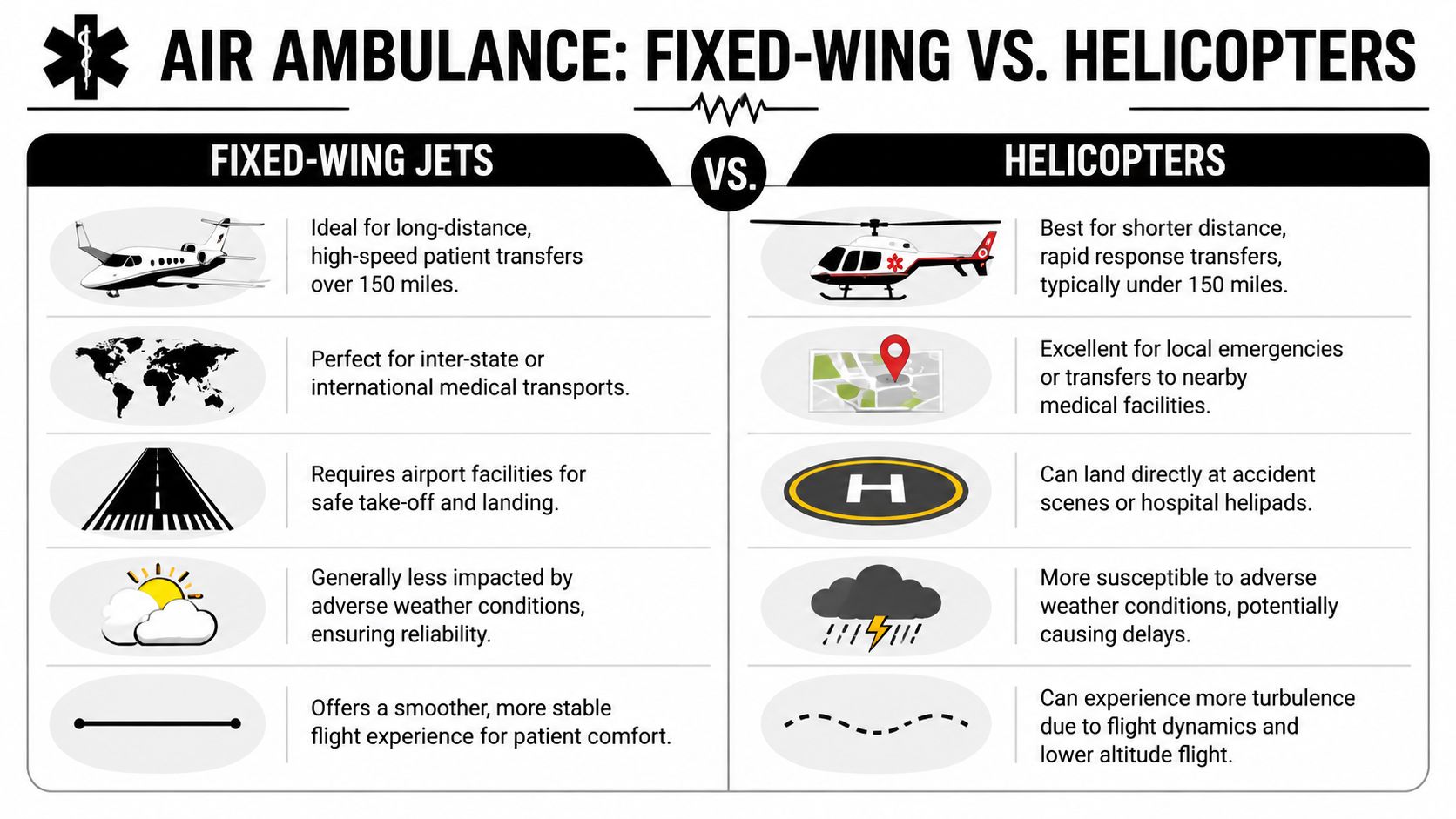
Helicopters are excellent when a patient must be picked up close to the scene or moved a short distance quickly. They can land on helipads and in places that don’t have runways.
Fixed-wing jets serve a different role. They’re used when the patient needs to travel a longer distance, often between cities, states, or countries, and when the transfer must happen in a more controlled cabin environment.
A critical advantage is weather reliability. As explained in this comparison of fixed-wing and rotary-wing air ambulance operations, fixed-wing air ambulances can operate in fog and other inclement weather conditions that would ground most rotary-wing aircraft. For a family waiting on a transfer, that can mean fewer delays and fewer painful last-minute cancellations.
Side-by-side comparison
| Capability | Fixed-Wing Jet (e.g., Cessna Citation) | Rotary-Wing (Helicopter) |
|---|---|---|
| Best use | Longer-distance hospital transfers | Shorter-range urgent response |
| Takeoff and landing | Needs airport facilities | Can use helipads and scene access |
| Weather flexibility | Often better suited to fly in conditions that ground many helicopters | More limited by certain weather conditions |
| Patient comfort | Smoother cabin environment for longer trips | More affected by lower-altitude flight dynamics |
| Cabin purpose | Better suited for stretcher care, equipment access, and cross-region transport | Better for rapid access where runway use isn’t possible |
If you want a more detailed service-level comparison, this guide on fixed-wing vs rotary-wing medical transport breaks down how providers use each option.
What families usually need to know
The choice usually comes down to the job.
- Choose a helicopter when location is the problem: A patient needs pickup from a site or facility without practical runway access.
- Choose a fixed-wing jet when distance is the problem: The patient must travel far and needs care during the trip.
- Consider weather and timing together: A transfer plan only works if the aircraft can depart under the conditions that day.
A helicopter can reach places a jet can’t. A jet can complete trips a helicopter shouldn’t be asked to handle.
That’s the key distinction. One isn’t “better” in every way. They solve different transport problems.
Key Advantages for Complex Patient Needs
Some patients don’t just need transportation. They need an environment that supports medical care over distance, with enough space, stability, and planning to protect them during the trip.
That’s where fixed-wing medical transport becomes especially important.
General aviation discussions often mention that fixed-wing aircraft have greater range. What they usually leave out is the medical meaning of that range. As described in this overview of fixed-wing aircraft and long-distance travel capability, that capability matters for bariatric transport, medically fragile senior transfers, and multi-leg hospital coordination across regions.
Why range matters in patient care
A long-distance transfer isn’t just a longer version of a local ride. More distance creates more demands.
A patient may need oxygen the entire way. Another may need careful positioning to avoid pain or breathing difficulty. A family may need the patient moved from a community hospital to a specialty center, then from the destination airport to the receiving facility without interrupting care.
A fixed-wing jet helps because the aircraft is meant for that larger mission. It can connect cities and regions in one coordinated plan rather than forcing a patient through repeated transfers that add fatigue and risk.
Patients who often benefit most
Different medical situations call for different aircraft features.
- Bariatric patients: These transports may require more cabin room, specialized loading arrangements, and space for clinicians to work safely around the patient.
- Medically fragile seniors: Older adults often tolerate a quieter, more controlled environment better than the noise and disruption of more exposed forms of travel.
- Patients needing specialty care far from home: A longer-range aircraft makes it possible to reach the right facility rather than settling for the nearest one.
- Multi-facility transfers: Some cases require coordination among sending hospitals, receiving teams, ambulances, and airport access on both ends.
Why cabin conditions matter too
Families often focus on speed, but comfort and physiologic stability are just as important.
Cabin pressurization, room for monitoring equipment, and the ability to keep a patient lying flat can make a major difference for someone recovering from surgery, dealing with respiratory issues, or too weak to tolerate standard air travel. That’s why fixed-wing medical flights are not just about getting there fast. They’re about reducing stress on the patient while the trip is happening.
One provider example is Med Jets by Air Trek, which uses fixed-wing jets for hospital-to-hospital transfers, bedside coordination, and cases that may include bariatric capability or family accompaniment when the mission allows. The aircraft type matters because the mission is medical first, transportation second.
Inside a Flying Intensive Care Unit
When people hear “medical jet,” they sometimes picture a private plane with a stretcher inside. In truth, the setup is far more organized.
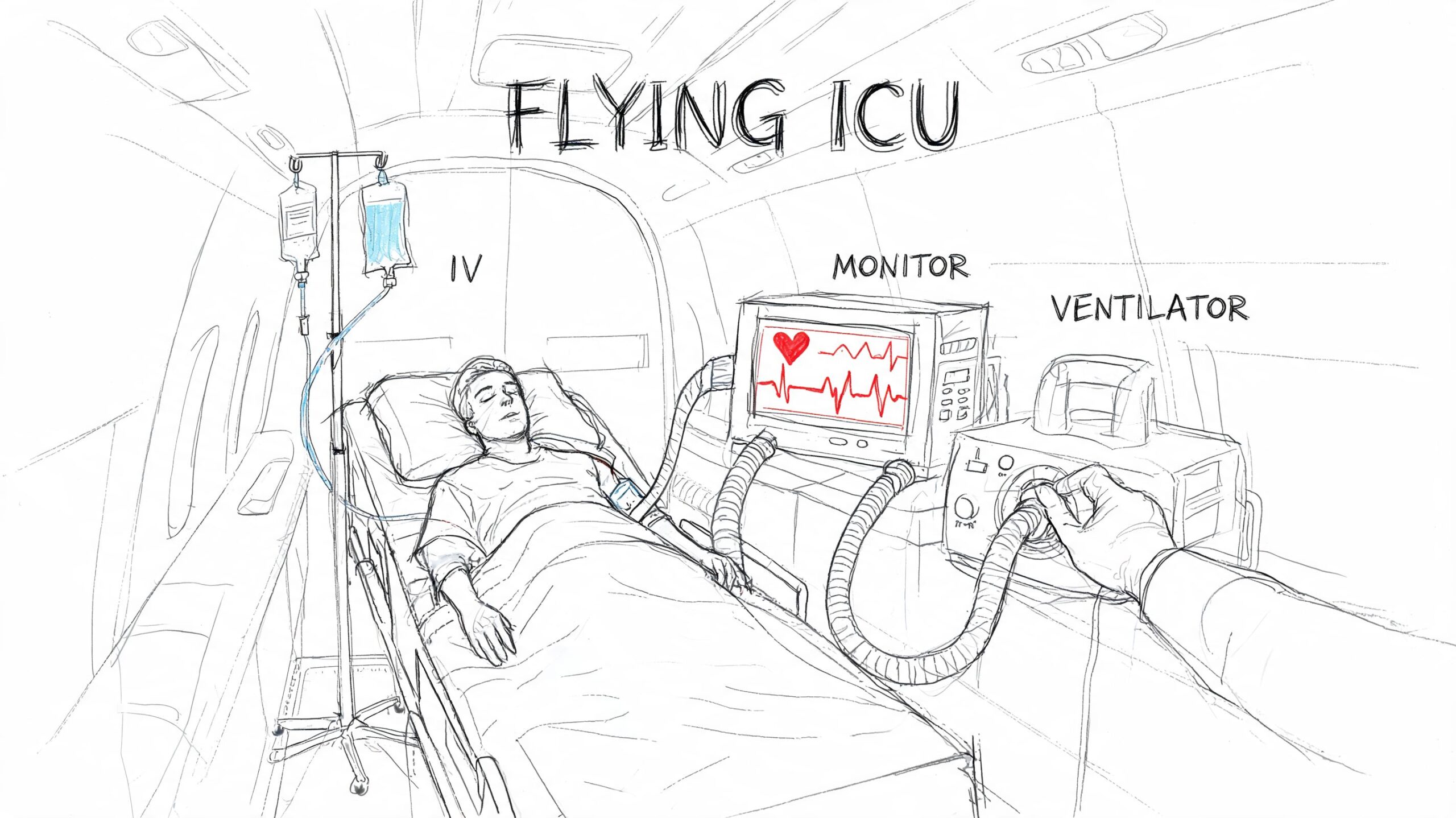
A fixed-wing air ambulance is set up so clinical care continues during flight. The patient isn’t just being moved. The crew is monitoring, treating, communicating, and preparing for the handoff at the receiving facility.
What the cabin is designed to do
Medical jets aren’t shaped by accident. The fuselage is engineered to reduce drag while preserving internal space for patient access and equipment, and engine-powered thrust creates a quieter, lower-vibration cabin than rotorcraft, which can reduce patient stress and support clearer crew communication, as explained in this aerospace reference on fixed-wing aircraft design and powered flight characteristics/02:_Generalities/2.01:_Classification_of_aerospace_vehicles/2.1.01:_Fixed_wing_aircraft).
That design translates into practical benefits inside the cabin:
- Space to reach the patient: Clinicians need room to monitor the airway, check lines, adjust medications, and respond if the patient’s condition changes.
- Room for equipment: Depending on the case, the aircraft may carry monitors, oxygen systems, infusion pumps, suction, and other medical gear.
- A calmer care setting: Less vibration and noise can help both the patient and the clinical team.
For one example of how a medical jet is configured for this role, this page on the Cessna Citation III air ambulance fleet shows how aircraft are adapted for patient transport rather than standard passenger use.
Who is onboard
The aircraft typically has two different kinds of crew working together.
| Team member | Main role |
|---|---|
| Pilots | Operate the aircraft, manage flight planning, weather decisions, and safe transport |
| Flight nurse or paramedic | Provide direct patient care, monitoring, medications, and in-flight clinical response |
| Medical oversight | Supports clinical protocols and higher-level case review when needed |
That division matters because it keeps aviation responsibilities and patient-care responsibilities clear.
Here’s a short visual that can help make the environment easier to picture.
The best in-flight medical environment is the one that feels controlled, predictable, and quiet enough for the crew to focus on the patient.
What families notice most
Families usually remember three things after a medical flight.
First, the cabin feels purposeful. Every seat, cabinet, and piece of equipment has a reason to be there. Second, communication tends to be clearer than they expected because the crew can talk and hear each other. Third, the handoff matters. A good flight ends with the receiving team fully briefed, not with the patient arriving at an airport.
The Medical Flight Process From Start to Finish
Arranging a medical flight can feel overwhelming at first, especially if you’ve never done it before. The process becomes easier once you know what usually happens and who handles each part.
The goal is simple. Move the patient safely from the current bedside to the next one, with as few gaps as possible.
In the United States, providers have continued investing in this model. A study of air medical transport found that the fixed-wing fleet has grown by 2.2% per year over the last decade, while fixed-wing base airports have grown by 3.6% annually, reflecting ongoing use for time-sensitive patient transfers, according to this PubMed-indexed air medical transport analysis.
What usually happens first
The first call is typically about fit. The coordinator gathers the patient’s location, destination, diagnosis, mobility limits, and current level of care. At that stage, the team is trying to answer whether a fixed-wing medical flight matches the patient’s condition and timing needs.
After that, records matter. The transport team usually needs medical notes, medication information, and details from the sending physician or case manager so the clinical crew can prepare.
The transfer process in plain terms
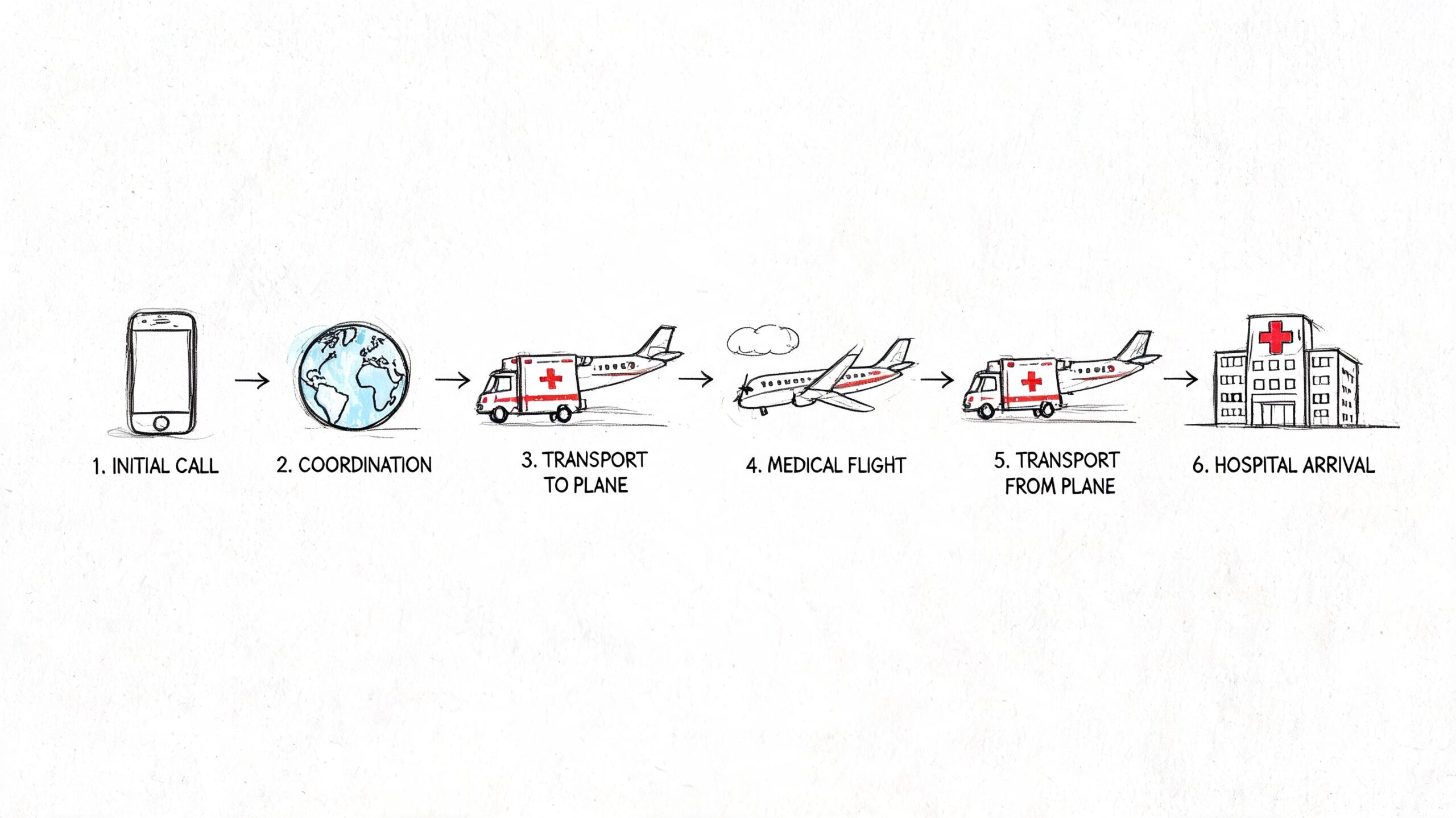
Initial inquiry
A family member, hospital case manager, insurer, or assistance company contacts the flight coordinator.Medical review
The clinical team reviews the case to confirm what level of care, equipment, and staffing are needed during flight.Logistics planning
The coordinator aligns aircraft availability, airport routing, ground ambulances, and the receiving facility’s readiness.Financial and authorization steps
Insurance review, payment arrangements, or sponsor approval may happen during this stage, depending on the case.Day-of-transport coordination
Ground transport brings the patient to the aircraft, the flight crew takes over during the air segment, and receiving-side transport completes the transfer.Hospital handoff
The medical team gives report to the receiving clinicians so care continues without starting over.
What helps the process move smoothly
Families and case managers can reduce stress by having a few items ready.
- Recent medical records: Notes, medication lists, and current treatment details help the flight team assess needs quickly.
- Receiving facility information: The name of the accepting physician or unit can prevent unnecessary delays.
- Decision-maker contact: One reliable point person helps the coordinator avoid crossed messages.
- Practical travel questions: Ask early about who can accompany the patient, what luggage is allowed, and what ground transport is included.
Most families don’t need to master the logistics themselves. They just need to know what information the coordinator will request and why it matters.
Common Questions About Fixed-Wing Medical Flights
People usually ask the most practical questions once they understand what is fixed wing and why a jet may be recommended.
How is the cost determined
Medical flight pricing depends on the route, the patient’s condition, the level of clinical staffing needed, the aircraft required, and whether ground transport is part of the plan. Because those details change from case to case, the most useful step is to request a case-specific quote. This overview of medical flight cost factors explains the main elements providers review.
Can a family member travel with the patient
Often, yes, if the patient’s medical setup and aircraft configuration allow it. Providers also need to consider weight, space, safety procedures, and the care team’s access to the patient during the flight.
What documents are usually needed
Most transports require medical records, physician information, and signed transport paperwork. If the trip crosses borders, additional identification and travel documentation may also be needed.
Can the patient bring personal items
Usually yes, but space is limited. Bring essential items first, such as identification, medications if requested, glasses, hearing aids, a phone charger, and a small comfort item.
Ask what the patient needs for care, then ask what supports comfort. Pack in that order.
Are pets ever allowed
Some providers can accommodate pets in certain situations, but that depends on the mission, cabin setup, and any medical or safety restrictions for that specific flight. It’s best to ask early rather than assume.
Is a fixed-wing medical flight only for emergencies
No. Many fixed-wing flights are urgent, but not all are lights-and-sirens emergencies. They’re also used for non-emergency hospital transfers, return-home transports, specialty care access, and medically supported travel that commercial airlines can’t safely handle.
If you need to make a decision quickly, remember the core idea. Fixed-wing means an airplane or jet with stationary wings. In medical transport, it usually means a long-range aircraft configured to move a patient safely, comfortably, and with clinical support from one point of care to the next.