
It's 3 PM on a Friday. You're trying to move a medically complex patient out safely, the family wants answers about air medical transport, utilization review is pushing back on continued stay, and three fresh admissions still need a solid assessment. None of that is unusual anymore. It's a normal hospital afternoon.
That's why good case manager resources can't just be a pile of bookmarks. They need to function like a working toolkit. One resource should help you structure the assessment, another should support medical necessity discussions, another should tighten discharge education, and another should solve the messy logistics nobody talks about enough, especially when a patient has to move across facilities or across state lines.
Case management is a formal, multi-step healthcare discipline with recurring components that include patient identification, assessment, care planning, implementation, monitoring, transition or discharge, navigation, advocacy, education, counseling, and community service development, as summarized in StatPearls on case management. That matters on the hospital floor because the case manager isn't just processing tasks. The role sits at the center of communication, barriers, timing, and follow-through.
The market is also moving toward more digital and coordinated delivery. One analysis estimates the global medical case management market at USD 5.99 billion in 2025, projected to reach USD 8.95 billion by 2034 at a 4.56% CAGR. In practice, that tracks with what many teams already feel. The work is less about isolated referrals and more about integrated coordination across care settings.
Below is the shortlist I'd want in reach in a busy hospital setting. These are the case manager resources I'd use to move from chaos to coordination.
1. Med Jets by Air Trek

When discharge planning includes a medically fragile transfer, most generic resource lists stop being useful. They'll tell you how to find community services. They won't tell you how to coordinate a stretcher-level move, align sending and receiving teams, handle family questions, and keep the transport plan from falling apart after hours. That's where Med Jets by Air Trek stands out.
This is one of the oldest family-operated air ambulance programs in the country, serving patients since 1978. They're available 24/7 at 1-800-MED-JETS, and the practical value for hospital case managers is that they don't just provide the aircraft. They coordinate the transfer end to end, including emergency flights, professional medical escorts, ground transfers, documentation support, hospital-to-hospital continuity, and insurer coordination.
Why it solves a real discharge bottleneck
The biggest problem in transport planning usually isn't finding one more vendor. It's integrating the transport piece into the actual care transition. Med Jets is useful because the workflow is built around that reality. Pilots, clinicians, and dispatchers are involved in moving the case from intake to arrival, which is exactly how complex transfers need to be managed.
Their Cessna Citation II, III, and V aircraft are configured for one to two patients plus accompanying family. That setup is often a better fit for focused, individualized transfers than a larger, less personal process. Bariatric capability and a pet-friendly environment also matter more often than people admit, especially when anxiety, family presence, and comfort affect whether the transfer goes smoothly.
Practical rule: If a patient transfer includes family coordination, receiving-facility timing, and medical oversight, don't treat transport as the final task. Build it into the discharge plan from the start.
A useful operational explainer for teams deciding aircraft type is Med Jets' guide to fixed-wing vs. rotary-wing transport.
Trade-offs to know before you call
This isn't the cheapest-looking option on a website because there isn't a flat public rate card. Pricing is case by case, which can frustrate teams that want instant cost visibility. But for complicated transfers, that's often more realistic than pretending every move fits a standard package.
The other limitation is aircraft size. Smaller jets work well for many transfers, but extremely complex ICU transports may require a larger specialized platform.
- Best for: Hospital case managers, discharge planners, insurers, seniors, bariatric patients, and families managing high-stakes transfers
- What works well: Live coordination, continuity across air and ground legs, hands-on support with logistics and communication
- What doesn't: Situations where a team expects self-service online pricing or needs a very large aircraft configuration
2. Case Management Society of America
At 4:30 p.m., the discharge is delayed, utilization review is asking one question, social work is asking another, and the bedside nurse wants to know who owns the next step. In that kind of pressure, a hospital team does better with a shared practice model. That is why CMSA belongs in a case manager's toolkit.
Case Management Society of America gives case managers a professional framework they can use before a case becomes chaotic. I use it as an anchor resource for role clarity, decision-making, and team expectations. In practical terms, it helps answer a question that comes up in every busy hospital: what is case management responsible for, and where does that responsibility begin and end?
Where CMSA earns its place
The StatPearls summary of case management describes case management as a collaborative process centered on communication, coordination, and resource use to support quality, safety, and cost-conscious care. The distinction is important because it places case management in the middle of the care team's decision flow, not at the edge of it handling paperwork after decisions are already made.
That framing is especially useful during initial assessment and discharge planning, when teams need a common language for barriers, goals, and next actions. CMSA's Standards of Practice, along with its DEIB and health equity addendum, give leaders a credible base for orientation, competency documents, and policy review. If I am building a department resource hub, CMSA is the section that defines the work before I add task-specific tools like medical necessity criteria or transitions checklists.
There are trade-offs. Some resources sit behind membership or purchase requirements, so it is not always the quickest option for a staff member who needs a free bedside reference in the moment. Chapter engagement also varies by region. In active markets, the networking and education are useful. In quieter ones, the value is heavier on the published standards than on local community.
CMSA also helps newer staff understand where adjacent issues fit without turning every question into a case management duty. For example, transport financing questions often surface during discharge planning, but they require a separate operational resource. In those cases, I would pair CMSA's practice framework with a more specific explainer on whether insurance covers air ambulance transport.
- Strong fit for: Department leaders, preceptors, new case managers, and hospitals standardizing role expectations
- Best feature: Clear practice standards that organize judgment, communication, and scope
- Watch out for: Membership costs, paywalled materials, and uneven chapter value depending on region
If a team is unclear on scope, accountability, or the difference between coordination and task completion, CMSA is one of the first resources I would put in place.
3. American Case Management Association plus Compass Training
If CMSA gives you the broad professional framework, ACMA Compass gives you structured hospital training. That's why I see it as a leadership tool more than a personal reference library. It's built for consistency.
Hospitals don't usually fail because staff care too little. They fail because ten smart people are doing the same workflow ten different ways. Compass helps reduce that variation with standardized training libraries for hospitals, physician advisors, and health plans, plus CE-bearing education that works for onboarding and ongoing competency.
Best use case in a hospital
Compass is strongest when a department is growing, merging functions, or trying to clean up inconsistent practice across sites. It gives leaders a shared curriculum for topics that frequently drift, including regulations, social drivers of health, and motivational interviewing.
I also like it for physician advisor alignment. That's not glamorous, but it matters. When case management and physician advisors use different language around status, barriers, and next steps, avoidable conflict follows.
One side issue that often comes up during transitions planning is transport coverage. ACMA won't solve that directly, but teams dealing with specialty transport questions may find Med Jets' explainer on whether insurance covers air ambulance transport useful for framing those conversations.
Standardized onboarding doesn't make people less thoughtful. It gives them a reliable baseline so they can use judgment where it matters.
Trade-offs
Compass is an enterprise-style solution. You'll need a quote, and implementation makes the most sense when leadership is prepared to manage rollout rather than just buy access.
Membership information and pricing aren't always as centralized online as busy leaders would like. Still, if your core problem is uneven practice, this is one of the more practical case manager resources available.
4. Commission for Case Manager Certification
A hiring manager has two strong finalists. Both have hospital experience. One has the CCMC credential, and one does not. In a competitive hiring or promotion decision, that certification often breaks the tie because it signals follow-through, exam-based validation, and commitment to case management as a specialty.
That is the practical value of the Commission for Case Manager Certification. It does not teach day-to-day discharge tactics the way an association toolkit or transitions resource might. It serves a different role in a case manager's toolkit. It helps leaders set a standard for professional development, and it gives individual case managers a credential that carries across hospitals, health plans, and community-based roles.
Where CCMC fits in the toolkit
I use CCMC as a career-ladder and retention tool. For newer staff, it creates a clear development target after onboarding and initial role stabilization. For experienced staff, it supports advancement into lead, educator, or specialized positions where credibility matters.
It also helps during team building. A department with a healthy mix of certified staff often has an easier time defending practice standards, mentoring newer hires, and showing executives that case management is a disciplined function, not just a collection of tasks.
Analysts at the U.S. Bureau of Labor Statistics describe a steady employment market for social and community service managers, with continued projected growth and recurring annual openings in the field, which supports the broader case for investing in professional development over time through the BLS occupational outlook page.
Best use case in a hospital
CCMC is most useful when a department wants more than education hours and attendance records. It gives leaders a concrete benchmark they can build into job descriptions, clinical ladders, tuition support, and succession planning.
I would also use it when a team is trying to strengthen credibility with physician leadership, utilization review partners, or external payers. Certification does not replace judgment. It does show that a case manager has met a recognized standard and stayed current enough to maintain it.
Certification works best after a case manager has a stable practice foundation. It is a poor substitute for strong onboarding, but a strong addition to it.
Trade-offs
The trade-off is straightforward. Exam preparation takes real time, fees can be a barrier for some staff, and renewal requires consistent CE tracking. Leaders who encourage certification should be ready to support it with study time, reimbursement, or a defined advancement path. Otherwise, it becomes one more expectation without operational backing.
- Best for: Case managers seeking stronger portability, formal recognition, and a clear professional milestone
- Less ideal for: Teams that need immediate workflow tools for discharge planning, handoffs, or medical necessity review rather than a credential pathway
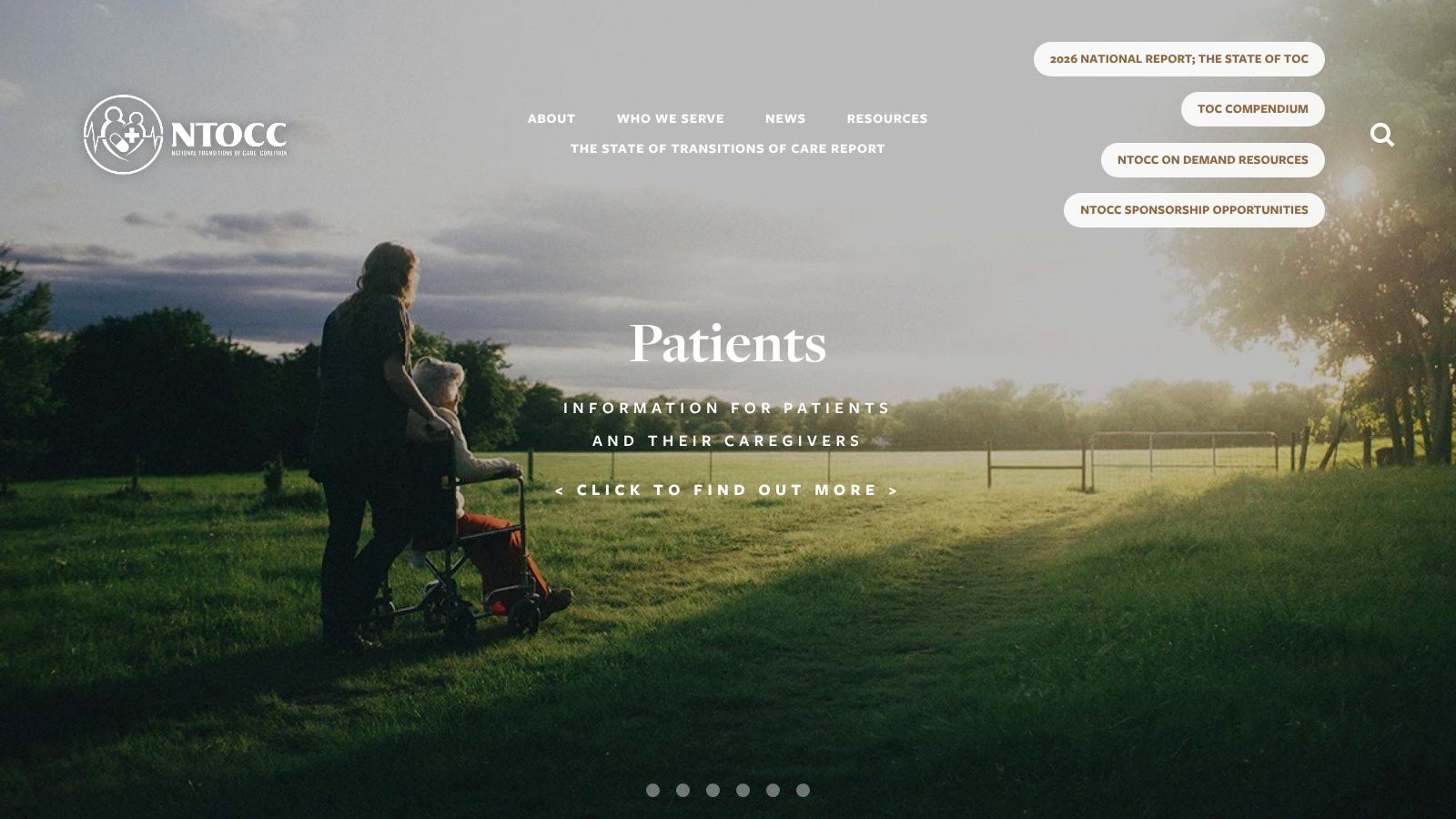
5. National Transitions of Care Coalition
The National Transitions of Care Coalition is one of those resources that often gets overlooked because it isn't flashy. That's a mistake. If your biggest pain point is handoff quality, this site gives you practical material you can circulate in committees and small improvement projects.
Its value is in breadth. You get a transitions-of-care compendium, evaluation tools, and a knowledge center that can support providers, patients, and policymakers. That multi-stakeholder angle matters because transition failures rarely belong to one department alone.
Where NTOCC helps most
I'd use NTOCC when a hospital knows discharge problems exist but hasn't yet chosen a formal vendor or major consulting approach. It's especially good for teams trying to tighten a process before asking for a larger budget.
The materials are also shareable. That sounds minor, but it isn't. A useful tool that a nurse manager, pharmacist, case manager, and quality lead will all read is worth more than a polished framework nobody uses.
Start with the handoff point that fails most often. Medication list confusion, follow-up scheduling, or receiving-facility communication. Fix one reliably before you redesign everything.
The trade-off
Some content is older, and experienced leaders will need to adapt it to current workflows, EHR realities, and local compliance requirements. NTOCC won't give you the implementation muscle that a paid program can.
Still, for free or low-friction case manager resources focused on transitions, it's hard to ignore.
6. AHRQ Transitions of Care Resources
The AHRQ transitions of care resource center is where I go when I need free, credible tools for a quality improvement problem. It's not a vendor. That's the point. You're getting toolkits and implementation materials you can adapt locally.
For busy hospital teams, the practical standouts are discharge resources, health literacy materials, and the MATCH medication reconciliation toolkit. If medication discrepancies keep showing up after transfer or discharge, AHRQ gives you a place to start without waiting for a major software purchase.
Why this belongs in a real toolkit
One market analysis found that web-based delivery held the largest share in medical case management services at 34.4% in 2026, with the market projected to grow from USD 8.2 billion in 2026 to USD 12.4 billion in 2033 at a 7.2% CAGR. The operational point is more important than the market number. Digital case-management platforms are increasingly tied to standardized data entry, real-time capture, integration, and compliance reporting.
AHRQ helps teams improve the workflow side of that equation. It won't replace your software, but it can make your process cleaner and more consistent.
For complex receiving-facility transfers, teams may also need practical transport guidance beyond routine discharge planning. Med Jets' article on how to transfer an ICU patient to another hospital is useful because it addresses the logistics-heavy side many generic discharge tools miss.
What to expect
- Best for: Medication reconciliation projects, discharge redesign, health literacy improvement, and quick-cycle pilots
- Strength: Free, credible, and immediately usable
- Limitation: You still need a local owner to tailor the material and drive adoption
If your team asks, “What can we pilot next month without waiting on procurement?” AHRQ is usually a strong answer.
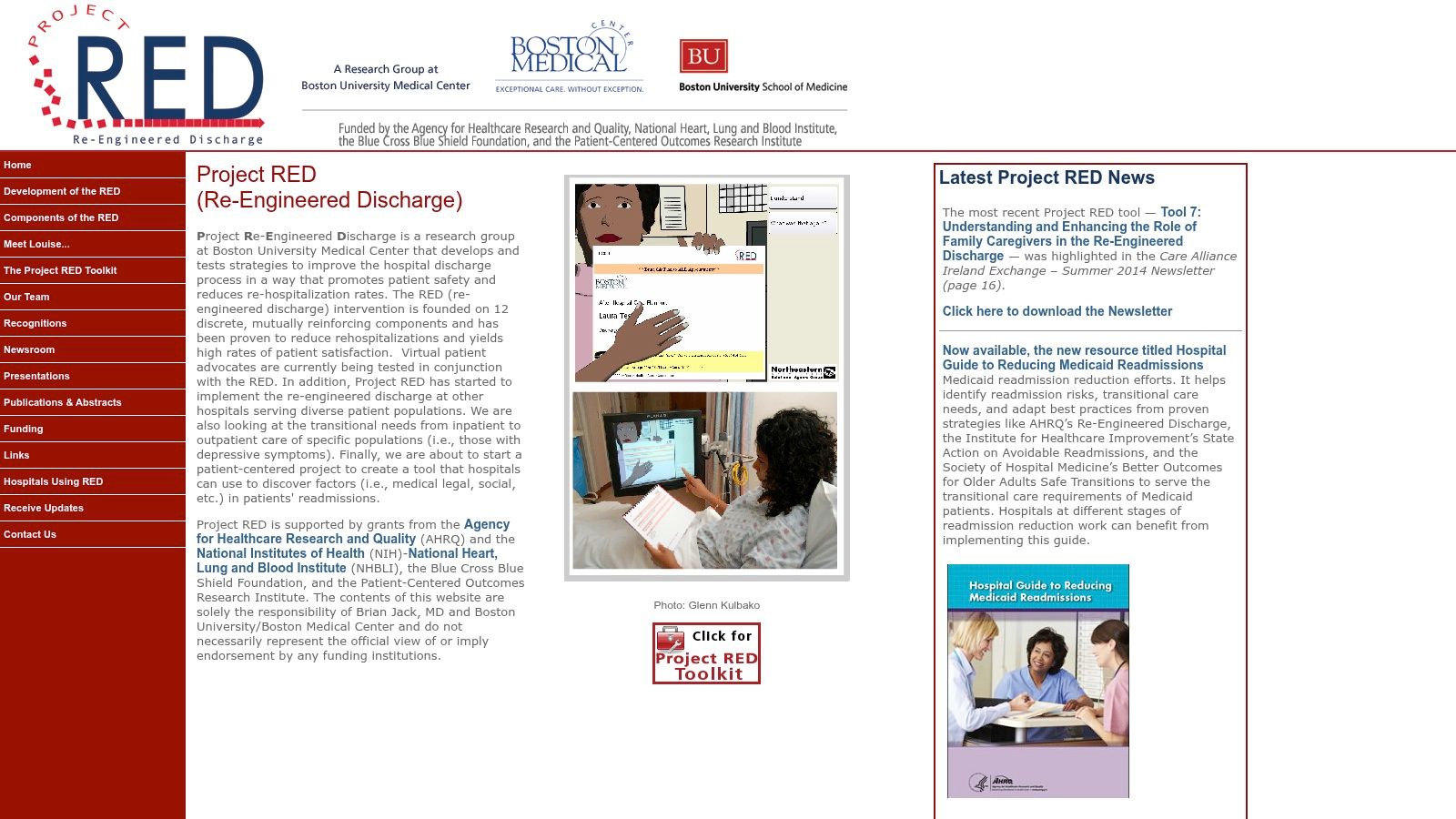
7. Project RED
Project RED is one of the most practical discharge resources available because it's structured around what patients and families need after they leave, not just what the hospital needs documented before they go.
That difference shows up in the tools. The After-Hospital Care Plan templates, scripts, implementation guides, and patient education materials are all built to support a more understandable discharge process. For case managers, that's valuable because discharge failure often starts with communication failure.
What it does better than many discharge programs
Project RED is especially strong when your hospital has a health literacy gap. If patients leave with instructions they can't explain back, don't expect adherence, timely follow-up, or smooth escalation when something goes wrong.
I also like that it includes cultural and limited-English-proficiency adaptations. A lot of discharge resources mention equity in broad terms. RED gives teams materials they can work with.
- Best use: Standardizing discharge education and after-hospital planning
- What works: Templates, scripts, and coaching structure that frontline teams can use
- What doesn't: Complete automation. You'll still need to decide how to build these materials into your EHR and education systems
The main caution is age. Some documents have been around a while, so a local champion needs to modernize formatting and fit them into current workflow.
8. Society of Hospital Medicine Project BOOST
If Project RED is strong on patient-facing discharge structure, Society of Hospital Medicine Project BOOST is stronger on implementation discipline inside the hospital. It's built for inpatient teams that need a framework, risk identification methods, standardized discharge elements, and optional mentored rollout.
That mentored component is a major differentiator. Some hospitals don't need it. Others absolutely do.
When BOOST is the better choice
Use BOOST when your challenge isn't just content. It's change management. If the team already has discharge materials but still struggles with readmission review, high-risk patient identification, or inconsistent execution across service lines, BOOST is often the better fit.
The toolkit and implementation guidance help, but the primary value is the structure around adoption. Leaders often underestimate how much coordination a discharge redesign requires.
If no one owns the rollout, the toolkit becomes shelfware. Assign operational accountability before you launch.
Trade-offs in plain terms
The mentored model is appealing because it offers more support than a static toolkit. The trade-off is cost and bandwidth. You'll need contracting, project management, and multidisciplinary engagement.
That means BOOST isn't the first move for every department. But for hospitals that are ready to run a serious transitions initiative, it's one of the more grounded options.

9. MCG Health Care Guidelines
MCG Health Care Guidelines is where case management, utilization review, and post-acute planning start speaking the same language. In many hospitals, that's half the battle.
MCG is most useful when the team needs structured support for admission status, expected length of stay, discharge planning, and post-acute placement. It helps frame not only whether a patient still needs acute care, but what the next safe setting should be.
Why hospitals rely on it
A lot of case manager resources are educational. MCG is operational. It influences daily conversations with physicians, payers, and post-acute partners.
The patient-facing education pieces also matter. Teams often overlook how useful it is when the same framework supports both internal planning and patient communication.
- Best for: Utilization management teams, case managers handling post-acute placement, and organizations trying to reduce provider-payer friction
- What works well: Shared criteria across inpatient, ambulatory, behavioral health, and chronic care contexts
- Constraint: It's an enterprise product, so cost, integration, and training effort vary by hospital
This isn't a casual bookmark. It's infrastructure. If your hospital has it, staff need governance and training so they apply it consistently.
10. InterQual
InterQual is another foundational tool for medical necessity and level-of-care support, but it earns a place separately from MCG because the workflow emphasis is different. InterQual increasingly leans into automation, interoperability, and prior authorization support.
That makes it particularly relevant for organizations trying to reduce manual review burden and tighten provider-payer communication.
Where InterQual fits best
InterQual is strong when your pain points include procedural review, imaging, DME, behavioral health criteria, or high-volume authorization workflows. The automation tools and FHIR-oriented interoperability direction are useful for teams that are trying to do more without adding layers of manual review.
In other words, this is less about individual education and more about decision support at scale.
What to expect before rollout
The strengths are obvious. Longstanding market presence, recognized criteria, and growing automation capability.
The cautions are just as real.
- Plan for governance: Criteria tools only help when staff apply them consistently
- Plan for training: Inter-rater reliability doesn't happen automatically
- Plan for compliance oversight: Automation supports judgment. It doesn't replace accountability
Hospitals that buy InterQual without a clear training and escalation structure usually end up frustrated. Hospitals that govern it well often get much more value from the investment.
Top 10 Case Manager Resources Comparison
| Service | Core features | Experience & Quality (★) | Value & Pricing (💰) | Target Audience (👥) | Unique Selling Points (✨) |
|---|---|---|---|---|---|
| 🏆 Med Jets by Air Trek | 24/7 air + ground transfers; Cessna Citation II/III/V; clinician-staffed; bariatric & pet-friendly | ★★★★★, since 1978; many 5‑star reviews; EMS‑inspected | 💰 Case-by-case quotes; works with families & insurers | 👥 Families, hospital case managers, insurers, bariatric & senior patients | ✨ End‑to‑end coordination; small‑jet personalized cabins; regional Florida & international coordination |
| Case Management Society of America (CMSA) | Standards of Practice, education, local chapters | ★★★★, widely adopted standards | 💰 Membership & some paid resources | 👥 Hospital case managers, discharge planners | ✨ National practice framework; active peer community |
| ACMA + Compass Training | Compass competency libraries, CE modules, onboarding tools | ★★★★, widely used in hospitals | 💰 Enterprise licensing (quote) | 👥 Hospitals, physician advisors, health plans | ✨ Standardized training + CE credits for workforce alignment |
| Commission for Case Manager Certification (CCMC) | CCM exam, CE requirements, exam prep workshops | ★★★★, recognized, portable credential | 💰 Published fees for exam/renewal; prep costs possible | 👥 Case managers, employers, payers | ✨ Board certification with national employer recognition |
| National Transitions of Care Coalition (NTOCC) | TOC Compendium, toolkits, evaluation tools | ★★★, practical multi‑stakeholder resources | 💰 Many free materials; limited paid support | 👥 Providers, QI teams, policymakers | ✨ Shareable toolkits focused on reducing readmissions |
| AHRQ Transitions Resources | RED, MATCH toolkits, webinars, QI guidance | ★★★★, research‑backed federal resources | 💰 Free evidence‑based tools (no implementation team) | 👥 Hospitals, ambulatory QI teams, researchers | ✨ Robust, evidence-based toolkits for discharge & med safety |
| Project RED (BU/BMC) | 12‑component discharge toolkit, AHCP templates | ★★★★, plug‑and‑play discharge resources | 💰 Free toolkits; requires local implementation owner | 👥 Case managers, discharge teams, patient educators | ✨ AHCP templates, teach‑back scripts, LEP adaptations |
| SHM – Project BOOST | Mentored rollout, toolkit, benchmarking & EHR options | ★★★, structured change management | 💰 Fee‑based mentored implementation; contracting required | 👥 Inpatient teams, transitions committees | ✨ Mentored implementation + benchmarking support |
| MCG Health – Care Guidelines | Admission status, LOS goals, post‑acute criteria | ★★★★, nationally recognized guidelines | 💰 Enterprise license; integration/training costs | 👥 Hospitals, health plans, case managers | ✨ Aligned payer‑provider carecriteria for discharge planning |
| InterQual (Optum) | Evidence‑based criteria, automation (AutoReview), FHIR | ★★★★, long market presence; automation tools | 💰 Licensed solution; module pricing varies | 👥 Payers, utilization managers, hospitals | ✨ Automation + interoperability for prior auth & UM workflows |
Building Your Ultimate Case Management Resource Hub
The biggest mistake teams make with case manager resources is treating them like separate reference points instead of a connected operating system. In real hospital work, the value isn't in having ten good tools. It's in knowing which tool belongs at which decision point.
One simple way to think about the list is by workflow. CMSA and CCMC help define the profession and strengthen credibility. ACMA Compass helps standardize team training. MCG and InterQual support medical necessity, level of care, and placement decisions. AHRQ, Project RED, NTOCC, and BOOST improve transitions and discharge execution. Med Jets by Air Trek covers a gap many resource lists ignore altogether, which is transport coordination when a safe discharge depends on getting a patient from one facility to another with clinical continuity.
That transport gap deserves extra attention. Public-facing case management content often emphasizes housing, benefits, and behavioral health support, but fewer resources address the operational questions case managers encounter during medically complex transfers. The issue often isn't a lack of resources. It's the lack of integration into a single transfer plan, a challenge highlighted in the discussion of targeted case management and coordination needs in Cornerstone Montgomery's targeted case management overview. In a busy hospital, that's the difference between a discharge that closes cleanly and one that drifts into delay, confusion, or safety risk.
If you're wondering where to start, don't try to implement everything at once. Pick the failure point that causes the most downstream damage in your setting.
- If medication reconciliation breaks down: Start with AHRQ's MATCH tools.
- If discharge instructions are inconsistent: Use Project RED materials.
- If staff practice varies too much by unit or tenure: Look hard at ACMA Compass and CMSA standards.
- If status and placement disputes eat up the day: Focus on MCG or InterQual.
- If complex transfers keep becoming last-minute emergencies: Build a transport workflow with a specialized partner like Med Jets.
That last point matters more than many teams expect. A medically appropriate discharge plan isn't complete if the transport plan is weak. Families ask practical questions. Sending facilities need documentation. Receiving facilities need timing they can trust. Someone has to coordinate all of it.
The field itself is growing and professionalizing, and digital adoption keeps pushing case management toward more integrated workflows rather than isolated referrals. The pressure on hospital case managers won't ease soon. But better structure changes the day-to-day experience. Instead of reinventing the plan every time, you start pulling from a tested toolkit.
That's what a real resource hub should do. It shouldn't just help you find information. It should help you move the case.
Medically complex transfers often fail in the handoff, not in the clinical plan. If your team needs an air medical partner that can coordinate flights, ground transport, documentation, and family communication, Med Jets by Air Trek is worth having in your discharge toolkit.