
When a hospital says your loved one needs an air ambulance, the clock starts moving fast. A case manager may already be calling operators. Insurance may be asking for details. Family members are searching on their phones, trying to figure out which company is safe, qualified, and equipped for the patient in front of them.
That's when quality assurance measures stop sounding like paperwork and start sounding like what they really are. A safety net.
In air medical transport, the best work often happens before the engines start. Someone checks whether the crew matches the patient's needs. Someone confirms the aircraft can carry the right stretcher setup and medical equipment. Someone reviews documentation, verifies communication with the sending hospital, and makes sure the receiving team is ready. Those checks aren't extras. They're the system behind a safe flight.
Families often ask the same things. How do I know this provider is careful? What should I ask besides price? If a patient is medically fragile, bariatric, elderly, or complex, how can I tell whether a company provides quality care for such patients?
Those are the right questions. They're also the questions many articles skip.
The Unseen Safety Net in Medical Flights
A daughter is standing in a hospital hallway with her phone in one hand and a folder of discharge papers in the other. Her father has been stabilized after a serious illness, but he can't travel on a commercial flight. The hospital team says an air ambulance is the safest option. She hears terms like bedside-to-bedside, medical crew, pressurized cabin, and transfer coordination. Then she hears another term that sounds technical and distant. Quality assurance.

From the outside, quality assurance can sound like internal office language. From the flight line, it means something more practical. It means people are checking the care plan, the aircraft, the equipment, the staffing, the documentation, and the handoff points before a patient is moved through a stressful and risky environment.
What families are really asking
Most families aren't asking for a lecture on audit systems. They're asking:
- Will my loved one be safe in the air?
- Does this crew know how to handle this exact kind of patient?
- If something goes wrong, how will this company catch it and learn from it?
- Can I verify any of that myself?
Those questions are fair. They're also smart.
Practical rule: If an air ambulance provider can't explain its safety checks in plain language, keep asking until it can.
A strong provider should be able to describe its quality assurance measures without hiding behind jargon. If the answer is vague, overly promotional, or dismissive, that tells you something. Good programs usually welcome informed questions because their systems are built to stand up to them.
Safety you can't always see
The safest medical flight may look uneventful to the family. A calm crew. A smooth transfer. No delays. Quiet confidence. What you don't see is the chain of decisions behind that calm.
That unseen work is what this guide is about. Not just what quality assurance measures are inside an air ambulance company, but how families and case managers can use the right questions to verify whether those measures are real.
Why Quality Assurance in Air Transport Is Non-Negotiable
Air medical transport combines two high-risk environments at once. Aviation has little room for error. Critical care medicine has little room for delay. Put them together in a confined cabin, with weather, scheduling pressure, handoffs between facilities, and a patient who may already be unstable, and you can see why safety systems have to be deliberate.
Quality assurance exists because trust alone isn't enough.
Why the industry had to get more serious
A major warning came from the federal level. A 2017 GAO report on air ambulance oversight found that insufficient data collection and transparency were hindering Department of Transportation oversight. That same report came after a period in which the median price for helicopter air ambulance transport doubled from $15,000 to $30,000 between 2010 and 2014, while oversight still lacked the transparency needed for effective monitoring.
That matters for families because systems under pressure can drift toward inconsistency if nobody is measuring performance clearly. Good quality assurance measures push in the opposite direction. They require review, documentation, and accountability.
What can go wrong without it
When QA is weak, the problems aren't abstract. They show up in very ordinary moments:
| Situation | What a weak system looks like | What a strong system does |
|---|---|---|
| Hospital handoff | Missing details about oxygen needs, medications, or isolation requirements | Confirms clinical information before launch |
| Aircraft preparation | Equipment present but not matched to the patient | Verifies capability against the actual case |
| Crew assignment | Team is available, but not ideal for the patient complexity | Matches staffing to patient risk |
| Post-flight review | Issues are talked about informally and then forgotten | Documents, reviews, and corrects them |
Families often ask, “Isn't the FAA enough?” FAA rules matter, but aviation compliance alone doesn't answer the full medical question. A legally operated aircraft isn't automatically a well-run medical transport program.
A safe air ambulance mission depends on more than a plane being airworthy. It depends on the whole chain working together.
Why this is a patient issue, not a paperwork issue
When providers take quality assurance measures seriously, they create a repeatable process. That means fewer decisions are left to improvisation. It also means the organization can look back, identify weak spots, and improve before the next patient is loaded.
That's why QA in air transport isn't optional. It's the difference between a service that looks professional and one that has a disciplined way to protect patients under pressure.
The Core Components of an Air Medical QA Program
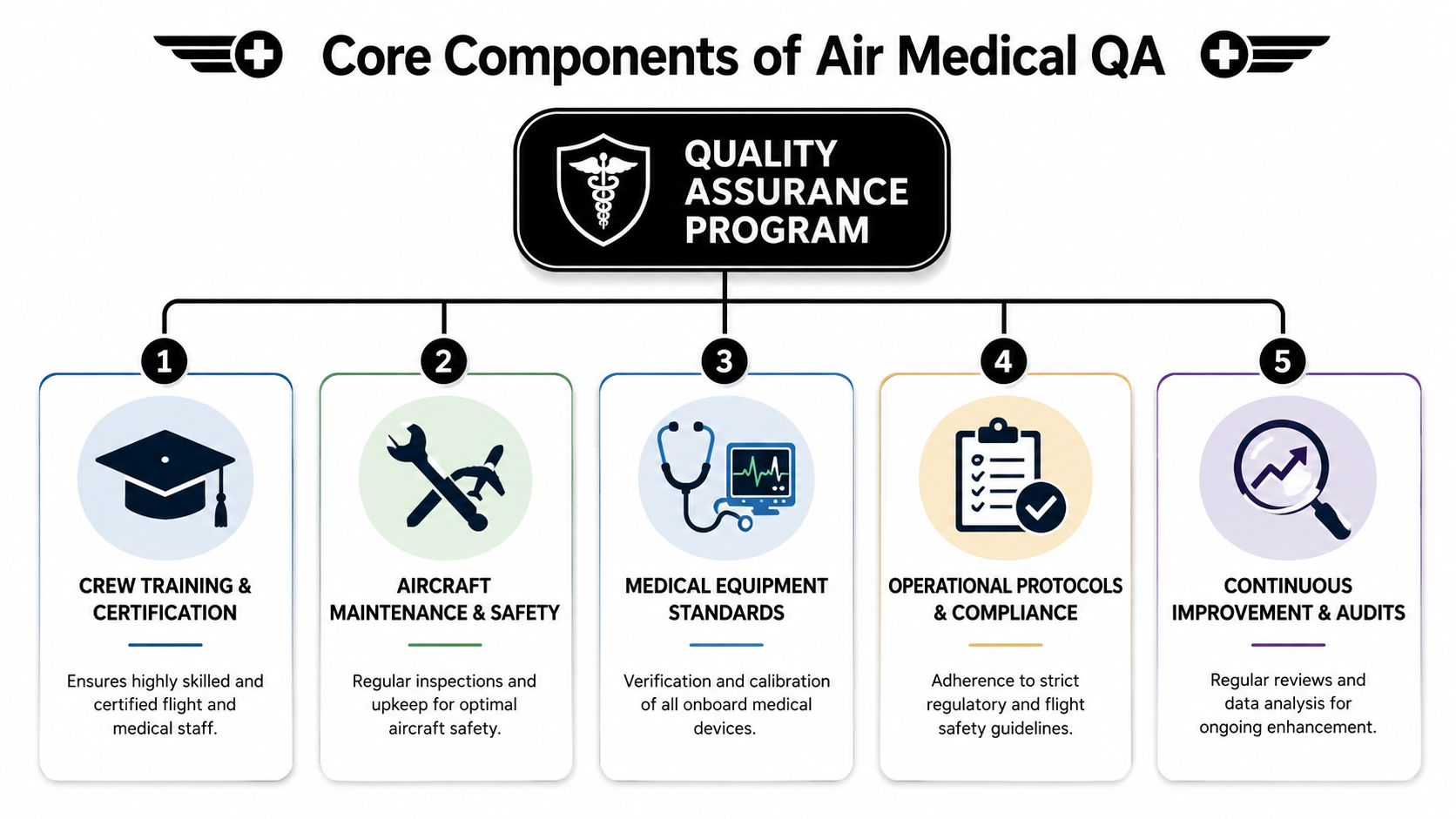
A good air medical QA program doesn't sit in one department. It runs across the entire mission. Clinical care, aircraft readiness, equipment control, communication, and review processes all connect. If one part is weak, the others feel it.
One useful benchmark is that 93% of providers have a formal QA program, and within those programs 100% of patient care reports for high-risk events like cardiac arrest are reviewed, plus a random 20% of all other reports according to this air medical quality benchmark summary. That tells families something important. QA is supposed to be standard practice, not a boutique extra.
Clinical review
The first pillar is patient care itself. Did the crew follow protocol? Was the patient monitored appropriately? Were medications, ventilator settings, oxygen delivery, and handoff details documented accurately?
For high-risk cases, full review matters because these are the missions where errors carry the highest consequences. In plain terms, a good program doesn't shrug and say, “The patient made it.” It asks whether the care process was correct from start to finish.
Aircraft and equipment readiness
Families sometimes focus on the medical crew and forget the platform. But the aircraft is part of the care environment. Space, stretcher configuration, power supply, oxygen systems, and equipment mounting all affect safety.
A strong QA process checks whether onboard medical devices are present, functional, and appropriate for the mission. It also looks at the maintenance culture around the aircraft itself. If you want a plain-English way to think about it, the plane has to be safe to fly and safe to treat in.
Operational discipline
Dispatch decisions, weather review, flight planning, communications, hospital coordination, and ground transfer planning all live here. Within these operations, many near misses begin. Not always with dramatic failure, but with incomplete information, rushed assumptions, or poor handoffs.
Organizations that take safety seriously usually build formal reporting around small problems, not just major incidents. For teams interested in the operational side of safety culture, this overview of streamlining near misses compliance is useful because near-miss reporting is one of the clearest signs that a company is trying to learn before someone gets hurt.
Field insight: The safest crews I've worked with never treated a near miss as “no big deal.” They treated it as a free lesson.
QA versus CQI
Basic QA asks, “Did we meet the standard?” Continuous Quality Improvement asks, “How do we get better from what we found?”
That difference matters. A mature program doesn't just collect charts and close the file. It uses structured review, leadership input, and team follow-up to change training, revise workflows, or tighten protocols. Clinical and operational teams also benefit from disciplines like crew resource management in air medical operations, because communication failures often sit behind errors that look technical on the surface.
A simple way to picture the system
Think of the five core parts this way:
- Crew competence: The right clinicians and pilots for the mission.
- Aircraft safety: A reliable aircraft with disciplined maintenance.
- Medical equipment control: Devices that are checked, stocked, and ready.
- Operational compliance: A mission plan that follows aviation and medical rules.
- Improvement loop: Audits, reviews, and corrective action after the mission.
If a provider can explain all five clearly, you're usually talking to a program with real structure behind it.
From Protocols to Practice How Med Jets Delivers on Safety
The easiest way to understand quality assurance measures is to see what they look like when a provider has to move a real patient from one hospital to another. Not in theory. In practice.
Med Jets by Air Trek has been operating since 1978 and is one of the nation's oldest family-operated air ambulance programs. That history matters less as a marketing point than as a sign of operational maturity. In this business, long-term reputation usually comes from doing the unglamorous parts well: coordination, aircraft readiness, paperwork, communication, and consistent bedside-to-bedside execution.

What safety looks like in day-to-day operations
A provider can talk about standards all day. The better question is whether those standards show up in the mission details.
With Med Jets by Air Trek, that means a dedicated air ambulance operation using Cessna Citation II, III, and V aircraft configured for medical transport, with coordination that covers hospital communication, ground logistics, and continuity of care from departure to arrival. Families dealing with urgent transport usually notice the communication first. Case managers often notice the difference in documentation flow and coordination discipline.
Another concrete sign is whether a provider can explain how it manages the hardware side of safety. A useful reference point is its approach to air ambulance equipment maintenance schedules, because reliable medical transport depends on what's been checked before the patient ever boards.
Specialized patients need more than general promises
One of the biggest gaps in the industry involves complex patient types. According to this discussion of QA gaps for specialized transport cases, while 93% of providers report having a QA program, there are still significant gaps in measuring outcomes for specialized cases, including the lack of standardized QA metrics for bariatric load limits or in-flight stabilization protocols.
That's not a minor detail. If a patient is bariatric, medically fragile, elderly, or unusually equipment-dependent, generic assurances aren't enough. Families should ask about actual stretcher systems, loading procedures, cabin space, weight-related planning, and the crew's comfort with nonstandard physiology.
What this means for families evaluating a provider
A serious operator should be able to answer questions such as:
- Can you transport a bariatric patient safely in this aircraft configuration?
- What equipment do you use for patients with higher mobility or positioning needs?
- How do you coordinate with the sending facility if the patient's condition changes before departure?
- What happens if a piece of medical equipment fails in flight?
Those questions don't make you difficult. They show you understand where quality assurance measures matter most.
Accreditation and Audits What They Mean for Patient Safety
Families often hear a string of credentials and acronyms during a stressful phone call. FAA. CAMTS. Medical director oversight. Clinical standards. It can blur together fast.
The simplest way to sort it out is this: regulation tells you a provider meets required rules. Accreditation and auditing help show whether the provider has chosen to submit its operation to deeper review.
FAA compliance versus broader program quality
FAA oversight is essential. It addresses the aviation side of the mission, including aircraft operation and related requirements. But families are usually deciding on more than a legal flight. They're choosing a flying medical environment.
That's where broader audits and medical transport accreditation matter. They speak to the systems around crew qualifications, policy consistency, training records, equipment control, and operational discipline.
What an audit should tell you
When a provider says it's audited or accredited, don't stop there. Ask what that means in practical terms.
A useful set of follow-up questions includes:
- Who reviews your operation from the outside?
- How often are your medical and operational standards reviewed?
- What documents are checked during those reviews?
- How do audit findings turn into changes in training or policy?
If the company can connect those answers back to actual records and processes, that's a strong sign. Documentation standards are part of that picture, because weak records make it hard to verify anything after the fact. For a practical example of why paperwork quality matters, review how medical documentation standards support safer transports.
Accreditation is valuable because it asks a provider to prove its systems, not just describe them.
What families should listen for
You don't need to become an aviation auditor overnight. You do need to listen for clarity.
A trustworthy provider usually explains credentials in plain language and welcomes specific questions. A weaker one often leans on buzzwords, avoids details, or shifts quickly back to sales language.
Here's a simple comparison:
| What you hear | What it may suggest |
|---|---|
| “We follow all required rules.” | Baseline compliance, but not much detail |
| “We're reviewed against formal standards, and here's how that affects crew training and patient care.” | Stronger quality culture |
| “Our team can walk you through our documentation, oversight, and review process.” | Confidence backed by systems |
For families, audits and accreditation matter because they make safety more visible. They don't guarantee perfection. They do make it easier to separate polished marketing from disciplined operations.
Key Questions to Ask Any Air Ambulance Provider
For families and case managers, closing the information gap is a significant challenge. A 2020 scoping review of air ambulance performance evaluation found that patient-centered outcomes such as communication quality and continuity of care are rarely published or standardized for public comparison. In everyday terms, that means families often have to make a high-stakes choice without a public scorecard.
So ask direct questions.
Start with capability, not price
A low-stress transfer and a high-acuity ICU-level flight are not the same product. The first question should always be whether the provider fits the patient.
Ask:
- What kinds of patients do you transport most often?
- Can your crew manage this diagnosis, this oxygen requirement, or this equipment setup?
- If the patient is bariatric, pediatric, or medically fragile, what specific accommodations do you provide?
Listen for concrete answers. Aircraft type. Stretcher setup. crew composition. Equipment. Coordination steps.
Ask how the provider checks itself
Quality assurance measures should be visible in the answers.
Use questions like these:
How do you review flights after they're completed?
You're listening for formal review, not vague reassurance.How do you handle incidents, close calls, or documentation problems?
Strong programs learn from small failures early.Who oversees clinical quality and protocol updates?
A serious provider should be able to explain the role of medical leadership.How do you verify that onboard equipment is ready for this specific patient?
This verification process demonstrates actual equipment discipline.
Ask, “Can you walk me through what happens from referral to arrival?” The answer usually tells you more than a brochure does.
The video below offers another helpful look at what families should think about when evaluating air medical transport.
Questions that reveal communication quality
Because public comparison is limited, communication itself becomes a quality signal.
Try this short checklist:
- Who will update me during the process?
- How do you coordinate with the sending and receiving hospitals?
- What paperwork do you need before launch?
- What happens if the transport timing changes?
- Can a family member travel, and under what conditions?
A provider with strong operational discipline usually answers those questions calmly and specifically.
A quick screening table
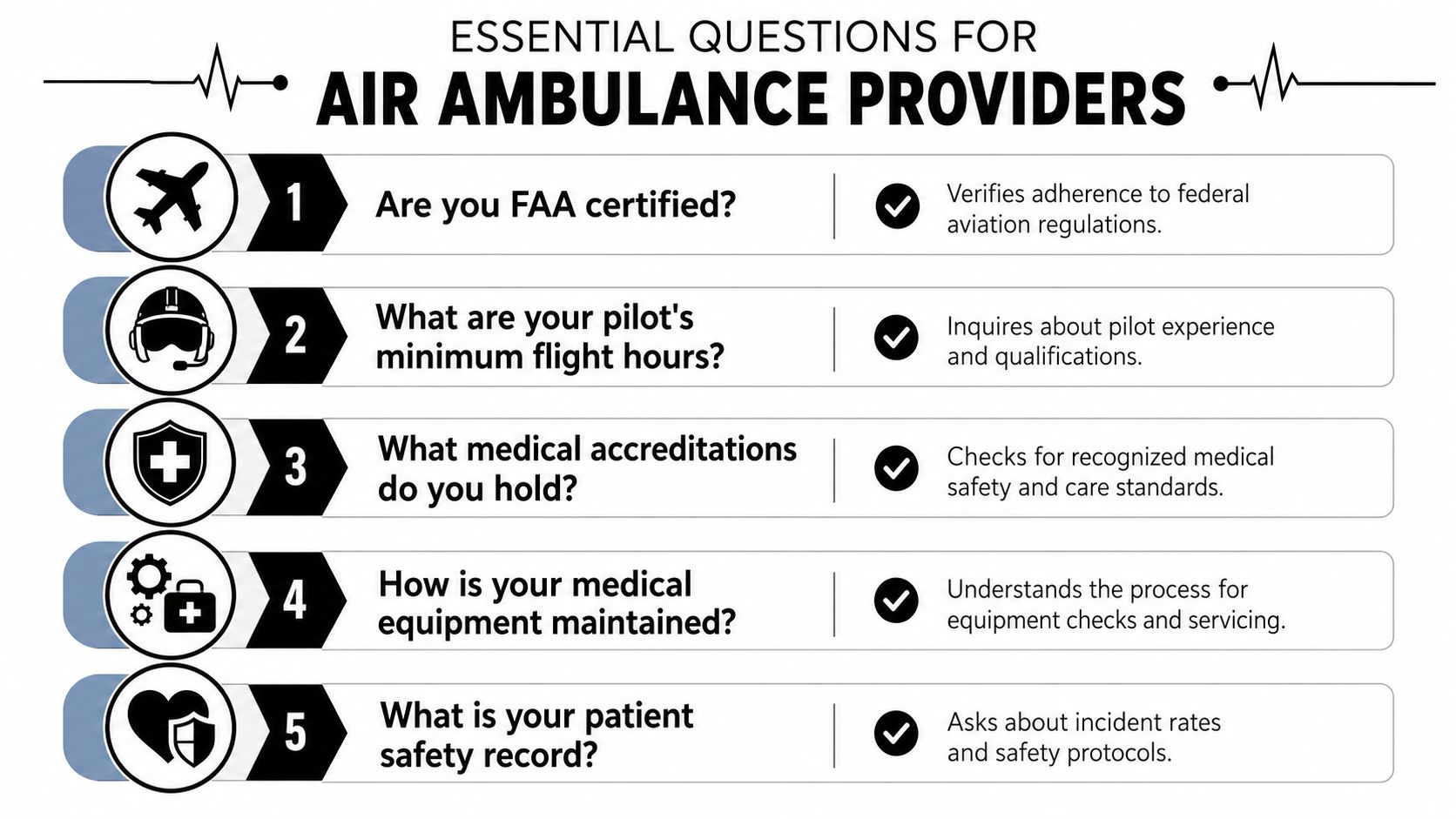
| Ask this question | Why it matters |
|---|---|
| Are you FAA certified? | Confirms required aviation oversight |
| What experience does your flight crew have with patients like this one? | Tests fit for the actual case |
| How is your medical equipment checked and maintained? | Reveals readiness, not just availability |
| How do you review safety events and high-risk cases? | Shows whether quality assurance measures are active |
| How do you support continuity of care between hospitals? | Exposes coordination strength |
Red flags families should notice
Some answers should make you pause.
- Pressure to book before questions are answered: Urgency is real, but that shouldn't shut down basic safety questions.
- No clear explanation of specialized capability: This matters for nonstandard patients.
- Generic answers about “top-quality care” without process details: Marketing language isn't verification.
- Confusion about who handles communication or records: Handoffs are where mistakes often start.
The goal isn't to interrogate people. It's to confirm that the provider has systems, not just confidence.
Your Final Check for a Safe Flight Home
When you're arranging an air ambulance, you don't need to master every clinical or aviation detail. You do need a way to verify that the company has real quality assurance measures behind its promises.
That means looking for three things. Safe clinical care. Reliable aircraft and equipment practices. Disciplined operations with clear review and accountability. If a provider can explain those areas plainly, answer pointed questions, and describe how it learns from problems, you're on firmer ground.
Families also have practical concerns outside the aircraft. If a loved one needs help moving a scooter or other mobility gear as part of the larger trip, this guide on how DME Superstore helps transport mobility equipment can help you think through that piece of the logistics.
The best providers don't get defensive when families ask hard questions. They expect them.
If you need a provider that can explain its process clearly, Med Jets by Air Trek offers 24/7 air ambulance coordination, experienced medical flight crews, and bedside-to-bedside support for families, hospitals, and case managers. You can learn more about Med Jets by Air Trek and speak with the team directly about patient needs, aircraft capability, and transport planning.