
A hospital case manager gets the call late in the day. The patient is fragile, the receiving facility is ready, the family is asking the right question, and it's the same one every experienced transport professional asks first.
Is the aircraft safe, and is every piece of onboard medical equipment ready to work exactly as intended?
That question sounds simple. It isn't. In air medical transport, you're not just moving a patient from one zip code to another. You're moving a ventilated patient, a cardiac patient, a neonatal patient, or a medically complex adult through a tightly controlled environment where reliability has to be built long before the wheels leave the ground.
That's where equipment maintenance schedules matter. They are not paperwork for a file cabinet. They are the system behind patient safety, flight legality, crew confidence, and clinical continuity. When a transport ventilator, monitor, suction unit, stretcher system, electrical inverter, or aircraft component is maintained on a disciplined schedule, the flight team can focus on care instead of improvisation.
Families often ask a version of the same thing: “How do we know this is being checked?” Case managers ask it in a more operational way: “What standards should I expect from a provider?” Both questions lead to the same answer. Safe transport depends on rigorous, documented, repeatable maintenance practices that cover the aircraft, the installed systems, and the medical equipment used during the mission.
The Critical Question Behind Every Medical Transport
A family member standing outside an ICU room usually isn't thinking in maintenance language. They're thinking about oxygen, timing, turbulence, medication pumps, and whether their loved one will be stable during transfer. A discharge planner has a different version of the same concern. They need to know the transport provider won't introduce avoidable risk into an already difficult handoff.

In practice, the core question is this: What prevents a mission-critical device from failing in flight? The answer is never luck. It's a maintenance system with defined intervals, clear responsibilities, pre-mission checks, calibration control, replacement planning, and records that can stand up to scrutiny.
Why the question matters so much in air medical transport
In a hospital, if a bedside monitor shows a fault, another unit may be down the hall. In an aircraft, there is no equipment room one door over. The transport team works in a compact, mobile treatment space with limited redundancy and no tolerance for uncertainty. That changes how serious equipment maintenance schedules need to be.
Every experienced maintenance director learns the same lesson. The most dangerous failure is often the one that looked minor on the ground. A connector that's loose, a battery with shortened endurance, a calibration drift that stays hidden during casual use, or a component that was “probably fine” can become a patient care issue when altitude, vibration, noise, and time pressure enter the picture.
Practical rule: In medical aviation, the maintenance schedule is part of the patient care system, not separate from it.
What reassurance actually looks like
Reassurance does not come from broad promises. It comes from disciplined habits:
- Pre-flight checks: Crews confirm operational status before the mission begins.
- Scheduled servicing: Technicians perform recurring inspections, upkeep, and replacements before failure is likely.
- Calibration control: Clinical equipment is verified to provide accurate readings and therapy delivery.
- Documented traceability: Someone can prove what was done, when it was done, and who did it.
That's the foundation behind confident transport decisions. When those controls are in place, the case manager can coordinate with more confidence, and the family can focus on the patient rather than wonder whether the equipment is being trusted on hope alone.
Understanding the Principles of Equipment Maintenance
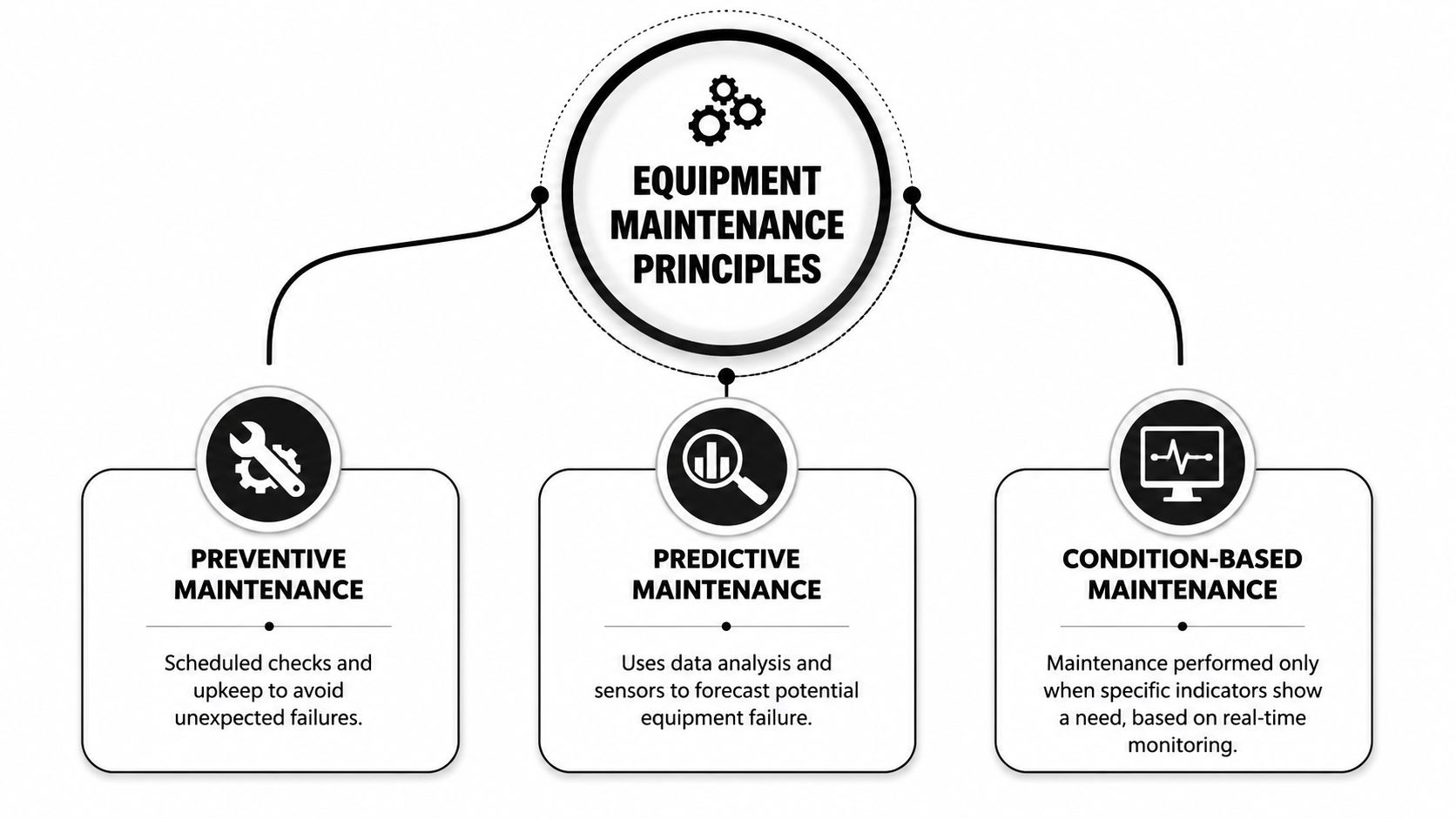
The easiest way to understand equipment maintenance schedules is to think about your car. If you wait until the engine overheats on the highway, you're using a run-to-failure strategy. If you change fluids, inspect brakes, and replace parts before they fail, you're using preventive maintenance. If a sensor warns you about a specific developing problem, you're using condition-based or predictive methods.
That same logic applies to aviation and medical equipment, except the stakes are far higher.
The four maintenance approaches that matter
Preventive maintenance is scheduled work done before failure. That includes inspections, lubrication, cleaning, battery checks, software updates, and planned part replacement.
Predictive maintenance uses trend data to anticipate failure. In some environments that means watching vibration, temperature, or performance patterns and intervening before the fault becomes operational.
Condition-based maintenance happens when actual equipment condition crosses a threshold. Instead of changing a part only because the calendar says so, the team responds to a measured sign of deterioration.
Corrective maintenance happens after something is found defective or after failure occurs. It has a place, but nobody wants it to be the primary strategy for patient-critical equipment.
Why preventive discipline usually wins
For most safety-critical assets, waiting for failure is poor practice. Maintenance costs typically represent 5 to 15% of total production costs, and best practice is to set preventive maintenance intervals at 80 to 90% of an asset's actual MTBF so there's a buffer before the expected failure point, as outlined in Oxmaint's maintenance guide.
That principle matters in medical transport because you don't schedule around average luck. You schedule around controlled reliability.
A useful term here is MTBF, or Mean Time Between Failures. It helps a maintenance team understand how long equipment typically runs between breakdowns. Another important measure is OEE, or Overall Equipment Effectiveness, which is often used more broadly in industrial settings to judge how much of an asset's full potential is utilized. In aviation medicine, the practical version of those ideas is simpler: how reliably does the equipment perform, and how often does it create disruption?
Good maintenance programs don't rely only on what the manual said when the equipment was new. They learn from actual service history.
What works and what doesn't
What works is matching the maintenance strategy to the asset.
- Critical life-support devices: These need scheduled checks, calibration control, and documented service intervals.
- Frequently used transport gear: This benefits from both routine inspection and usage-informed servicing.
- Low-criticality auxiliary items: Some may justify inspection-first strategies rather than aggressive scheduled overhaul.
What doesn't work is applying one blanket rule to every asset. Some organizations over-maintain non-critical equipment and under-monitor mission-critical devices. Both are mistakes.
If you manage a service operation outside aviation and want a grounded look at maintenance discipline in a smaller-shop context, FixyFlow's guide for service businesses is a useful contrast because it shows how process control starts with basic operational habits. In air medical environments, that same discipline scales upward and becomes more formalized.
For providers that rely on dedicated technical oversight for specialized onboard systems, a role like a medical equipment specialist becomes essential. That function bridges the gap between clinical expectations and technical execution.
The Regulatory Framework for Air Medical Safety
In air medical transport, compliance is not a branding exercise. It is the minimum acceptable operating condition. Regulations exist because crews, patients, and operators need common rules for airworthiness, training, documentation, and dispatch decisions.
A case manager doesn't need to memorize aviation law, but it helps to understand what strong oversight looks like. It means the flight cannot go because someone is in a hurry. It goes only when the aircraft, the crew, and the required equipment meet the applicable standard.
Maintenance schedules are a legal requirement
In Canada, Standard 625 of the Canadian Aviation Regulations mandates that all aircraft, excluding ultra-light or hang-gliders, must be maintained in accordance with a maintenance schedule approved by the regulatory authority, ensuring continuous airworthiness, as stated in Transport Canada's Standard 625.
That principle is bigger than one country. The underlying expectation is the same across credible air medical operations. Aircraft and associated systems are maintained against approved schedules, not informal habits.
What a Minimum Equipment List actually means
One term that often causes confusion is Minimum Equipment List, or MEL. An MEL is a regulator-approved document that allows an aircraft to be legally dispatched with certain inoperative equipment under defined conditions, provided those conditions are met.
That does not mean “anything broken is acceptable.” It means regulators define, in advance, what may be deferred, under what restrictions, for how long, and with what operational limitations. In serious operations, the MEL protects safety because it removes guesswork. Dispatch decisions are governed by approved criteria, not optimism.
Medical readiness goes beyond the airplane
There's also the clinical side. Under 14 CFR Part 135, FAA-approved medical personnel must complete a training program within the preceding 24 calendar months, and each program includes a minimum of 4 hours of ground instruction, according to the electronic Code of Federal Regulations for Part 135.
That matters because equipment safety isn't just about maintenance technicians. It also depends on clinicians using devices correctly, recognizing abnormalities, and following operating procedures consistently.
Regulations set the floor. Strong operators build systems above that floor because fragile patients don't benefit from minimum effort.
How regulations translate into patient safety
For families and hospital staff, the practical implications are straightforward:
- The aircraft follows an approved maintenance program.
- The operator cannot legally substitute personal judgment for regulator-approved dispatch criteria.
- Crew training remains time-bound and documented.
- Medical mission readiness depends on both airworthiness and equipment readiness.
That layered structure is reassuring for a reason. It means the flight is supported by engineering discipline, operational rules, and medical standards that all have to align before transport begins.
How to Create an Effective Maintenance Schedule
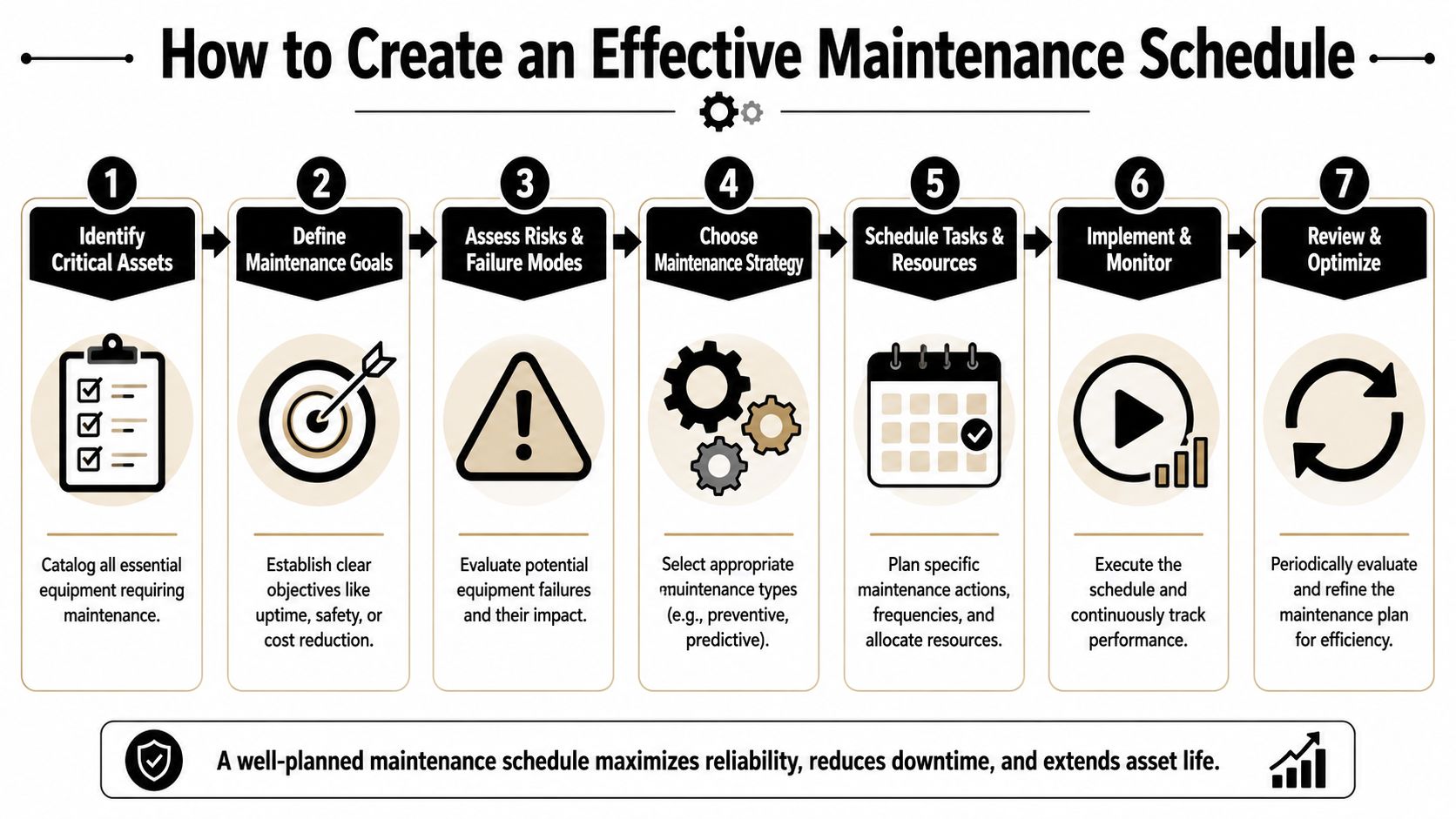
A good maintenance schedule is built, not improvised. If you're responsible for clinical devices in a hospital transport unit, a flight program, or any mobile care environment, the process should be deliberate and auditable from the start.
Start with the asset list and criticality
Begin with a complete inventory. Not a rough list. A real one. Every ventilator, monitor, suction device, infusion pump, stretcher power system, battery charger, inverter, oxygen regulator, and installed aircraft support component needs an identity.
Then rank each asset by criticality. Ask two direct questions:
- If this fails, does patient safety suffer immediately?
- If this fails, can the mission continue safely?
That step keeps teams from treating every item the same. A life-support device and a convenience accessory should never sit on the same maintenance logic.
Use the right trigger for each task
Effective equipment maintenance schedules are built around three primary interval triggers: time-based, usage-based, and condition-based, and heavy equipment examples commonly use 250, 500, 1,000, and 2,000 hour service intervals to match wear patterns, as explained in Sockeye's guide to equipment maintenance scheduling.
In medical aviation, the same principle applies even when the exact intervals differ by device and manufacturer guidance.
- Time-based triggers: Good for recurring inspections, calendar servicing, and compliance checks.
- Usage-based triggers: Useful when wear depends on hours, cycles, or mission exposure.
- Condition-based triggers: Best when sensors, diagnostics, or performance checks can signal the actual need for intervention.
A common mistake is forcing everything onto the calendar. Another is trusting usage alone when calibration drift or storage conditions also matter.
Define the task, the person, and the record
A schedule isn't complete until every task answers these questions:
- What exactly gets done
- Who is qualified to do it
- What tools or parts are required
- What counts as pass or fail
- Where the result gets recorded
That level of detail prevents the most common failure in maintenance programs, which is assuming everyone interprets “check unit” the same way.
Here's a sample framework you can adapt.
| Equipment | Daily/Pre-Use Check | Weekly Check | Monthly/Quarterly Check | Annual/Bi-Annual Service |
|---|---|---|---|---|
| Transport ventilator | Power-on self-test, battery status, alarm verification, circuit inspection | Functional verification and accessory check | Performance review, configuration review, condition inspection | Full service and calibration per manufacturer and regulatory requirements |
| Cardiac monitor defibrillator | Battery charge check, leads and cable inspection, screen and alarm check | Operational test and accessory inventory | Output verification and condition review | Certified preventive service and calibration |
| Portable suction unit | Vacuum check, canister and tubing inspection, battery check | Functional run test | Seal and performance inspection | Full preventive service and replacement of worn components as required |
| Infusion pump | Power, display, controls, battery, and alarm check | Function test | Accuracy review and physical inspection | Scheduled calibration and preventive maintenance |
| Stretcher loading system | Visual latch and restraint check | Full movement and locking test | Structural and wear inspection | Detailed service and certification as applicable |
Build reviews into the calendar
Schedules fail when nobody revisits them. Review completion rates, overdue work, repeat findings, and unscheduled repairs. If a device repeatedly develops the same issue between planned service events, the interval or task scope probably needs revision.
For teams refining their broader process, this outside perspective on how to improve your equipment maintenance programs is useful because it reinforces the idea that scheduling is only as strong as the follow-through behind it.
Field lesson: The schedule should be simple enough to execute under pressure and detailed enough to survive an audit.
Maintenance Schedules in Action Medical and Aviation Examples
Theory matters, but maintenance is often best understood when observed in real operations. In transport medicine, the difference between a weak schedule and a strong one is visible in the routine.

A transport ventilator on a flight program
Consider a transport ventilator assigned to an air ambulance mission set. It doesn't wait for annual service to prove readiness. All medical equipment used in air transport missions must undergo rigorous maintenance schedules including daily pre-flight inspections and calibration checks before every mission to ensure operational integrity, as noted in Paraflight's medical air transport preparation guidance.
That standard changes daily behavior.
Before the aircraft leaves, the clinician or designated crew member performs the pre-flight check. They verify power, alarms, battery condition, circuit integrity, settings interface, and general readiness. If anything is questionable, the equipment doesn't get a pass because the departure time is tight. It gets removed from service or escalated.
Later, on a recurring shop schedule, a technician performs deeper function checks, looks for wear patterns, reviews service history, and confirms the unit remains within service requirements. Then, on the manufacturer-driven preventive cycle, the ventilator receives more thorough service, including calibration and replacement of components subject to scheduled change.
If you want to understand the kind of onboard systems and mission gear that have to work together during transport, Med Jets offers a helpful overview of flight equipment used in medical transport.
The same device in a hospital ICU
Now compare that same ventilator model in a fixed hospital environment. The clinical goal is still reliability, but the operating stress is different. The unit isn't exposed to aircraft vibration, loading constraints, changing power configurations, or the same transport packaging demands.
That usually means the maintenance schedule can lean more on environmental stability. Access to backup devices is also easier. If a problem appears, the care team may have faster substitution options than a flight crew in a departure sequence.
The takeaway isn't that hospital schedules are loose. It's that mobile aviation assets need tighter operational discipline because the margin for improvisation is smaller.
A short visual example helps make that real:
What strong practice looks like day to day
In mature programs, you see the same habits repeatedly:
- Crew checks are standardized: The pre-use routine follows a checklist, not memory.
- Technical service is separate from casual inspection: A quick glance never replaces scheduled preventive work.
- Out-of-service decisions are respected: Delays caused by equipment questions are treated as safety decisions, not operational annoyances.
That last point matters. When a provider pauses to resolve an equipment discrepancy, that is usually evidence of a healthy safety culture.
Recordkeeping Audits and Continuous Improvement
Maintenance that isn't documented is difficult to defend, difficult to analyze, and difficult to trust over time. In regulated environments, recordkeeping is part of the maintenance work itself.
A solid schedule tells people what should happen. The records prove what happened.
Why audit-ready records matter
Every maintenance action should leave a trail. That includes inspection findings, corrective action, calibration status, deferred items if applicable, technician identity, dates, and return-to-service documentation. Without that, a team can't reliably answer basic questions after the fact.
Hospital partners should expect this level of discipline. If a transport provider can't show clean records, it becomes harder to verify compliance, investigate discrepancies, or demonstrate consistency across the fleet and equipment pool.
A practical benchmark is worth noting here. Organizations conducting monthly reviews of schedule compliance and tracking KPIs such as overdue tasks and rework rates achieve a 40% reduction in missed maintenance events and a 22% improvement in asset uptime by using root cause analysis to revise intervals, according to this preventive maintenance benchmark discussion.
What to review every month
A monthly review doesn't need to be complicated, but it does need to be disciplined.
- Overdue work: Which tasks slipped, and why?
- Repeat discrepancies: Are the same units showing the same faults?
- Calibration exposure: Are any clinical devices approaching limits or documentation gaps?
- Rework patterns: Did a completed task solve the issue?
- Interval quality: Did anything fail between scheduled service events?
The best schedules improve because someone studies the misses, not because someone assumes the original plan was perfect.
Documentation as a safety tool
When teams analyze maintenance history, they often find the weak points quickly. Maybe one battery type ages poorly in transport use. Maybe one mounting arrangement causes cable wear. Maybe a task is being done on time but not in enough depth.
That is where systems and standards matter. A provider that treats record control seriously is better positioned to support hospital documentation needs too, especially when care transitions, equipment status, and mission readiness all have to align. Med Jets outlines that broader discipline in its approach to medical documentation standards.
Continuous improvement is not abstract. It's the practical habit of learning from every work order, every discrepancy, and every close call before it becomes a patient event.
Frequently Asked Questions About Equipment Maintenance
What's the difference between maintenance and calibration
Maintenance keeps equipment functional and reliable. Calibration verifies that a device measures or delivers within required accuracy. A monitor can power on and still be out of calibration. A ventilator can pass a basic function check and still need a scheduled calibration event.
What happens if equipment is found unserviceable before a flight
A strong program stops and resolves it. That might mean swapping equipment, delaying departure, using approved backup resources, or removing the aircraft from service depending on the issue. Families sometimes hear “delay” and worry. In this context, a delay caused by a failed check is often evidence that the safety system worked.
Who is qualified to perform maintenance on air medical equipment
It depends on the equipment and the task. Aircraft maintenance requires appropriately authorized aviation personnel. Medical device maintenance and calibration may require trained biomedical personnel, manufacturer-qualified technicians, or others specifically authorized under the operator's procedures. The critical point is that the schedule should define qualifications clearly rather than assume any technician can do any task.
Should every asset be on the same preventive schedule
No. Criticality, manufacturer requirements, environment, frequency of use, and service history all matter. Some low-criticality assets may justify inspection-focused oversight instead of aggressive scheduled service. Patient-critical assets should be managed far more tightly.
Why do equipment maintenance schedules matter so much in air medical transport
Because air medical crews can't pull over and replace a life-support device mid-mission. The schedule reduces uncertainty before the patient is loaded. That's why disciplined operators treat maintenance planning, pre-flight checks, calibration status, and documentation as one integrated safety system.
What should a hospital case manager ask a transport provider
Ask whether the aircraft and onboard medical equipment are maintained on documented schedules, whether pre-flight equipment checks are performed before each mission, how discrepancies are handled, and whether records are audit-ready. Those questions are practical, fair, and directly tied to patient safety.
When a family or case manager needs air medical transport, confidence comes from disciplined systems behind the scenes. Med Jets by Air Trek has been providing medical transportation solutions since 1978, with experienced crews, dedicated aircraft, and coordinated support from first call to arrival. If you need help arranging a transfer, visit Med Jets by Air Trek to learn more.