

A hospital case manager gets the call late in the day. The patient is medically fragile, needs a long-distance transfer, and also has bariatric requirements that rule out a standard setup. A spouse insists on staying with the patient. A service animal is part of the care routine. The receiving hospital wants records before wheels-up. The insurer wants clarity on coverage. Ground transport on both ends has to match the aircraft configuration. Nobody in that chain can afford a missed handoff.
That's where ad-hoc transport breaks down.
When providers, hospitals, insurers, and ground teams only know each other transaction by transaction, the case turns into a scramble. People repeat the same information across multiple calls. Clinical details get rechecked because nobody trusts the last handoff. Family expectations are managed too late. Billing questions surface after the mission is underway, not before. For the patient, it feels chaotic. For the case manager, it feels risky. For the insurer, it looks uncontrolled.
Strong network partnerships change that dynamic. They replace one-off coordination with known contacts, agreed workflows, credentialed operators, documentation standards, and a shared understanding of what patient-centered care means when the case is complicated. In air medical transport, that matters most when the patient doesn't fit the simple script.
Why Ad-Hoc Medical Transports Are Failing Patients
A complex transfer rarely fails because one person didn't care. It fails because too many parties are trying to solve the same problem from different systems, with different priorities, and no shared operating model.
What the case manager is up against
Take a realistic transfer scenario. A discharge planner needs to move a bariatric patient from a regional facility to a specialty center several states away. The sending team is focused on clinical readiness. The receiving team wants bed confirmation and timing. The family wants to know whether one person can accompany the patient and whether the patient's animal can travel safely. The insurer wants medical necessity, transport mode rationale, and network status. Ground teams want weight, lift requirements, access details, and timing windows.
In an ad-hoc arrangement, every one of those questions lands at a different point in the process.
That creates predictable failure points:
- Clinical mismatch: The aircraft or medical crew may be available, but not configured for the patient's size, acuity, or equipment needs.
- Communication drift: Hospital staff, transport coordinators, and family members hear different versions of timing and scope.
- Coverage confusion: Nobody confirms the network path early enough, so the financial conversation starts after the transfer is already emotionally committed.
- Human needs get treated as side issues: Family accompaniment and pet accommodation become “maybe” items instead of planned operational components.
Practical rule: If family, mobility needs, or animal accompaniment are discussed after flight acceptance, the operation is already behind.
Why generic partnership advice misses the real problem
A lot of business content about partnerships treats the relationship like a sales channel. That misses the point in air medical transport. Here, the partnership has to carry clinical, operational, billing, and emotional weight at the same time.
That's especially true for continuity cases involving bariatric patients or medically fragile travelers who need bedside-to-bedside support across fragmented hospital systems. Generic frameworks assume urban density, interchangeable vendors, and straightforward patient handoffs. Real transfer work often involves rural sending facilities, limited local resources, difficult ground access, and families who are trying to stay physically close during a crisis.
Questions people ask usually sound like this:
- How do network partnerships reduce transfer delays when multiple providers are involved?
- What should a hospital ask an air ambulance partner before sending a bariatric patient?
- Can a transport network support a family escort and still stay clinically compliant?
- How do insurers evaluate an in-network air ambulance partner for complicated transfers?
Those are the right questions. They force the partnership discussion out of theory and into execution.
What works better
A working network partnership doesn't start with a logo swap or a referral agreement. It starts with operational honesty. Can the air provider support the patient profile the hospital sees? Can the insurer trust the documentation package? Can dispatch coordinate ground, bedside handoff, and receiving-facility timing without improvising each leg?
When those answers are built into the relationship, the patient experiences continuity instead of fragmentation. That's the standard worth building toward.
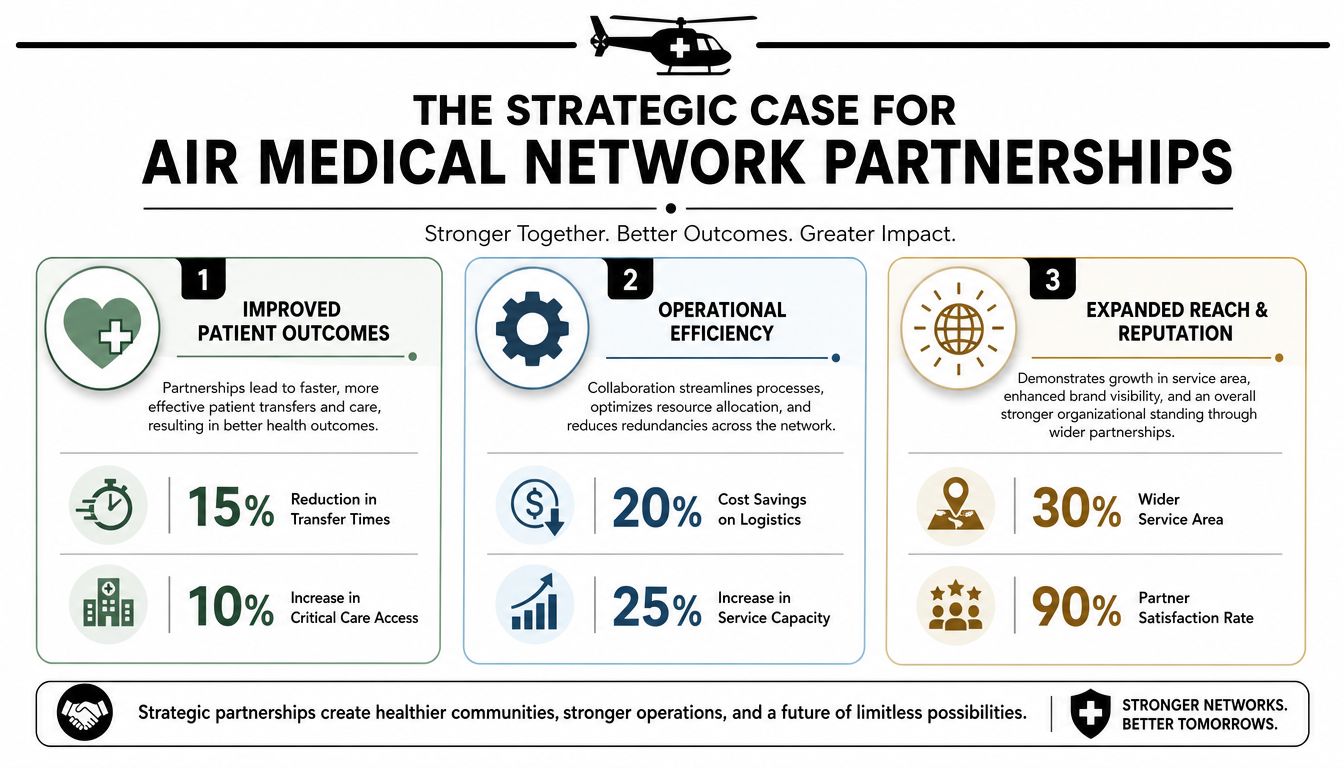
The Strategic Case for Air Medical Network Partnerships
Formal partnerships aren't paperwork for its own sake. They're a risk-control system for one of the most sensitive points in care delivery.
In the air ambulance market, less than 25% of commercially insured patient transports occur within in-network partnerships, leading to a 77% out-of-network rate for helicopter services and a 40% balance bill incidence averaging $19,851 per case, according to research on air ambulance billing and network status. That single set of numbers explains why hospitals, case managers, insurers, and families all feel exposed when they don't have an established transport network.
Why the status quo costs everyone
For hospitals, the immediate problem is discharge and transfer friction. Staff spend valuable time finding an available provider, validating capability, coordinating records, and calming family concerns that should've been addressed by a known network pathway. The reputational risk is real too. Families often don't separate the hospital from the transport arrangement. If billing shock arrives later, they remember who initiated the transfer.
For insurers, unmanaged transport relationships create the opposite of predictability. Every mission becomes a new negotiation over necessity, rates, and documentation quality. That's not just expensive. It's slow.
For patients and families, the biggest problem is uncertainty. They need to know who's moving the patient, who's allowed to travel, how handoffs will work, and whether the transfer is clinically and financially coherent.
What formal network partnerships actually improve
The strongest network partnerships create structure in four places:
| Partnership area | What improves |
|---|---|
| Coverage alignment | In-network pathways reduce the chance that patients and families learn about financial exposure after the mission |
| Clinical handoff | Hospitals work with transport teams that already understand documentation, escalation routes, and receiving-facility expectations |
| Operational speed | Dispatch and case management stop rebuilding the process from zero each time |
| Member experience | Insurers and hospitals can support a more consistent patient journey, including non-clinical needs |
That last point gets ignored too often. A patient-centered transfer isn't only about lifting a patient safely. It's also about making the transfer survivable emotionally for the people around them. In long-distance moves, family presence can stabilize communication and decision-making. The same is true when a service animal or pet is part of the patient's daily reality and mental stability.
The best transport partnership is the one that removes uncertainty before the call becomes urgent.
There's also a practical lesson from adjacent coordination-heavy industries. Teams that deal with multi-party travel and timing constraints know that process clarity matters as much as the vehicle itself. A useful comparison is managing business travel effectively, where itinerary control, stakeholder communication, and service standards all have to line up. Air medical transport is more clinically serious, but the operational principle is similar. Unclear handoffs create avoidable failure.
Mutual aid planning is part of that discipline too. Systems that rely on a single provider without backup options stay brittle under stress. Hospitals and transport programs that use formal mutual aid agreements tend to handle surge, geography, and special-case complexity more cleanly because roles are already defined before the difficult call arrives.
A Blueprint for Partner Outreach and Engagement
Most outreach fails before the first call because the message is too generic. Hospitals, specialty clinics, insurers, and case management teams don't all care about the same thing. If you pitch them with one broad partnership deck, you'll sound unprepared.

Start with the right target list
A disciplined partner map saves time. That matters because the average partnership manager spends 35% of their time solely on partner discovery, costing businesses approximately £13,300 and 584 hours per person annually for this activity alone, as outlined in these partnership management figures.
Don't begin with “every hospital in the region.” Build a narrower list based on actual fit.
A useful sequence looks like this:
Referral-heavy hospitals
Look for facilities that regularly need higher-acuity transfers, long-distance repatriation, or specialty destination placements.Specialty programs
Bariatric surgery centers, transplant centers, burn programs, rehab networks, and tertiary systems often see continuity problems that standard transport vendors don't solve well.Case management leadership
Frontline planners feel the pain, but directors can change process. Reach both.Insurer network and case teams
Don't wait until hospital volume is established. Early payer conversations shape how your value is interpreted.
Tailor the value proposition by partner type
Each audience needs a different lead message.
- Hospitals want reliability: They care about safe handoff, transfer readiness, reduced administrative friction, and fewer escalations from families.
- Insurers want control: They want documentation quality, consistent communication, and a transport partner that doesn't create billing surprises.
- Case managers want responsiveness: They need one call path, clarity on what's possible, and confidence that special needs won't trigger last-minute reversals.
- Specialty centers want continuity: They care about receiving patients with the right information, equipment support, and timing discipline.
A bad opening says, “We provide nationwide medical transport solutions.”
A better opening says, “We help hospitals and payers move complex patients, including bariatric and medically fragile cases, with a defined process for family accompaniment, bedside coordination, and receiving-facility handoff.”
Field note: If your outreach doesn't mention the partner's actual operational pain, they'll assume you're another vendor selling lift capacity.
Use outreach that sounds like a practitioner wrote it
Here's a simple first email to a hospital case management leader:
Subject: Reducing friction in complex patient transfers
We work with hospitals that need dependable long-distance medical transport for cases that don't fit a standard discharge pattern, including bariatric patients and transfers where family accompaniment matters.
I'd value a short conversation about where your current transfer process gets stuck, especially around after-hours coordination, documentation flow, and hard-to-place patients. If there's a fit, we can outline a practical network pathway rather than another one-off vendor relationship.
And here's a payer-facing version:
Subject: In-network transport model for complex member transfers
I'm reaching out to discuss a structured air medical partnership approach for medically necessary transfers that need stronger documentation, clearer communication, and a more consistent member experience.
We've found the biggest gaps usually appear in cases involving long-distance coordination, medically fragile members, and non-standard accompaniment needs. If useful, I can share how we frame service scope, escalation, and operational accountability in early contracting discussions.
A short visual overview can help internal champions explain your model to their teams.
Questions to expect in early conversations
Don't wait for these. Bring answers.
| Common question | What the partner is really asking |
|---|---|
| Can you handle bariatric cases? | Are you operationally prepared, or are you just saying yes to win the account? |
| What about a spouse or family escort? | Can you preserve patient stability without creating confusion in the cabin or during handoff? |
| How do you coordinate records? | Will our staff have to chase your team for basics? |
| What happens after hours? | Is this a real operating partner or a daytime business development office? |
The strongest outreach doesn't oversell. It shows that you understand complexity, you've planned for it, and you know the difference between availability and readiness.
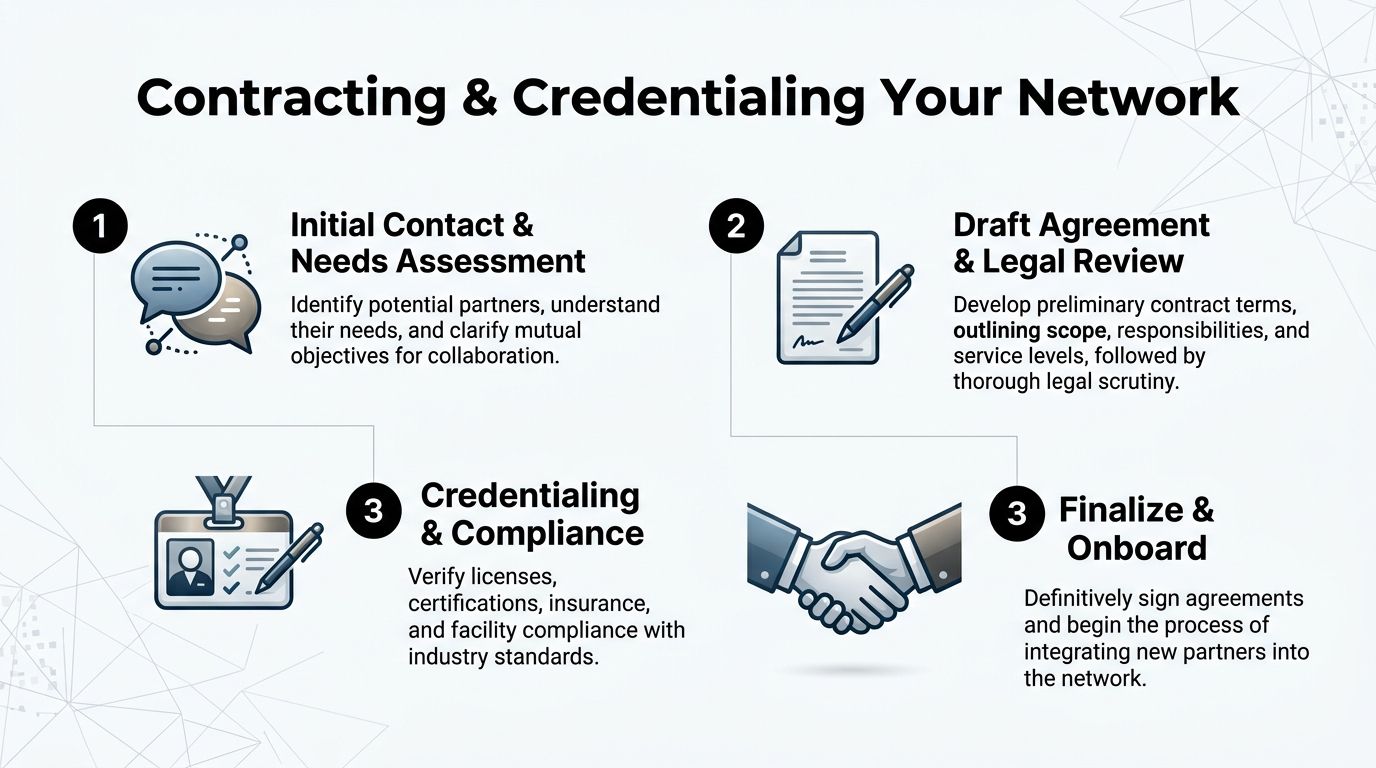
Contracting and Credentialing Your Network
Interest is easy. Formalizing a partnership is where weak operators get exposed.
Hospitals and insurers don't need broad promises. They need contracts that define service scope, response expectations, credentialing standards, and dispute prevention. If those details stay fuzzy, the relationship will rely on goodwill until the first difficult case tests it.
Use real models, not abstract language
A good example of concrete in-network contracting is that in February 2023, Air Methods and UnitedHealthcare formally announced a partnership to provide air ambulance services to UnitedHealthcare members, establishing a named model for in-network air ambulance service, as noted in this air ambulance market overview. The takeaway isn't that every provider should copy that exact structure. The takeaway is that named parties, defined scope, and explicit member coverage beat vague affiliation language every time.
What should be in the agreement
A transport partnership contract should answer operational questions before they become billing fights or clinical escalations.
Core components usually include:
Service scope
Define what transfers are covered. Include facility-to-facility, bedside-to-bedside coordination, specialty patient profiles, and any exclusions.Activation process
Specify who can request service, how calls are escalated, and what intake information is required before acceptance.Documentation standards
State what clinical, insurance, and consent records must be transmitted, and in what order.Rate structure and billing terms
The agreement should explain how reimbursement works, when authorization is required, and how exceptions are handled.Performance expectations
Set response, communication, and issue-resolution expectations. If you don't define these, each party will invent its own standard later.
Sometimes a lighter preliminary document helps both sides frame the relationship before full legal drafting. For teams that need a quick primer, it helps to understand what is an MOU and how it differs from a definitive contract. An MOU can clarify intent, but it won't replace a proper service agreement when patients, reimbursement, and compliance are on the line.
Get very specific about who owns each handoff. “Shared responsibility” usually means no one acts fast enough when a case changes.
Credentialing is where trust becomes real
Credentialing shouldn't be treated like admin cleanup after the contract is signed. It's the operational proof behind the promise.
A hospital or payer will usually want a clean documentation package that can be reviewed without repeated follow-up. That package often includes FAA operating credentials, medical licenses, insurance coverage details, clinical protocols, quality documentation, and contact paths for operational escalation.
A strong process also gives partners a central reference point for required forms and review standards. A practical benchmark is keeping alignment with documented medical documentation standards so hospital and payer teams aren't guessing about what your intake process requires.
Watch for these negotiation traps
Some clauses create long-term problems if they're accepted too casually.
| Clause area | Healthy version | Risky version |
|---|---|---|
| Exclusivity | Limited, conditional, tied to actual performance | Broad exclusivity with no volume commitment |
| Service levels | Defined expectations with operational carve-outs | Blanket guarantees that ignore weather, clinical complexity, or receiving delays |
| Termination | Clear cure period and transition terms | Immediate exit rights that leave active workflows stranded |
| Exception handling | Written process for unusual cases | Silent contract that forces case-by-case conflict |
Credentialing and contracting aren't separate tasks. They're one discipline. If the contract says one thing and the credentialing file suggests another, the partner will notice. That's when confidence drops, legal review expands, and momentum disappears.
Integrating Operations for Seamless Patient Care
A signed contract doesn't move a patient. Operational integration does.
Many network partnerships encounter a common sticking point. Everyone agrees in principle, but the first complicated transfer still depends on improvisation. The sending nurse doesn't know who updates the family. The ground team doesn't know whether the patient needs bariatric loading support. The receiving unit doesn't know when records will arrive. The insurer gets a utilization review packet that looks different every time.
Build the handoff around the patient, not the org chart
In air medical work, bedside-to-bedside service only exists when all handoffs are choreographed. That starts with a single communication spine.
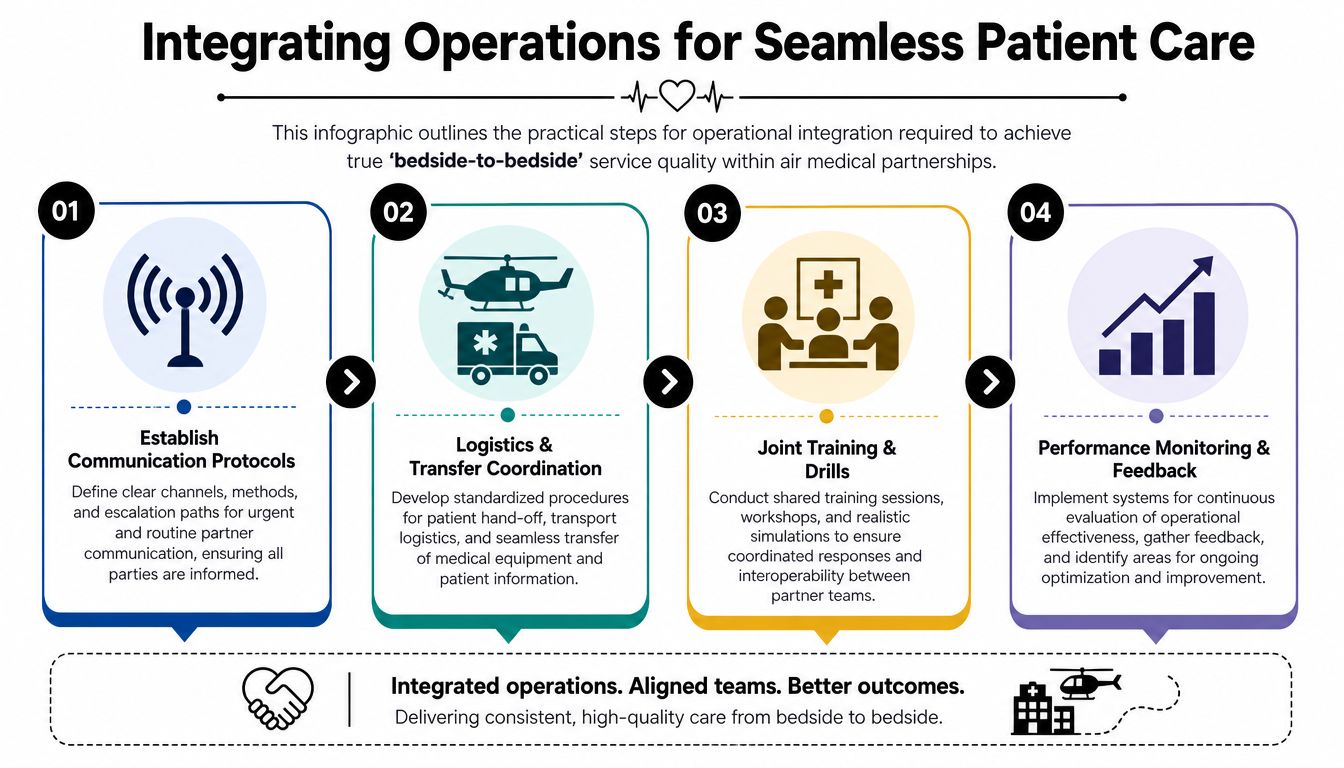
For most partnerships, the operational design should include:
- One intake path: One number, one portal, or one dispatch route for activation.
- Named role ownership: The hospital knows who handles clinical intake, who handles logistics, and who handles family communication.
- Escalation rules: If the patient condition changes, weather shifts, or ground transport slips, everyone knows who gets called first.
- Receiving coordination: The destination team gets timing updates and records in the same pattern every time.
That consistency matters because transport mode decisions can affect outcomes. Helicopter transport to Level I trauma centers demonstrates a 1.5% absolute increase in survival rates and a 57% lower likelihood of death compared to ground transport, according to this air ambulance services market report. For insurers and hospitals, that kind of evidence supports why network inclusion should be tied to integrated clinical workflows, not just vendor availability.
Make room for the human details early
The hardest cases usually involve details that generic transport workflows ignore.
A practical integration plan should address questions like:
- Can a family member accompany the patient, and under what conditions?
- How is a service animal or pet handled without disrupting clinical safety?
- What equipment, loading, and ground coordination are needed for a bariatric patient?
- Who confirms access limitations at the sending and receiving sites?
- What happens if the family arrives with expectations the contract never addressed?
Those aren't side questions. They shape the mission.
A transfer can be medically sound and still fail the patient if the partnership treats family communication like an afterthought.
Shared systems matter more than flashy systems
You don't need a complicated tech stack. You need one that your partners will use. In practice, that usually means secure document exchange, visible status updates, and a consistent way to capture handoff milestones.
For organizations thinking through interoperability, the Simbie AI approach to EHR integration is a useful example of how care coordination tools can reduce friction between systems. The lesson for air medical partnerships is straightforward. If clinical and logistical data live in separate silos, the phone will keep doing work that software should've handled.
A stable continuity model also helps to document what the patient journey should look like beyond the flight itself. Clear patient continuity of care standards make it easier for partners to define how records, equipment needs, family updates, and receiving-facility acceptance all fit into one operating workflow.
A simple workflow for complex cases
Here's a working pattern for a difficult transfer:
| Operational phase | What the network should do |
|---|---|
| Intake | Confirm clinical status, destination acceptance, insurance pathway, bariatric needs, and accompaniment requests |
| Mission planning | Match aircraft and crew, line up ground transport on both ends, prepare loading and access plan |
| Pre-departure communication | Update sending facility, receiving facility, insurer contact, and family with one aligned timeline |
| Transport and handoff | Move records, equipment, and patient together with live escalation if conditions change |
| Post-mission review | Close the loop on documentation, coverage questions, and partner feedback |
Mature network partnerships separate themselves from transactional vendors. They don't just fly the patient. They absorb complexity without turning the patient and family into project managers.
Measuring and Sustaining Partnership Success
A partnership isn't mature because the contract is signed. It's mature when the partners can review performance candidly, fix weak points quickly, and keep the relationship useful under pressure.
What to review regularly
The most useful reviews stay close to operations. Focus on what your partners can act on.
Track items such as:
- Transfer request patterns: Which service lines, facilities, or member scenarios generate the most need?
- Activation friction: Where are requests stalling before acceptance?
- Documentation quality: Are hospitals and insurers getting complete information in the format they expect?
- Escalation themes: What keeps triggering preventable calls, rework, or confusion?
- Experience feedback: What are families, case managers, and receiving teams saying after difficult transfers?
A quarterly business review works well when it includes both leaders and the people who coordinate missions. Senior sponsors can approve changes, but frontline teams usually know where the workflow is breaking.
What mature partnership management delivers
The long-term business case for disciplined partnership management is strong. High-maturity partnership programs generate 28% of a company's revenue, according to these strategic partnership benchmarks. In air medical transport, the lesson is practical. If a provider treats network partnerships as a side project, the value stays limited. If it manages them as a core operating system, the relationships compound.
That doesn't mean every partnership should expand. Some should be narrowed. Some need stronger service boundaries. Some need better documentation habits before deeper integration makes sense.
Strong network partnerships survive because both sides keep proving value, not because the agreement auto-renews.
Questions people often ask at this stage are the right ones. How often should hospital and transport partners review performance? What should an insurer demand in a transport scorecard? How do you know when a referral relationship is ready to become a formal network partnership?
The answer is usually visible in the work itself. If transfers feel smoother, communication gets shorter because trust is higher, and fewer cases turn into avoidable disputes, the partnership is doing its job.
If your team is evaluating air medical transport options for complex hospital transfers, bariatric cases, medically fragile patients, or family-accompanied flights, Med Jets by Air Trek can help. As a family-operated program serving patients since 1978, the team coordinates end-to-end medical transport with a patient-centered approach that includes specialized aircraft capability, ground transport coordination, and 24/7 support.