

A call about medical transport usually comes at a bad moment. Someone you love is in a hospital far from home, or a local hospital has said they need a higher level of care elsewhere. You're trying to think clearly while doctors, insurance representatives, and family members all ask questions at once.
That's when the term fixed-wing aeroplane often enters the conversation.
For most families, it doesn't feel like an aviation question. It feels like a safety question. Can your loved one travel that far? Will there be medical care on board? Is a helicopter better? Who handles the details from one hospital bed to the next?
A fixed-wing aeroplane, in plain language, is an airplane with wings that stay in place while the aircraft moves forward. In medical transport, that simple design matters because it makes long-distance travel possible in a way that is steady, efficient, and practical for many patients who need to move between cities, states, or countries.
When Every Mile Matters an Introduction to Medical Transport
A transfer decision often starts with a hard, practical question. If the right care is far away, what is the safest way to get a patient there without adding new risk on the way?
That question comes up in many forms. A family may need to bring someone home after a serious illness in another state. A local hospital may need to send a patient to a larger centre with a specialist team. A rehabilitation facility may have accepted a patient, but the drive is too long for someone who needs monitoring, oxygen, pain control, or careful positioning. In each case, distance is no longer just an inconvenience. It affects treatment, comfort, timing, and safety.
Air medical transport solves that problem by turning a long and difficult journey into a controlled medical transfer. For families, the primary issue is not aviation for its own sake. It is choosing a transport method that fits the patient's condition, the route, and the level of care needed between one hospital bed and the next.
What families usually need to sort out first
The first decisions are usually straightforward once someone explains them clearly:
- Is the transfer urgent or planned? Some patients need to move quickly because a higher level of care is waiting elsewhere. Others are stable enough for a scheduled flight once the receiving hospital, medical records, and ground transport are arranged.
- What care is needed during the trip? Some patients need a full air ambulance team with medical equipment on board. Others may only need a medical escort and close supervision while traveling.
- Why use an airplane instead of another option? Fixed-wing transport is generally chosen for longer distances, especially when the goal is to move a patient efficiently between cities, states, or countries while maintaining medical oversight during the trip.
Families often hear the words “air ambulance” and picture urgency and noise. Many fixed-wing transfers are more measured than that. The pace is careful, the planning is deliberate, and the flight is built around the patient's needs.
How the decision is usually made
The aircraft is only one part of the decision. The sending team, the receiving team, and the transport provider all look at the same practical points: how stable the patient is, how far they need to go, what equipment must travel with them, whether weather or airport access could affect timing, and how much support is required on the ground at both ends.
A helpful way to picture it is to compare transport choices to different kinds of road travel. A short, urgent trip across town calls for one kind of vehicle. A long cross-country move for someone who needs continuous care calls for another. Fixed-wing medical transport is often selected because it handles long-range travel more efficiently and with less interruption than a long ground trip.
That does not make it the right answer for every patient. Some people need a helicopter for a short, time-sensitive transfer from a location without easy airport access. Some are well enough for a non-emergency medical escort arrangement. The right choice depends on the patient first, then the map.
For families, that distinction matters. Once you understand that medical transport is chosen by condition, distance, and onboard care needs, the conversation becomes clearer and less overwhelming.
How a Fixed-Wing Aeroplane Takes Flight
If you're trusting an aircraft with someone's care, it helps to understand why it flies in the first place. You don't need a pilot's license. You just need a workable mental picture.
A fixed-wing aeroplane has wings that don't spin or flap. The aircraft moves forward, air flows over and under the wings, and that motion creates lift.
The simple hand-out-the-window example
Think about riding in a car and holding your hand out the window. Tilt your hand slightly and you feel it rise or push back. An airplane wing uses that same basic idea, just with a shape designed to manage airflow much more effectively.
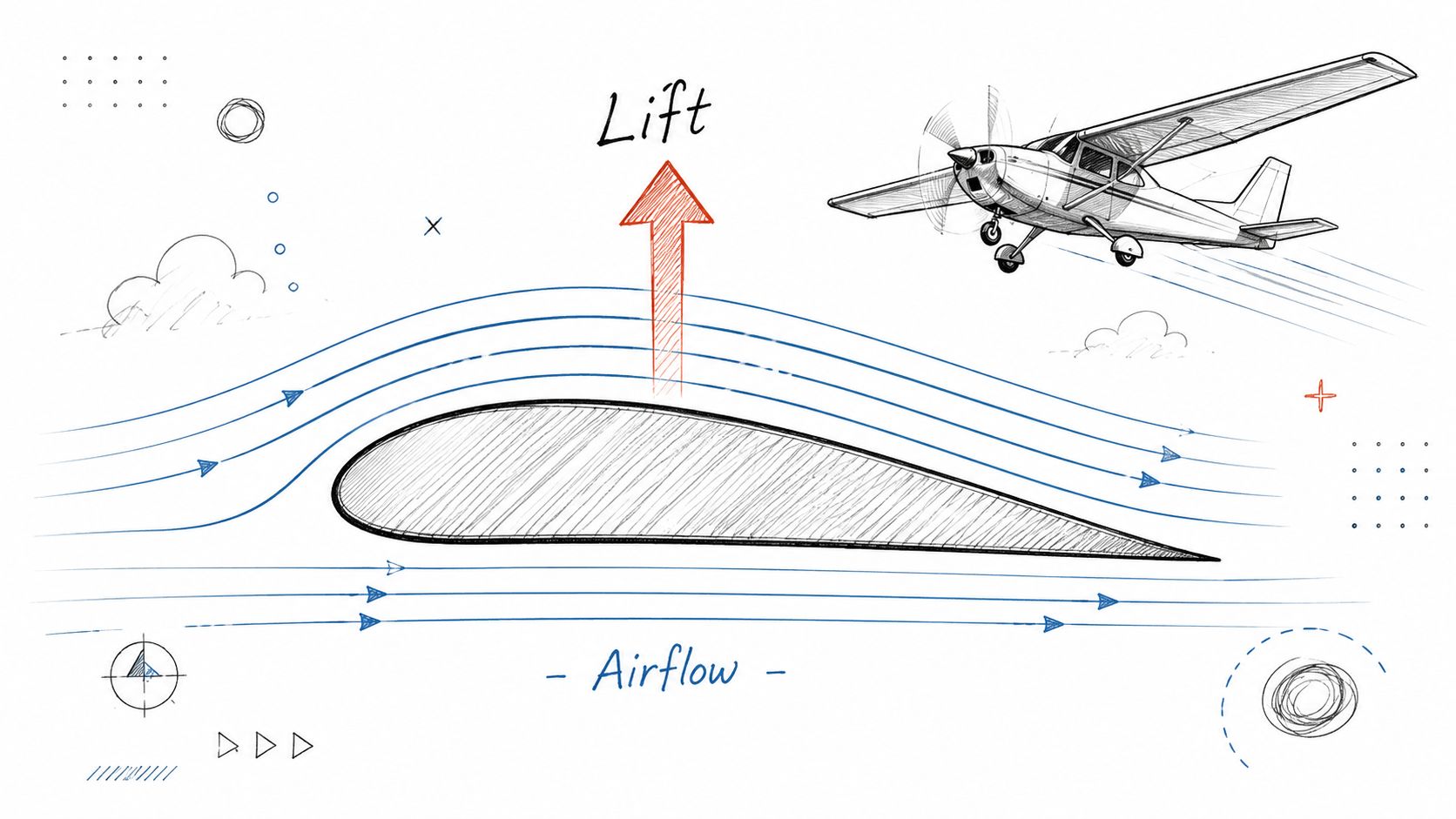
Sir George Cayley established the foundational concept of the modern fixed-wing aeroplane in 1799, defining it as a fixed-wing machine with separate systems for lift, propulsion, and control, and identifying the four forces of flight: weight, lift, drag, and thrust, according to the fixed-wing aircraft history summary on Wikipedia.
Those four forces sound technical, but they're easy to translate:
- Weight means gravity pulling the aircraft downward.
- Lift is the upward force created by the wings moving through the air.
- Thrust is the forward push from the engines.
- Drag is the resistance the aircraft meets as it moves through the air.
When the aircraft is properly balanced, those forces work together rather than against each other.
The parts that matter most
You'll hear a few aircraft terms during a transport call. Here's what they mean in plain English:
| Part | What it is | Why it matters in medical transport |
|---|---|---|
| Fuselage | The main body of the aircraft | This is where the cabin, patient area, crew seats, and medical equipment are located |
| Wings | The fixed surfaces that generate lift | They make efficient long-range flight possible |
| Tail | The rear surfaces that help control direction and balance | They help the aircraft stay stable and respond predictably |
| Engines | The power source that moves the aircraft forward | Forward motion is what lets the wings create lift |
Why stability matters more than families realize
In medical flying, “smooth” isn't just a comfort issue. It supports patient care.
A stable aircraft gives clinicians a better environment for monitoring equipment, managing medications, and watching for changes in the patient's condition. Even in formal performance testing, level flight depends on controlled equilibrium. One testing standard describes level flight as maintaining a stabilized vertical speed with less than ±25 feet deviation over a 60-second interval at target altitude, while holding airspeed constant, according to this DTIC flight test document.
Practical rule: Families don't need to memorize flight science. They do benefit from knowing that a fixed-wing aircraft is designed around controlled, balanced flight, not improvisation.
A short history that builds confidence
The technology behind airplane flight didn't appear overnight. Cayley's work turned flight into a scientific problem instead of a fantasy. Later inventors advanced the design until practical flying became possible.
That long development path matters. Medical aviation relies on a type of aircraft built on understood principles of lift, propulsion, and control. For families, that's reassuring. The system is complex, but the fundamentals are well established.
Fixed-Wing Jets vs Helicopters for Patient Transport
A family gets the call. Their loved one must move to another hospital today. The first question often sounds simple: “Do they need a helicopter or a jet?” In practice, that choice depends on where the patient is, how far they need to go, and what kind of care is easiest to deliver during the trip.
A helicopter and a fixed-wing jet are both air ambulances, but they are built for different jobs. Helicopters solve the access problem. Jets solve the distance problem.
For a quick visual comparison, this summary helps: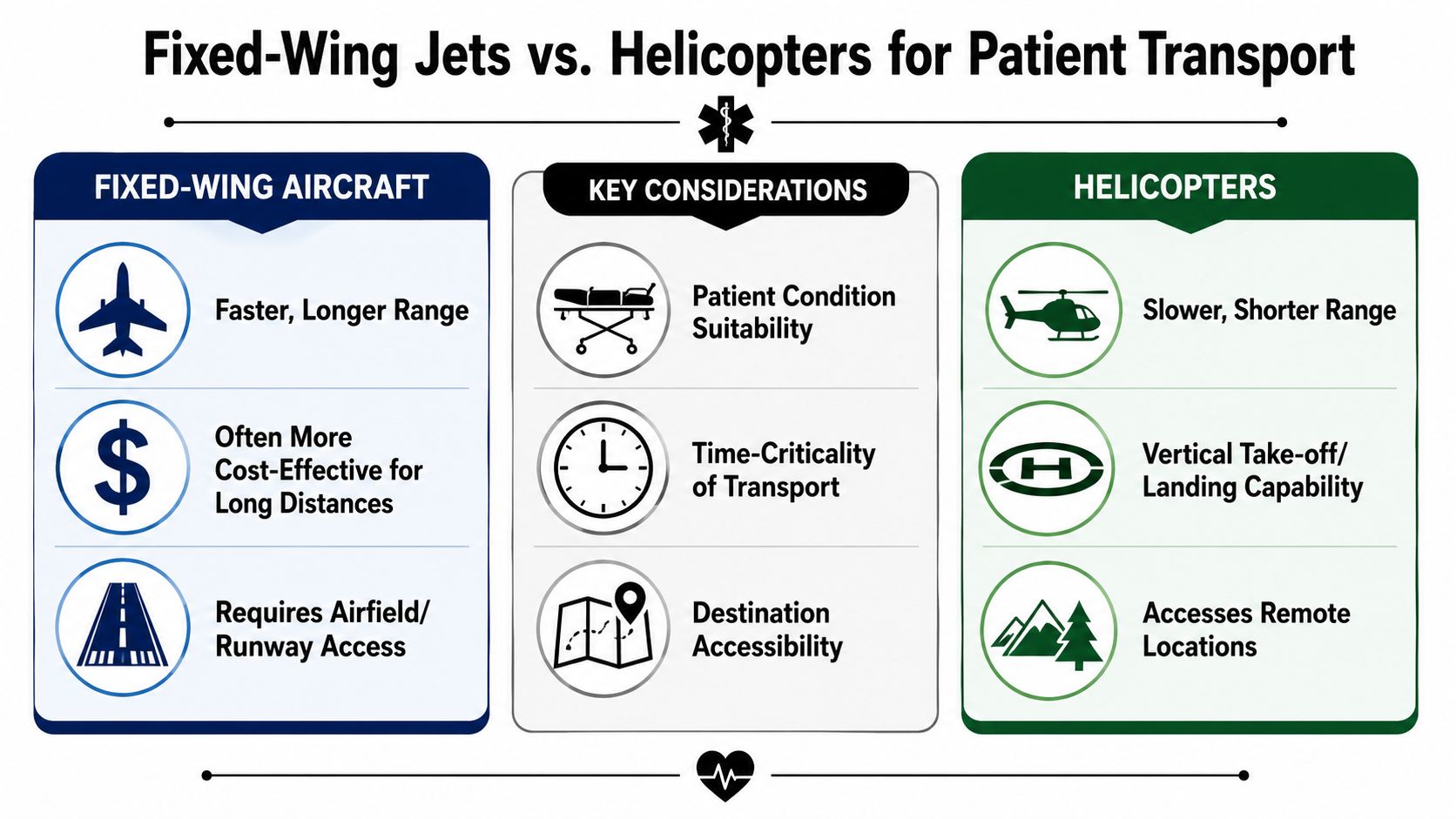
The practical differences families feel
The clearest way to understand the choice is to start with the route.
If a patient is leaving an accident scene, a remote area, or a hospital without practical airport access, a helicopter may be the fastest way to reach them. It can lift off and land in tighter spaces, which reduces the time spent getting the patient to a runway.
If the transfer is between hospitals in different cities, states, or countries, a fixed-wing jet is often the better fit. It covers longer distances more efficiently and is commonly used for hospital-to-hospital transfers, often with ground ambulances handling the trip between the facility and the airport at each end.
Here is the side-by-side view that usually answers the first round of family questions:
| Consideration | Fixed-wing jet | Helicopter |
|---|---|---|
| Distance | Better suited to longer routes between cities, states, or countries | Better suited to shorter-range movement |
| Takeoff and landing | Needs runway or airport access | Can land vertically in more limited areas |
| Typical role | Interfacility transfer and longer urgent or scheduled moves | Scene response and short emergency transfer |
| Care environment | Often more comfortable for extended transport time | Often more useful when immediate pickup location matters most |
What actually drives the decision
Transport coordinators usually sort the choice through three practical questions.
Where can the patient be picked up safely?
If there is no reasonable airport access nearby, a helicopter or a ground ambulance segment may be needed first.How long is the trip?
Longer routes often favor fixed-wing aircraft because they are designed to cover distance efficiently.What does the patient need during transport?
A fragile patient may need a cabin environment that supports ongoing monitoring, medication management, and more working room for the medical team.
That last point can surprise families. The fastest-looking aircraft is not always the best clinical choice. The goal is not just speed in the air. The goal is safe, well-supported movement from one care team to the next.
When a helicopter is the right answer
Helicopters are often chosen for urgent pickups where direct access matters more than range. That includes roadside incidents, small communities, island locations, and hospitals that need rapid transfer support before a patient can be moved farther.
A fixed-wing jet may still be part of the overall plan. Some transports use a combined approach: ground or helicopter to reach an airport, then fixed-wing for the longer leg. That is why families may hear the phrase “bed-to-bed transport.” It usually means the operator is arranging the full chain of movement, not only the flight itself.
Questions families ask are usually very practical:
- Can a helicopter do the whole trip? Sometimes, but long distances can make that less practical.
- Why not always use a jet if it covers more ground? Because the patient still has to get safely to and from the airport.
- Which one is better for a medically delicate patient? The answer depends on the patient's condition, the route, weather, airport access, and how much in-transit care the team expects to provide.
For a plain-language overview, this explanation of fixed-wing vs. rotary-wing transport gives helpful context.
Later in the decision process, families often want to see the difference in action. This short video gives useful context:
A simple way to read the choice
The aircraft is chosen to fit the patient, the route, and the transfer plan.
That is the core idea.
A helicopter helps when access is the main obstacle. A fixed-wing jet helps when distance and in-flight transport conditions matter more. Good medical transport planning brings those pieces together so the family is not choosing between aircraft labels. They are choosing the safest, most workable path for the patient.
Inside an Air Ambulance Jet Types and Capabilities
A family often reaches this point with one very practical concern. If my relative is sick enough to need an air ambulance, what will the aircraft be able to do for them in the air?
The answer starts with a simple distinction. An air ambulance jet is not judged by how polished it looks from the outside. It is judged by whether the cabin, equipment, and crew setup fit the patient's medical needs from takeoff to landing.
What the cabin is built to do
Inside, the layout is organized around treatment. You will usually see a stretcher locked into a secure position, medical equipment mounted so it stays stable in flight, oxygen available, and seats placed to give clinicians access to the patient.
A normal private jet is arranged for passenger comfort. A medical jet is arranged so care can continue in a confined space, with noise, vibration, and limited room taken into account.
That difference matters more than many families expect.
Some providers operate fixed wing fleets configured for one or two patients, with space for family in certain cases, as described in Rescue's overview of fixed-wing aircraft. The important point is not the marketing label. It is whether the specific aircraft on your trip can support your relative's size, condition, and treatment plan.
Why the same label can mean very different capability
Two aircraft may both be called air ambulances, yet one may be appropriate for a stable patient on oxygen while another is set up for a patient who needs intensive monitoring, a ventilator, or more room for transfer and positioning.
Families often hear broad terms such as “ICU jet” or “bariatric capable.” Those terms are only useful if the provider can explain what they mean in practice.
Ask about the actual setup:
Stretcher and loading system
The key question is whether the patient can be moved into the aircraft safely, with the right lifting and securing method for their condition.Clinical working space
The crew needs enough room to reach the patient's airway, IV lines, monitors, and medications during the flight.Power, oxygen, and mounted equipment
Equipment should be secured and ready for use, not carried as an afterthought.Family seating
Some aircraft can safely carry a family member. Some cannot, especially when the medical team needs more cabin space.
What “flying ICU” means in plain language
Families hear this phrase often, and it can sound vague. In practical terms, it means the aircraft is equipped so the medical team can continue active treatment in the air, not merely watch the patient during transport.
That may include cardiac monitoring, oxygen delivery, medication infusions, ventilator support, suction, and continuous reassessment. A good way to verify that level of readiness is to ask which aero medical supplies and equipment will be onboard for this patient's specific diagnosis and current condition.
Ask what the aircraft can support for your patient, not just what category the aircraft falls into.
Bariatric and high-acuity flights require more detailed screening
The decision-making process becomes very specific. A provider may say they can transport a bariatric patient, but the safer question is whether this aircraft can do it safely on this route, with this patient's size, mobility limits, and medical needs.
For that reason, families should ask about cabin door dimensions, stretcher limits, loading equipment, transfer method, and how much room clinicians will have once the patient is inside. The Association of Air Medical Services offers industry context on air medical operations and standards, and that broader framework helps explain why aircraft choice is tied so closely to patient handling and onboard care.
A larger body size is only one part of the picture. Pressure injuries, respiratory support, inability to self-position, or multiple infusion lines can also change which aircraft is appropriate.
A realistic cabin walkthrough
Here is what the process usually looks like from the family's point of view. The patient arrives at the airport from the sending location with a ground team. Before loading, the flight crew confirms monitoring, medications, oxygen, and transfer steps. Once onboard, the stretcher is secured, equipment is checked again, and the medical team settles into positions that let them reach the patient throughout the flight.
If a family member is approved to travel, their seat is chosen for safety first and access second.
One provider families may encounter in this space is Med Jets by Air Trek, which operates fixed-wing medical transport with aircraft configured for patient transfer, medical staffing, and coordinated ground movement. That is the standard families should use when comparing options. Ask how the aircraft is configured, how the patient will be loaded, what care can continue in flight, and whether the plan fits the person you are trying to help.
Your Guide to a Safe and Seamless Medical Flight
The logistics feel overwhelming until someone breaks them into sequence. Most successful transports follow a chain of decisions and handoffs that's more organized than families expect.
This visual captures the process at a glance: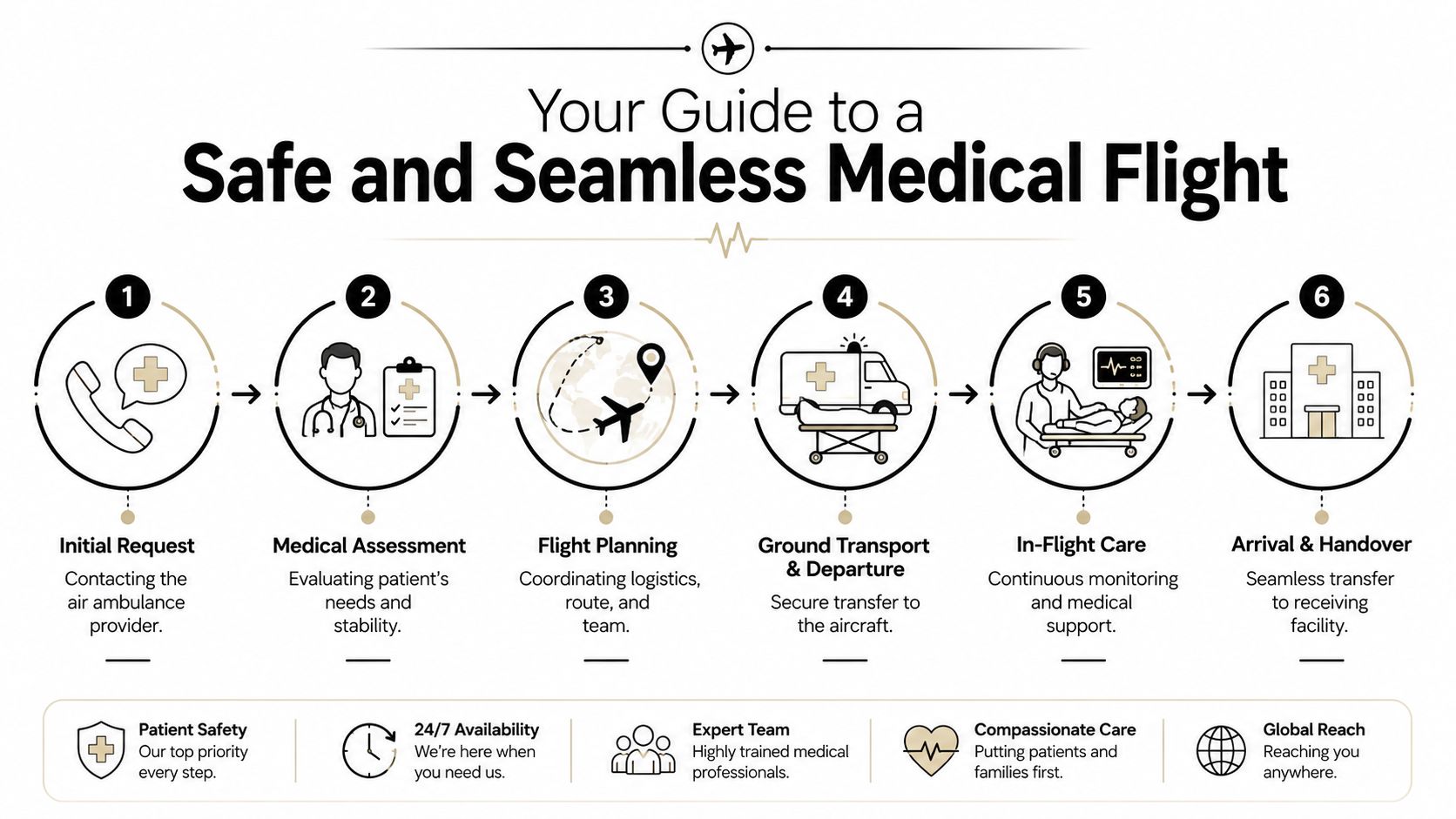
Step one starts with the right call
The first conversation usually covers the patient's location, current condition, destination, and urgency. The coordinator also needs to know whether the patient is in a hospital, rehab facility, home, or another setting.
Families often feel pressure to have every answer immediately. You don't need every answer. You do need the basic medical and location details so the provider can begin determining whether the flight is clinically and logistically appropriate.
The assessment shapes the plan
A transport team reviews the case and matches the aircraft, crew, and equipment to the patient's needs. This is also where the sending and receiving facilities come into focus.
The phrase bed-to-bed matters because it means the trip is treated as one coordinated movement, not just an airplane ride in the middle. In fixed-wing medical transport, bed-to-bed service includes arranged ground transportation so the patient can move from the point of care to the destination facility with continuity, as noted earlier in the article.
What happens next in plain order
Most flights move through a process like this:
Initial intake
A coordinator gathers medical, contact, and location information and begins route planning.Clinical review
The provider confirms the patient can travel safely and identifies the crew and onboard support needed.Ground coordination
Ambulances or medical ground teams are arranged at one or both ends if required.Airport and flight planning
Pilots, dispatch, and operations align the route, timing, and aircraft readiness.In-flight care
The medical team monitors the patient throughout the trip and responds as needed.Arrival and handoff
The receiving team takes over with records, report, and patient status transferred clearly.
Smooth transport depends on handoffs. The best flights are the ones where no one has to guess what happens next.
What families can do to help
Families don't need to run the mission, but they can make the process easier.
Keep documents together
Identification, insurance details, hospital contacts, and the receiving facility information should be easy to access.Choose one family point person
One consistent contact reduces confusion and duplicate calls.Ask who updates whom
Clarify whether the provider contacts the hospitals directly, whether family must notify the receiving team, and when status updates will be shared.
Why the process feels calmer once it's visible
A fixed-wing medical flight may sound dramatic, but the workflow is usually disciplined. Pilots focus on flight. Clinicians focus on patient care. Coordinators and dispatch handle route details, records, and timing.
That structure is what turns a stressful long-distance transfer into a manageable medical operation.
Essential Questions for Arranging Medical Air Transport
A family often reaches this stage after a hard phone call. A doctor says the patient needs care in another city, and now every provider sounds similar. That is when the right questions matter most.
Price and departure time are only part of the decision. The safer choice usually comes from fit. You need to know whether the aircraft, medical crew, loading plan, and ground support match the patient's condition from start to finish.
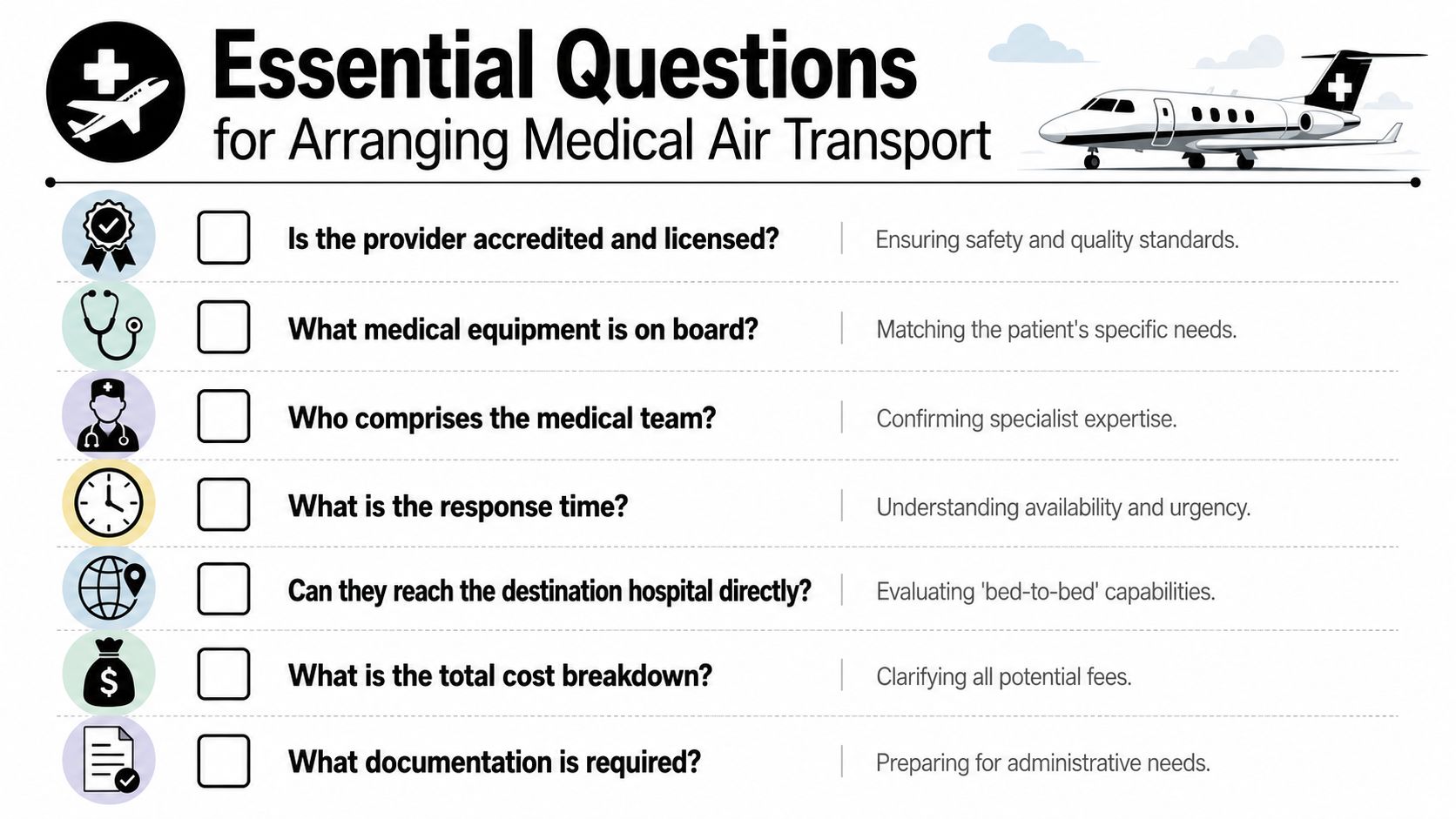
Start with the questions that reveal how the trip will actually work
A good provider should be able to answer in plain language. If the explanation feels vague, keep asking.
What medical team will be on board for this patient?
Ask for the actual crew type and why that staffing fits the diagnosis, current stability, and likely in-flight needs.What equipment will be set up for this case before departure?
A patient on oxygen, a ventilator, cardiac monitoring, or special positioning may need a specific cabin setup, not just a standard stretcher.Is this bed-to-bed service?
Clarify who arranges the ambulances, who speaks with the sending and receiving facilities, and who manages delays if the timing changes.What records and consent forms should we gather now?
This helps prevent last-minute pauses and gives the family a clear job during a stressful day.Can someone travel with the patient?
If yes, ask where that person sits, what baggage is allowed, and whether medical or safety restrictions apply.
These questions do more than fill in details. They show whether the company is describing a real care plan or offering general promises.
Questions that matter for larger patients and complex loading needs
Bariatric transport is one of the clearest examples of why aircraft type alone is not enough. Two services may both say they use a fixed-wing aeroplane, yet one may be able to load and position the patient safely while the other may not.
As noted earlier in the article, aircraft configuration can affect patient safety and practicality. For bariatric cases, families should ask about the physical path into the aircraft and the usable space inside, not just the weight limit on a brochure.
Ask directly:
- What are the loading limits for this aircraft and stretcher system?
- How will the patient enter the cabin?
- What door width, cabin clearance, and turning space apply to this case?
- How will the patient be positioned once on board?
- Will extra lifting equipment or a larger ground crew be required?
A simple way to view this is to treat the trip like a chain. If one link fails, such as the ambulance ramp, the aircraft door, or the cabin layout, the whole transfer becomes harder and less safe.
If the provider cannot explain loading, positioning, and unloading step by step, you still do not have a clear transport plan.
Questions about cost, coverage, and other transport models
Billing deserves the same level of clarity as medical planning. Ask for the expected charges, what could increase the total, what insurance coordination the company handles, and what happens if the schedule changes after the aircraft is assigned.
It can also help to compare medical transport with how operators simplify private jet travel in standard charter settings. That contrast helps families see what a regular private flight includes, and what a medical flight adds in staffing, equipment, coordination, and duty of care.
Some families are not arranging an urgent one-time air ambulance. They are trying to understand return-home options after hospitalization away from home. In that situation, it helps to review programs that fly you home after a medical event and compare them with case-by-case medical flight arrangements.
A final family checklist
Before you agree to any provider, you should be able to answer these questions without medical jargon:
| Question | Why it matters |
|---|---|
| Who will care for the patient in flight? | Shows whether the crew matches the patient's condition |
| What aircraft is being used, and how will it be configured? | Confirms the cabin setup fits the case |
| How will the patient get from hospital bed to aircraft and from aircraft to hospital bed? | Reduces the chance of gaps or delays |
| What limits apply for size, weight, equipment, or special handling? | Helps families judge whether the plan is realistic |
| Who gives updates during the trip? | Reduces confusion and repeated calls |
When those answers are clear, a fixed-wing aeroplane stops being an abstract aviation term. It becomes a practical medical tool. And for families, that clarity often brings the first real sense of control.