

At 2 a.m., the question is rarely just which hospital has the strongest cardiology reputation. The real question is whether the patient can reach the right team fast enough, with the chart, imaging, medication list, and accepting physician lined up so care does not stall on arrival.
New York City gives families several legitimate options for advanced cardiac care. A few of these programs are recognized nationally, as noted earlier, but name recognition only gets you part of the way. In transfer work, the better question is fit: Which center is set up for this specific problem, and can it accept the patient now?
That answer changes by case. A patient with cardiogenic shock may need a hospital that can take an unstable transfer and escalate quickly to mechanical circulatory support. Someone with severe valve disease may be better served at a center that can evaluate both surgery and transcatheter options without another handoff. Post-operative complications, refractory arrhythmias, advanced heart failure review, transplant evaluation, and adult congenital disease each narrow the field further.
Transport planning matters just as much. Families coming from outside the city often have to handle bed availability, insurance approval, disc and image transfer, and whether ground or air transport is appropriate. Timing is part of the clinical decision, especially in time-sensitive cardiac emergencies, which is why the medical golden hour in emergency transport matters in real-world transfer planning.
The hospitals in this guide are strong for different reasons. The goal is not to crown one winner. It is to help families choose the right destination, then get there with fewer delays and fewer surprises.
1. NYU Langone Health – NYU Langone Heart
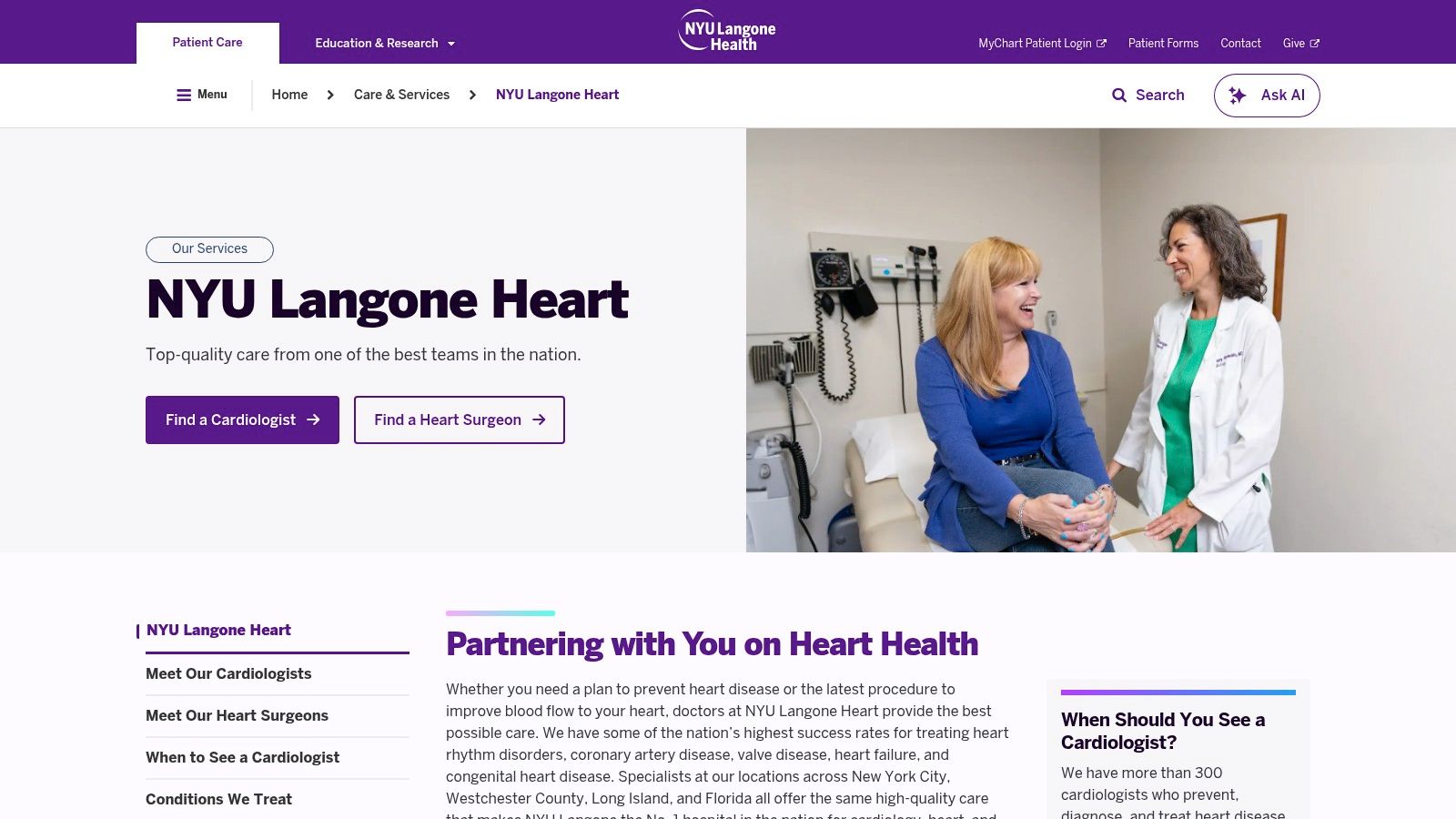
NYU Langone is one of the strongest first calls when the case may need a full-service academic heart program and the family wants one system that can coordinate inpatient and ambulatory care across multiple sites. In practical terms, that means less fragmentation when a patient needs imaging, interventional cardiology, surgery, electrophysiology, advanced heart failure review, and then structured follow-up.
For people searching best cardiac hospitals in New York City, NYU stands out because it combines reputation with broad service-line depth. It's also part of the small group of NYC programs ranked near the very top nationally, as noted earlier.
Where NYU Langone fits best
NYU Langone Heart is a strong match for patients who may need:
- Structural heart care: Valve workups and transcatheter options can move faster when imaging and intervention teams are tightly linked.
- Advanced heart failure review: If the sending hospital is uncertain whether the patient needs LVAD or transplant evaluation, a center with that capacity avoids a second transfer later.
- Complex but coordinated follow-up: Families who need surgery in Manhattan and follow-up closer to Brooklyn or another NYU site often prefer one chart, one system, and one referral chain.
The trade-off is scale. Large academic centers are good at complex care, but they can be slower when a family is trying to book one specific subspecialist for a non-emergent second opinion.
Practical rule: Ask whether the accepting service is cardiology, cardiac surgery, heart failure, or electrophysiology. "Accepted by the hospital" isn't the same thing as "accepted by the right team."
The transfer side matters just as much. If the patient is unstable, don't frame the conversation as travel first. Frame it as clinical suitability, acceptance, and timing. Then solve transport around that. Families often underestimate how narrow the true medical golden hour can feel when records, imaging discs, and bed assignment are moving in parallel.
A final caution: verify both facility participation and physician participation with the insurance plan. With major academic systems, out-of-network surprises often come from the professional side, not just the hospital bill.
2. Mount Sinai Fuster Heart Hospital at The Mount Sinai Hospital
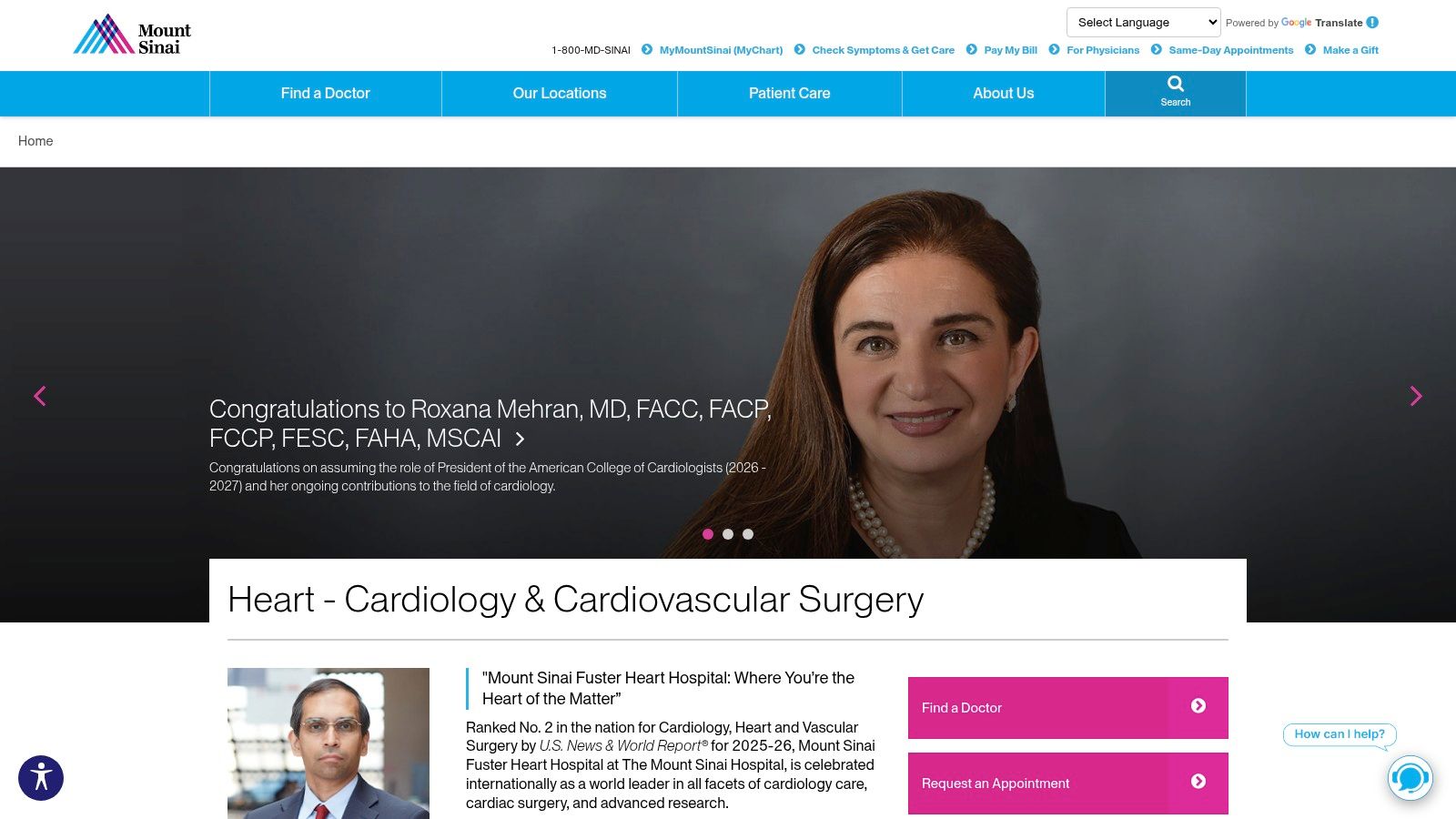
A common transfer scenario goes like this: a patient arrives at a community hospital with an acute cardiac problem, stabilizes briefly, then starts to exceed what the local team can support. The question shifts from "Which hospital has a good heart program?" to "Which center can take this patient now, with the right service lined up?" Mount Sinai often enters the discussion at that point.
This is a strong option for escalations rather than routine admissions. I would look here when the case may involve failed PCI, refractory arrhythmia, severe valve disease, cardiogenic shock, or advanced heart failure that may require a higher level of review during the same hospitalization. The value is breadth. Cardiology, cardiac surgery, electrophysiology, imaging, and advanced heart failure can be brought into one plan without setting up a second transfer a day later.
Where Mount Sinai fits well
Mount Sinai is often a good match when the sending team needs flexibility after arrival, not just a single procedure on the schedule:
- Interventional and surgical coverage in the same episode of care: If the patient may need cath-based treatment first, then urgent surgical review, this kind of center can support both paths.
- Subspecialty depth for complicated histories: Prior bypass, prior valve work, recurrent arrhythmia, or mixed cardiac and systemic illness usually require more than one opinion in the same admission.
- System reach beyond one building: Discharge planning, step-down placement, and follow-up can be easier when the referral chain stays within one health system.
One challenge can be campus and service-line confusion.
Families often hear "Mount Sinai" as if it refers to a single location with every cardiac service in one place. In transfer work, that assumption causes delays. The sending hospital needs the exact campus, the accepting physician or service, and confirmation that the bed request matches the patient's level of care.
When a family tells me, "We're going to Mount Sinai," I ask which location accepted the patient and whether cardiology, cardiac surgery, heart failure, or EP is actually taking the case.
That level of detail affects dispatch, records delivery, and authorization. It also changes the transport plan. A stable patient coming for a scheduled second opinion is one problem. A patient on vasoactive support after a failed intervention is another. In those higher-risk cases, the mechanics of how to transfer an ICU patient to another hospital and questions about air ambulance insurance coverage for interfacility transport need to be addressed early, before the accepting bed opens.
Mount Sinai rewards organized coordination. When the accepting team is clearly identified and the transfer packet is complete, the process is usually straightforward. When ownership is fuzzy, the delay usually happens in the handoff between hospitals, case management, and transport, not in the cardiac care itself.
3. NewYork‑Presbyterian/Columbia University Irving Medical Center – Seymour, Paul & Gloria Milstein Division of Cardiology
Columbia is the destination I think about for rare, layered, or unusually high-acuity cardiac problems. That includes advanced heart failure, transplant-level care, complex valve disease, congenital issues extending into adulthood, and patients whose diagnosis is still evolving.
This is also where "best" has to mean more than prestige. Public-facing hospital pages often tell you who's highly ranked, but they don't tell you enough about transfer readiness, campus routing, or how easy it is to plug into a real referral path for time-sensitive cardiac care. That gap is discussed in Columbia Cardiology's note on New York ranking visibility and access context.
Best fit for highly specialized referrals
Columbia is often the right choice when the sending team needs:
- Advanced heart failure and transplant judgment: Not every patient transferred for "heart failure" needs transplant-level care, but some do, and it's better to send once than bounce twice.
- Adult congenital continuity: Adults with congenital heart disease often need a center used to the overlap between pediatric-origin anatomy and adult complications.
- Imaging-heavy decision-making: If the treatment path depends on advanced imaging, valve planning, or nuanced surgical candidacy review, a highly specialized academic program helps.
The common frustration is campus complexity. NewYork-Presbyterian is a system, not one door. Families need the exact receiving campus and service from the start.
Field note: Before any aircraft or ground unit is booked, get the accepting physician name, unit if known, and direct transfer-center confirmation.
That becomes even more important when the patient is coming from another state or another country and the transport itself may require insurer review. A realistic first read on whether insurance covers air ambulance can prevent a last-minute dispute after the medical team has already decided transfer is appropriate.
4. NewYork‑Presbyterian/Weill Cornell Medicine – Ronald O. Perelman Heart Institute
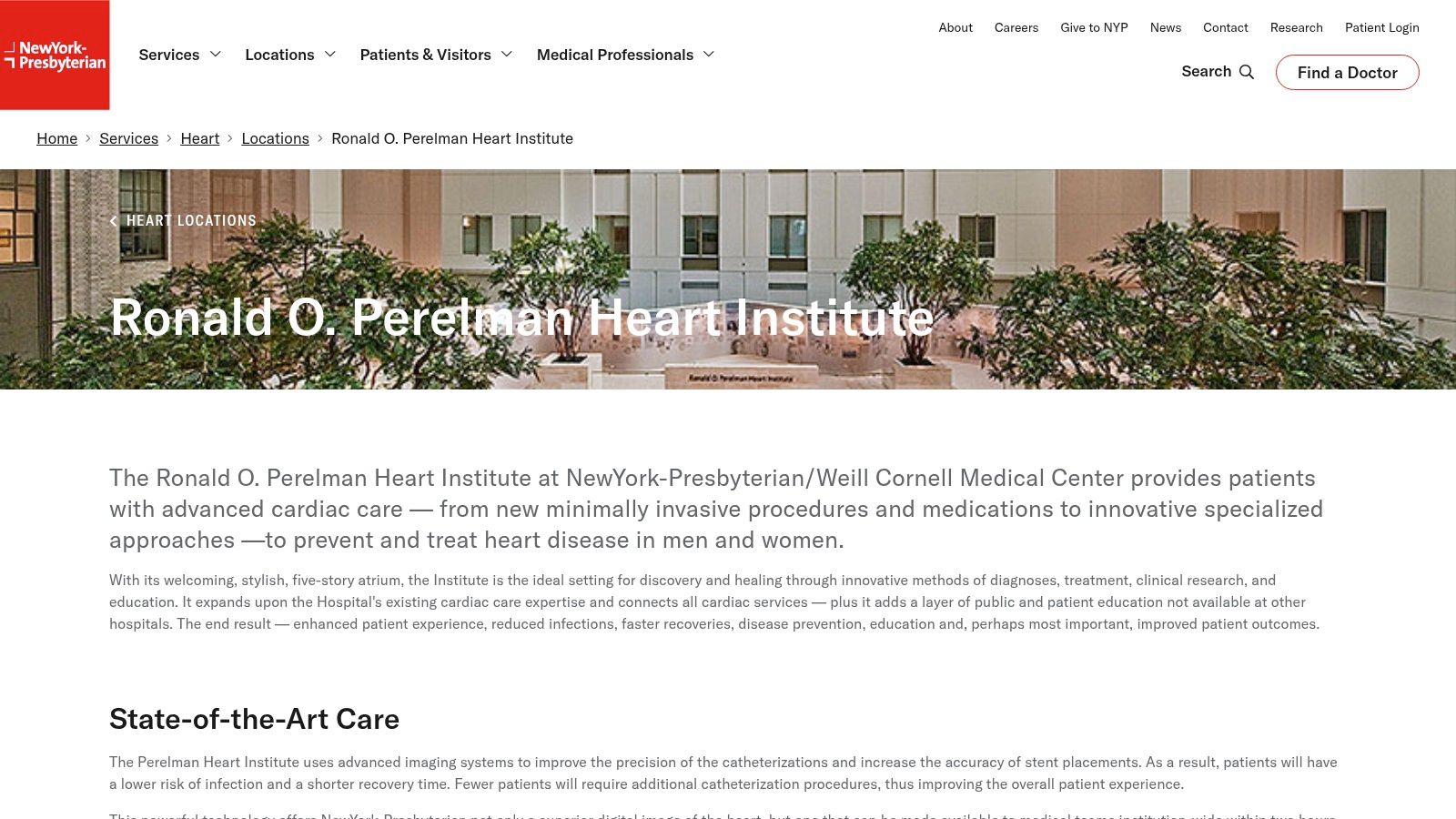
A common referral scenario looks like this. The diagnosis is serious, but the question is not merely which hospital has the biggest name. The crucial question is whether the patient needs a center that can sort through catheter-based options, surgery, rhythm management, and recovery planning without wasting time or adding an unnecessary transfer.
That is where Weill Cornell often fits well. The Ronald O. Perelman Heart Institute is a strong option for patients who need advanced procedural care and careful coordination across cardiology, cardiac surgery, and electrophysiology. In practical terms, that often includes valve disease, complex coronary disease, arrhythmias, and selected surgical cases where a less invasive approach could affect ICU time, rehab needs, and discharge planning.
Its place inside the NewYork-Presbyterian system matters, but for a different reason than branding. Columbia and Weill Cornell sit under the same larger umbrella, yet they are not interchangeable from a transfer standpoint. Families should ask which campus has accepted the patient, which attending or service is taking the case, and whether the transfer is for consultation, procedure, or full admission.
Where Weill Cornell tends to make sense
As a screening choice, Weill Cornell deserves an early look for:
- Minimally invasive cardiac surgery evaluation: This matters when the patient is stable enough to compare approaches and recovery time will affect work, caregiving, or travel back home.
- Structural heart and electrophysiology coordination: Some cases involve both rhythm problems and a valve or coronary issue. Sending the patient to a center used to handling both can prevent split opinions and repeat testing.
- Athlete and high-performance cardiology questions: Return-to-play or return-to-exertion decisions require more than a routine discharge plan.
The practical trade-off is that highly specialized care usually brings more administrative work on the front end. For an urgent transfer, that may mean confirming bed status, receiving service, imaging transfer, and transport mode within a narrow window. For a planned admission, it usually means checking network status, prior authorization, physician participation, and whether follow-up care can happen closer to home.
Cost deserves a direct mention here because families often ask too late. Charges for cardiac imaging and procedures can vary widely across hospitals and insurance arrangements, and a secondary review or out-of-network surprise can turn a well-intended transfer into a billing fight. That is why I advise families to treat financial clearance as part of placement, not as a separate task after the accepting physician says yes.
For scheduled cases, get three answers before booking transport: who is accepting the patient, what exact service is planned, and whether the insurer has approved that level of care at that campus. Those details matter as much as the hospital name.
5. Lenox Hill Hospital (Northwell Health) – Heart & Vascular

A family arrives in Manhattan expecting one final hospital choice, then learns the cardiologist is recommending Lenox Hill. That usually means the case needs strong procedural capability in the city, with the added flexibility of the Northwell system behind it.
Lenox Hill deserves serious consideration for coronary disease, valve evaluation, cardiac surgery, and complex interventional work. It is also one of the hospitals I keep in mind when a patient wants Manhattan access without committing to the largest academic campus from the start. For some families, that makes scheduling, follow-up, and bedside support easier to manage.
Where Lenox Hill is a strong choice
Lenox Hill often fits well for patients who need:
- A high-level Manhattan heart program with strong interventional and surgical depth
- Evaluation for minimally invasive or robotic cardiac surgery
- A hospital that can connect the patient to other Northwell sites if the care plan expands
That network point matters more than families expect. In transfer planning, the hospital name on the first acceptance call is not always the campus where every part of treatment will happen. With Lenox Hill, ask early whether the expected path is consultation only, full treatment there, or workup at Lenox Hill followed by a Northwell transfer for a narrower subspecialty need.
A potential trade-off is its scope concentration. Some highly specialized cases may stay within Northwell but move to another hub for the definitive procedure or advanced support. That is not a problem if everyone knows it upfront. It becomes a problem when transport, insurance authorization, and family lodging are arranged for one location and the plan changes 24 hours later.
A hospital can be the right place for evaluation and major treatment, while a small subset of ultra-complex cases still need to be routed within the same health system.
For out-of-town families, that distinction affects more than convenience. It changes whether to book local ground transport only, whether to hold off on return travel, and whether the insurer needs approval for one admission or a transfer between campuses. Before committing to Lenox Hill from outside New York, confirm the accepting physician, the likely procedure site, and whether the team expects the patient to remain there through discharge.
6. Montefiore Einstein Center for Heart & Vascular Care
Montefiore Einstein is one of the strongest options for patients whose cardiac problem sits at the edge of several specialties at once. Advanced heart failure, transplant-level care, adult congenital disease, cardio-obstetrics, and complex rescue cases are the types of referrals where this program earns attention.
It also serves a broad regional population, which changes how I think about transfer readiness. Programs that handle a steady stream of referrals from inside and outside the city often have practical pathways for moving medically complex patients through evaluation and escalation.
Why case managers keep Montefiore in the mix
Montefiore Einstein is worth serious consideration when the patient may need:
- Heart failure escalation: Cases that may involve mechanical support or transplant evaluation shouldn't be sent somewhere that will need to hand off again.
- Cardio-obstetrics expertise: Pregnancy-related cardiac cases need coordination across disciplines from the first phone call.
- Bronx access with academic depth: For some families, especially those with support systems in the Bronx or northern suburbs, this can be a more realistic destination than central Manhattan.
The downside is geography for Manhattan-centered families. A transfer into the Bronx isn't difficult in itself, but family logistics, hotel planning, and follow-up travel can become harder if the support network is elsewhere.
That said, I wouldn't let borough preference drive the decision in a complex case. If the patient needs the right team, the right team matters more than the zip code.
7. Maimonides Medical Center – Heart & Vascular Institute

Maimonides is the Brooklyn option I'd raise early when the family wants strong heart care without assuming Manhattan is the only serious destination. It has meaningful structural heart, interventional, electrophysiology, and advanced heart-failure capability, and for many patients that local access matters.
That local advantage isn't just convenience. It can reduce the practical strain of repeated family visits, outpatient follow-up, and step-down planning after a major hospitalization.
Best use case for Maimonides
Maimonides makes a lot of sense for:
- Brooklyn-based patients who need high-level inpatient cardiac care close to home
- Structural heart cases where TAVR or transcatheter mitral repair may be part of the discussion
- Patients who may need ECMO-level critical care support during the acute phase
The limitation is important and should be said plainly. It isn't the destination you'd usually pick for a transplant pathway. If transplant evaluation becomes central, many candidates are referred onward to Manhattan or Bronx transplant programs.
That doesn't make it a lesser program. It makes it a different kind of program. For many acute admissions, definitive care can happen there. For a narrower group of patients, it may be the right stabilizing and diagnostic center before transfer to a transplant hub.
Families often ask, "Should we skip Brooklyn and go straight to Manhattan?" The better question is, "Does this patient need a transplant center now, or a strong cardiac center now?"
Top 7 NYC Cardiac Hospitals Comparison
| Center | 🔄 Implementation complexity | ⚡ Resource requirements | ⭐ Expected outcomes / 📊 Impact | 💡 Ideal use cases | ⭐ Key advantages |
|---|---|---|---|---|---|
| NYU Langone Health – NYU Langone Heart | High 🔄, multisite transplant & LVAD coordination | Very high ⚡, specialized ORs, transplant ICU, coordinators | Excellent ⭐⭐⭐, top 1‑yr transplant survival; high throughput 📊 | Heart transplant, LVAD, complex structural interventions | Top national rankings, outcomes transparency, high transplant volume |
| Mount Sinai Fuster Heart Hospital | High 🔄, quaternary center with broad subspecialty bench | High ⚡, cath‑lab innovation, research & trial infrastructure | Very good ⭐⭐⭐, strong national ranking; research‑driven care 📊 | Complex interventional/surgical cases; clinical trials | Renowned leadership, extensive trials, cath‑lab innovation |
| NYP/Columbia Milstein Division of Cardiology | High 🔄, research‑intensive, multi‑campus coordination | High ⚡, advanced imaging, surgical teams, trial networks | Excellent ⭐⭐⭐, depth in complex/rare disease; high procedural volumes 📊 | Complex valve/aortic surgery, congenital care, advanced heart failure | Strong rare‑disease expertise, pediatric–adult continuum, clear referral pathways |
| NYP/Weill Cornell – Perelman Heart Institute | High 🔄, integrated NYP pathways; minimally invasive programs | High ⚡, robotic surgery, EP labs, trial access | Very good ⭐⭐⭐, strong structural heart outcomes; broad trial portfolio 📊 | Minimally invasive/robotic surgery, structural interventions, athlete cardiology | Leaders in less invasive approaches, extensive clinical trials |
| Lenox Hill Hospital – Heart & Vascular (Northwell) | Moderate 🔄, regional program within a larger system | Moderate ⚡, robotic/minimally invasive labs; network referrals | Good ⭐⭐, recognized for minimally invasive/robotic surgery 📊 | Minimally invasive/robotic procedures, women's heart health, community care | History in robotic surgery, Manhattan access, Northwell referral network |
| Montefiore Einstein Center for Heart & Vascular Care | High 🔄, quaternary academic workflows; multidisciplinary conferences | High ⚡, LVAD/ECMO, NIH‑supported research, transplant teams | Very good ⭐⭐⭐, strong heart‑failure/ECMO/ transplant capabilities 📊 | Advanced heart failure/LVAD/transplant, cardio‑obstetrics, high‑risk referrals | Deep LVAD/ECMO experience, strong academic & research infrastructure |
| Maimonides Medical Center – Heart & Vascular Institute | Moderate 🔄, high‑volume borough program; limited transplant services | Moderate ⚡, structural heart labs, ECMO center, multiple sites | Good ⭐⭐, documented quality recognitions; first‑in‑borough procedures 📊 | TAVR, transcatheter mitral repair, acute MI/heart‑failure care for Brooklyn patients | Brooklyn access, quality awards, ECMO Center of Excellence |
From Decision to Transfer: Your Action Plan
Choosing among the best cardiac hospitals in New York City isn't only about reputation. It's about matching the patient's actual problem to the right service line, then getting acceptance, transport, and insurance details lined up in the right order.
Q: What is the first step to arrange a transfer?
A: Call the receiving hospital's transfer center or intake line. Have the diagnosis, current clinical status, insurance information, medication list, and recent records ready. The receiving team will usually want physician-to-physician communication before they confirm acceptance.
Q: What should families ask on that first call?
A: Ask whether the patient is being accepted by cardiology, cardiac surgery, electrophysiology, heart failure, or another specific service. Ask which campus is receiving the patient. Ask whether the hospital needs imaging pushed electronically, faxed records, or both.
Q: How do we handle long-distance patient transport?
A: If the patient can't travel safely on a commercial flight or by standard ground transport, an air ambulance may be necessary. A provider such as Med Jets by Air Trek can coordinate bedside-to-bedside transport, including the aircraft, medical crew, and ground transportation linked to the sending and receiving hospitals.
Q: Can family travel with the patient?
A: Often yes, but that depends on aircraft configuration, patient condition, and mission requirements. Ask early. If a family member must travel separately, coordinate arrival timing with the receiving hospital so somebody can be present when the patient lands.
Q: What about insurance and out-of-pocket costs?
A: Verify more than hospital network status. Confirm the facility, the treating physicians if known, and any transport-related authorization requirements. This is especially important for planned admissions and cross-state transfers.
Q: What if the first hospital choice can't take the patient?
A: New York City provides assistance. The city has unusual depth in elite cardiac programs, so coordinators often have credible backup options within a short ground-transport radius after landing. That redundancy can reduce delay when beds or service lines are constrained at the first-choice center.
The families who move through this best usually do three things well. They get the right accepting service, they keep records moving with the patient, and they verify the financial side before wheels are up whenever the case allows. In a cardiac transfer, good logistics don't replace good medicine. They protect it.