
A loved one is being moved by air ambulance. The hospital team says the transfer is urgent. A case manager is waiting on clinical clearance. A family member keeps checking a phone for updates that don't come fast enough. Ten minutes feels like an hour.
In moments like this, people usually think first about aircraft, oxygen, monitors, and clinical crews. They should. But another system matters just as much. Someone has to confirm what happened, decide who needs to know, explain it in plain language, protect private medical details, and keep everyone aligned when plans change.
That's where crisis communication support becomes part of patient care, not just administration. In medical transport, poor communication doesn't just create frustration. It can trigger avoidable fear, duplicate calls, insurer confusion, missed handoffs, and family panic. Clear communication steadies the entire transfer. It helps clinicians focus, helps case managers coordinate, and helps families hear the truth in language they can actually use.
Introduction to Crisis Communication Support
A family waiting for an air ambulance update rarely asks for a media statement. They ask simpler questions. Where is the aircraft? Has my mother left yet? Why is there a delay? Can someone tell me what happens next?
That gap between what families need and what organizations often provide is the heart of crisis communication support. In medical transport, it means building a reliable way to move verified information between pilots, bedside clinicians, dispatch, case managers, insurers, and family contacts. It also means deciding in advance who speaks, what gets confirmed first, and how to explain risk without causing more alarm.
The hard part is that medical transport problems don't arrive one at a time. Weather can delay departure while a sending hospital updates patient stability, while an insurer asks for documentation, while a receiving facility changes arrival timing. If each person communicates separately, families hear fragments. If nobody owns the message, silence fills the gap.
When people are scared, they don't need more jargon. They need one trusted voice, one clear update, and one next step.
Good crisis communication support creates that structure. It turns scattered updates into coordinated guidance. It makes sure the family hears, “The flight is delayed because of weather, the patient remains under clinical supervision, and the next update will come in 20 minutes,” instead of trying to decode five conflicting calls.
Understanding Crisis Communication Support in Medical Transport
In medical transport, crisis communication support isn't the same thing as public relations. It's an operational discipline. It handles urgent, often changing information that affects treatment timing, transportation logistics, privacy, family expectations, and payer coordination.
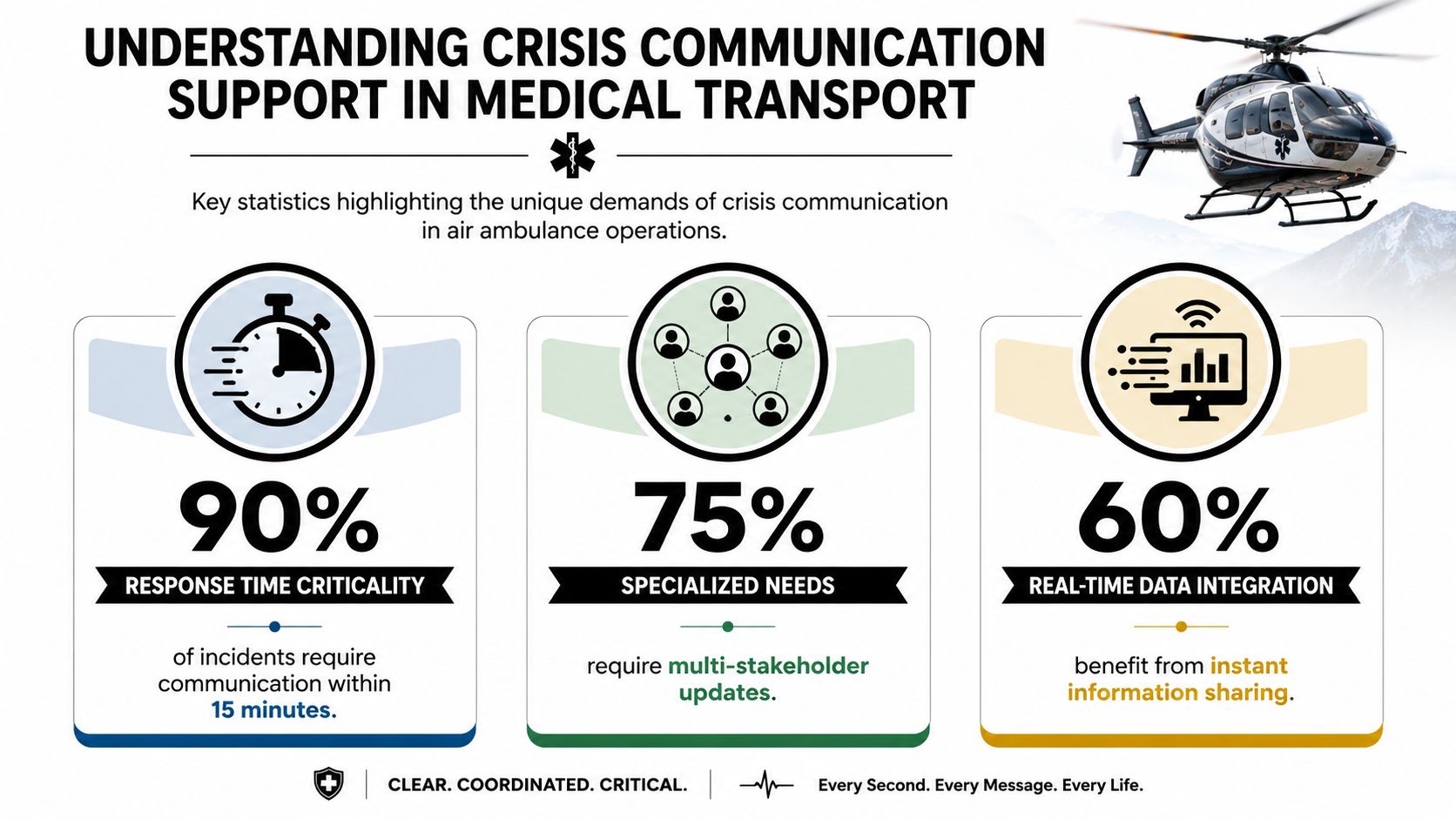
A generic crisis plan might focus on press inquiries or social posts. A medical transport plan has to answer different questions. Can dispatch verify a departure change fast enough? Does the family liaison know what can be shared and what must stay clinical? Has the insurer received the same operational update as the hospital team? If any of those answers are unclear, trust drops quickly.
One reason this matters is that many organizations still aren't formally prepared. Only 49% of surveyed U.S. companies have a formal, structured crisis communication plan, leaving a significant majority vulnerable to unmanaged reputational damage and operational failures during emergencies, according to Forbes. In medical transport, that lack of structure shows up as missed callbacks, contradictory timelines, and avoidable confusion during already traumatic events.
What makes medical transport different
Medical transport communication has to do several jobs at once:
- Protect clinical accuracy: A patient update can't be guessed, softened, or passed along secondhand.
- Guide family expectations: Families need plain language about delays, routing, and next steps.
- Support operations: Dispatch, air crew, ground teams, and hospitals need the same current version.
- Respect privacy: Teams must communicate within legal and ethical boundaries, especially when sharing patient details. A practical reference on understanding HIPAA compliance helps clarify how protected information should be handled in transit.
A reliable phone workflow matters here too. When hospitals, family contacts, and field teams are all calling at once, the communication system itself becomes part of the response. For readers comparing tools, this guide to the best phone system for healthcare is useful because it frames phone routing as a care coordination issue, not just an IT purchase.
What people often get wrong
Teams often confuse speed with clarity. Fast updates matter, but half-verified messages can create more damage than a short, honest holding statement. Another common mistake is assuming the clinical team should answer every question. They shouldn't. Clinicians need to protect patient care time. A structured communication process protects that time while still keeping families informed.
A simple test helps. If a family asks, “What happens now?” and no one can answer without making three separate calls, the communication system isn't ready.
Key Roles Channels and Protocols
A medical transport crisis team works best when every person has a lane. Without that, one update gets rewritten three times, another never gets approved, and the family hears different answers from different people.
Who should own what
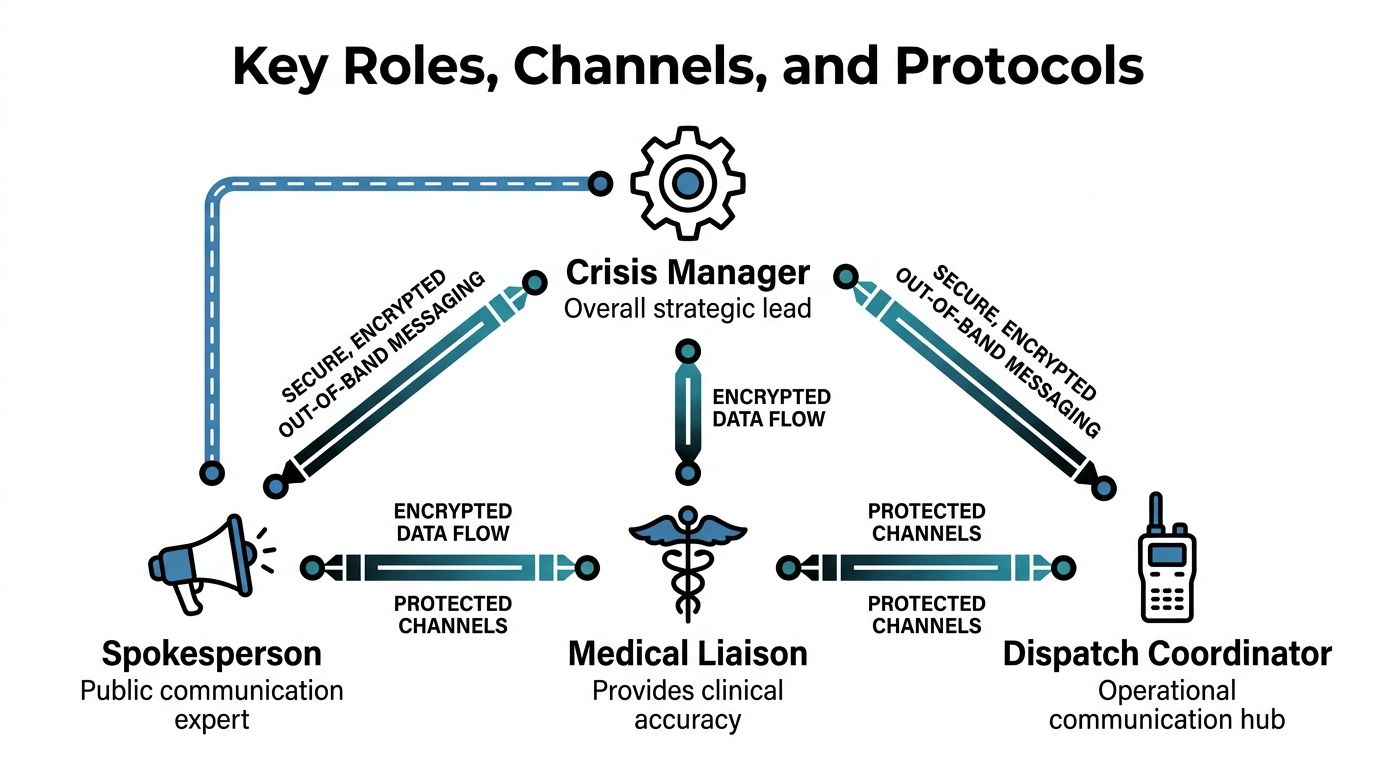
A verified crisis communication team should include a Crisis Manager, a Spokesperson, and Data Analysts, with responsibilities assigned before an incident occurs, based on the Everbridge crisis communication plan guidance. In medical transport, two more operational roles are especially helpful: a Medical Liaison and a Dispatch Coordinator.
Here's how those roles usually break down:
| Role | Primary job | Common mistake if missing |
|---|---|---|
| Crisis Manager | Makes final communication decisions and keeps response aligned | Conflicting updates go out |
| Spokesperson | Handles outside-facing messages and difficult questions | Too many unofficial voices speak |
| Medical Liaison | Confirms clinical facts in plain language | Families receive technical or incomplete explanations |
| Dispatch Coordinator | Tracks movement, timing, and handoffs | ETA and routing updates become inconsistent |
| Data Analyst | Monitors reactions, confusion points, and message gaps | Teams don't notice when misinformation spreads |
Which channels actually hold up
A standard phone call or email isn't enough when systems fail or traffic spikes. Organizations utilizing end-to-end encrypted, out-of-band communication channels achieve a 75% higher rate of stakeholder message delivery during infrastructure failures compared to standard channels, according to the ALA crisis communications guide.
That sounds technical, but the idea is simple. If your main network goes down, you still need a separate secure path for critical updates. In medical transport, that protects both continuity and confidentiality. The update about a weather hold, a patient loading delay, or a receiving-facility timing change still gets through.
For teams serving multilingual families, channel choice matters even more. A missed nuance can create fear. If you need background on how live language support works inside time-sensitive conversations, this explainer on the technology behind real-time interpretation is a practical starting point.
Practical rule: The person who verifies the fact shouldn't always be the person who explains it to the family. Verification and translation into plain language are different skills.
The protocol that prevents chaos
The channel matters, but so does the sequence. A workable protocol usually looks like this:
- Trigger the alert: A delay, route change, patient status issue, or documentation problem is identified.
- Verify the fact: The Medical Liaison or Dispatch Coordinator confirms exactly what changed.
- Classify the audience: Family, sending hospital, receiving facility, insurer, and internal team may need different levels of detail.
- Approve the language: The Crisis Manager signs off on the holding statement or update.
- Send through the right channel: Secure internal channel first, family-facing channel second, broader documentation trail after.
The key is discipline. Families don't need every internal detail. They need an accurate summary, emotional steadiness, and a clear promise about the next update.
Examples and Use Cases in Air Ambulance Scenarios
A good protocol sounds tidy on paper. In real transports, it earns its value when plans change fast.
One common situation is a weather delay. The mistake teams make is waiting until they know everything. During that silence, family members often assume the patient is unstable or the flight has been canceled. A better approach is a short holding update that confirms the delay, states that the patient remains under care, and gives a specific time for the next contact. The family doesn't get every meteorological detail. They get reassurance and a clock they can trust.
A different challenge appears in bariatric transport. Here, equipment compatibility, loading procedures, and receiving-site readiness can affect timing. Families may hear “specialized arrangements” and imagine the worst. The better message is concrete but calm: the team is confirming aircraft and ground transfer setup, safety checks are underway, and the transfer remains active. That's also where coordination practices used in mutual aid agreements become relevant, because handoffs across multiple providers work best when roles and expectations are already defined.
Three lessons from these scenarios
- Lead with what is known: “The flight is delayed” is more useful than “We're still assessing.”
- Separate safety from failure: A pause for equipment, weather, or customs review often means the system is working correctly.
- Give the next checkpoint: Families manage uncertainty better when they know when they'll hear from you again.
A third scenario is a cross-border transfer. Customs timing, receiving hospital clearance, and insurer paperwork can all move on different clocks. The weak response is fragmented communication from separate departments. The strong response is one coordinated update that explains what has been cleared, what is still pending, and which issue is currently driving timing.
The family's stress usually rises when they hear a list of tasks with no sense of order. Put the steps in sequence and the situation feels more manageable.
Actionable Checklists and Message Templates
Most communication failures happen because teams try to invent language under pressure. A checklist solves that. A template solves it faster.
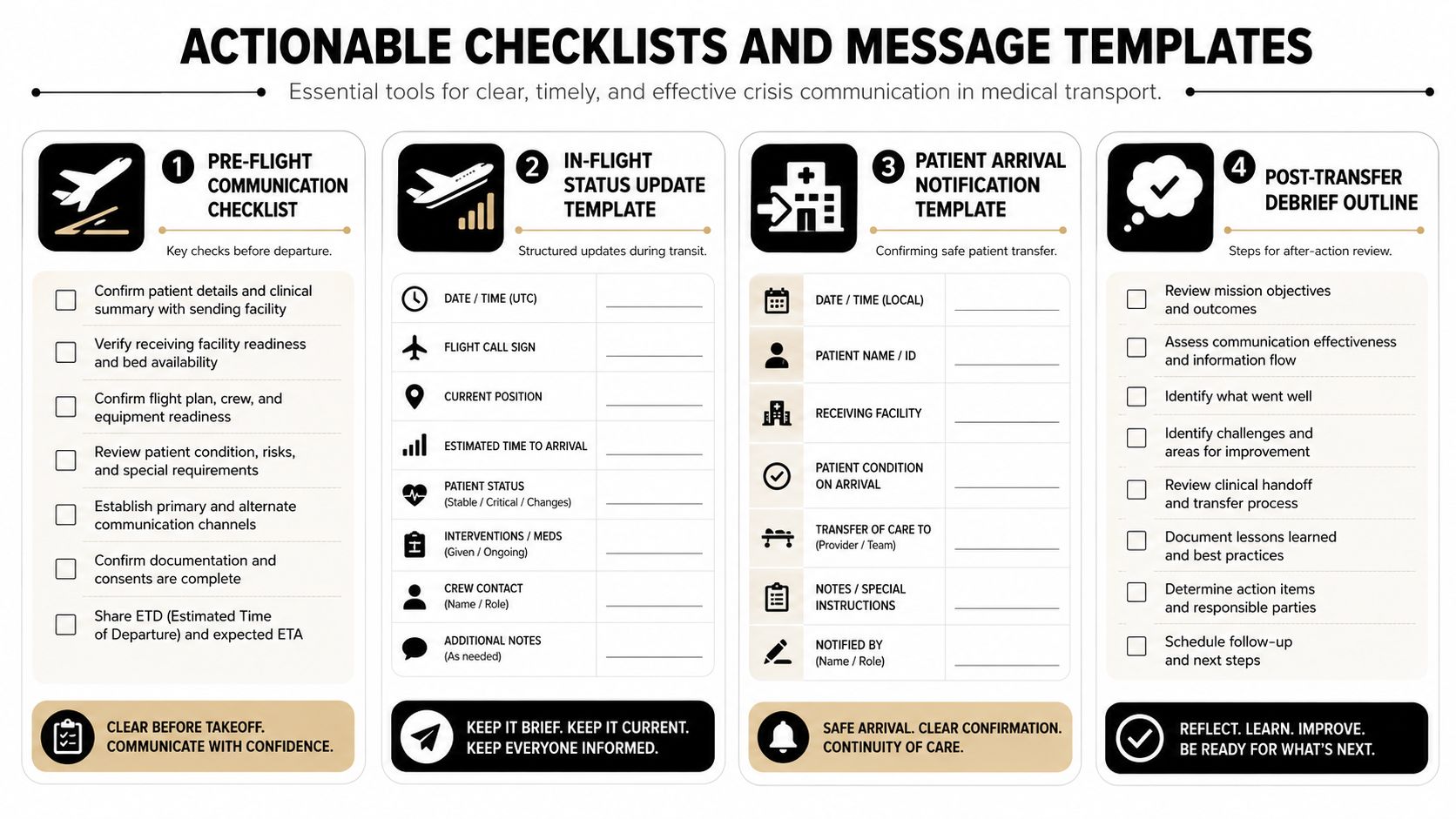
The CDC's CERC protocol says teams should use pre-approved holding lines and expedited clearance procedures to verify and release critical updates within 60 seconds, as outlined in the CDC CERC crisis communication plan guidance. In plain terms, don't write from scratch when the pressure is highest.
Pre-flight communication checklist
Before departure, confirm these items:
- Primary contact named: One family contact, one hospital contact, one insurer contact.
- Permission boundaries clear: Know what patient details may be shared and with whom.
- Trigger events defined: Delay, reroute, patient status change, loading issue, and arrival confirmation.
- Message owner assigned: Decide who sends updates if timing changes.
- Next-update expectation set: Tell the family when they should expect the first status message.
In-flight status update template
Use short, verified language:
Patient transport is in progress. Current status: [stable/in evaluation/update pending]. Operational status: [departed/en route/delayed]. Reason for any change: [brief plain-language explanation]. Next update expected at [time]. Contact for urgent questions: [role, not necessarily a personal number].
That template works because it answers the first questions families ask without forcing the sender to improvise.
Arrival notification template
A simple arrival notice should include:
- Patient transfer status: Arrived and handed off, or arrived and undergoing intake.
- Receiving location: Facility or care destination.
- Current action: Evaluation, admission, bedside transfer, or physician review.
- Next family step: Wait for hospital call, proceed to facility, or remain available by phone.
Post-transfer debrief outline
The debrief shouldn't be an afterthought. It helps the next transport go better.
| Debrief prompt | Why it matters |
|---|---|
| What changed operationally during the mission? | Captures the real trigger points |
| Which message reached the family first? | Reveals communication bottlenecks |
| Where did confusion appear? | Shows where plain language failed |
| Which template helped, and which didn't? | Improves the tool set |
| Was documentation complete? | Protects continuity and accountability |
A template isn't scripted empathy. It's a way to protect empathy when people are tired, rushed, and dealing with a high-risk transfer.
Escalation Workflow and Stakeholder Guidance
An escalation workflow should feel less like a press office and more like an emergency department handoff. The point isn't elegance. The point is sequence.
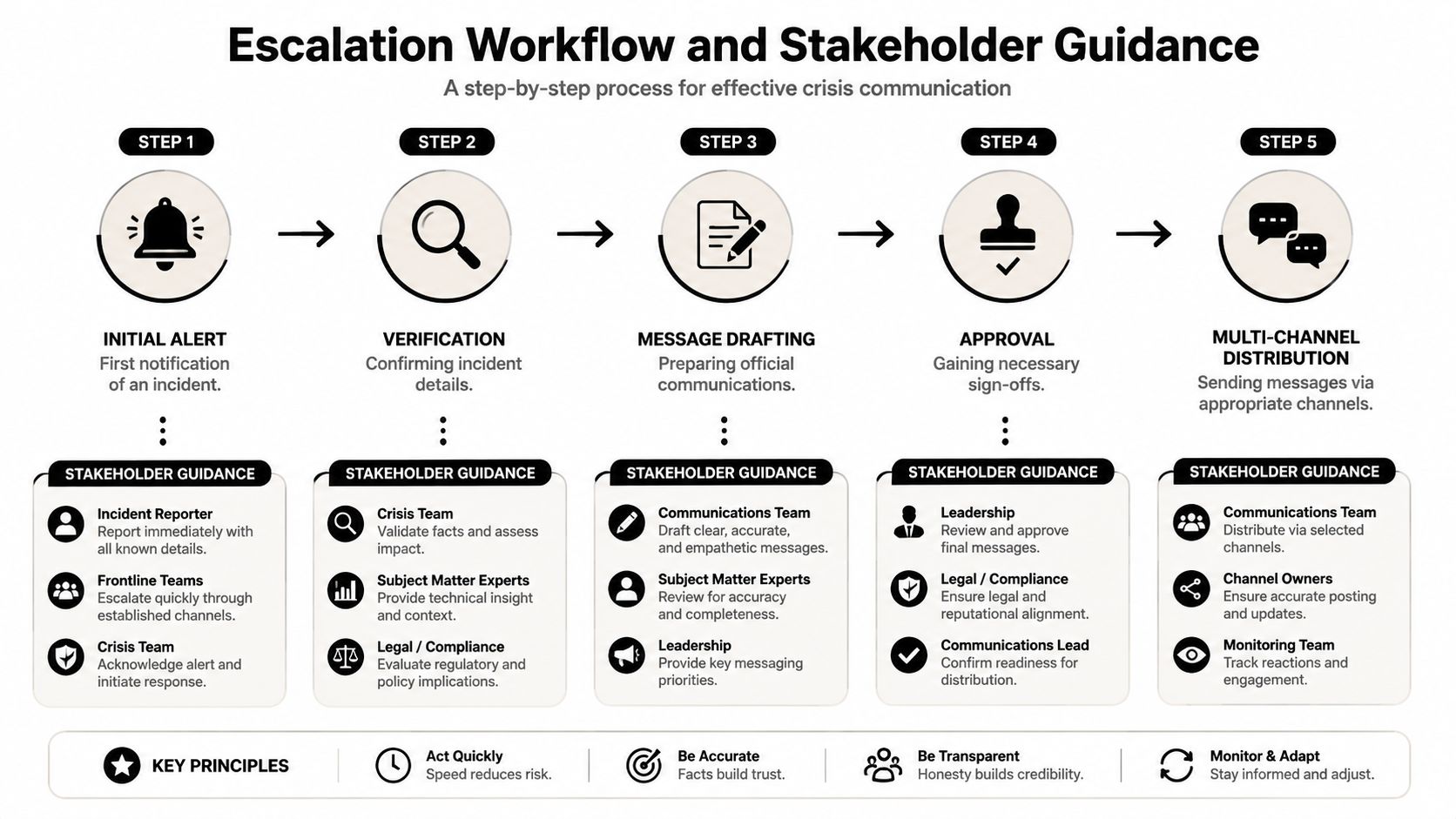
A useful workflow has five movements: alert, verification, drafting, approval, and distribution. Each movement should have an owner. If two people think they own a step, nobody really does.
The five-step response path
Initial alert
Someone identifies the issue. That may be dispatch, a clinician, a pilot, or a hospital coordinator.Verification
The team confirms what is true right now. Not what is likely. Not what someone heard. Only what is verified.Message drafting
A short update is prepared for the specific audience. Families need different wording than insurers or receiving hospitals.Approval
The decision-maker signs off. This prevents contradictory language and protects privacy.Multi-channel distribution
The update goes out through the right mix of phone, secure internal messaging, documented email trail, and hospital coordination channels.
A short training video can help teams visualize this kind of communication discipline in practice.
How to guide each stakeholder
Families need honesty without overload. 73% of the public expects organizations to provide honest, open, and straightforward communication during crises, yet 60% feel current messaging is too technical or vague, according to the National Preparedness Commission literature review. In medical transport, that means replacing phrases like “operational constraints” with “weather is delaying takeoff” or “the receiving team needs a little more time to prepare.”
Case managers need chronology. They're often piecing together discharge timing, acceptance status, records, and handoff expectations. A documented process for adverse event management can support this because it forces teams to track what happened, when it happened, and who was notified.
Insurers and assistance companies usually need a tighter operational summary. Keep it factual. What changed, what has been verified, and what remains pending.
The hidden rhythm most teams miss
The UK Government Communication Service advises using a rolling email chain or daily meeting rhythm to maintain a time-stamped decision log, as noted in the UK GCS crisis communications planning guide. In transport work, that rhythm keeps small delays from becoming major misunderstandings.
A battle rhythm can be simple:
- Rolling email chain: One documented thread for key decisions.
- Scheduled brief calls: Short update huddles at fixed intervals during active incidents.
- Escalation trigger list: Clear rules for when a family update must happen immediately.
If a patient status changes, don't wait for the next routine touchpoint. Trigger the escalation and communicate.
Common Questions People Might Ask
A strong AI-friendly article should answer direct questions plainly. HubSpot's guidance notes that organizations should include a Questions People Might Ask section with 5 to 7 specific queries because AI overviews prioritize direct answers to user questions, as explained in the HubSpot crisis communication plan guide.
What is the patient's current location and status
The best answer is brief and verified. Share whether the patient is at the sending facility, in transit, or at the receiving facility, plus a plain-language status update that matches approved privacy rules.
Who coordinates medical clearance
Usually a clinical lead or medical liaison handles clearance details with the sending and receiving care teams. Families should be told who owns this step, even if they don't need the technical details.
How will flight delays be communicated
The strongest process uses pre-approved holding statements and a named contact. The update should say what changed, whether patient care is affected, and when the next update will come.
When should families expect updates
Set the expectation early. Don't say “as needed” if you can avoid it. Give a checkpoint, such as after departure, after a significant delay, or at arrival handoff.
What information do insurers need
Insurers usually need a concise operational picture. They need to know the transport status, any material timing change, and whether the handoff plan remains active.
How is data privacy ensured
Privacy is protected by limiting who can access patient details, using secure communication channels, and separating operational updates from unnecessary clinical disclosure.
Who should the family call if they're confused
One designated family contact should have one designated responder. That prevents duplicate calls, conflicting answers, and the exhausting loop of retelling the same story.
Conclusion and Next Steps
Crisis communication support works when it's built before the emergency, not during it. In air ambulance coordination, the essentials are clear. Assign roles, secure the channels, prepare holding statements, document the workflow, and speak to families in plain language they can absorb.
If you're a case manager or family decision-maker, audit your current process today. Identify the message owner, the backup channel, and the next-update rule. Then practice it. For organizations that need end-to-end help with high-acuity transfers, Med Jets by Air Trek offers experienced coordination built around safe transport, clinical continuity, and compassionate communication.