
At 2 AM, nobody cares whether a provider's website says “always available.” You care about whether a qualified person answers, understands the case, and starts moving the transfer forward without making you repeat the story three times.
That's the essence of customer service availability in air ambulance work.
Families usually call when a local hospital can't provide the next level of care, when weather and distance make ground transport unrealistic, or when a medically fragile traveler needs supervised transport home. Case managers call when discharge timing, receiving-facility acceptance, and bedside stability all have to line up at once. In both situations, the wrong kind of “24/7” creates delay, confusion, and risk.
Some providers mean “you can leave a message anytime.” Others mean a dispatcher, coordinator, or clinician is actively available to assess the case, gather records, line up the aircraft, and coordinate handoff. Those are not the same thing. If you're arranging transport from a rural hospital, the gap matters even more because the promise of nonstop access often sounds stronger than the actual operational coverage.
The questions that protect patients are rarely the easy ones. Who answers at night. How quickly can they move on a rural pickup. What happens if the first aircraft is unavailable. When do they discuss cost. Will they explain why a specific aircraft and medical crew are appropriate for the patient. Those are the questions that tell you whether you're dealing with a real transport operation or a thin front-end call process.
The Moment You Need an Answer Not an Answering Machine
A common call starts with panic in the background. A spouse is standing in a hallway outside a small hospital. A case manager has just said an air ambulance may be needed. The bedside team is waiting on acceptance from a larger facility. Everyone needs the same thing immediately. A clear answer from someone who can act.
That's why customer service availability isn't a soft service issue in medical transport. It's part of the transfer itself. If the first contact stalls, the whole chain stalls. Records don't move. Bedside updates get delayed. The receiving facility gets less notice. Family expectations start to drift away from reality.
I've seen families assume that if a company advertises around-the-clock service, it means a flight coordinator is instantly reachable and is authorized to move the case. Sometimes that's true. Sometimes it means a message is taken and passed along. In urgent transport, those are completely different experiences.
Practical rule: When you call about a medical flight, your first question should be, “Am I speaking with someone who can start the transport process right now?”
Even the phone system itself holds more significance than generally appreciated. Missed calls at the first point of contact can create needless delay, which is why businesses in many sectors pay close attention to basics like adjusting ring duration on business phone systems. In air medical coordination, the principle is even simpler. If the call doesn't reliably reach the right team, the rest of the operation never gets a chance to work.
A family in crisis doesn't need polished language. They need practical answers:
- Can you review the patient's condition now
- Can you coordinate with the sending hospital
- Can you explain what happens next
- Can you tell me whether this is an actual overnight dispatch desk or an answering service
If you want to see how providers discuss service realities and patient communication, Med Jets has a useful archive on aero customer service.
The most reassuring call is usually not the one with the fanciest script. It's the one where the person answering can calmly explain the next steps, what information is needed, and what might delay the flight.
What Is Customer Service Availability in Medical Transport
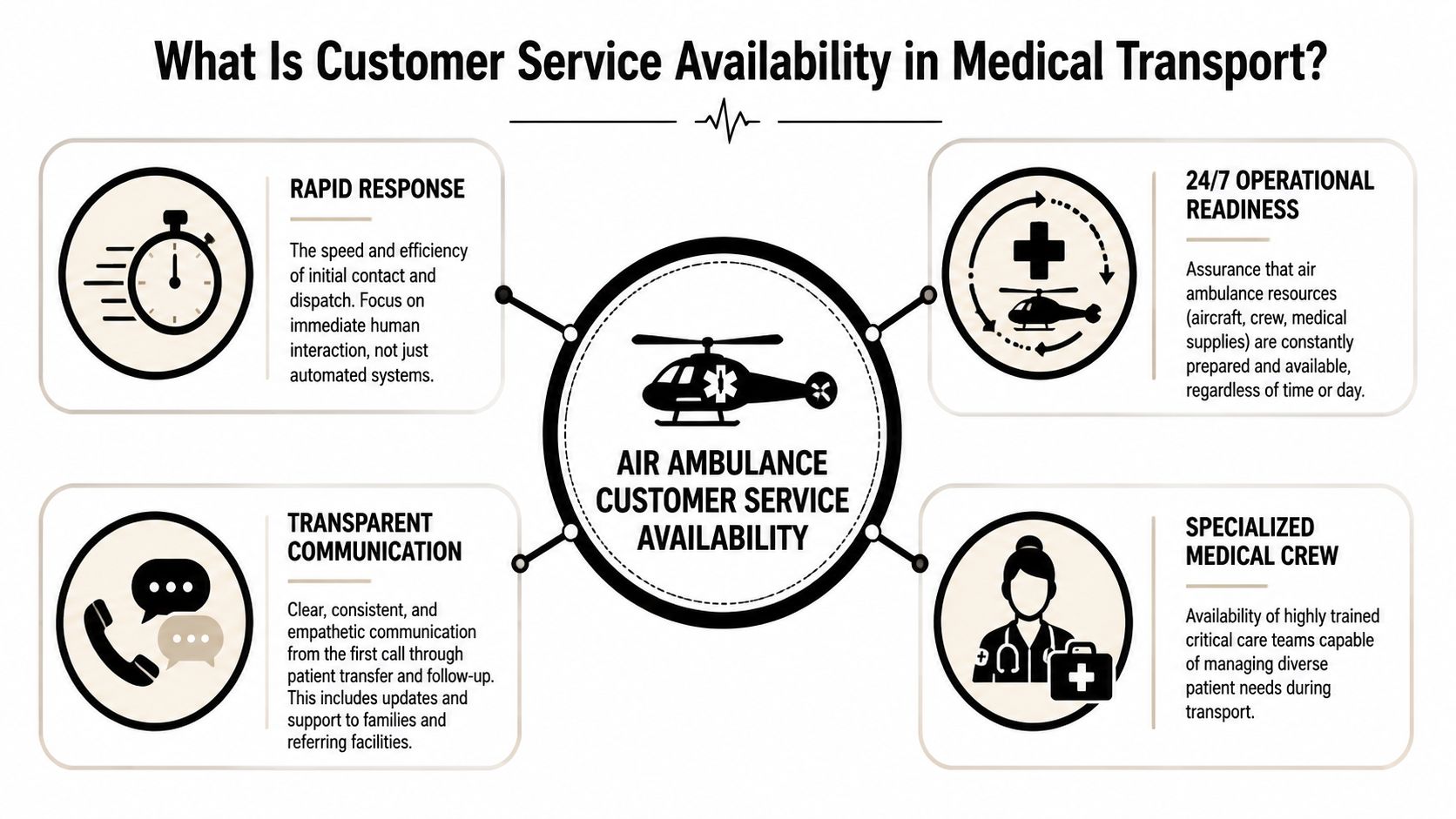
Customer service availability in medical transport means access to the right people at the right time. Not just access to a phone number. Not just a chatbot. Not just someone who promises a callback. It means operational access to people who can assess urgency, coordinate logistics, and keep the transfer moving.
Think of it this way. A strong air ambulance operation should function more like a hospital emergency department than a daytime office. Families often confuse the front office with the transport operation itself. Those are separate layers.
The difference between office hours and operational hours
This distinction is one of the first things I want families and new case managers to understand. A provider may have limited administrative hours for billing, paperwork questions, or non-urgent follow-up, while maintaining a separate emergency communications function all day and all night.
Med Jets states that admin hours are 8am to 9pm, while the 24/7 communication center operates continuously for emergency dispatch and flight coordination on its main service information page. That's a useful model for how these systems should be described. It separates routine office staffing from emergency availability.
A provider that explains this clearly is already telling you something important. They understand that “when is the office open?” and “when can you launch a transport?” are not the same question.
What real availability looks like
Real customer service availability in this setting usually includes several moving parts:
- Immediate intake capability: Someone can collect the clinical and logistical basics without delay.
- Clinical escalation: If the patient is complex, a nurse or other qualified clinician can be brought into the conversation quickly.
- Dispatch coordination: The team can contact the sending hospital, receiving facility, ground transport, and flight crew in sequence.
- Family communication: Someone stays reachable while the case develops, especially if plans change.
That's why many healthcare groups also study broader medical practice call handling solutions. The tools differ from air ambulance operations, but the lesson is the same. Availability depends on workflow design, not slogans.
If a provider can't explain who answers after hours, how the case is triaged, and when a clinician gets involved, you don't yet know what “24/7” means.
The safest assumption is this. A website claim is marketing. A clear explanation of staffing, escalation, and dispatch authority is operations.
Why Availability Is a Clinical and Logistical Imperative
In medical transport, delayed communication doesn't stay in the customer service lane. It spills into patient care, bed management, family decision-making, and transport timing.
That's why customer service availability belongs in the same conversation as readiness and coordination. A call answered promptly by the right person can accelerate chart review, receiving-facility communication, aircraft assignment, and ground arrangements. A call that bounces around can leave the patient waiting while everyone assumes someone else is handling the next step.
Expectations have changed, but medical urgency hasn't
A projected benchmark for 2026 is that 74% of consumers globally now demand that customer service be available 24/7, according to AmplifAI's customer service statistics roundup. In many industries that's about convenience. In air ambulance work, it's closer to operational viability.
Families calling about a transfer aren't comparing you with a retail help desk. They're asking whether somebody can help them now, while physicians are deciding timing, while the patient's condition may change, and while a receiving facility may only have a narrow window to accept transfer. The expectation for nonstop access is entirely reasonable in that context.
Why delays cause bigger problems than people expect
The first delay is rarely the only delay. If intake starts late, the medical records request starts late. If records move late, clinical review starts late. If that review starts late, aircraft and crew planning start late. Then family communication deteriorates because nobody has a clean answer yet.
A provider with strong availability reduces that cascade. The point isn't speed for its own sake. The point is preserving continuity.
Here's what usually works well in practice:
- One accountable coordinator: The family and facility know who owns the case.
- Clear thresholds for escalation: Complex clinical questions go to qualified medical staff quickly.
- Honest wording: If weather, distance, or aircraft positioning may affect the mission, the coordinator says so early.
- Consistent callbacks: Families can tolerate difficult news better than silence.
What doesn't work is a vague promise that “someone will get back to you soon.” In a routine consumer setting, that's frustrating. In a transfer environment, it can disrupt planning across multiple teams.
Availability isn't only about being reachable. It's about being reachable by someone who can make the next decision without delay.
That's the standard families should expect. Not perfection. Not fantasy. Just a real operation that treats communication as part of patient movement, not as a separate customer service box to check.
Key Metrics That Define True Availability
Most providers can say they're available. Fewer can explain what that means in measurable terms.
That's where metrics matter. They turn a vague promise into something you can test. If you're a family member, you may not ask for a spreadsheet in the first call. If you're a hospital case manager or insurer, you should ask how the operation measures answer times, queue performance, and call loss.
The metric that tells you whether the phones are really staffed
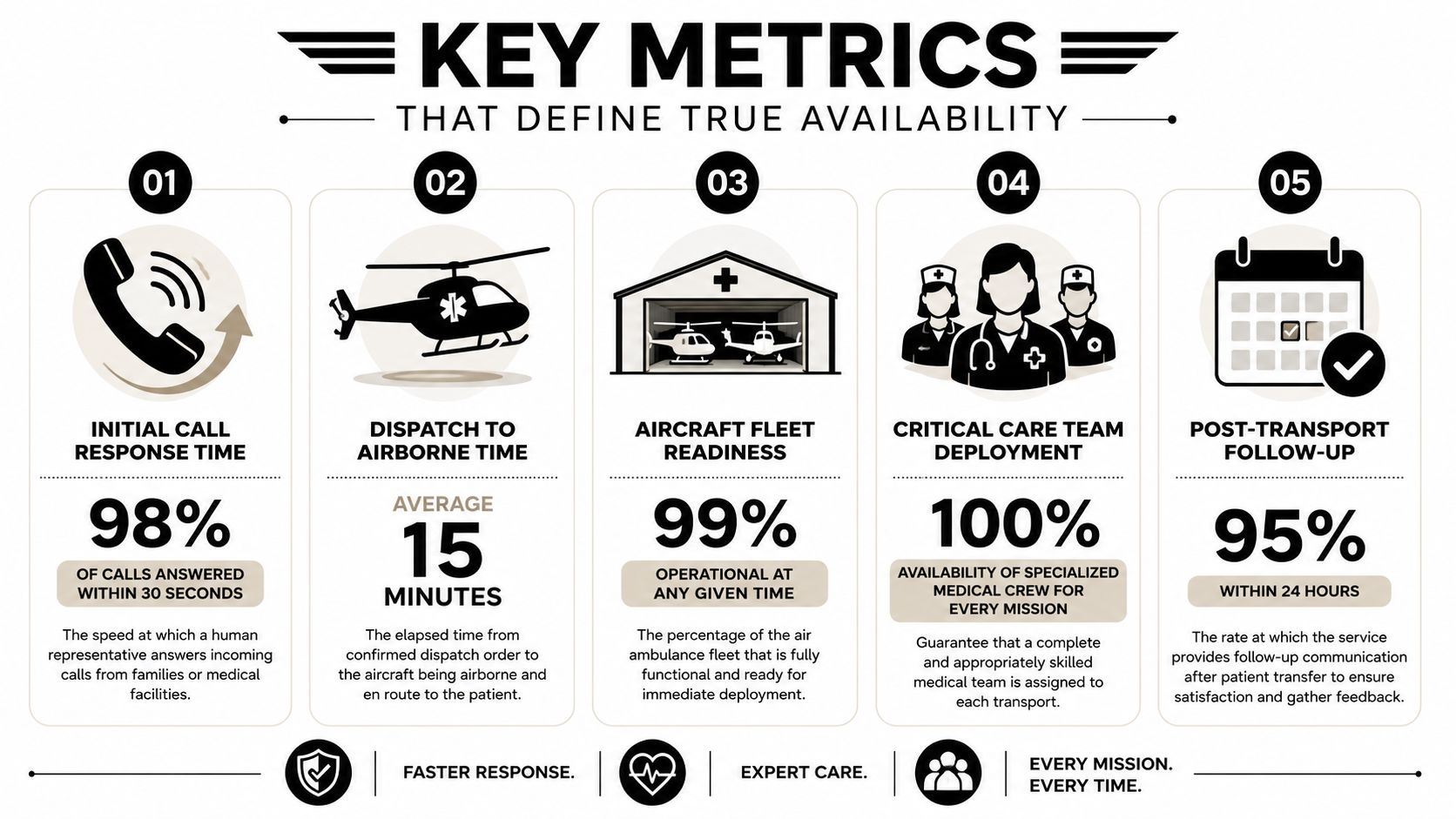
The clearest benchmark in voice operations is the 85/20 service level, which means 85% of calls should be answered within 20 seconds, based on the benchmark summary published by BlueTweak. For a family in distress, that number translates into a simple question. Does the operation pick up quickly enough to start helping before frustration turns into call abandonment.
BlueTweak also notes that the abandonment rate for optimized voice queues is 3–8%, and going beyond that can correlate with lost coordination opportunities. In air ambulance work, an abandoned call is not just a service defect. It can mean a bedside nurse, spouse, or discharge planner gives up and calls elsewhere, repeating the case from scratch.
The metrics worth asking about
You don't need jargon to use these well. You need plain-English definitions.
| Metric | What it tells you |
|---|---|
| Service level | How often the team answers within a target window |
| Average speed to answer | How long callers typically wait before a human answers |
| Abandonment rate | How many callers hang up before getting help |
| After-hours escalation | Whether overnight calls go directly to operations or sit in a holding pattern |
A provider doesn't have to hand over every internal dashboard to give a useful answer. But they should be able to describe their standards and how they handle overload.
What strong answers sound like
A capable provider often answers these questions directly:
- “Who answers at night?” A dispatcher or coordinator with authority to start the case.
- “What if the lines are busy?” There's overflow handling, backup staff, or a defined escalation path.
- “How do you prevent dropped handoffs?” The operation documents each contact point and assigns ownership.
- “What should I expect after the first call?” A sequence, not a shrug.
Weak answers usually sound vague. “We're available around the clock.” “Someone monitors the line.” “We do our best.” Those statements may be true, but they don't tell you whether the operation is structured to perform under stress.
Ask for the standard, not the slogan. “How fast do you answer urgent calls, and what happens if the queue backs up?”
In this field, the phone tree is part of the transport system. If it breaks down, everything downstream gets harder.
Operational Practices That Ensure Constant Readiness
Reliable availability doesn't happen because a company puts a phone number on its homepage. It happens because the operation is built to absorb interruptions, late-night calls, changing patient status, and moving logistics.
Families often see only the front end. They hear a calm voice, get an update, and assume the process is straightforward. Behind that call, a good transport operation is usually juggling records, flight planning, crew coordination, bedside updates, and ground transport timing at the same time.
The systems that support round-the-clock response
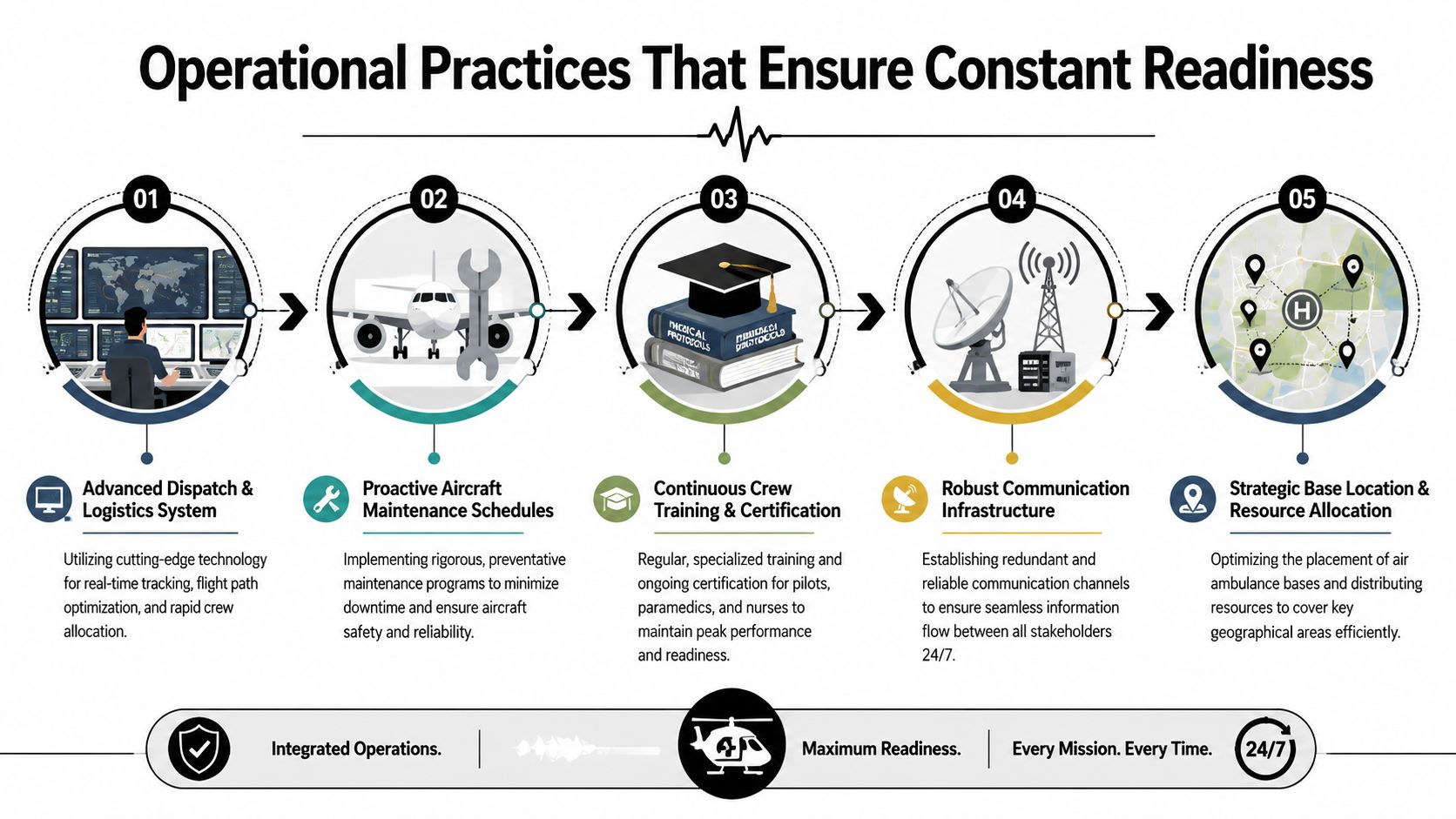
A provider that maintains consistent customer service availability usually has a few visible traits.
- Dedicated communications coverage: Overnight calls don't disappear into a generic answering loop.
- Clinical input on demand: A coordinator can bring in nursing or medical review when the case needs it.
- Redundant communication paths: If one contact route fails, another remains available for hospitals, crews, and families.
- Clear dispatch ownership: One team knows who is doing what, and in what order.
This is also where coordination agreements matter. During disruptions, providers may rely on external partners, regional support, or prearranged backup relationships. If you want to understand how those partnerships can affect continuity, Med Jets offers a plain-language overview of mutual aid agreements.
What families should listen for on the call
You can often hear operational maturity in the first few minutes. The coordinator asks for the sending facility, diagnosis, level of oxygen or monitoring, destination, and contact names. They don't wander. They don't promise impossible timelines before they know the case.
By contrast, weak systems show themselves quickly:
- Repeated basic questions can mean poor intake workflow.
- No clear next step usually means nobody has taken ownership.
- Promises before review can signal a sales-first mindset.
- Silence after the call often means the case is waiting in an internal queue.
One practical example of a defined staffing commitment is this statement published through Seniors Blue Book: “Med Jets by Air Trek provides 24/7 nursing availability for patient care coordination” on its company profile article. That kind of detail is more useful than a generic claim because it identifies who is available and for what purpose.
Readiness is planned, not improvised
A serious operation doesn't depend on one hero dispatcher having a good night. It depends on staffing, procedures, and backups that hold up when calls cluster or missions change.
The best overnight coordinator isn't the one who sounds fastest. It's the one who knows exactly which call, record, and handoff has to happen next.
That's what constant readiness looks like. Not noise. Not hype. Quiet control.
Your Checklist Questions for Any Air Ambulance Provider
The hardest part of choosing a provider is that the weak points often stay hidden until the case is already underway. That's why good questions matter.
One of the biggest blind spots is rural access. A documented concern in public-facing discussion of air ambulance coverage is the myth that “24/7 availability” is universally reliable, even though there are documented gaps in rural and non-major metropolitan areas where dispatch times exceed critical windows, as outlined in the BMJ Group discussion of regional gaps in 24/7 air ambulance access. Families in remote areas often assume the same response picture they'd expect near a major metro base. That assumption can create painful surprises.
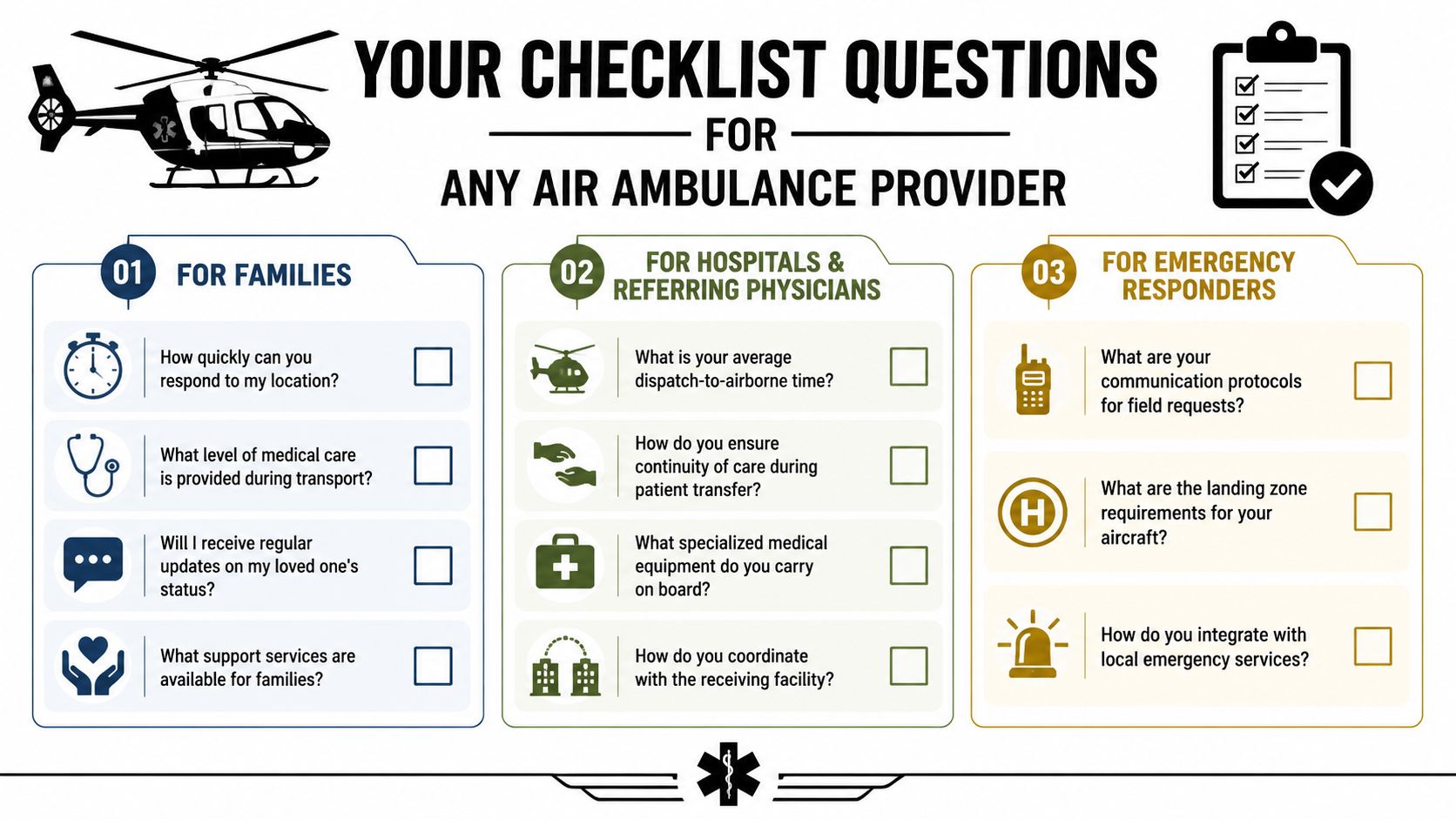
Questions families should ask first
Start with the questions that expose whether the operation is real, immediate, and transparent.
- “Who am I speaking with right now?” Ask whether it's a coordinator, dispatcher, clinician, or answering service.
- “Can you respond to this hospital location, and what could slow that response?” This is especially important for rural pickups.
- “What updates will I receive, and who gives them?” Families need a communication plan, not occasional reassurance.
- “When do we discuss cost and authorization?” You need clarity early, before pressure builds. If prior approval may matter, this guide to understanding prior authorization helps frame the issue.
Questions case managers and discharge planners should ask
Case managers usually need sharper operational detail because they're coordinating multiple parties at once.
- “Who owns the case from acceptance through arrival?”
- “How do you coordinate with the receiving facility and bedside team?”
- “What happens if the patient's status changes before wheels up?”
- “How do you handle transports that originate outside major metro coverage areas?”
Those questions force a provider to talk about process instead of branding.
Questions that uncover pricing and trust issues
Cost and availability are often linked more closely than families realize. If a provider won't explain aircraft selection, crew mix, or why a mission may take longer from one location than another, you don't have enough information to judge the quote.
Use this table as a quick screen:
| Audience | Question to Ask |
|---|---|
| Family member | Who answers emergency calls overnight, and can that person begin the case immediately? |
| Family member | If my loved one is in a rural hospital, what factors could delay pickup? |
| Case manager | What is your process from first call to clinical review to dispatch decision? |
| Case manager | How do you communicate timeline changes to the sending and receiving facilities? |
| Insurance coordinator | When do you discuss authorization, estimate, and any variables that may affect the transport plan? |
| Any caller | Will you explain why this aircraft and medical crew are appropriate for this patient? |
A trustworthy provider doesn't get irritated by direct questions. They answer them clearly, even when the answer is inconvenient.
The reason this matters is simple. Providers who cut corners usually hope you won't ask about remote coverage, staffing depth, or how the quote was built. Ask anyway.
From First Call to Safe Arrival
When people talk about customer service availability, they sometimes make it sound like a courtesy feature. In air ambulance work, it's closer to infrastructure. The call, the triage, the updates, the escalation path, and the dispatch coordination all sit on top of it.
That's why the strongest providers tend to welcome detailed questions. They don't need to hide who answers after hours, how emergency communications differ from office staffing, or what factors affect a rural response. They know clarity helps the family, the hospital, and the transport team work from the same reality.
One final warning matters here. Consumer Reports' advocacy work notes that a lack of transparency between pricing and operational availability can mislead families, and that red flags include pressure to commit before clinical assessment or refusal to explain aircraft selection criteria in relation to patient needs, as discussed in its analysis of air ambulance regulation and transparency concerns. If a company pushes for commitment before it explains the case plan, slow down.
A safe, smooth transfer usually starts with a simple test. Call. Ask hard questions. Listen for direct answers. The right provider won't treat those questions as a problem. They'll treat them as part of doing the job correctly.