
The moment someone says, “You can go home,” most families feel two things at once: relief and panic. Relief that the hospital stay is ending. Panic because discharge often arrives with papers, prescriptions, follow-up instructions, equipment questions, and a clock that suddenly starts ticking the minute the patient leaves the floor.
That's where a solid hospital discharge checklist matters. A weak handoff doesn't usually fail in one dramatic way. It fails in small, common ways. A medication list that doesn't match the pharmacy. A ride that never got confirmed. A patient who technically can walk, but can't safely get up the front steps. A family that hears “home tomorrow” and assumes that means “ready for anything.”
Discharge planning has been a measurable part of healthcare for decades, not just a workflow preference. In 1964, the National Center for Health Statistics launched the National Hospital Discharge Survey, which helped establish discharge as a clinical transition worth tracking across nonfederal short-stay hospitals nationwide.
This guide is written the way experienced case managers and discharge planners think. Practical, not theoretical. It also goes beyond standard homegoing advice by covering medically fragile patients, bariatric patients, and people who may need long-distance transfer or air medical coordination. If you're also dealing with injuries after a crash, Highbar Physical Therapy's accident treatment options may be useful during recovery planning.
1. Medication Reconciliation and Discharge Prescriptions
Medication mistakes are one of the fastest ways a safe-looking discharge turns into a bad weekend. The patient leaves with a printed list, the family has an older list in a bag, the outpatient pharmacy sees something different, and no one is sure which version is final.
That's why the discharge medication list has to answer four basic questions clearly. What was taken before admission, what changed in the hospital, what stops now, and what starts now. If any of those are fuzzy, the handoff isn't finished.
What the final medication list should include
A good medication review includes prescription drugs, over-the-counter medicines, supplements, insulin, inhalers, eye drops, wound medications, and anything taken only “as needed.” Families often forget to mention vitamins, sleep aids, or herbal products. Those still matter.
Standard discharge guidance also tells patients to review what changed, know what was stopped, and know who to contact with questions. The larger gap is responsibility. MedlinePlus discharge guidance reinforces medication review and questions about ongoing care, but many discharge packets still don't clearly spell out who owns the final verification when the hospital list, pharmacy profile, and caregiver understanding don't match.
Practical rule: Never let the patient leave with an unresolved “we'll sort it out with the pharmacy later” medication question.
Questions to ask before leaving
- What changed: Which home medicines should be stopped, restarted, or adjusted today?
- What timing matters: When was the last dose of each important medicine given, and when is the next dose due?
- What problem to watch for: Which side effects mean “call the doctor,” and which mean “go back now”?
- Who owns the discrepancy: If the discharge list conflicts with the pharmacy or primary doctor's list, who will correct it today?
For medically fragile and long-distance transport patients, the medication handoff has to travel with the patient. A medical escort or flight team needs the current list, recent dosing times, allergies, and any drugs that may affect breathing, blood pressure, sedation, or seizure control. A paper packet alone isn't enough if no one has confirmed that the packet is accurate.
2. Clinical Summary and Medical Records Documentation
A patient can have an excellent hospital stay and still have a poor discharge if the records going out are thin, late, or unclear. The receiving doctor, rehab unit, home health nurse, or transport team shouldn't have to guess what happened.
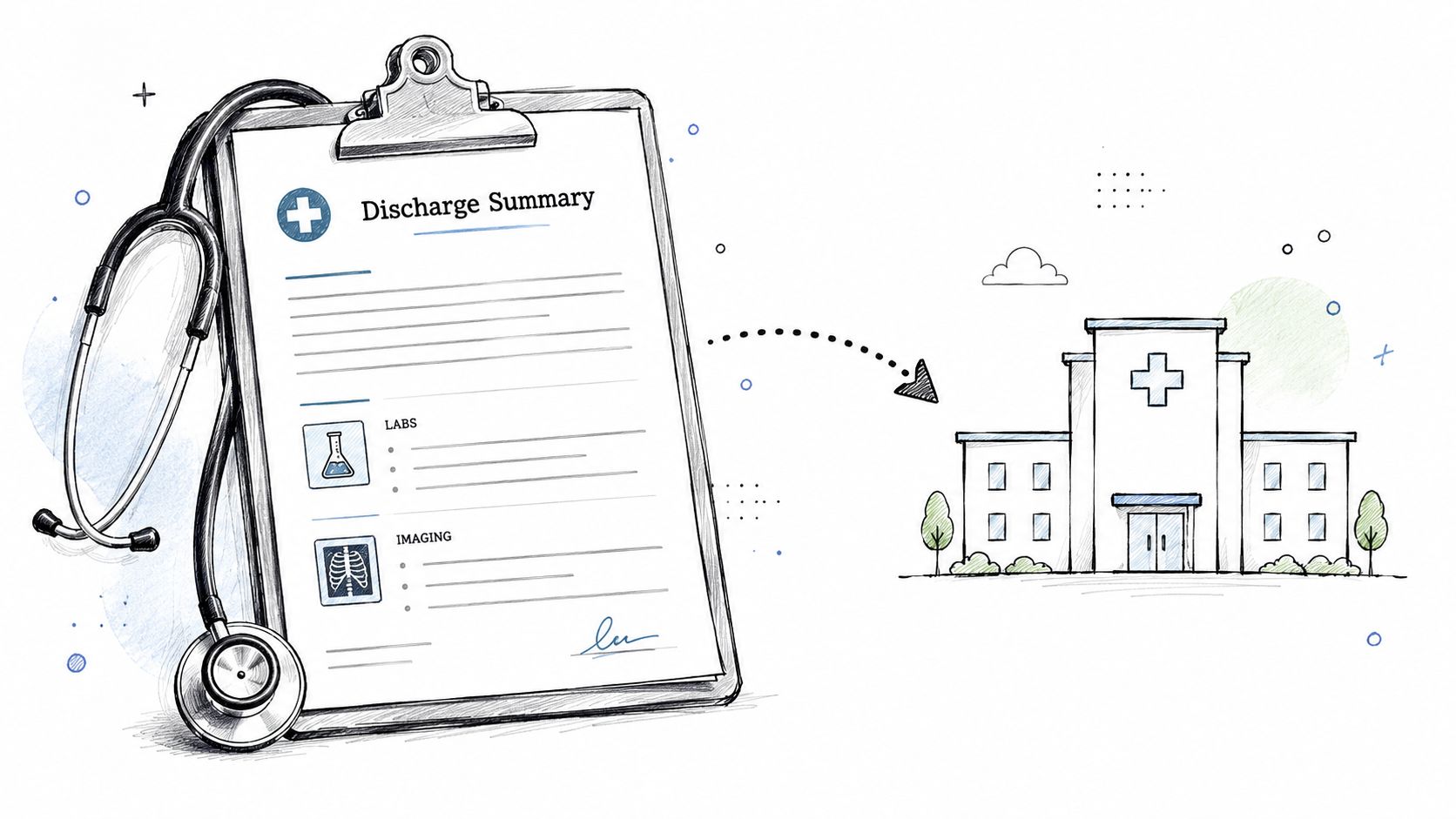
The discharge summary should read like a bridge, not a billing note. Diagnosis, major events, procedures, current condition, pending issues, restrictions, and next-step recommendations all need to be easy to find.
A visual reminder helps families understand what should exist before discharge:
What receiving teams actually need
For routine home discharge, families usually care most about diagnosis, test results, restrictions, wound care, and follow-up. For transfer cases, the record needs more. The receiving facility and transport clinicians need the clinical story, not just the discharge order.
A practical handoff packet should include the current history and physical, discharge summary, medication list, code status, allergies, recent labs or imaging that matter to the next setting, and any special nursing or therapy instructions. Teams handling cross-border or interstate transfers often also need organized copies that meet medical documentation standards for transport coordination.
Missing records slow care, create duplicate testing, and force the next team to make decisions with partial information.
Questions to ask before records leave the floor
- What is still unresolved: Are any test results still pending, and who will follow them?
- What changed recently: Has the patient had any new symptoms, oxygen needs, or procedure-related issues in the last day?
- What is the current function: Can the patient walk, transfer, eat, toilet, and manage stairs?
- What documents were sent: Did the patient and receiving provider get the same final version?
If the patient needs records in another language, that should be handled carefully. Families often move too quickly on this step and create errors by relying on ad hoc translation. A guide to risk-free medical record translation is useful when the next care team requires translated documents.
3. Follow-up Appointments and Care Continuity Scheduling
“Follow up with your doctor” isn't a plan. It's a vague instruction that shifts the entire burden to a patient who may still be weak, confused, in pain, or trying to get home across state lines.
In practice, the most reliable discharges have appointments scheduled before the patient leaves. Time, place, clinic name, phone number, and reason for follow-up should all be written down. If the office will call later, that should be treated as unfinished business, not completed planning.
Why this step deserves urgency
A strong example comes from a veterans' behavioral health setting, where a standardized discharge checklist improved post-discharge appointment attendance from 16% in the comparison group to 74% among 84 patients, while also reducing readmissions after a 90-day collection period, according to a discharge checklist project report. That result tracks with what discharge planners see every day. Follow-up gets done more often when it is made concrete before discharge, not handed off as homework.
For patients going to another city or facility, continuity planning becomes more than appointment-setting. It includes confirming who will receive the patient clinically, how records will arrive, and whether the next team is expecting special needs such as dialysis timing, bariatric equipment, oxygen, or wound care.
Questions to ask before discharge
- Who is the first doctor to see the patient next: Primary care, surgeon, specialist, rehab physician, or another hospital team?
- Has the appointment been booked: What date, what location, and with which provider?
- What if travel is involved: Is the destination clinic near the receiving facility, hotel, or home?
- What if mobility is limited: How will the patient physically get to that visit?
For long-distance cases, some families need transport support beyond the hospital stay itself. That may include critical care transport coordination when the next level of care is far away or medically supervised travel is required. If geography complicates follow-up, our online health consultations may help families bridge questions while local care is being established.
4. Patient Education and Discharge Instructions
A discharge can fail within hours if the patient leaves with instructions nobody can carry out. I see this after late-day discharges, after anesthesia, and in families who are trying to learn five new tasks while arranging a ride, medications, and the first night at home or in transit.
Patients need one clear set of instructions that answers the actual questions that come up after the elevator doors close. What needs to happen tonight. What can wait until morning. What is part of expected recovery. What means call for help now. For medically fragile patients, bariatric patients, and anyone traveling a long distance, those instructions also need to account for positioning, skin protection, oxygen, medication timing, and who is responsible during transport.
Written instructions should be organized by task, not buried in mixed paperwork. Group them under medications, activity limits, diet, wound or device care, bowel and bladder concerns, warning signs, and contact numbers. If a caregiver has to flip through several packets to figure out whether a drain output is normal at 9 p.m., the discharge packet is not ready.

What works better than a generic handout
Teach-back is still one of the best checks on discharge readiness. Ask the patient or caregiver to explain the plan in plain language. Ask when the next dose is due, who they would call for fever or worsening pain, or show how they will handle a dressing change. That method exposes confusion while staff, supplies, and the chart are still available.
Good teaching also separates expected recovery from warning signs with specifics. “Some soreness and mild fatigue are expected” is useful. “Call the surgeon for increasing redness, new drainage, fever, uncontrolled pain, or a dressing soaked through” is much better. Patients should not have to guess which symptoms belong to healing and which symptoms point to infection, bleeding, dehydration, medication trouble, or a failed home plan.
Travel adds another layer. A patient heading two hours away has different risks than a patient going downstairs to a family car. For air ambulance, medical escort, or other supervised long-distance transport, the receiving team and the transport team both need the same instructions on oxygen needs, pressure-injury prevention, transfer technique, medications due en route, and what clinical changes should trigger diversion or reassessment. Bariatric patients need special clarity on turning schedules, lift assistance, weight-rated equipment, and skin checks in folds and pressure areas.
“If your family can't explain the plan back in simple language, discharge teaching isn't done.”
Questions patients and caregivers should ask
- What do we need to do in the first 24 hours: Which tasks happen tonight, and in what order?
- What symptoms are expected: What pain, drainage, swelling, fatigue, appetite change, or confusion would be normal for this diagnosis or procedure?
- What signs mean we need help now: What should prompt a call to the nurse line, the specialist, urgent care, or 911?
- Who is responsible for each care task: Who handles wound care, injections, feeding tubes, drains, oxygen, mobility assistance, or repositioning?
- What changes if travel is involved: What should a family escort, wheelchair transport crew, or air ambulance team watch during the trip?
- What problems are more likely for this patient: Is there extra risk related to frailty, bariatric size, respiratory support, delirium, pressure injuries, or long travel time?
The best discharge teaching is specific enough that a tired caregiver can use it at home, in a hotel, or during transfer to another facility without guessing. That is the standard to aim for.
5. Functional Status Assessment and Equipment Assistive Devices
At 6 p.m., the discharge order is in, the ride is arranged, and everyone agrees the patient is "going home." Then the family gets to the house and realizes the front steps have no rail, the bathroom doorway is too narrow for the wheelchair, and the only person available to help cannot safely manage a transfer. That is how preventable readmissions start.
Functional assessment answers a practical question. Can this patient do what the destination requires, with the help and equipment that will be there? Medical stability does not answer that on its own. A patient may be stable for discharge and still be unsafe in a recliner, unsafe on stairs, or unsafe during a long trip home.
Therapy, nursing, and case management should translate hospital performance into real-world tasks. "Modified independent" in the chart may still mean the patient needs extra time, cueing, a raised surface, or standby help. For discharge planning, the details matter. A patient who can walk a short distance on a level hospital floor may still fail at bathroom access, bed mobility, car transfers, or entry steps.
Match function, equipment, and destination
The safest plan lines up three things at the same time: what the patient can physically do, what equipment is ordered, and what the discharge setting can support. If one part is missing, the plan is weak.
Start with the tasks that tend to break down first at home or in transit. Transfers. Toileting. Bathing. Bed mobility. Stairs. Oxygen management. Endurance over several hours, not just a few supervised minutes. Patients with medically fragile conditions need another layer of review if fatigue, orthostasis, pain, delirium, respiratory compromise, or wound precautions could change performance quickly after leaving the unit.
Bariatric discharges need even tighter coordination. Standard walkers, commodes, wheelchairs, beds, slings, and ramps may not be weight-rated or wide enough. I have seen otherwise solid discharge plans fail because the equipment fit the order but not the patient. Confirm capacity, dimensions, turning radius, and whether caregivers can still assist safely once the device is in the home.
Transport has to match function too. A patient who needs positioning support, pressure relief, continuous oxygen, supervised transfers, or weight-rated loading equipment should not be placed into a routine vehicle plan and expected to "make it work." For longer trips, families should also clarify what medical insurance may cover for ambulance transport before discharge, especially if the patient may need a higher level of transport than a private car or basic wheelchair ride.
What should be confirmed before discharge
- Current functional level: Can the patient transfer, toilet, dress, bathe, and get in and out of bed with the help that will be available?
- Home or destination barriers: Are there steps, narrow doorways, low toilet seats, uneven surfaces, or a long walk from curb to bed?
- Equipment specifics: What is needed, what size or weight rating is required, who is supplying it, and when will it arrive?
- Caregiver capability: Is the caregiver present, trained, physically able, and willing to provide the amount of help the patient needs?
- Transport fit: Can the patient tolerate the trip length, positioning, and transfer demands, or is medical transport more appropriate?
- Specialty needs: Does the patient need bariatric equipment, pressure redistribution surfaces, lift assistance, oxygen support, or monitoring during a long-distance or air transfer?
Consumer discharge checklists often mention equipment, but the harder question is whether the equipment, destination, and caregiver plan work together. As noted in hospital discharge checklist guidance, home safety, transportation, caregiver support, and equipment setup all need direct review before discharge, not after the patient is already struggling at home.
Questions patients and caregivers should ask
- What can the patient safely do today, not on a good day: What tasks need hands-on help versus supervision only?
- What equipment has been ordered exactly: Brand or type, size, weight rating, oxygen settings, mattress type, lift type?
- Will the equipment be in place before arrival: If not, what is the backup plan for the first night?
- Can the caregiver physically perform the transfers: Has anyone watched them do it correctly?
- What changes if travel is long or medically complex: How will pain, fatigue, swelling, oxygen use, toileting, or repositioning be handled en route?
- If the patient is bariatric or medically fragile, what extra protections are in place: Lift support, skin protection, pressure relief, wider equipment, additional staff, or air ambulance coordination if distance and condition require it?
The best functional discharge plan is specific enough to survive real life. It should still work when the patient is tired, the caregiver is stressed, the home setup is imperfect, and the trip is longer than anyone hoped.
6. Insurance Financial Counseling and Discharge Cost Documentation
A discharge can look organized on paper and still fall apart at the pharmacy counter, during equipment delivery, or when a transport bill arrives. I see that happen when coverage questions stay vague until the patient is already home.
Financial counseling needs to answer practical questions before discharge. Patients and families should leave knowing what insurance approved, what is still pending, what will likely create out-of-pocket costs, and who owns each next step. If that conversation does not happen, people often delay medications, refuse recommended services, or choose an unsafe discharge destination because it feels cheaper in the moment.
This matters even more in complex cases. Medically fragile patients may need multiple authorizations at once. Bariatric patients may face added costs tied to higher-capacity equipment, extra transport staff, or limited vendor availability. Long-distance transfers can create a gap between what is medically appropriate and what the plan will cover, especially if ground transport is unsafe or unrealistic.
What should be clarified before discharge
Start with the decisions that affect the first 72 hours. Confirm whether prescriptions are covered, whether prior authorization is still pending, whether home health or facility placement has final approval, and whether ordered equipment has been authorized and scheduled for delivery. Families also need written documentation of any expected self-pay items.
Transport deserves its own review. Standard ambulance coverage rules do not always translate cleanly to interfacility transfer, bariatric transport, or cross-state movement. If the patient may need monitored long-distance transport, ask for the medical necessity documentation before discharge and review this explanation of medical insurance coverage for ambulance services so the family understands the likely limits.
Good discharge cost documentation should also match the clinical plan. If the chart says the patient needs oxygen, a specialty mattress, wound supplies, or skilled follow-up, the financial record should show whether each item was approved, denied, substituted, or referred to another payer source. That prevents a common failure point. The care plan says one thing, but the family receives something else.
Questions patients and caregivers should ask
- What has insurance approved in writing: Medications, home health, rehab, skilled nursing, equipment, transport, nursing visits?
- What is still pending today: Prior authorization, formulary exception, placement review, equipment delivery, transport approval?
- What costs could show up after discharge: Copays, coinsurance, deductibles, private-pay transport, upgraded equipment, noncovered supplies?
- Who should we call first if something is denied: Hospital financial counselor, case manager, insurer case manager, DME company, receiving facility?
- If the patient needs bariatric, medically fragile, or long-distance transport, what is the backup plan: Alternate vendor, appeal, private-pay quote, delayed discharge, or air ambulance review?
- What documentation are we leaving with: Authorization numbers, denial notices, medical necessity forms, itemized orders, and contact names with phone numbers?
Families do better when the cost plan is as specific as the medical plan. Clear numbers, clear contacts, and written approvals reduce last-minute decisions that can put the patient right back in crisis.
7. Communicable Disease Screening and Infection Prevention Protocols
This item often gets overlooked because everyone is focused on discharge speed. But infection status changes who can safely pick the patient up, what precautions a caregiver needs at home, and whether a receiving facility or transport crew can accept the patient as planned.
The issue isn't only diagnosis. It's the practical implications of diagnosis. If the patient has a respiratory infection, does the family know about masking and room separation? If there is a concerning organism or active diarrhea, do they understand cleaning, linen handling, and who needs to be notified before transfer?
Precautions have to follow the patient
For home discharge, the patient and caregiver need simple, written instructions. How long to isolate if applicable. Whether to wear a mask around others. What equipment or surfaces need cleaning. Which symptoms in family members should prompt evaluation.
For facility transfer or air medical movement, the threshold is higher. The crew needs to know what precautions are required before boarding. The receiving team needs advance notice. Equipment used during transport may need cleaning steps or handling limits after arrival.
Infection precautions that stay inside the chart don't protect anyone. The patient, caregiver, transport team, and receiving unit all need the same message.
Questions to ask before transport or home discharge
- Is there an active infection concern: Respiratory illness, resistant organism, wound infection, diarrhea, tuberculosis concern?
- What precautions apply: Masking, gloves, isolation, cleaning, separate room, limited visitors?
- Who has been told: Family, home health, receiving facility, transport company?
- Should discharge or transport wait: Is the timing safe for others involved?
This matters even more in shared travel environments. A patient who seems “fine to go” may still require coordination on personal protective equipment, cabin prep, or destination acceptance. Families shouldn't assume that transport teams can improvise this safely at pickup.
8. Advance Directives Code Status and End-of-Life Care Planning Documentation
Discharge is one of the moments when goals of care need to be unmistakably clear. Not because every patient is near the end of life, but because transitions create risk for confusion. The team that knows the patient best is handing off to another team, another setting, or another transport crew.
If code status is unclear at discharge, the next emergency becomes harder for everyone. Families argue. Receiving staff hesitate. Transport clinicians may not know whether to escalate aggressively or follow documented limits.
What must travel with the patient
The chart should match the conversation. If the patient has an advance directive, healthcare proxy, DNR order, DNI preference, or palliative plan, copies need to go with the patient and to the next responsible providers. Verbal assurances aren't enough.
This is especially important in serious illness, hospice transitions, and medically supervised travel. If a patient deteriorates during a long ground transfer or flight, the crew needs unambiguous documentation. Anything less creates delay and moral distress in the moment.
Questions families should ask directly
- What is the current code status: Full code, DNR, DNI, or something more specific?
- Is it documented in the discharge packet: Not just in conversation?
- Who has a copy: Family, proxy, receiving facility, primary doctor, transport team?
- Does the current plan still reflect the patient's wishes: Especially after a major decline or new diagnosis?
Some families avoid this conversation because they think it means giving up. It doesn't. It means making the next handoff honest. A patient going to rehab may still want full treatment. A patient with advanced illness may want limits. Both choices deserve clear documentation and clean transmission.
8-Point Hospital Discharge Checklist Comparison
A discharge packet can look complete and still fail the patient 24 hours later. I see that most often when one high-risk detail gets missed. A medication change never reaches the next clinician. A bariatric patient goes home without the right lift support. A family books long-distance transport before anyone confirms oxygen, stretcher needs, or flight clearance.
This comparison is most useful when discharge is more than a routine trip home. It helps teams and families weigh what takes the most coordination, where delays usually happen, and which items deserve extra scrutiny for medically fragile patients, bariatric transfers, and long-distance moves that may involve air ambulance planning.
| Item | 🔄 Implementation Complexity | ⚡ Resource Requirements | ⭐ Expected Outcomes | 💡 Ideal Use Cases | 📊 Key Advantages | ❓ Questions to Ask |
|---|---|---|---|---|---|---|
| Medication Reconciliation and Discharge Prescriptions | High. Requires cross-checking inpatient changes, home medications, and new prescriptions | Pharmacy support, clinician review time, accurate medication history | Fewer medication errors and fewer post-discharge calls about dosing confusion | Polypharmacy, high-risk diagnoses, inter-facility transfers, air ambulance escorts | Improves medication safety and supports uninterrupted care across settings | Which medications were stopped, started, or changed? Who reviewed interactions? Do we have enough supply for travel and the first few days after arrival? |
| Clinical Summary and Medical Records Documentation | High. The summary has to be accurate, current, and sent securely to the next team | Clinician time, EHR access, secure transfer process | Better handoff quality, less duplicate testing, fewer avoidable delays after arrival | Complex admissions, inter-facility transfers, MedJets flights | Gives receiving clinicians the clinical context they need to continue treatment safely | Has the discharge summary been sent already? Are imaging, labs, operative notes, and consults included? Does the transport team have the documents they need in transit? |
| Follow-up Appointments and Care Continuity Scheduling | Moderate. Coordination often depends on specialist access, timing, and transportation | Scheduling staff, provider availability, transport planning | Faster follow-up and earlier identification of decline after discharge | High-risk patients, long-distance transfers, bariatric follow-up | Keeps the plan from stalling once the patient leaves the hospital | What appointments are already booked? Who is responsible for arranging the rest? If travel is long-distance, should any visits happen before transport? |
| Patient Education and Discharge Instructions | Low to moderate. Good teaching takes customization, teach-back, and caregiver involvement | Written instructions, interpreter services, nursing or case management time | Better adherence, clearer return precautions, fewer avoidable mistakes at home | Surgical recovery, chronic disease management, low health literacy, new equipment users | Helps patients manage day-to-day care and recognize warning signs early | What symptoms mean call the doctor versus call 911? Can the patient or caregiver explain the plan back in their own words? Are instructions written for the actual home setting and travel plan? |
| Functional Status Assessment and Equipment/Assistive Devices | Moderate to high. Safe discharge depends on matching physical needs to the destination and transport method | PT/OT input, DME coordination, home or facility readiness review | Safer transfers, fewer falls, better mobility support after discharge | Mobility-limited patients, older adults, bariatric patients, medically fragile travelers | Matches staffing, equipment, and destination setup to real functional needs | Can the patient transfer with one assist, two assists, or mechanical lift? Is the bed, wheelchair, commode, or oxygen equipment already in place? For bariatric transport, are weight limits and doorway measurements confirmed? |
| Insurance, Financial Counseling, and Discharge Cost Documentation | Moderate. Coverage details and authorizations can slow discharge if addressed late | Financial counselors, payer communication, authorization support | Fewer billing surprises and fewer delays tied to uncovered services | High-cost transports, uninsured or underinsured patients, post-acute placement | Clarifies what is covered and what requires prior approval | What costs are likely after discharge? Has transport been authorized in writing? If air ambulance is being considered, what documentation does the payer require first? |
| Communicable Disease Screening and Infection Prevention Protocols | Low to moderate. The work is routine, but omissions create immediate safety problems | Testing supplies, PPE, infection prevention input, documentation | Safer transport and safer arrival for staff, roommates, and receiving facilities | Active infections, outbreak periods, immunocompromised patients, shared transport environments | Supports proper isolation planning, PPE use, and destination readiness | Does the patient need isolation precautions during transport or on arrival? Were recent test results shared with the receiving team? Does the crew need any special PPE or cabin preparation? |
| Advance Directives, Code Status, and End-of-Life Care Planning Documentation | Moderate. The conversation may be difficult, but the paperwork must be clear | Social work or palliative support, legal forms, updated chart documentation | Fewer treatment disputes and clearer decisions during deterioration in transit or after arrival | Serious illness, hospice transitions, high-risk transfers, medically supervised travel | Gives families, receiving clinicians, and transport crews clear direction | What is the current code status? Is it documented in the packet, not just discussed? Does the receiving team and transport crew have the same version of the plan? |
Use this table as a pressure test, not just a checklist. If one row looks harder than the rest, that is usually where discharge breaks down first. In complex transitions, the weak points are rarely random. They tend to involve medications, records, equipment, follow-up timing, or transport logistics that were treated as separate tasks instead of one coordinated plan.
Your Partner in Complex Medical Transitions
At 4:30 p.m., the discharge order is in, the family is waiting downstairs, and one missing detail can still unravel the whole plan. The oxygen supplier has not confirmed delivery. The receiving facility has not seen the updated medication list. The patient can sit for only short periods, but the ride home is three hours. This is the point where preventable complications start.
A good hospital discharge checklist keeps the handoff intact after the patient leaves the unit. In practice, that means the destination, transport method, records packet, medications, equipment, and follow-up plan all match the patient's actual condition on the day of discharge. As noted earlier, a large share of patients move on to home health or facility-based post-acute care. That is why discharge planning has to function as one coordinated transition, not a stack of separate tasks completed by different departments.
Hospitals that build discharge readiness into the daily workflow tend to make fewer last-minute decisions. One example is a JMIR Human Factors report on an EHR discharge-readiness tool, which described a multidisciplinary process with regular status updates inside the chart. That approach reflects what experienced case managers already know. The safest discharges are updated early, revised often, and checked again when the plan changes.
For patients and caregivers, the best safeguard is to verify each handoff out loud. Ask who scheduled the follow-up visit. Ask whether the medication list in the packet matches what the bedside nurse reviewed. Ask whether the wheelchair, bariatric commode, lift, wound supplies, or home oxygen will be in place before arrival. Ask who to call that evening if the plan falls apart. A discharge packet helps, but direct questions catch mistakes that paperwork misses.
Complex cases need a higher standard. Medically fragile patients, bariatric patients, dialysis patients, patients with high oxygen needs, and patients traveling long distance cannot be discharged safely on assumptions. They need a plan built around weight limits, mobility tolerance, positioning needs, infection precautions, power requirements for equipment, caregiver availability, and the clinical risks of transit. I have seen otherwise solid discharges fail because the team planned for the diagnosis but not for the trip.
That is also why each checklist item should include a short “Questions to Ask” section. It gives families and caregivers a way to catch gaps before transport starts. Can the patient tolerate the planned ride time? Is there a backup if the receiving bed changes? Has the crew received the current clinical summary and isolation status? If the patient is traveling across state lines or by air, who is responsible for medication timing, oxygen, and transfer-of-care communication on arrival?
When long-distance transfer is part of the plan, transport coordination has to match the medical reality of the case. Med Jets by Air Trek is one option hospitals and families may consider when the discharge involves medically supervised transport, bed-to-bed coordination, record transfer, ground segments, or bariatric capability. That service does not replace discharge planning. It extends the handoff beyond the hospital so the patient arrives with the same clinical information, equipment planning, and level of support that the sending team intended.