

You're often asked for the same paperwork at the worst possible moment. A patient is unstable, a receiving facility is waiting, the family wants answers, and someone from the transport side says, “Can you send the malpractice certificate and liability details?” If you don't work with air medical transport every day, that request can feel like one more stack of jargon dropped onto an already urgent transfer.
In practice, that paperwork matters as much as the aircraft schedule and bedside report. A well-run transfer doesn't depend only on clinical skill in the cabin. It also depends on whether the provider's insurance matches the care being delivered, the states involved, and the facility expectations on both ends.
That's where many families and newer case managers get tripped up. They assume a licensed transport provider is automatically fully covered for every clinician, every procedure, and every route. Sometimes that's true. Sometimes it isn't. The difference usually shows up in the fine print, the policy type, and whether anyone checked the certificate before wheels up.
Why Malpractice Insurance Matters for Patient Transfers
A common transfer scenario goes like this. The sending hospital has a patient who needs a higher level of care, the receiving team has accepted, and the transport has to move quickly. Then someone asks whether the flight crew's malpractice insurance is current and acceptable to the facility. That question can sound administrative. It's not. It's a patient safety question dressed in paperwork.

In air medical transport, the patient is moving through a compressed care environment. The crew may be managing infusions, airway concerns, monitoring changes in condition, and coordinating with hospitals across jurisdictions. If something goes wrong, malpractice insurance is the financial mechanism that stands behind the clinicians and the operator. Without it, the transfer may still launch, but everyone is carrying more risk than they realize.
What the paperwork tells you
The insurance certificate is more than proof that a premium was paid. It can help you answer practical questions:
- Is the provider current: A lapsed policy can create immediate problems for licensure, credentialing, and claims handling.
- Are the clinicians covered: Some documents focus on the company name but leave you asking whether the medical personnel are included.
- Do the limits fit the trip: A straightforward domestic escort and a complex interstate ICU-level flight don't carry the same operational exposure.
Practical rule: If a provider hesitates to produce clear insurance documentation, slow the process down and verify before the patient moves.
Why this matters to families and case managers
Families usually focus on bedside questions. Is the team experienced? Can one relative accompany the patient? Will the receiving hospital be ready? Those are all important. But malpractice insurance requirements deserve a place on the same checklist because they reflect accountability.
When a transport company maintains solid coverage, it usually signals disciplined operations. The provider has had to document compliance, satisfy licensing rules, and think through what happens if a claim arrives long after the transport is over. That isn't abstract risk management. It's part of what separates a fully prepared transfer from one that only looks organized on the surface.
Occurrence vs Claims-Made Policies Explained
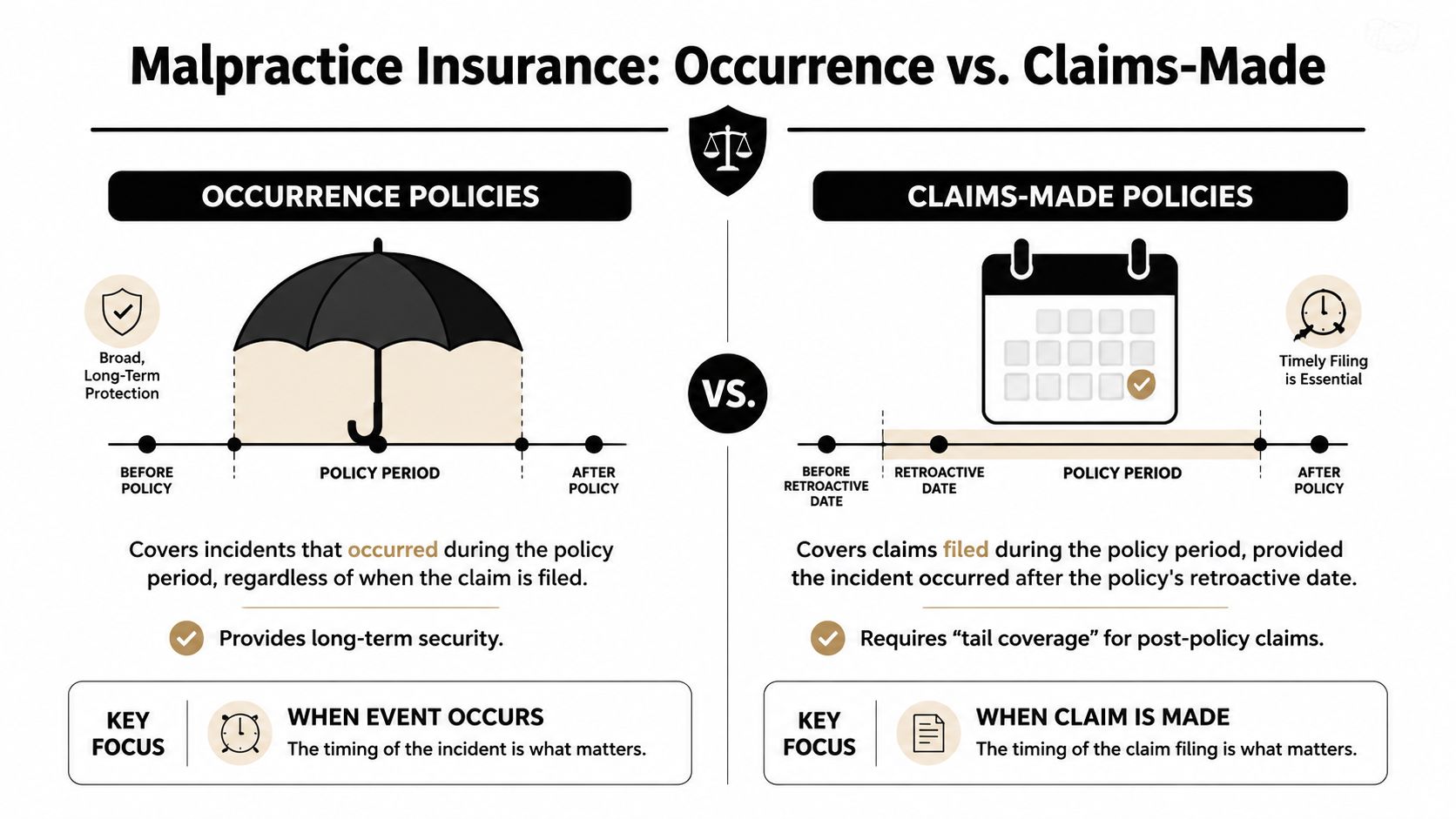
Most confusion around malpractice insurance requirements comes down to one basic question. When does the policy have to be active for coverage to apply? That's the key difference between occurrence and claims-made coverage.
This comparison helps make it visual.
Occurrence coverage
Think of an occurrence policy like a warranty tied to the date the event happened. If the covered incident took place while the policy was active, that policy responds later, even if the claim doesn't arrive until much later.
That matters in transport because not every complaint or legal claim appears right away. A patient transfer can seem uneventful on the day of service, then become the subject of review long after discharge paperwork is filed away. With occurrence coverage, the key question is whether the incident occurred during the insured period.
Claims-made coverage
A claims-made policy works more like an active subscription. It usually responds only if the claim is made while the policy is in force and the incident falls within the covered time frame.
That can work well, but only if everyone pays attention when clinicians change employers, when transport vendors switch carriers, or when a company stops operating. If the policy ends and no extended reporting protection is in place, a later-filed claim may land in a gap.
A clean transfer record today doesn't mean the liability window closes today.
Why tail coverage matters
That gap is where tail coverage becomes important. Tail coverage extends the reporting period for claims-made policies after the original policy ends. In simple terms, it keeps the door open for claims that show up later.
The need for that long view isn't theoretical. The verified data notes that claim resolution takes 4 to 5 years on average in the context of going-bare risk and delayed liability exposure, discussed in Gallagher's review of physician malpractice insurance requirements. In transport work, that timeline matters because the patient, sending facility, receiving facility, and crew may all be in different states and different systems by the time a claim develops.
Here's the video version if you want a quick primer before reviewing a certificate:
A quick way to ask the right question
When you're reviewing documents, don't ask only, “Do you have malpractice insurance?” Ask:
- What kind of policy is it
- Who is named or covered under it
- If it's claims-made, what protects the provider after the policy ends
Those three questions usually get you much closer to the actual risk than a simple yes-or-no answer.
Decoding State and Facility Minimum Requirements
There's no single national rulebook for air medical malpractice coverage. That surprises many newer case managers. They expect one federal minimum to govern every crew and every aircraft. In reality, malpractice insurance requirements can come from state licensing rules, accrediting expectations, hospital contracting, and medical staff policies.
That's why a provider that looks compliant on one transfer can still run into trouble on the next. A domestic operator may satisfy one state's licensing standard but still need additional documentation for an interstate move or for a hospital that applies stricter credentialing standards.
What state rules can require
Some air ambulance rules are direct and unforgiving. In major U.S. states regulating air ambulance services, malpractice insurance requirements for air medical personnel consistently mandate a minimum of $1,000,000 per occurrence and $3,000,000 aggregate, and this 1M/3M structure is codified in Arkansas, Colorado, and Utah, where failure to maintain those exact amounts can trigger license denial or revocation under state rules, as reflected in the Arkansas air ambulance regulatory framework.
That kind of rule changes how you read a certificate. You're not just checking for “some insurance.” You're checking whether the provider meets a threshold that can be tied directly to operating authority.
Why one compliant state doesn't solve everything
A provider may be licensed in its home state and still face questions from hospitals elsewhere. Receiving facilities often want confidence that the transport team's insurance aligns with their own risk standards. The sending side may want the same reassurance before releasing a medically complex patient.
For case managers who handle Washington-based patients or referrals tied to that market, expert guidance on WA medical malpractice can help frame how state-specific requirements and professional liability expectations vary outside the air transport niche. It's useful context because transport decisions often intersect with broader provider credentialing issues.
Facility expectations often sit above the legal floor
Hospitals don't always stop at state minimums. They may ask for:
- A current certificate of insurance
- Proof that medical personnel are included
- Evidence that the insurer is acceptable under facility contracting standards
- Confirmation that the transport scope matches the policy language
That last point causes more friction than people expect. If a transfer involves higher-acuity interventions, bariatric movement, specialty equipment, or a clinician working at the edge of an expanded role, the paperwork has to support that reality.
When a hospital asks for insurance verification, it isn't adding busywork. It's checking whether the transfer plan and the coverage plan match.
The working lesson for transfer coordination
Treat state minimums as the floor, not the finish line. A provider may be legal to operate and still not be the cleanest fit for a particular patient movement. The safest approach is to verify licensure, compare policy limits to the jurisdictions involved, and confirm the receiving facility won't reject the crew on arrival because the documentation doesn't satisfy its standards.
Understanding Your Policy Limits and Endorsements
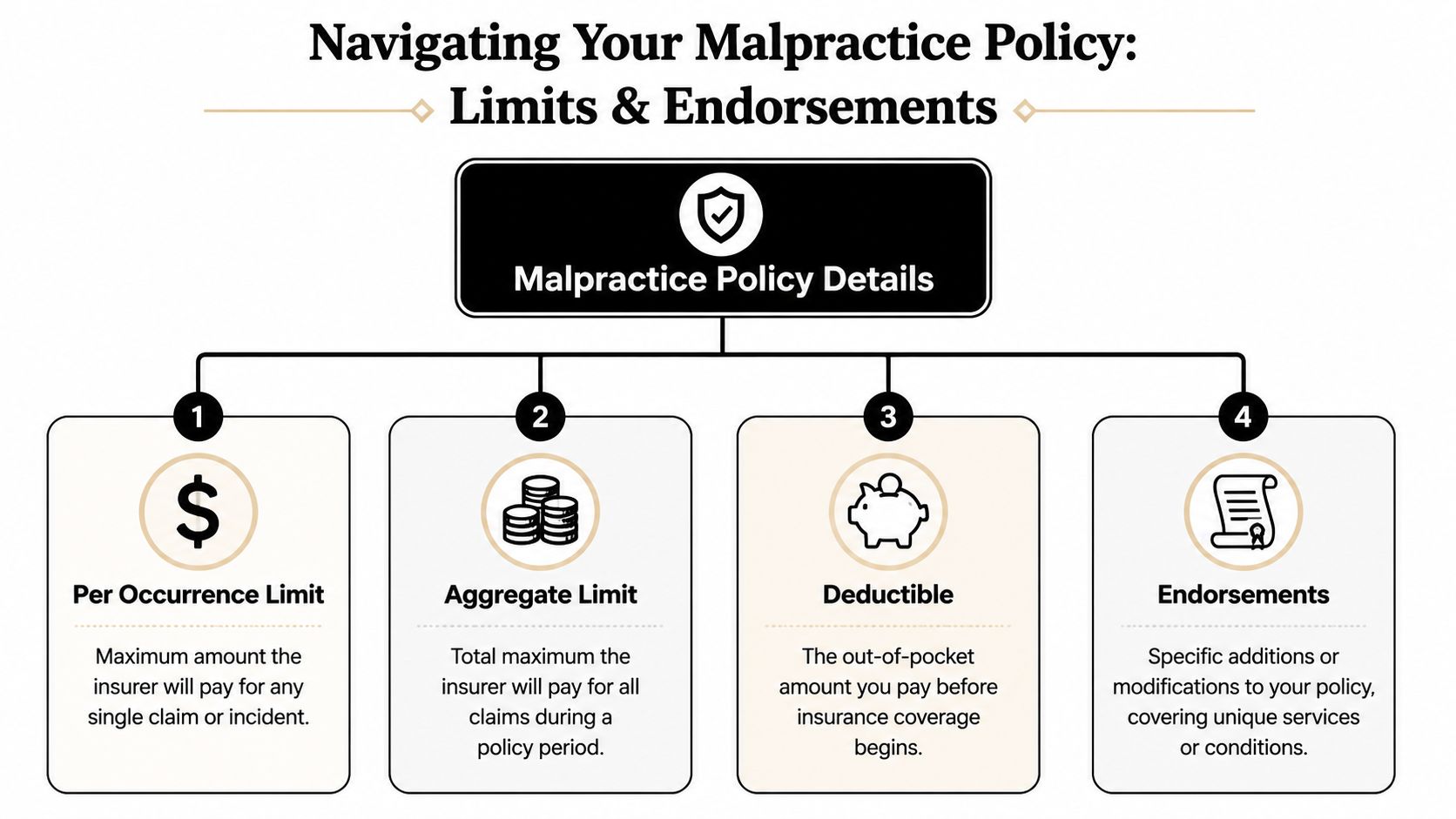
Once you have the certificate, the two numbers that matter most are the per occurrence limit and the aggregate limit. Newer coordinators sometimes focus on the first number and miss the second. That's a mistake.
This visual lays out the moving parts.
The two numbers that control the policy
The per occurrence limit is the maximum the insurer will pay for one covered claim. The aggregate limit is the total the insurer will pay for all covered claims during the policy period.
Colorado's air ambulance licensing rule spells that out clearly. It requires proof of professional malpractice and liability insurance with minimum amounts of $1,000,000 for each individual claim and $3,000,000 for all claims against the service or its medical personnel, as stated in the Colorado air ambulance insurance regulation.
How to read those numbers in real life
A simple way to think about it is this:
| Policy term | What it means in practice |
|---|---|
| Per occurrence | The cap for one event or claim |
| Aggregate | The total cap for the full policy year |
| Endorsement | A written change that adds, limits, or clarifies coverage |
If a provider has a strong per occurrence number but a thin aggregate, the policy may look healthy at first glance while leaving less protection later in the year. For transport coordination, that matters because you usually don't know what prior claims activity has already touched the annual aggregate.
Endorsements are where the real story often sits
The base policy is only part of the picture. Endorsements modify it. In transport work, endorsements can affect whether specialized services, equipment use, or certain clinician activities are included or carved back.
Review these carefully:
- Named insured wording: This helps show whether the company alone is insured or whether the medical personnel are also covered.
- Professional services language: It should fit the actual transport mission, not a generic office-based care description.
- Exclusions and carve-outs: If the language limits unusual procedures or settings, that can become a problem in flight.
Check the match: The policy should describe the work the crew actually performs, not the work someone assumes they perform.
What works and what doesn't
What works is a certificate review paired with a plain-English follow-up. Ask the broker or provider to explain how the policy applies to transport clinicians, high-acuity care, and the specific route involved.
What doesn't work is accepting a one-page COI as if it answers every coverage question. A certificate is useful, but it isn't the whole contract. If something in the transfer profile is unusual, ask whether an endorsement addresses it directly.
Specialized Coverage for Air Ambulance and Medical Escorts
Air medical transport sits at the intersection of medicine and aviation. That's why generic malpractice discussions often miss the mark. A bedside provider in one facility and a transport clinician moving a patient across borders don't face the same operating environment, even if both carry professional liability coverage.
The higher the acuity and the farther the route, the more important it becomes to confirm that the coverage structure fits the mission. A domestic transfer can be one thing. An international movement with airport handling, receiving-country expectations, and cross-border medical coordination is another.
Why air transport needs more than a generic policy mindset
International accreditation standards and Canadian provincial rules can set a higher bar than many U.S. domestic minimums. EURAMI Fixed Wing Air Ambulance Standards require a minimum malpractice indemnity benchmark of $3,000,000 USD aggregate for health care professionals, and that higher benchmark can directly affect an operator's ability to secure international flight permits and cross-border transfers, according to the EURAMI Fixed Wing Air Ambulance Standards Version 6.0.
That creates a practical divide. An operator may be properly structured for domestic work and still need upgraded coverage to participate smoothly in international or cross-border care. If you're sorting through options for trip protection and transfer planning, Med Jets also outlines broader considerations around emergency medical transport insurance.
Where standard assumptions break down
Specialized transport raises questions that ordinary office-based malpractice reviews don't always answer cleanly:
- Cross-border operations: The policy and supporting credentials may need to satisfy parties outside the provider's home state.
- Higher-acuity patients: More complex interventions can expose weak policy wording.
- Medical escort models: Coverage has to follow the clinician's actual role, not just the company brand on the itinerary.
A useful way to think about it
For a family, a transport aircraft can feel like a flying hospital room. Operationally, that's too simple. It's a medical environment moving through multiple legal and regulatory settings. The insurance has to travel with the care model.
That's why stronger operators usually don't treat malpractice insurance requirements as a box-checking exercise. They treat them as part of mission readiness. When coverage supports the route, the credentials, and the clinical scope, the transfer tends to move with fewer surprises.
Verification Steps and Common Pitfalls to Avoid
A transfer can look fully buttoned up at 10:00 a.m. The aircraft is booked, the sending team has signed off, and the family thinks the hard part is over. Then someone asks for proof that the flight nurse, the medical director, and the transport company are all covered for the actual care planned in the air, and the answers get vague fast.
That is usually where preventable delay starts.
For air medical transport, insurance verification should work like a preflight check. The certificate of insurance is only one instrument on the panel. It matters, but it does not tell you everything you need to know about who is covered, what care is covered, and whether a claim tied to an in-flight event would fall inside the policy.
What to check on the certificate
Read the COI the way you would read a transport summary. Match names, dates, and scope.
Start with four basic questions:
- Who is the named insured? The legal entity on the certificate should match the operator or escort company you are hiring.
- Are the dates current? The policy period has to cover the actual transport date.
- What type of malpractice coverage is in place? The provider should answer clearly, not vaguely.
- What limits are listed? Review whether the stated limits meet the expectations of the states, hospitals, and programs involved in the move.
Then go one level deeper. Ask whether the clinicians assigned to the mission are covered under that policy, whether contracted staff are included, and whether higher-acuity services such as ventilator management, infusion work, or critical care interventions in transit require a separate endorsement.
A polished certificate can still hide a weak coverage setup.
Common gaps case managers miss
The first trap is assuming licensure answers the insurance question. It does not. A provider may be legally operating and still carry coverage that is too narrow for the transfer you are arranging.
The second trap is stopping at the company name. In air transport, the company, the aircraft operator, the medical director, and the bedside crew do not always sit under one policy structure. If a flight uses contracted clinicians or a separate medical escort team, confirm that the actual people touching the patient are insured for that role.
The third trap is ignoring the care plan. A stable bedside transfer and a cross-country critical care flight are not the same risk. If the patient may need advanced airway management, vasoactive drips, blood products, or specialty monitoring, ask whether those services fall inside the malpractice wording. Coverage should follow the mission, not just the brand on the quote sheet.
A practical verification sequence
Use a short process every time:
- Request the COI early. Day-of-trip review creates pressure and weak decisions.
- Confirm the insured entity. Match the legal name to the transport agreement.
- Ask who is covered. Get a direct answer on employees, contracted clinicians, and medical directors.
- Verify the policy form. If it is claims-made, ask how prior acts and post-transport claims are handled.
- Review transport-specific exclusions. Look for limits tied to flight medicine, specialty procedures, or multistate work.
- Check facility requirements. Sending and receiving hospitals may expect more than the state minimum.
- Document the answers. Save the COI, emails, and any coverage confirmation in the transfer file.
If a transport later raises billing or documentation problems, organized insurance claim assistance for medical transport cases can help keep records, timelines, and communications in order while coverage questions are being sorted out.
What experienced coordinators avoid
Verbal reassurance from a scheduler is not enough. Schedulers are often helpful, but they may not control the insurance file or understand where endorsements begin and end.
Another mistake is accepting broad language like “we cover all our crews.” Ask for the specific structure behind that statement. In this field, one vague answer can hide a contractor gap, an expired policy period, or a policy written for ground work that does not cleanly fit air medical care.
The clean answer is straightforward. Here is the active certificate. Here are the limits. Here are the covered clinicians. Here is how claims would be handled if something from the transport surfaced later. That level of clarity usually marks an operator that treats insurance as part of mission readiness, not sales paperwork.
FAQ and Documentation Checklist for Case Managers
Case managers don't need to become insurance underwriters. They do need a repeatable checklist. When the transfer is urgent, a simple process keeps everyone from skipping the one question that matters later.
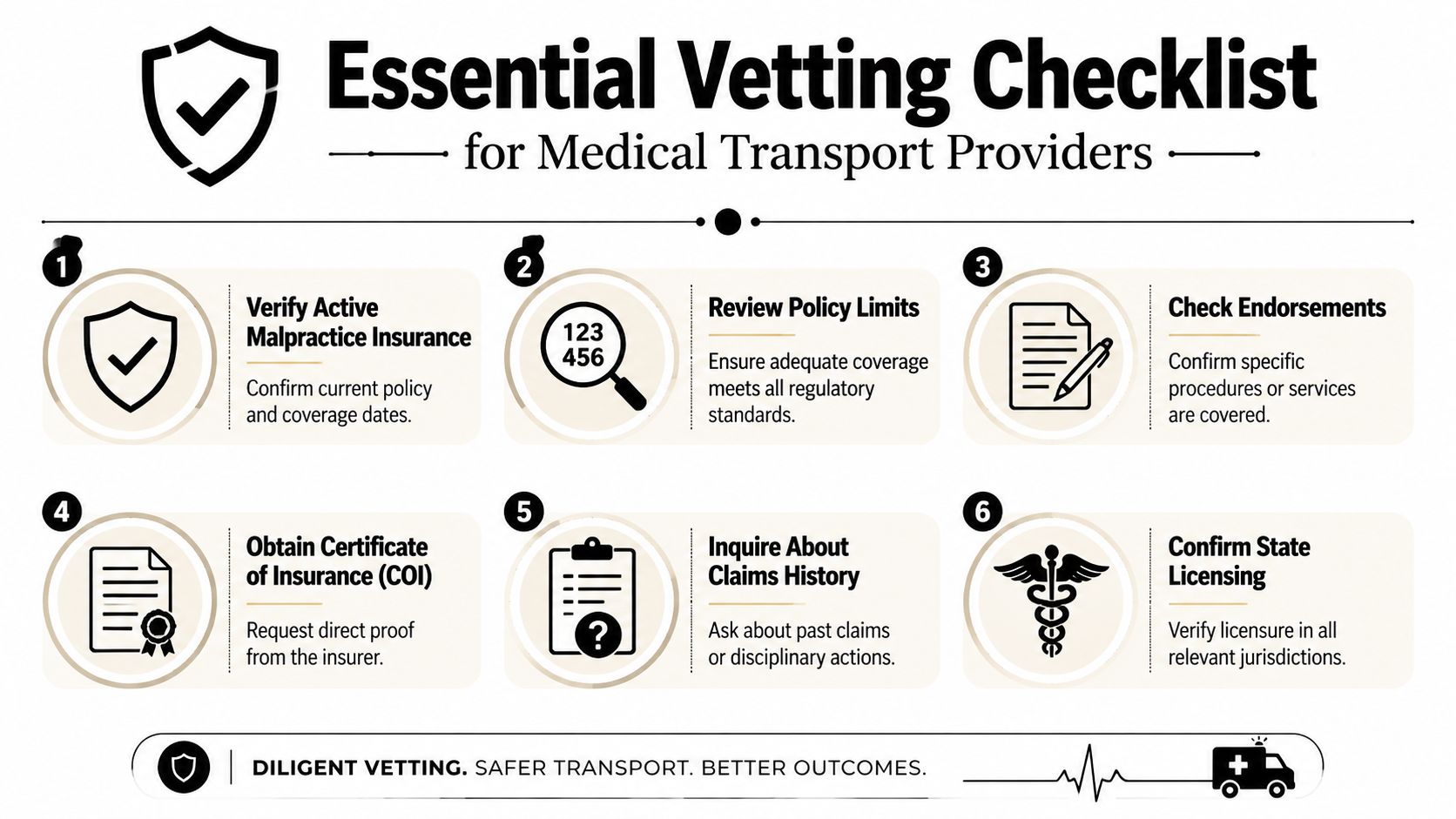
This is the version I'd keep at the desk or in the transfer packet.
Documentation checklist
Before confirming the transport, gather:
- Current certificate of insurance: Confirm active dates and insured entity.
- Policy type confirmation: Ask whether the malpractice policy is occurrence or claims-made.
- Limit review: Make sure the stated limits meet the state and facility expectations involved in the move.
- Clinician coverage confirmation: Verify that the actual medical crew is covered, not just the company name.
- Scope and endorsement review: Ask whether advanced in-flight care or specialized services are covered.
- Licensure check: Confirm the provider is licensed and acceptable for all relevant jurisdictions.
If you want a central place to organize transfer planning materials, these case manager resources can help structure the operational side alongside insurance review.
Common questions people ask
Does malpractice insurance cover scope-of-practice changes during emergency air transport
Not always. A frequently asked question is whether malpractice insurance covers scope-of-practice changes during emergency air transport. Policies often exclude services outside a clinician's defined scope, even though emergency transfers may require that expansion, as noted in the AOA discussion of scope of practice and malpractice insurance.
What happens if a claim is filed years after the transfer
That depends heavily on whether the policy is occurrence-based or claims-made, and for claims-made coverage, whether tail protection exists. If no one verifies that early, the gap may not become visible until long after the transport is over.
Is a certificate of insurance enough by itself
No. A COI is useful, but it's summary proof. It doesn't replace reading the policy terms, endorsements, and exclusions that determine how the insurance responds.
Should families ask about this too, or only hospitals
Families should ask. They don't need to negotiate policy language, but they can absolutely ask whether the provider has active malpractice coverage for the clinicians involved and whether the transport meets the receiving facility's requirements.
The safest transfers usually come from teams that treat insurance the same way they treat ventilator settings and handoff reports. It's part of readiness, not an afterthought.
If you need help coordinating a fully documented patient movement, Med Jets by Air Trek can help families, case managers, and facilities arrange end-to-end medical transport with experienced support available around the clock. You can learn more through Med Jets by Air Trek.