
You're probably reading this while juggling bigger worries than paperwork.
A doctor has recommended an air ambulance. A parent, spouse, or child needs to move quickly. You're comparing aircraft, bedside reports, oxygen needs, insurance calls, and hospital timing. In that rush, one question often gets pushed to the side until much later: Who will see my loved one's medical information during this transfer, and how is it protected?
That question matters more than most families realize. A medical flight doesn't happen in one room with one nurse station. Information moves between hospital staff, case managers, dispatch, medical crew, pilots, ground transport teams, and the receiving facility. If the transfer crosses state lines or borders, the privacy picture gets even more complicated.
Good patient privacy protection isn't separate from good medical transport. It's part of it. A provider that handles records carelessly often handles communication carelessly too. Families feel that immediately. So do case managers trying to coordinate a clean handoff.
Why Patient Privacy Matters Most During a Medical Flight
The usual medical flight starts with urgency.
A hospital case manager calls for records. A family texts insurance cards. A coordinator asks about ventilator settings, oxygen needs, stretcher requirements, and destination acceptance. Someone sends imaging. Someone else confirms whether a family member can ride along. In a few hours, a lot of sensitive information can move through a lot of hands.
That's why air medical transport creates a different privacy environment than a hospital room. The patient is moving. The care team is changing. Communication happens by phone, tablet, radio, secure portal, and paper packet. The aircraft itself is a confined setting where crews must balance fast care with quiet, careful communication.
The security of patient health information demands utmost attention across healthcare generally. Between October 2009 and April 2026, over 1 billion individual health records were exposed in large data breaches in the U.S., and in 2024 alone an average of 792,226 individuals had their data compromised daily, according to healthcare breach statistics compiled by HIPAA Journal. For families arranging transport, that number changes the conversation. Privacy isn't a side issue. It's part of safe coordination.
What makes a flight different
In the air ambulance setting, privacy risks don't come only from hacking.
They also come from ordinary moments:
- Open verbal updates: A crew member gives a report where others can overhear.
- Loose paperwork: Printed records travel with the patient and need secure handling.
- Multi-party coordination: More people need some information, but not everyone needs all of it.
- Cross-border movement: Different privacy rules may apply once a transfer leaves one jurisdiction and enters another.
Practical rule: The faster a transfer moves, the more disciplined the privacy process has to be.
Families often assume that because a transfer is medical, every detail should be shared freely with every participant. That isn't how good operations work. The best teams share what the next person needs to do their job, not the patient's entire story by default.
Understanding Your Rights Under HIPAA in the Air
If HIPAA feels abstract, think of it as the rulebook that tells medical organizations when they can use or share health information and what they must do to protect it.
For air transport, that matters because families sometimes worry the aircraft is outside the usual healthcare system. In many cases, it isn't. The HIPAA Privacy Rule, enacted in 1996, legally defines air ambulance services as "health care providers" when they engage in electronic transactions, making them "covered entities" required to protect PHI and provide patients with access to their records within 30 days, as explained in this legal opinion on EMS patient communications and HIPAA.
That means your privacy rights don't stop at the hangar door.
What counts as protected information
Protected Health Information, or PHI, is broader than many people think.
It can include a diagnosis, medications, imaging, and treatment notes. It can also include identifying details tied to care. If a patient's name, destination, or flight detail sits in the same record set as medical information, that combination can become protected information.
A simple way to think about it is this:
| Example | Protected |
|---|---|
| A patient's oxygen requirement | Yes |
| A patient's name linked to medical condition | Yes |
| A flight detail linked to treatment record | Yes |
| A generic aircraft tail number by itself in public operations context | Not necessarily |
That's why experienced coordinators are careful with what they send in emails, intake forms, and booking notes.
What rights matter most during transport
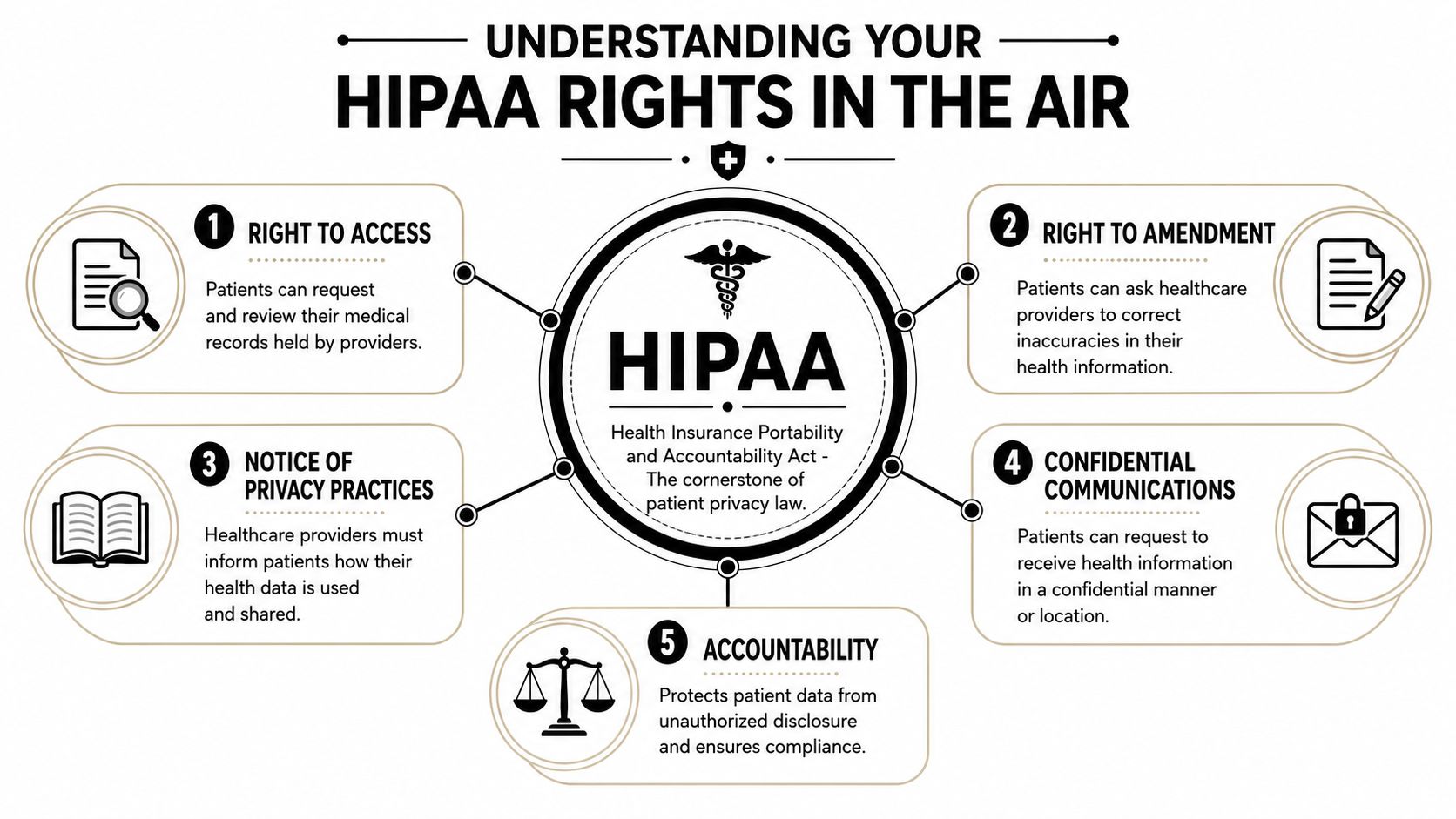
In a transport setting, families usually care about five practical HIPAA rights:
- Access to records: You can request your records from a covered entity.
- Notice of privacy practices: The provider should tell you how information is used and shared.
- Accountability for disclosure: The organization must have privacy policies and documented handling practices.
- Confidential communication requests: You can ask for communication in a particular way or at a particular location.
- Requests to correct information: If something is inaccurate, you can ask for correction.
If you're vetting a provider, it helps to compare their process against a solid vendor checklist for HIPAA compliant services. The value of a checklist isn't the technology jargon. It's whether the organization can clearly explain who has access, where data goes, and how it's controlled.
You should also expect a transport company to have clear expectations for records and intake materials. A provider that documents carefully tends to transfer carefully. This is one reason many case managers review a company's medical documentation standards before sending a chart packet.
Ask a simple question: “Who will see this information before takeoff, during the flight, and after arrival?” A reliable team should answer without hesitation.
Identifying Key Privacy Risks During Medical Transfers
Most privacy guides focus on the hospital EHR. The transport chain has its own weak points.
A patient's information starts moving long before the aircraft lifts off. The first call may include age, condition, location, destination, and urgency. Then come nursing notes, medication lists, imaging, consent forms, passport details for international flights, and bedside updates. Every transfer point creates another chance for over-sharing, misrouting, or careless handling.

Where privacy can break down
The risk isn't just a dramatic cyber event. In transport work, ordinary workflow mistakes are common concerns.
- Booking stage: Too much information gets sent before it's required.
- Ground handoff: Staff discuss details in hallways, elevators, loading areas, or on the tarmac.
- Aircraft communications: A report may include more patient detail than the receiving side requires.
- Arrival packet: Paperwork may travel with labels, identifiers, and notes that aren't organized or minimized.
A persistent blind spot is “anonymous” travel information. A critical gap in patient privacy is the lack of clear guidance for non-hospital transport, and even "anonymized" health data can be re-identified with high accuracy when combined with travel or location data, as discussed in this research on re-identification risk in health data.
A simple example families recognize
Suppose someone says, “We never used the patient's diagnosis, only age range, route, timing, and destination details.”
That can still be sensitive.
On a long-haul medical flight, route, timing, specialty destination, and equipment notes may point back to one specific person, especially when the case involves a rare condition, a public figure, or a small community. In other words, removing the diagnosis line doesn't automatically make the data private.
The transport world often treats travel data as operational. Families experience it as personal. Both views matter.
This is why good patient privacy protection in air transport depends on restraint, not just software. Teams need secure systems, but they also need judgment.
Concrete Safeguards for Protecting Your Information
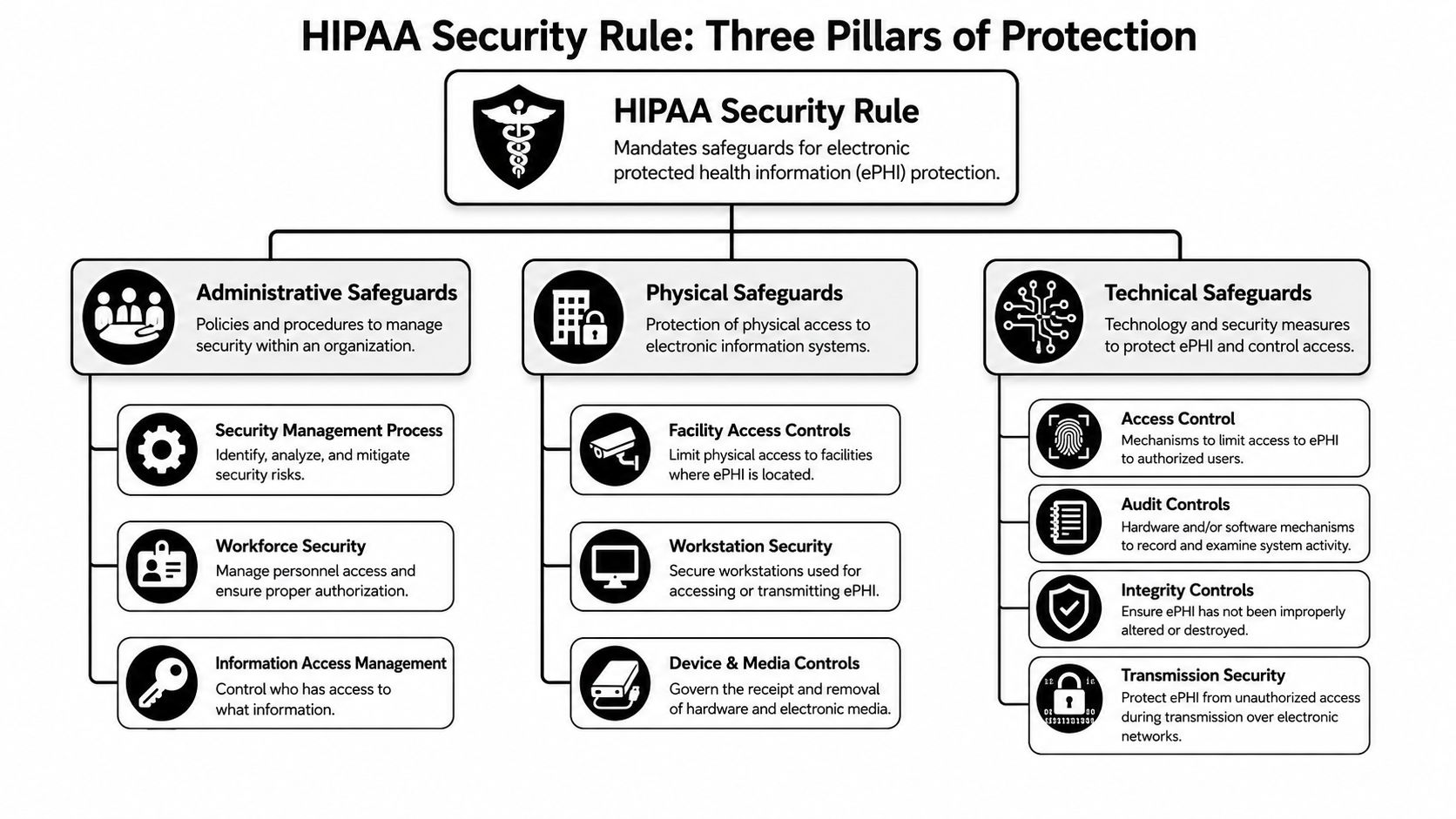
A strong privacy program in air medical transport rests on three HIPAA Security Rule pillars: administrative, physical, and technical safeguards. Families don't need to memorize the regulation. They just need to know what these categories look like in real life.
The technical piece gets the most attention because transport is communication-heavy. The HIPAA Security Rule mandates “Transmission Security” to protect ePHI sent over electronic networks. This is an addressable, but critical, specification for air ambulance providers who coordinate patient transfers via digital communication between dispatch, ground transport, and aircraft, according to the AMA overview of HIPAA Security Rule risk analysis and safeguards.
Administrative safeguards in daily operations
This is the people-and-process layer.
An air medical provider should define who may access records, when they may access them, and how they're trained to communicate. Dispatchers, clinicians, pilots, customer service staff, and billing personnel don't all need the same view of the chart.
Look for signs such as:
- Role-based access: Different team members receive only the information needed for their task.
- Written privacy procedures: Staff follow a documented process for intake, transfer, and handoff.
- Training for cramped environments: Crews know how to speak discreetly near family, airport personnel, and receiving teams.
Physical safeguards inside a moving operation
Notably, transport differs sharply from a stationary clinic.
Physical records may still travel with the patient. Tablets and phones may move between ambulance, ramp, aircraft, and hospital. A secure provider treats devices, printouts, labels, and disposal as part of patient privacy protection, not afterthoughts.
A practical comparison helps:
| Safeguard area | What it looks like on a transfer |
|---|---|
| Device security | Locked devices and controlled access during transport |
| Paper handling | Minimal printouts, organized packets, secure storage |
| Workspace discipline | Quiet reporting and shielded screens in shared spaces |
Technical safeguards that matter in the air
Technical safeguards are the controls built into the communication system itself.
A provider should use secure methods for transmitting records, care updates, and coordination notes between referral source, dispatch, aircraft, and destination. Transmission security matters because transport relies on movement. The information is rarely staying in one protected environment.
Field reminder: Encryption only solves part of the problem. Teams still need to send the right information to the right person at the right time.
That's the larger point. Administrative, physical, and technical safeguards work together. If one layer is weak, the others have to carry too much weight.
Defining Roles in the Chain of Privacy
Privacy in transport doesn't belong to one person. It belongs to the chain.
Families get frustrated when everyone says, “That's handled by someone else.” A cleaner approach is to define responsibility at each handoff. In transport work, that means the sending facility, the air medical provider, the receiving team, the insurer or assistance company, and the family all have a part to play.
What the transport coordinator should do
A coordinator sits at the center of information flow, so discipline matters from the first call. The standard is straightforward. The “minimum necessary” standard requires coordinators to share only medical stability information, equipment needs, and destination details, not specific diagnoses unless required for care. This is enforced through encrypted communication and discrete crew training from the moment a flight is booked, as described in this air medical privacy guidance on minimum necessary communication.
That means a skilled coordinator doesn't broadcast the full chart to every participant. They tailor information to purpose.
For example:
- Dispatch needs scheduling and mission logistics.
- Medical crew needs clinical detail for safe care.
- Pilots need operational details, not the patient's entire diagnosis history.
- Ground transport needs timing, equipment, and destination handoff instructions.
What the hospital case manager should do
Case managers often hold the largest bundle of records. Their role isn't solely to send everything fast.
They should confirm what the air medical provider needs for acceptance, clinical planning, and destination coordination. That protects the patient and reduces clutter that can create confusion during the transfer.
A good benchmark is whether the process supports clean patient continuity of care. Continuity and privacy aren't opposites. When records are organized and purposeful, both improve.
What families and insurers should do
Families sometimes think they have no role beyond signing consent. That's not true.
They should ask:
- Who gets updates during the trip?
- What information will be shared with the receiving hospital?
- Can communication be directed to one family contact?
- How do we request records later?
Insurers and assistance companies have their own responsibility. They need enough information to authorize, coordinate, or process the transport, but they shouldn't receive extra clinical detail that doesn't affect their role.
The cleanest transfers happen when every party can answer one question: “Why do I need this specific piece of information?”
Your Checklist for a Privacy-Conscious Transfer with Med Jets
Families often ask what “good privacy” should look like when choosing a provider. The answer isn't a polished brochure. It's a clear, consistent process.
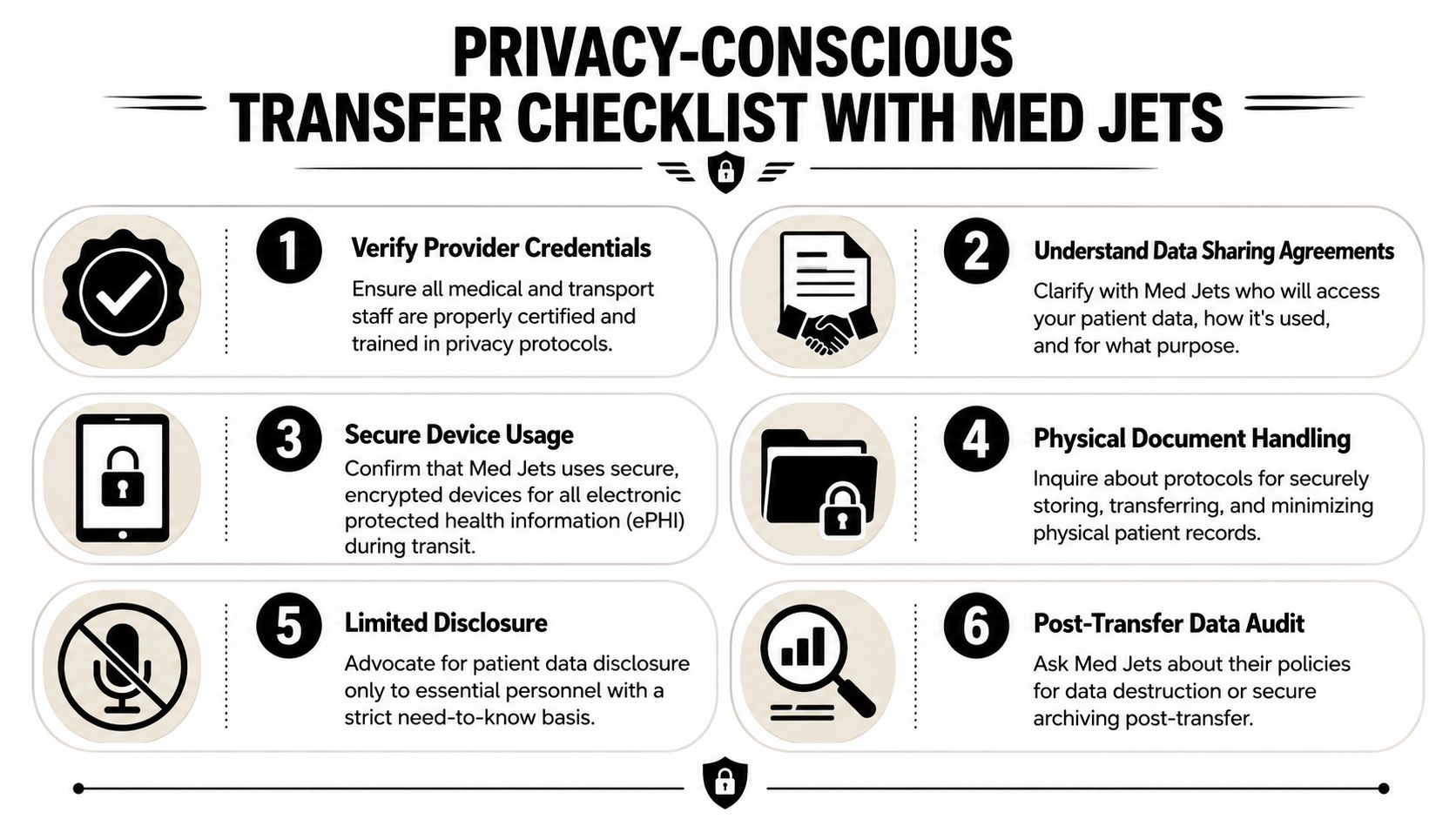
If you're arranging a transfer, use the checklist below as your standard for evaluating any air medical provider. It's also a practical way to prepare for a discussion with a flight coordinator. If a company can answer these questions directly, that usually signals a mature operation. If the answers are vague, privacy may be vague too.
Questions worth asking before you sign
- Who sees the patient record first: Ask whether intake staff, clinical reviewers, and dispatch all access the same materials or a limited subset.
- How is information sent to the aircraft and destination: You're listening for secure transmission practices, not casual texting or broad email forwarding.
- What happens to paper documents during the trip: Records may still travel physically, so ask how they're stored, handed off, and retained.
- How are family updates handled: Confirm whether one spokesperson should be designated to avoid accidental over-disclosure.
- What happens after arrival: Ask whether records are archived securely or disposed of according to policy.
What a reassuring answer sounds like
Good answers are specific.
A provider should be able to explain who has access, how handoffs work, and how they limit disclosure to people with a real need to know. They should also be comfortable discussing post-transfer handling of records. If the answer sounds improvised, that's useful information.
For families comparing options for a return or specialty transfer, it also helps to review the provider's broader transport approach, including services like medical flights that bring patients home safely. Privacy shouldn't be separated from the overall transfer workflow. It should be built into it.
A privacy-conscious provider doesn't act annoyed when you ask detailed questions. They expect those questions and answer them plainly.
Used this way, a checklist does more than screen vendors. It lowers stress. It gives families language for questions they already had but didn't know how to phrase.
Frequently Asked Questions About Patient Privacy
Does HIPAA apply to an air ambulance?
Often, yes. As covered earlier, air ambulance services that meet the HIPAA definition of a covered provider have privacy obligations similar to other healthcare organizations. That's why it's reasonable to ask for a privacy notice, a records process, and an explanation of how information is shared.
Can we ask the crew not to share a sensitive diagnosis?
You can ask for limited disclosure, and that request is worth making clearly. In practice, the crew may still need to share details that are necessary for treatment and safe handoff. The key question isn't whether the diagnosis is sensitive. It's whether that detail is required for care.
Does the new reproductive health privacy rule protect information during transport?
Families often encounter confusion. The 2024 HHS final rule strengthens protections for reproductive health information, but its application to independent transport providers in emergency situations is a common point of confusion for families arranging care for sensitive conditions, as summarized by EPIC's health privacy resource.
That means families should ask transport providers directly how they handle highly sensitive information and whether any emergency coordination needs could affect disclosure.
Can we block certain family members from getting updates during the flight?
Sometimes, but not always completely.
You can usually ask the provider to direct updates only to a designated contact. But emergency circumstances can complicate this. If a patient is incapacitated or a medical decision requires immediate coordination, staff may need to communicate more broadly than the family initially expected.
Can we ask for extra privacy protections even in an emergency?
Yes. Ask anyway.
Emergency care can narrow the options, but it doesn't erase the need for patient privacy protection. You can still request discrete communication, limited updates, and clarification about who will receive information. A good provider will clearly communicate what can be honored and what may need to change for safety.
Patient privacy protection during air medical transport isn't about stopping information from moving. It's about making sure the right information moves to the right people, in the right way, for the right reason.
If you're arranging a transfer and want a team that can explain both the medical and privacy side clearly, contact Med Jets by Air Trek.