

When a doctor says your loved one needs to be transferred, the room can feel smaller in an instant. You may hear a few phrases like “higher level of care,” “accepting physician,” or “bed availability,” and still not know the answer to the question that matters most. Why can't treatment happen here?
That reaction is normal. Families often assume a transfer means something has gone wrong, or that the current hospital is giving up. In most cases, it means the team is trying to match your loved one to the place that has the right people, equipment, and monitoring for what's happening right now.
I've seen this from both sides. As a case manager, you're tracking doctors, beds, records, insurance, and timing. As a flight coordinator, you're also thinking about whether the patient can safely move and what transport team can care for them on the way. For families, it can feel like everyone else speaks a language you haven't learned yet. You can learn enough, quickly, to ask good questions and stay grounded.
That Overwhelming Moment A Transfer Is Recommended
A common scene goes like this. Your loved one went to the nearest emergency room with sudden weakness, chest pain, severe breathing trouble, a head injury, or a complication after surgery. The local team acts fast. Then a physician tells you they recommend transfer to another hospital.
Your first questions are usually practical and emotional at the same time.
- Is this an emergency
- Is the current hospital unable to help
- Is the other hospital better
- How will they get there
- Can I go too
- Who is in charge now
Those are the right questions.
Often, the answer is simple even when the situation isn't. The current hospital may be doing exactly what it should do. It stabilizes the patient, identifies what's needed next, and arranges transfer to a hospital that can provide it. That can happen because the patient needs a stroke team, a heart procedure, a neurosurgeon, an ICU bed, or another service the first hospital doesn't have at that moment.
You don't need to understand every medical term right away. You need to understand the reason for the move, the destination, and the immediate plan.
If the timing feels intense, that's because some transfers happen in a narrow treatment window. Families often find it helpful to read a plain-language explanation of why timing matters in the medical golden hour, especially when decisions are moving quickly.
What families often misunderstand first
Many people hear “transfer” and think “discharge.” They're not the same thing. A transfer means your loved one is still under active medical care and is being moved to another facility for treatment.
People also assume a transfer is always by helicopter. It isn't. Some patients go by ground ambulance. Some go by helicopter. Others go by fixed-wing air ambulance for longer distances. The transport choice depends on the medical condition, urgency, and distance.
Three things to ask in the first five minutes
- What specific care does my loved one need that isn't available here
- Which hospital is being requested, and has that hospital accepted the patient
- What is being done right now to keep my loved one stable before transport
Those questions bring the conversation back to what matters. They also help you separate the reason for the transfer from the stress surrounding it.
The Core Clinical Reasons for a Hospital Transfer
The clearest answer to why are patients transferred between hospitals is resource matching. The patient's needs and the hospital's capabilities no longer match. According to AHRQ's review of interhospital transfer, about 1.5% of Medicare hospital admissions involve interhospital transfer, and the rate can reach up to 44% for acute myocardial infarction when higher-acuity care is needed.
That sounds technical, but the idea is familiar. If your local mechanic can diagnose a problem but doesn't have the tools or specialist to rebuild the engine, the car goes to a shop that does. Hospitals work the same way, except the stakes are much higher and time matters more.
Specialist care isn't available onsite
Some conditions need a physician or team that smaller or community hospitals may not have in-house.
A patient with a brain bleed may need a neurosurgeon. A patient with severe heart failure may need advanced cardiac specialists. A patient with a complex stroke may need a team that can perform a time-sensitive intervention. If your family is trying to understand what advanced cardiac illness can involve, Qaly's resource on advanced heart failure offers a useful plain-language overview of how specialized this care can become.
In these cases, the first hospital may diagnose the problem correctly and still need to send the patient elsewhere for definitive treatment.
The patient needs equipment or monitoring the hospital doesn't have
Some hospitals can stabilize a patient but can't provide the next layer of support.
That may mean:
- Advanced monitoring: The patient needs continuous ICU-level observation.
- Specialized machines: The needed equipment isn't available at the current facility.
- Dedicated unit placement: Care may require a burn unit, neuro ICU, cath lab, or another setting built for a narrow group of patients.
A family might ask, “If they already started treatment, why move now?” Because the first treatments can buy time, but they may not solve the underlying problem.
A specific procedure must happen at another center
Sometimes the need is less about a general “better hospital” and more about one exact service.
Examples include:
- Urgent intervention for a heart attack
- Stroke treatment that requires specialized capability
- Surgery that needs a subspecialty team
- Transplant-related evaluation or management
Practical rule: Ask the doctor to name the exact service, procedure, or specialist your loved one needs. Once you hear the specific reason, the transfer usually makes more sense.
It's not always about a higher level of care
Families are often surprised to learn that some transfers happen because the patient is improving. A hospital may transfer a stable patient closer to home, to rehabilitation, or to another facility for ongoing recovery. Other times, logistics or insurance network rules influence where care continues.
The key point is this. A transfer is usually about getting the patient to the place that fits the next phase of care, whether that next phase is more intensive treatment or a safer recovery setting.
How a Transfer Is Initiated and Approved
When families ask who starts a transfer, the answer is usually a small chain of people working together. One physician identifies the need. A case manager or transfer center begins coordination. Another physician at the receiving hospital formally accepts the patient.

That's why families sometimes hear, “We're waiting for acceptance,” even after the decision to transfer seems obvious. The destination hospital needs to confirm that it can take the patient and that the right service is available.
Who does what
The process usually looks like this:
The bedside doctor identifies the medical reason
The doctor determines that your loved one needs care the current hospital can't provide.The current team stabilizes the patient
This can include medications, breathing support, imaging, lab work, or other urgent treatment before movement.Case management or the transfer center coordinates
They gather records, contact possible receiving hospitals, help verify logistics, and line up transport.An accepting physician says yes
A doctor at the receiving hospital agrees to take over care.Transport is arranged
The team chooses ground or air based on the patient's condition, urgency, and distance.
What EMTALA means for your family
A transfer isn't supposed to happen casually. Federal law plays an important role here. The Emergency Medical Treatment and Active Labor Act, often called EMTALA, requires hospitals to transfer patients when they need specialized services unavailable at the current hospital and when the medical benefits of transfer outweigh the risks.
For families, that means the decision should center on patient benefit, not convenience.
It's also fair to know that the process can still feel subjective. Different doctors may view the same situation a little differently. Insurance networks can also affect where a patient is sent after the immediate emergency is addressed.
A related point that confuses many families is prior authorization. In an emergency transfer, the clinical decision often moves faster than normal insurance paperwork. Later, administrative details may catch up. This plain-language guide to understanding prior authorization can help you sort out what approval steps may happen in the background.
What “accepted” should mean to you
When a family hears “the patient has been accepted,” ask for three details:
- The receiving hospital name
- The accepting physician or service
- The bed or unit type if known
That tells you the transfer is real, not just requested.
A short overview can also help if you want to see a general explanation of how transfer coordination works in practice.
If you feel lost, ask one person on the hospital side to be your main contact. Families do better when they know exactly who will call with updates.
Choosing the Right Transport Ground vs Air Ambulance
The transport decision is medical first, logistical second. A patient doesn't go by air because it sounds faster. The team chooses the mode that best balances urgency, stability, distance, and the level of care needed during the trip.
Safe inter-hospital transfer depends on stabilization before departure, good communication, and picking the appropriate transport mode. The literature summarized in this review of inter-hospital transfer practice makes the central issue clear. The benefit of higher-level care has to be weighed against the risk of deterioration during movement.
The three factors that usually decide transport
A case manager or transport coordinator will usually focus on these questions:
How stable is the patient
Can your loved one safely tolerate movement, altitude changes, or a longer ride?How far is the receiving hospital
A nearby transfer may fit ground transport. A longer interstate transfer may point toward fixed-wing air ambulance.How urgent is the treatment
If minutes matter, the fastest medically appropriate option may be chosen.
Hospital Transfer Transport Options
| Factor | Ground Ambulance | Helicopter Air Ambulance | Fixed-Wing Air Ambulance (Jet) |
|---|---|---|---|
| Best use | Local or regional transfers | Shorter, time-sensitive hospital-to-hospital transfers | Longer-distance transfers, including interstate or international routes |
| Patient condition | Stable to moderately critical, depending on crew and equipment | Critical patients needing rapid access to another facility | Patients who need monitored long-distance transport with an onboard medical crew |
| Distance | Short to moderate | Short to moderate | Long |
| Weather impact | Road conditions and traffic matter | Weather can limit launch or routing | Weather matters, but jets are used for longer planned medical flights |
| Access | Door-to-door by road | Requires helipad or suitable landing process | Usually includes airport coordination plus ground ambulance on both ends |
| Family travel | Sometimes limited | Usually very limited | May allow one or more accompanying family members depending on aircraft and mission |
| Typical decision driver | Simplicity and local access | Speed for urgent regional movement | Distance, continuity of care during a long trip, and cross-state or cross-border movement |
When helicopter makes sense
Helicopters are often used when the receiving hospital is relatively close and the patient needs rapid transfer between facilities. They are most useful when road travel would add delay and when the patient's condition justifies the speed.
They are not the default choice for every urgent patient. Weather, landing access, and patient-specific medical issues all matter.
When a fixed-wing jet makes sense
Fixed-wing air ambulances are used for longer transfers. That might mean moving a patient across a state, across the country, or internationally when ongoing medical care is needed en route. In these cases, the aircraft functions like a small critical care space in the air.
One option families and case managers may encounter is Med Jets by Air Trek, which provides fixed-wing air ambulance transport, medical escorts, and coordinated ground segments for hospital-to-hospital transfers.
The right transport isn't the one that leaves first. It's the one that can safely carry your loved one from this bedside to the next one.
Key Questions for Families and Case Managers to Ask
When stress is high, people forget what to ask. Write these down in your phone or on paper. One good question at the right moment can prevent hours of confusion later.
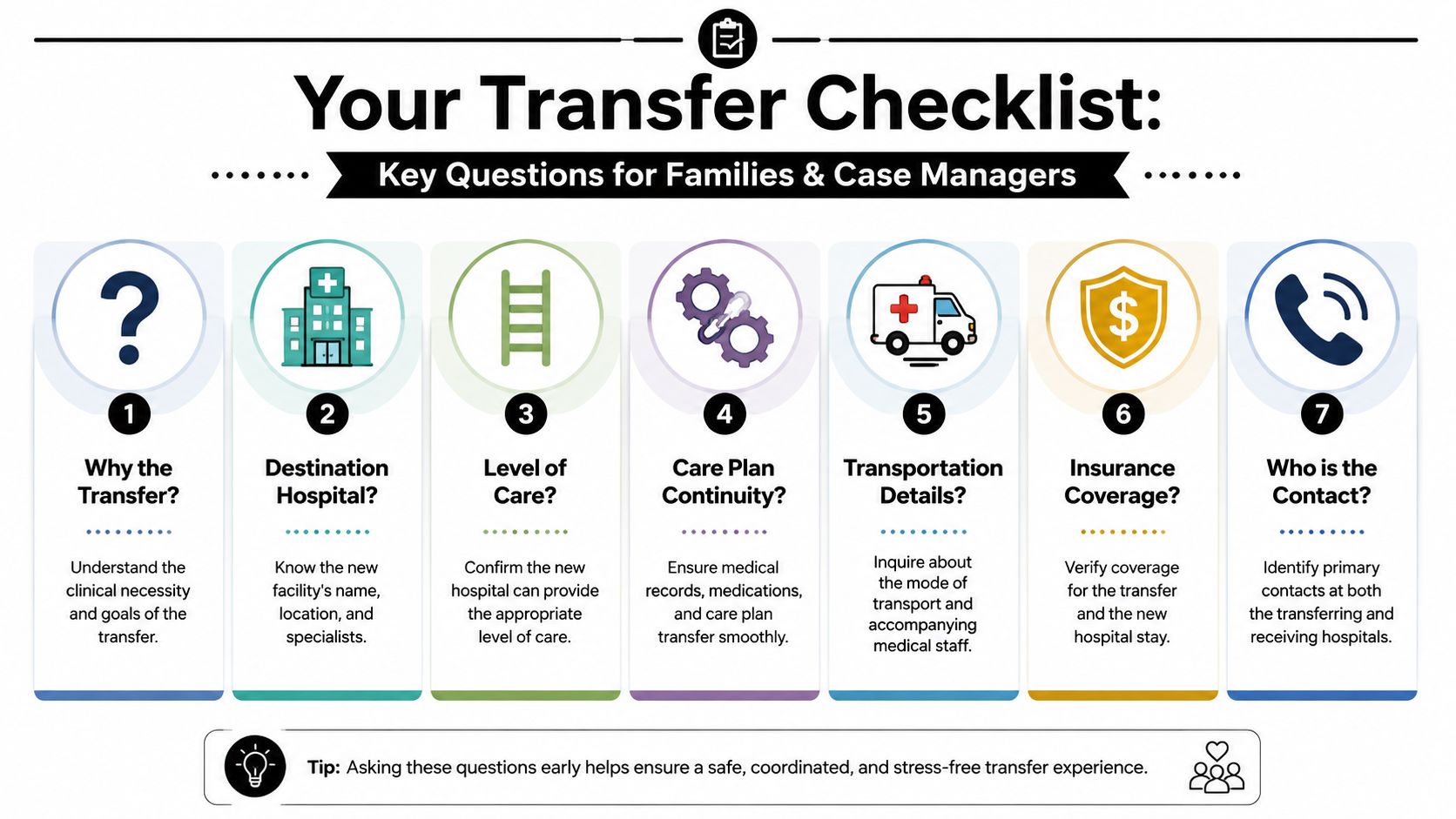
Questions for the transferring doctor
Start with the physician recommending the move.
What exactly is the medical reason for transfer
Ask for the answer in plain language, not just the diagnosis name.What treatment is needed at the next hospital
Try to get the exact specialist, procedure, or level of care.How stable is my loved one right now
You want to know whether this is urgent, time-sensitive, or planned as soon as safely possible.What risks should we understand during transport
Every transfer has risk. Ask what the team is doing to reduce it.
Questions for the case manager or transfer center
Here, families often get the most useful operational detail.
Which hospital is accepting the patient
Get the full hospital name and location.Who is the accepting doctor or service
It may be a specific physician, ICU service, trauma team, or specialty unit.Will records, imaging, and medication lists arrive before or with the patient
That includes scans, lab results, and physician notes.Who should I call for updates if the timeline changes
Ask for one direct number if possible.
Ask for names, not just job titles. “The case manager” is harder to track down than “Maria in case management.”
Questions for the transport team
Once the move is active, the transport crew becomes a central part of safety and communication.
What type of transport is being used, and why
Ground, helicopter, or fixed-wing should have a clinical reason behind it.Can a family member go with the patient
Sometimes yes, sometimes no. Aircraft type, patient condition, and safety rules all affect this.What belongings can travel with the patient
Bring essentials only unless told otherwise.What happens if the patient's condition changes during the trip
The crew should be able to explain the level of care they can provide on the way.
A small practical checklist
Before departure, try to confirm:
- Destination confirmed
- Receiving physician or service confirmed
- Transport mode confirmed
- Primary family contact confirmed
- Medication list and records sent
- Personal essentials packed
- Arrival instructions understood
Families don't need to manage the medicine. But you do have a role in reducing preventable confusion.
Navigating the Insurance and Financial Aspects
A transfer can trigger a second wave of anxiety. The first wave is medical. The second is financial. Families want to know what insurance will cover, whether the receiving hospital is in network, and whether transport creates a separate bill.
The most important phrase to understand is medical necessity. If the hospital documents that your loved one needed services unavailable at the first facility, that documentation often becomes the foundation for insurance review of both the transfer and the continued hospital stay.
What to ask the hospital and your insurer
Ask the hospital team for the medical reason for transfer in clear language. Then ask whether they can document that reason in the chart and discharge or transfer paperwork. You're not rewriting the record. You're making sure the clinical reason is clearly stated.
When you call the insurer, ask these questions:
- Is the receiving hospital in network
- Is the transport provider in network
- How does the plan review medically necessary transfers
- Will there be separate bills for hospital care and transport
- What records should I keep
If your coverage comes through work and you're trying to understand the broader language around plan design, network limits, and employer-sponsored coverage, a general Florida employee benefits guide can help you make better sense of the terms.
Two bills often surprise families
Hospital transfer situations often involve more than one bill. There may be:
- The original hospital bill
- The receiving hospital bill
- A separate transport bill
That doesn't automatically mean something is wrong. It means several providers were involved.
A focused explanation of whether insurance covers air ambulance can help families understand why transport claims are often handled differently from regular hospital claims.
Keep a simple paper trail
You don't need a legal file. You do need a basic record.
Keep:
- Names of people you spoke with
- Dates and times of calls
- Reference numbers from the insurer
- Copies of transfer paperwork if offered
- Any written explanation of the medical reason for transfer
If a claim is questioned later, clear notes help. They also reduce the chance that you'll have to reconstruct events while exhausted.
Your Hospital Transfer Checklist and Common Questions
When people ask why are patients transferred between hospitals, the shortest honest answer is this. The patient needs care, equipment, monitoring, or placement that the current hospital can't provide at that time. Your job as family is not to run the transfer. Your job is to understand the reason, confirm the destination, and keep communication clear.
Use this quick checklist:
Know the reason
Ask what exact service or level of care is needed.Know the destination
Confirm the hospital, unit, and accepting physician or service.Know the transport plan
Ask what mode is being used and whether a family member can accompany the patient.Know the contact person
Get one name and number for updates.Know the financial basics
Ask how the transfer is being documented for insurance.
Common questions
Can a family refuse a patient transfer?
Sometimes families can decline, but the medical team should explain the risks of staying. If the needed care isn't available where the patient is, refusing can carry serious consequences.
What if the patient worsens during transport?
Transport teams are selected based on the patient's condition and expected needs. They provide care during the trip and communicate with the receiving facility as needed.
How are bariatric patients transferred?
These transfers may require specialized stretchers, loading procedures, larger aircraft configurations, or additional crew planning. The team should address those details before departure.
Who arranges ground transportation from the airport to the new hospital?
For fixed-wing transfers, ground segments are usually coordinated as part of the overall transport plan. Ask who is responsible on both the sending and receiving ends.
When you know what to ask, the process becomes less mysterious. It may still be stressful, but it won't feel quite as out of your hands.
If your family or facility needs help coordinating a hospital-to-hospital air medical transfer, contact Med Jets by Air Trek for 24/7 transport coordination.