
When a patient needs a long-distance medical flight, oxygen suddenly becomes more than a hospital setting on a wall meter. A daughter may be asking whether her father can tolerate altitude. A discharge planner may be trying to confirm how oxygen will continue from bedside pickup to arrival at the receiving facility. A spouse may be staring at transport paperwork and wondering whether “pressurized cabin” means the same thing as “safe for someone with lung disease.”
Those are fair concerns.
In air medical transport, oxygen isn't a minor accessory. It's part of the life-support chain. The aircraft climbs into thinner air, the patient may already have limited reserve, and every handoff matters. What keeps that process safe is not luck. It's a combination of properly designed aircraft oxygen systems, trained crews, strict maintenance, and careful patient-specific planning.
Families often feel they've been dropped into a world of aviation terms, medical gas equipment, and FAA rules overnight. The good news is that the core ideas are understandable once someone explains them in plain language. If you've ever looked into topics like mastering medical device development, you already know that safe medical equipment depends on thoughtful design, testing, and human factors. Aircraft oxygen support follows the same principle, except the environment is moving fast and thousands of feet above the ground.
Your Guide to Oxygen on Medical Flights
A hospital case manager gets the call. The patient is stable enough to move, but not stable enough to travel without oxygen. The receiving hospital is far away. Ground transport would take too long. The family wants answers right now.
The first question is usually simple: Will my loved one be able to breathe safely during the flight?
That question sits underneath many others.
- What kind of oxygen equipment is on the aircraft
- What happens when the patient leaves the hospital room
- What if the oxygen need changes in the air
- What protects the patient if something unexpected happens
Those questions matter because flight changes the environment. Even in a pressurized aircraft, the air at cabin altitude doesn't behave exactly like air on the ground. For a healthy traveler, that may be only a mild stress. For a patient with pneumonia, COPD, heart failure, trauma, or a recent surgery, it can become a central part of the transport plan.
Practical rule: On a medical flight, oxygen planning starts before the stretcher ever moves.
Families also get confused by the word “oxygen” because it sounds singular, as if it were one tank and one mask. In reality, professional aircraft oxygen systems involve a full chain. There's a source, pressure control, delivery equipment, backup planning, and continuous clinical monitoring. There's also a difference between the aircraft's built-in supply and the portable equipment needed during ground segments.
A useful way to think about it is this: the patient needs an unbroken oxygen path from hospital bed to aircraft and from aircraft to the next bed. The job of the transport team is to make that path steady, safe, and adaptable.
What people usually want to know first
Most families aren't asking for gas-law formulas. They want to know three things:
- Can the aircraft support the ordered oxygen therapy
- Will trained clinicians manage it the whole way
- Are there backups if the situation changes
Those are the right questions. The rest of this guide breaks down how aircraft oxygen systems work in the medical flight setting, what regulations protect patients, and how experienced crews manage oxygen minute by minute.
Understanding Aircraft Oxygen System Types
The reason patients need oxygen in flight is simple, even if the science sounds intimidating at first. As an aircraft climbs, the air becomes thinner. There's still oxygen in the air, but the pressure that helps move oxygen into the lungs and bloodstream is lower. That's why altitude can leave people short of breath or lightheaded.
A mountain analogy helps. If you hike uphill, breathing can feel harder even though the air around you hasn't “run out” of oxygen. The body has to work with lower pressure. A medical flight brings the same issue into a faster, more controlled environment, and some patients don't have enough reserve to tolerate that change without support.
The two delivery categories used in aircraft
In aviation, the two main categories of aircraft oxygen systems are continuous flow and demand flow. Continuous flow gives a steady supply and is typically used below 25,000 feet, while demand flow delivers oxygen only during inhalation and is used at higher altitudes. These systems rely on cylinders, regulators, and masks, and they require aviation-grade breathing oxygen plus careful purging and filling practices to protect reliability and cleanliness, as described by HRD Aero Systems on aircraft oxygen servicing.
For families, the key difference is easy to understand:
- Continuous flow means oxygen keeps moving whether the patient is inhaling or not.
- Demand flow means the system delivers oxygen when the person breathes in, which conserves supply.
That's the aviation side. In air medical transport, clinicians also think about the source of oxygen available for the mission.
Comparison of Medical Oxygen Sources in Aviation
| System Type | How it Works | Best For | Key Consideration |
|---|---|---|---|
| Gaseous oxygen | Oxygen is stored in high-pressure cylinders and released through regulators and delivery devices | Most onboard aircraft medical oxygen use and many transfer setups | Requires careful pressure control, handling, and refill procedures |
| Liquid oxygen | Oxygen is stored in liquid form and converted to gas for use | Specialized settings where compact storage matters | Handling is more specialized and operational planning is stricter |
| Portable oxygen concentrator | A device draws in surrounding air and concentrates oxygen for delivery | Selected lower-acuity situations and some patient movement phases | Suitability depends on the patient's clinical needs and the device's capability |
Why families hear different terms
One source of confusion is that system type and oxygen source aren't the same thing. A team might talk about a cylinder, a concentrator, or onboard oxygen storage. They might also talk about continuous flow or demand flow. Those are related, but they answer different questions.
A simpler way to sort it out:
- One question is where the oxygen comes from
- Another is how the oxygen is delivered
- A third is whether the setup works for this specific patient
The safest transport plans match the equipment to the patient, not the other way around.
In medical transport, the large onboard supply usually covers in-flight care, while portable units support transitions in and out of the aircraft. That's what creates a complete oxygen journey instead of a disconnected series of handoffs.
Core Components of a Medical Jet Oxygen System
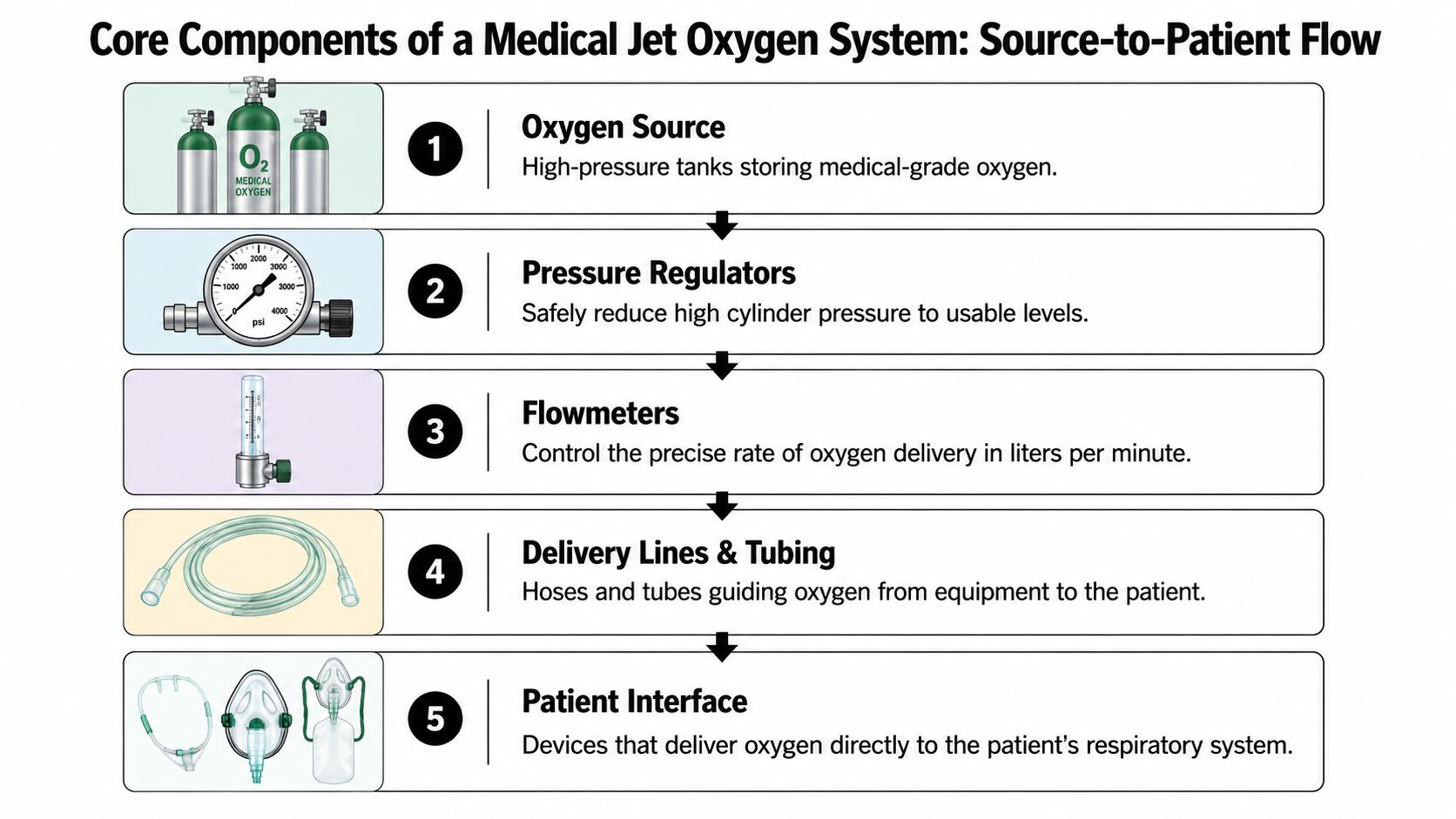
The easiest way to understand aircraft oxygen systems is to follow the oxygen from its source to the patient. Every piece in that chain matters. If one link is poorly maintained, poorly chosen, or poorly monitored, the whole system becomes less dependable.
The oxygen source
At the beginning are the oxygen cylinders. These are the tanks that store medical-grade oxygen under high pressure. In an air medical setting, crews depend on them as the primary supply during flight, while portable cylinders often support movement between the sending facility, the aircraft, and the receiving team.
The source sounds simple, but it has to be protected from contamination, physical damage, and filling errors. That's why aviation oxygen handling is more disciplined than many people expect.
Pressure control and flow setting
Oxygen in a cylinder is stored at far too high a pressure to send directly to a patient. That's the regulator's job. It steps pressure down to a usable level, safely and predictably.
Then comes the flowmeter, which lets clinicians set the amount of oxygen the patient receives. This function unites bedside medicine with aviation hardware. A patient on a nasal cannula needs one kind of setup. A patient requiring a mask or more advanced support needs another.
Tubing and patient interface
Once oxygen leaves the regulator and flowmeter, it moves through tubing and delivery lines to the patient interface. That may be a nasal cannula, a simple mask, or a higher-support mask depending on the patient's condition.
Families often underestimate this final step. The mask or cannula isn't a small detail. It's the part the patient directly experiences, and it has to fit the clinical goal and the patient's comfort.
The patient doesn't breathe from a tank. The patient breathes through a whole system that has to work together without interruption.
Fixed onboard systems and portable backup
Medical aircraft usually have a built-in oxygen capability, but transport teams also need portable oxygen for the moments when the patient isn't physically inside the aircraft. That includes elevator rides, loading, unloading, ambulance transfers, and occasional pauses during handoff.
That's why redundancy matters. The safest operations don't rely on a single cylinder sitting in one location.
A practical checklist of the chain looks like this:
- Source storage: Fixed aircraft cylinders and portable cylinders support both flight and transfer phases.
- Pressure reduction: Regulators convert high-pressure oxygen into a form clinicians can use safely.
- Flow adjustment: Flowmeters help the medical crew match delivery to the patient's current need.
- Transport pathway: Tubing, connectors, and delivery lines carry oxygen reliably through movement and vibration.
- Patient delivery: Cannulas and masks are chosen based on how much support the patient needs.
For readers who want to see the broader range of transport gear that supports this chain, Med Jets provides an overview of its aero medical supplies.
Why maintenance is part of patient care
People sometimes think maintenance is separate from bedside care. In aviation medicine, it isn't. A clean system, properly serviced valves, and inspected components directly affect whether oxygen will perform as expected when the cabin environment changes.
That's one reason experienced crews trust process. The patient may only see the mask. The team sees the entire path behind it.
FAA Regulations and Patient Safety Standards
FAA oxygen rules can sound technical, but their purpose is straightforward. They protect people from hypoxia, which is the dangerous drop in oxygen available to the body, and they create a margin of safety for normal operations and emergencies.
For crew operations, FAR 91.211 requires supplemental oxygen when cabin pressure altitude is above 12,500 feet MSL for more than 30 minutes, continuous use above 14,000 feet MSL, and oxygen availability for passengers above 15,000 feet MSL, as summarized by CFI Notebook's FAR 91.211 overview. Those aren't abstract cockpit rules. They reflect what altitude can do to human physiology.
What those altitude rules mean for a patient
A patient on a stretcher often starts with less respiratory reserve than a healthy pilot. That means any reduction in available oxygen matters more. Regulations give a floor for safety, but medical transport planning goes further by building the patient's diagnosis and current oxygen requirement into the mission plan.
If you're a family member asking, “Do I need oxygen if I'm flying at 13,000 feet?” the answer for a patient is not based on guesswork. It depends on the condition, the cabin environment, and the clinician's assessment. The team plans around the patient, not around a casual travel standard.
The emergency oxygen requirement that matters most
The most important rule for many medical flight readers is the emergency backup requirement for pressurized aircraft. Emergency systems must provide at least 10 minutes of oxygen after a loss of cabin pressure in pressurized aircraft certified above 25,000 feet, and if cabin altitude exceeds 30,000 feet, oxygen concentration must rise to above 94% almost immediately. NATO guidance also specifies performance aimed at maintaining safe alveolar oxygen pressure and preventing hypoxia during rapid decompression in high-altitude operations, as laid out in NATO AAMedP-1.3.
Why does that matter to a patient? Because the emergency system isn't meant to keep the aircraft cruising normally. It's meant to protect life long enough for a safe descent to a lower altitude where breathing conditions improve.
Key point: The backup oxygen supply buys time for controlled descent, not for improvisation.
How standards become real-world safety
Rules by themselves don't help a patient unless crews train to them and maintenance teams uphold them. In a strong air medical program, oxygen readiness depends on recurring inspection, crew familiarity with equipment, and documented maintenance discipline.
That includes practical issues such as:
- System cleanliness: Oxygen systems are purged after opening so residual gas and contaminants don't remain in the lines.
- Component inspection: Teams check for wear, corrosion, and condition issues that could undermine reliability.
- Crew competence: Pilots and clinicians need to understand indicators, masks, and system behavior under stress.
For case managers, a useful sign of seriousness is whether a provider can clearly explain equipment oversight, clinical training, and maintenance accountability. Med Jets outlines that operational discipline in its equipment maintenance schedules.
Questions worth asking
A concerned family member doesn't need to memorize regulatory language. They do need to ask sensible questions.
- How is emergency oxygen handled if cabin pressure changes
- What backup supply travels with the patient during loading and unloading
- Who confirms the system is ready before departure
- How are crew members trained on this exact equipment
Those questions translate regulations into something personal. They get you closer to the answer that matters most: whether the person on the stretcher will remain protected if the environment changes quickly.
How Oxygen Is Managed for Patients In-Flight
A flight medic's work with oxygen starts well before the aircraft door closes. The crew reviews the patient's diagnosis, current oxygen device, recent vital signs, and how the patient tolerated movement at the sending facility. They also think through the whole route, including ground segments and any delays that might keep the patient on portable oxygen longer than expected.
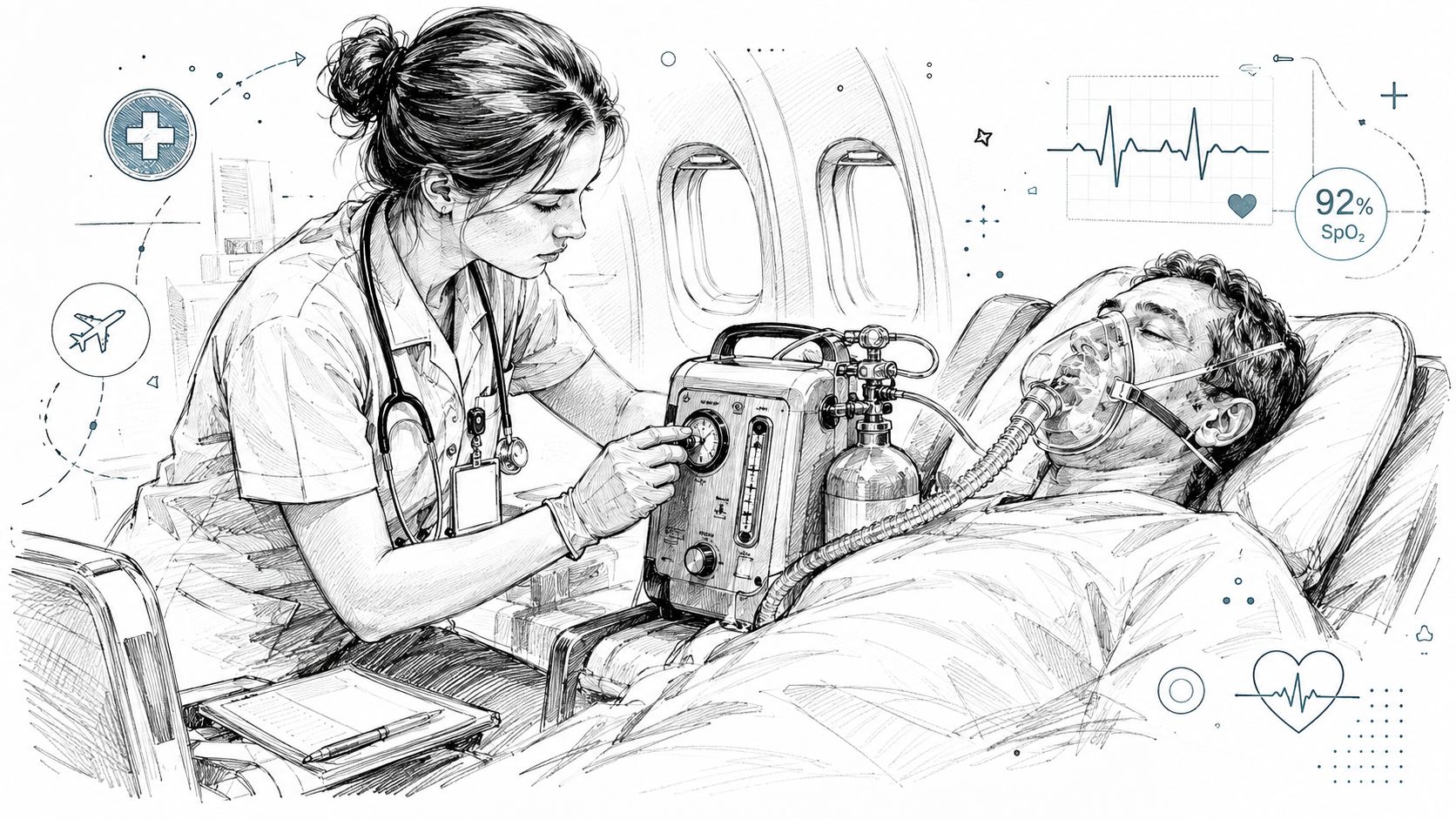
That preparation matters because in-flight oxygen management is active care, not passive transport. The crew doesn't just turn on oxygen and hope the number stays stable. They're watching the patient continuously and adjusting to the environment.
Before takeoff
A typical scenario helps. A patient leaves the hospital on supplemental oxygen and arrives at the aircraft on a portable setup. During that phase, the crew confirms the patient's interface is secure, checks comfort, reassesses breathing effort, and makes sure the transition to the aircraft supply won't interrupt therapy.
They also verify the backup plan. If loading takes longer than expected, the patient still needs a dependable oxygen path.
A clinical handoff usually centers on points like these:
- Current baseline: What oxygen support is the patient receiving right now, and how stable has that been
- Likely stress points: Does the patient desaturate with movement, anxiety, coughing, or repositioning
- Transfer continuity: How will the team move from hospital equipment to portable supply to onboard supply without a gap
During the flight
Once airborne, the crew watches both the patient and the system. A pulse oximeter helps track oxygen saturation, while direct assessment tells the rest of the story. Is the patient speaking comfortably. Is breathing becoming shallow. Is the mask staying in place. Is the patient tiring.
That's where good transport medicine becomes visible. If the patient's need changes, the clinician responds in real time rather than waiting for a problem to become obvious.
For readers who want a closer look at the kind of equipment that supports this bedside-style vigilance in the air, Med Jets describes its patient monitoring systems.
Here's a helpful visual overview of the environment crews work in:
What if the patient's needs change
Patients don't always behave the same way in the aircraft as they do in the hospital room. Movement, stress, position changes, and the cabin environment can all affect breathing. A calm patient may become anxious. A sleepy patient may lose a good mask seal. Secretions may increase. Pain may change the breathing pattern.
That's why crews stay proactive.
“Stable at departure” doesn't mean “no longer needs close attention.”
The in-flight rhythm often looks like this:
- Assess the patient's work of breathing, not just the monitor reading.
- Confirm the device is delivering as intended, with tubing, mask, and flow all checked.
- Adjust support as needed within the patient's care plan and clinical judgment.
- Prepare for handoff early so the receiving phase is as smooth as the departure phase.
Families often find this reassuring once they understand it. A medical flight isn't only transportation through the sky. It's a controlled clinical environment where oxygen is managed continuously by people who expect conditions to change and are prepared when they do.
Special Oxygen Needs in Air Medical Transport
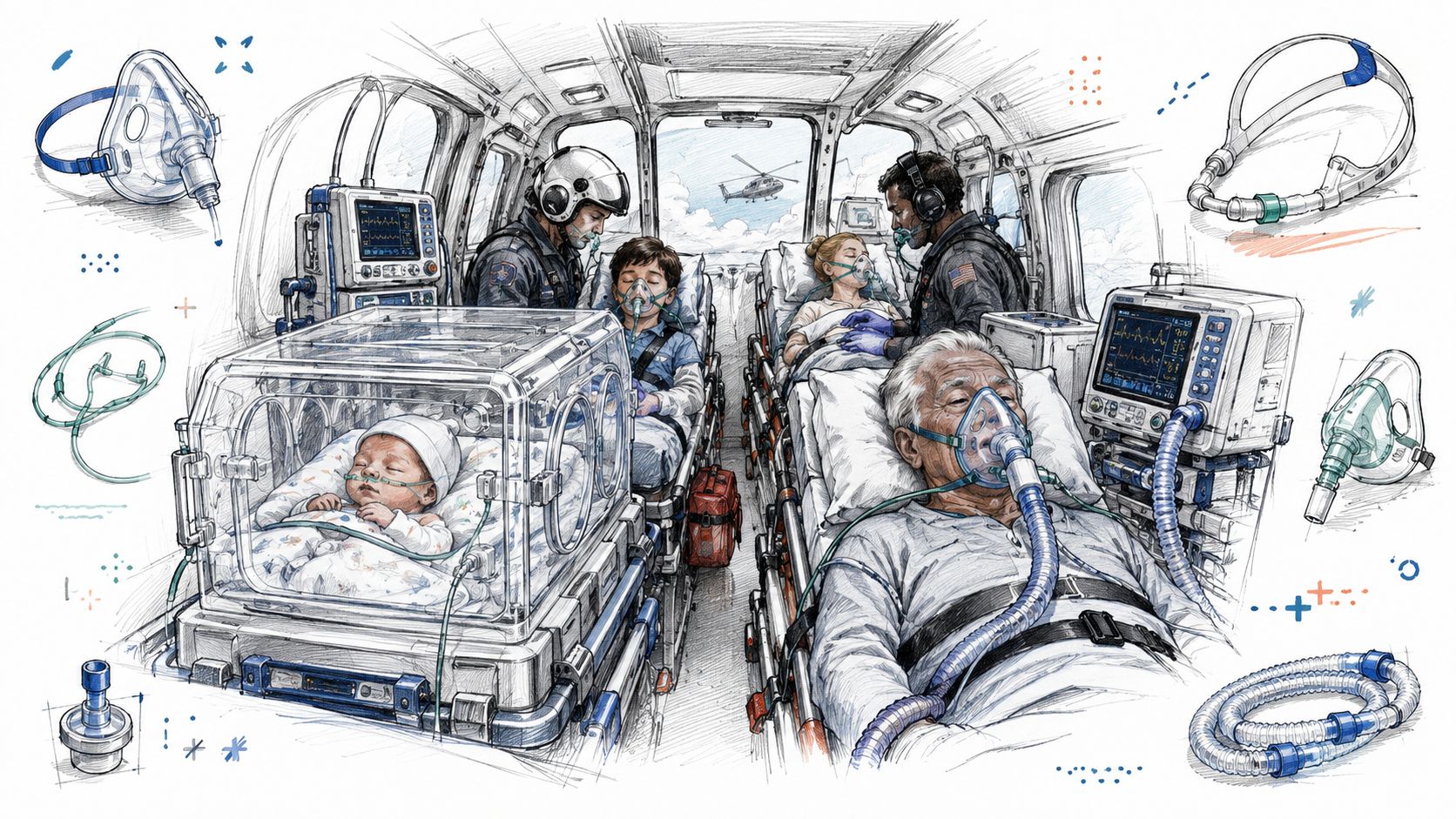
No two oxygen-dependent patients are the same. A person with advanced COPD, a bariatric patient with limited pulmonary reserve, a child with respiratory distress, and a newborn with delicate oxygen requirements may all need transport for very different reasons. The aircraft may be the same category of vehicle, but the oxygen strategy should not be one-size-fits-all.
Bariatric patients
Bariatric transport often requires more than extra space. These patients may have reduced chest wall compliance, sleep-disordered breathing, limited tolerance for lying flat, or higher ongoing oxygen needs. Transfers can also take longer because positioning, lifting, and secure loading must be done carefully.
That combination raises the importance of oxygen planning. The crew needs equipment access, appropriate patient interfaces, and a transport plan that accounts for every movement phase, not just cruise time.
Pediatric and neonatal patients
Children and newborns bring a different challenge. Their oxygen delivery must often be more precise, and they can change condition quickly. A child may not tolerate a mask the same way an adult does. A neonatal patient may require highly controlled respiratory support and extremely close observation.
This is one reason families should favor teams with dedicated pediatric and neonatal transport experience when those patients are involved. The issue isn't only having oxygen onboard. It's knowing how to tailor delivery, monitoring, and escalation for a smaller, more vulnerable patient.
Patients with condition-specific concerns
Some diagnoses call for extra planning before anyone approves a flight. A patient with a fragile pneumothorax history, severe bullous lung disease, complex ventilator dependence, or unstable secretions may need transport timing, route, or aircraft setup adjusted. In some cases, the medical team may decide that a certain method of transport is not appropriate until the condition is better controlled.
That isn't overcaution. It's good judgment.
A strong provider should be able to discuss issues like:
- Interface tolerance: Will the patient keep a mask or cannula in place comfortably during the trip
- Positioning needs: Does the patient breathe better upright, semi-upright, or with special support
- Escalation pathways: What happens if the patient needs more respiratory support than expected
- Transfer complexity: How will oxygen support continue through ramps, lifts, and ambulance handoffs
Complex patients don't just need oxygen. They need a transport team that understands how oxygen interacts with body habitus, age, disease, positioning, and stress.
Why specialization matters
Understanding this distinction reflects experience. General transport thinking may assume oxygen is a supply issue. Air medical thinking treats oxygen as both a supply issue and a clinical management issue. That distinction matters most in the patients who have the least margin for error.
If you're arranging a flight for someone with significant respiratory risk, ask whether the team has handled patients with similar needs before. The answer should be confident, specific, and grounded in process.
Checklist and FAQs for Arranging Oxygen Support
When you're arranging a medical flight, the fastest way to reduce uncertainty is to ask focused questions. Not broad questions like “Is oxygen available?” Almost every provider will say yes. Ask the questions that reveal how oxygen is managed.
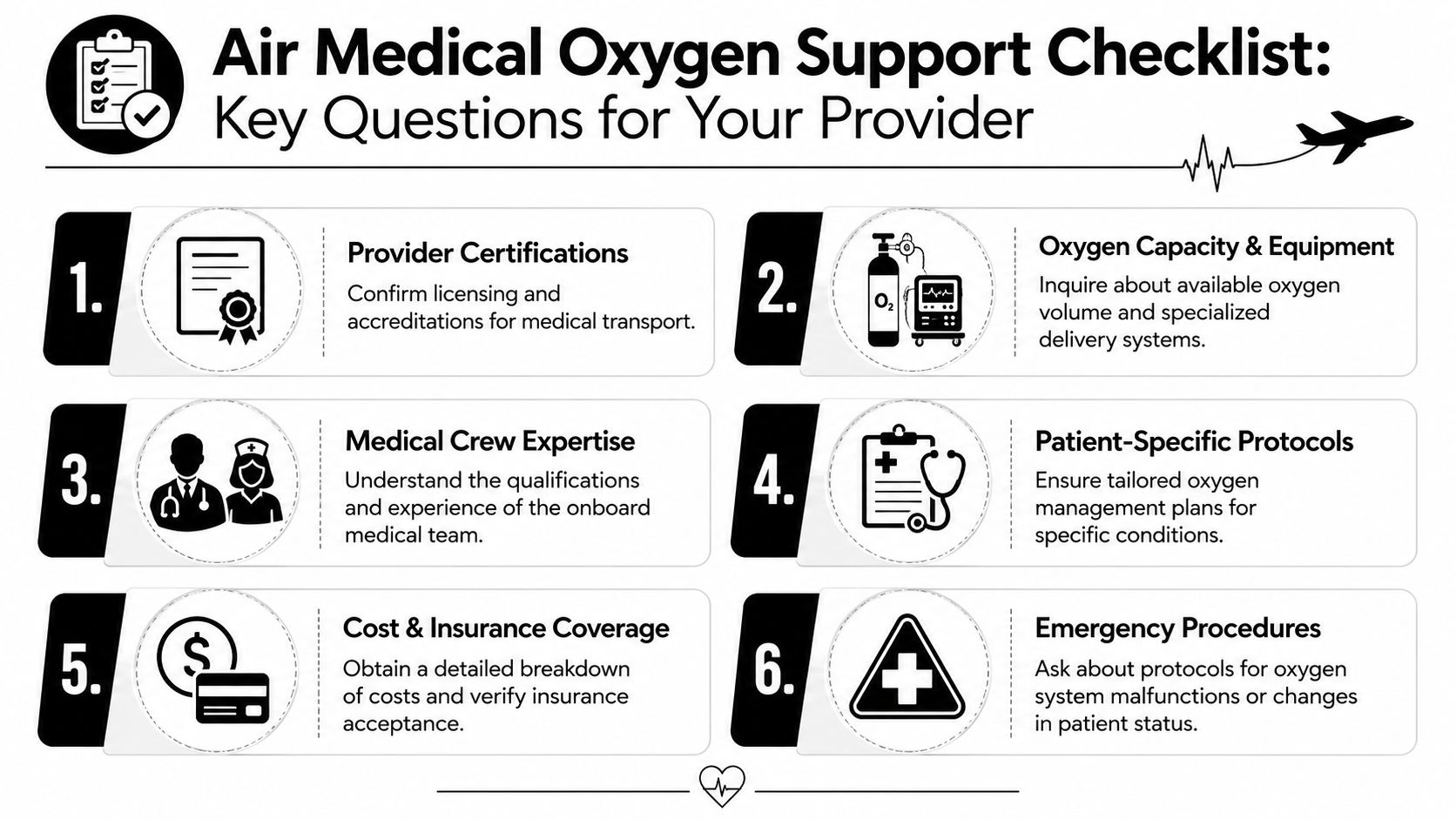
Questions to ask before booking
Use this checklist with any air ambulance or medical escort provider.
- Provider certifications: What medical transport licensing, inspection standards, and operational oversight apply to your program?
- Oxygen capacity and equipment: What onboard oxygen sources and delivery devices do you carry for patients with routine and higher-acuity respiratory needs?
- Medical crew expertise: What training does your onboard team have in managing oxygen-dependent patients during flight and transfer?
- Patient-specific planning: How do you adapt the oxygen plan for a patient with COPD, bariatric needs, pediatric needs, or another complex condition?
- Transfer continuity: How do you manage oxygen between the hospital, ground ambulance, aircraft, and receiving facility without interruption?
- Emergency procedures: What happens if the patient's respiratory status changes or if equipment needs to be switched during transport?
FAQ for families and case managers
Can a patient bring their own portable oxygen concentrator?
Sometimes, but that doesn't automatically mean it should be the primary plan. The transport team has to confirm whether the device fits the clinical need, the mission profile, and the transfer process. In many medical flights, the crew prefers to control the oxygen setup with equipment they know thoroughly.
What happens if the patient's oxygen need increases unexpectedly during the flight?
The onboard medical crew reassesses the patient, adjusts delivery within the care plan, and uses the aircraft's available equipment and backup supplies as needed. The key question isn't whether change can happen. It can. The key is whether the crew expects that possibility and is equipped to respond.
How do you handle oxygen during loading and unloading?
This is one of the most important questions to ask. The patient should have a continuous oxygen path during every movement phase, including stretcher transfers, elevator rides, ambulance legs, and aircraft loading.
Will the family member sitting with the patient also have oxygen if needed?
That depends on the aircraft setup, cabin plan, and the individual situation. If a companion has any respiratory concern, mention it early so the operator can address it directly.
How is oxygen use factored into the cost of a medical flight?
Ask for a written explanation of what's included in the transport quote. Oxygen support may be part of the broader medical transport package, but the details vary by mission and patient complexity. Clear answers up front prevent confusion later.
What if the patient is stable on the ground but gets anxious in flight?
That's common enough that experienced crews plan for it. Anxiety can affect breathing pattern, mask tolerance, and comfort. A team that manages medically fragile flyers regularly will treat that as part of patient care, not as an unusual inconvenience.
Ask the provider to explain their oxygen plan in plain language. If they can't explain it clearly, that's a warning sign.
The best answers are calm, direct, and specific to the patient in front of them.
If you're arranging transport and need a team that can coordinate oxygen support from hospital to hospital, Med Jets by Air Trek provides air ambulance service, medical escorts, and end-to-end transfer planning. You can reach the team through the Med Jets contact page for case-specific guidance.