
When you're arranging an air ambulance, the questions come fast. Is my patient stable enough to fly? What happens if they worsen in the air? Who tells the family if something goes wrong? For hospital case managers, discharge planners, and families, those questions aren't theoretical. They're immediate, emotional, and tied to trust.
That's why adverse event management matters. In plain terms, it's the plan for identifying, responding to, investigating, and learning from any unexpected patient safety issue during care or transport. In air medical transport, that plan has to work in a tight cabin, at altitude, between handoffs, and under time pressure. A good program doesn't promise that nothing unexpected will ever happen. It proves the team has already decided what to do if it does.
Ensuring Patient Safety at 30000 Feet
A common scene looks like this. The sending hospital has accepted the transfer. The receiving facility is ready. The family is trying to stay calm while asking whether someone can ride along. The case manager is balancing bed flow, authorizations, records, and timing. In the middle of all that, one concern sits underneath the logistics. How safe is this flight, really?
That concern is justified. Adverse events affect patients across healthcare settings far more often than generally understood. A review summarized by the National Center for Biotechnology Information notes that adverse events affect approximately 10% to 25% of patients during healthcare encounters globally, and that half are deemed preventable through better care practices (NCBI Bookshelf overview of adverse events). In transport medicine, you don't solve that risk with reassurance alone. You solve it with disciplined systems.
What strong operators do differently
In practice, the safest transport teams don't treat adverse event management as a paperwork exercise. They build it into dispatch screening, crew briefings, equipment checks, medication verification, in-flight monitoring, handoff structure, and post-flight review. That means people know who's speaking to medical control, who's documenting, who's preparing backup airway equipment, and who's updating the family liaison if the plan changes.
The benchmark many case managers look for is accreditation. The Commission on Accreditation of Medical Transport Systems, or CAMTS, is recognized as the gold standard for auditing medical transport organizations, and CAMTS-accredited programs are held to best practices that are typically more stringent than federal minimums (CAMTS safety overview). That matters because good adverse event management starts long before a patient is loaded.
Practical rule: In air transport, "safe" doesn't mean nothing unexpected can happen. It means the team has already trained for the expected unexpected.
Families also ask a harder question when the outcome is poor. If a patient dies in the hospital before or after transfer, what rights do relatives have to understand what happened? For Texas families trying to handle that process, this guide to Texas rights after hospital death is a useful starting point because it explains review, documentation, and what questions to ask next.
Questions worth asking before wheels up
A capable transport program should be able to answer these clearly:
- How are patients screened before flight: Ask what clinical criteria trigger additional review before dispatch.
- What happens if the patient deteriorates in flight: The answer should include escalation steps, diversion planning, and physician consultation.
- How are families updated: You want a real communication process, not a vague promise.
- How are incidents reviewed afterward: Strong teams investigate near misses as seriously as obvious harm events.
If those answers are clear, adverse event management stops sounding like a legal phrase and starts sounding like what it should be: a safety promise backed by process.
What Counts as an Adverse Event in Healthcare
A family may hear that their loved one "had a complication" during transfer and assume that means no one knows what happened. In practice, the wording matters. Clear definitions help the clinical team review the right facts, help case managers document the event accurately, and help families understand whether the decline came from the illness itself or from the care process.
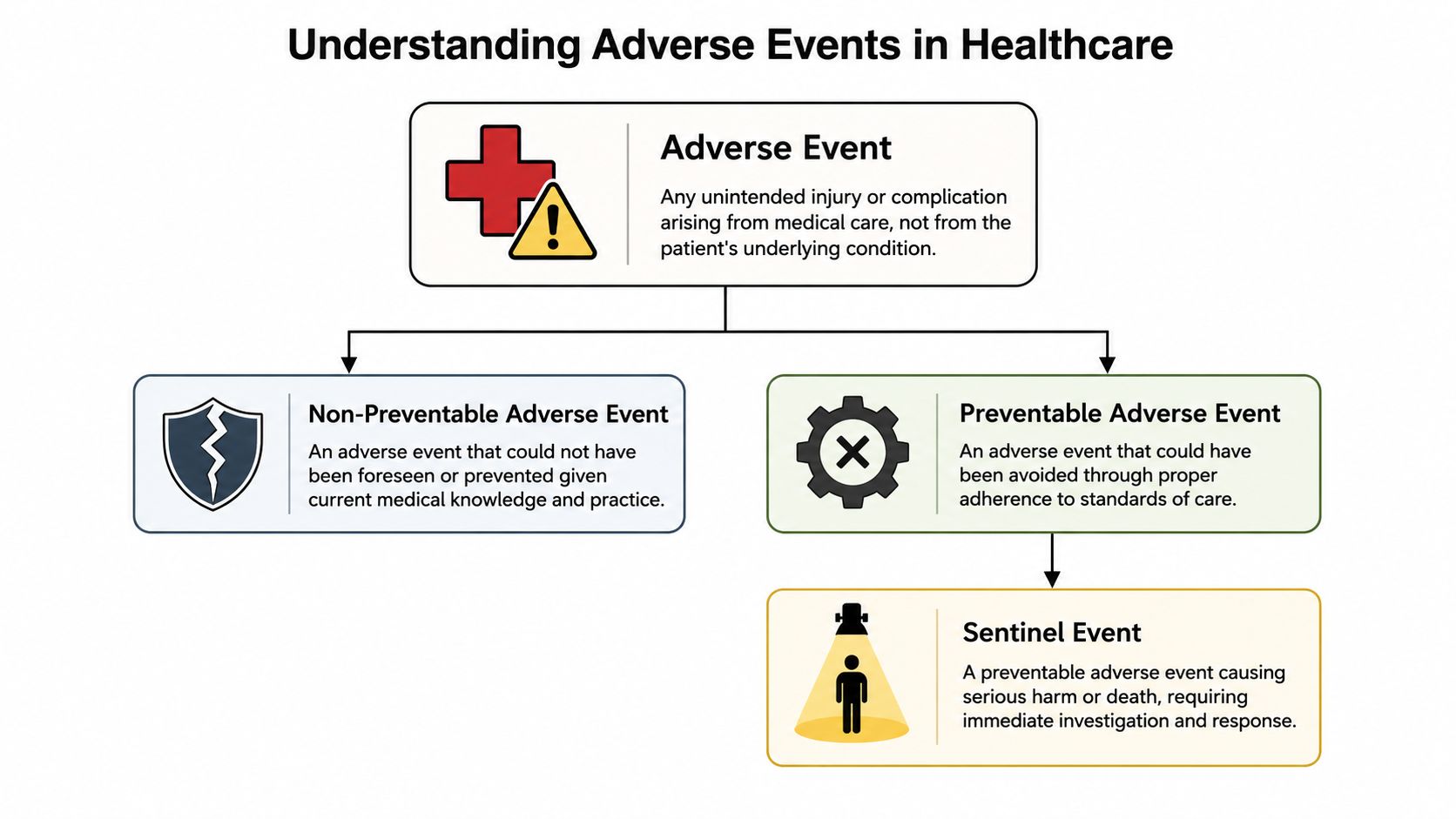
An adverse event is harm caused by medical care rather than by the patient's underlying condition. That distinction sounds technical, but it changes the entire review. A patient with severe sepsis can deteriorate despite appropriate treatment. A patient who receives the wrong vasopressor concentration and then crashes has experienced something different. The illness is still serious, but the care process now deserves formal scrutiny.
The terms that matter during review
Families deserve plain language, especially after a frightening transport. So do receiving teams.
| Term | Plain meaning | Transport example |
|---|---|---|
| Adverse event | Harm occurred because of care | Wrong medication concentration given during transfer |
| Near miss | An error was caught before it harmed the patient | A mislabeled syringe is identified during a cross-check |
| Sentinel event | Serious harm or death linked to a major safety failure | A catastrophic error that triggers immediate investigation |
| Complication | A known medical risk that can occur even with appropriate care | A fragile patient becomes unstable despite appropriate treatment |
Those categories are not just compliance language. They shape what gets reported, how the case is reviewed, and what the family is told. They also affect equity. Patients who transfer across language barriers, rural systems, or fragmented referral networks are more likely to have details lost in handoff, and that can blur whether a problem is recognized as disease progression or a care-related event.
What usually falls into the adverse event bucket
In transport medicine, the pattern is usually visible once the chart, equipment log, and handoff record are lined up.
- Medication-related issues: Wrong drug, wrong dose, delayed administration, infusion pump programming error, or missed allergy information.
- Care delivery problems: Delayed recognition of deterioration, incomplete handoff, failure to secure critical equipment, or missed reassessment during flight.
- Procedure-related harm: Injury or instability linked to airway management, vascular access, monitoring, packaging, or patient movement.
- Device and equipment failures: Oxygen delivery problems, monitor malfunction, battery failure, or preventable issues tied to poor equipment maintenance schedules and oversight.
- Infection-related concerns: Less common as an in-flight event, but still relevant in patients transferred with central lines, drains, ventilators, or other invasive devices.
A near miss still matters. If a syringe swap is caught before administration, the patient may be unharmed, but the system has shown you where it is thin.
Questions families and case managers ask
Is every bad outcome an adverse event?
No. Critically ill patients can worsen even with timely, appropriate care. The review asks whether the harm came from the illness, the treatment risk, or a breakdown in care.
If no one was harmed, should it still be reported?
Yes. Near misses often expose the same weak points that later injure patients. Good programs treat them as early warnings.
What makes an event preventable?
A preventable event could likely have been avoided through better adherence to the standard of care, clearer communication, better preparation, or functioning equipment. Some events are not preventable even when the team performs well.
Why does this matter so much to families?
Because families do not only want a label. They want an honest account, respect, and a clear plan for what happens next. In my experience, trust holds up better when the team names the event accurately, explains what is known, and does not hide behind vague language like "something happened."
Shared language supports safer care, but it also supports fairer care. It gives every patient and family the same chance to have concerns heard, facts reviewed, and next steps explained without confusion.
The Six Step Adverse Event Management Process
The best adverse event management systems are simple enough to follow under pressure and structured enough to stand up to review later. In air medical work, six steps matter. Miss one, and the system gets weaker. Do them well, and you create accountability without chaos.
A visual summary helps:
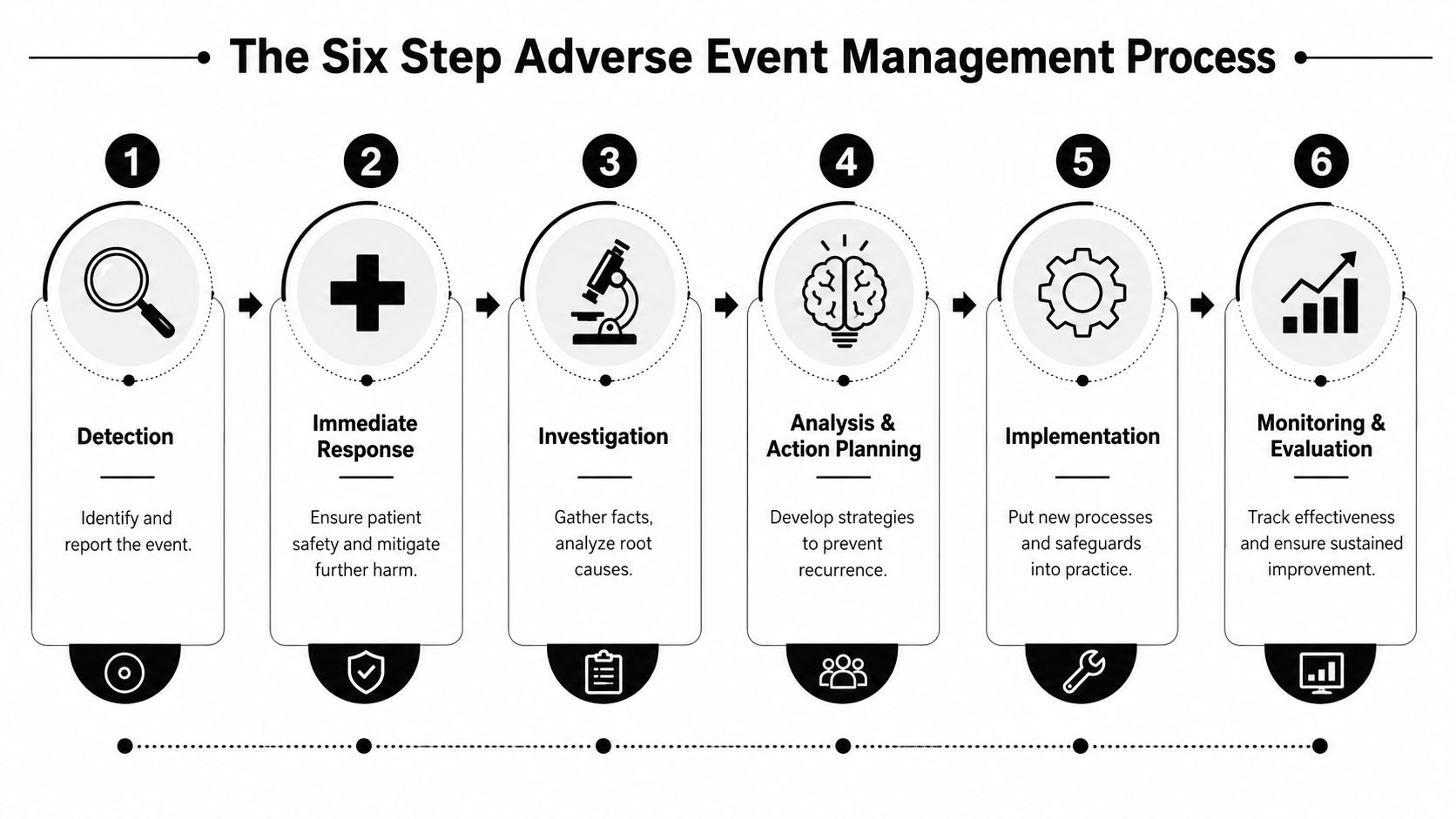
Step 1 Detection
Most events don't announce themselves dramatically. A patient trends downward. A pump alarm repeats. A handoff detail doesn't line up with the medication bag. Detection depends on vigilance, not heroics.
Good teams make detection easier by standardizing checklists, cross-checking orders, and using equipment that's maintained on a strict schedule. That's one reason operational discipline matters as much as bedside skill. Reliable programs treat maintenance as part of patient safety, not a separate department concern. A case manager who wants to see that mindset can ask about equipment maintenance schedules and oversight.
Step 2 Immediate response
Once a potential adverse event is identified, the first task is not paperwork. It's patient protection. Stabilize the airway, support circulation, correct the medication issue, stop the infusion, repeat the assessment, or change the transport plan if needed.
The practical question is always, What keeps the patient safest in the next few minutes? That may mean continuing the mission with additional support, slowing the pace to reassess, or coordinating a diversion if the patient's condition changes beyond what the original plan anticipated.
Step 3 Investigation
After the patient is safe, the team preserves facts. What time did the change occur? What was given, by whom, and in what order? What did the monitor show? What did the sending records say? Which handoff details were verbal and which were documented?
This stage works best when the team gathers facts before memory gets polished by hindsight.
Step 4 Root cause analysis
A proper root cause analysis asks more than who touched the patient last. It asks what conditions made the event possible. Was the handoff incomplete? Did similar packaging contribute to a medication error? Was the patient loaded before full stabilization? Did a language barrier or assumptions about age, size, disability, or social situation shape the plan?
The Institute for Healthcare Improvement recommends adding a direct question to reporting systems: "Did bias or equitable care issues potentially contribute to this event?" That recommendation pushes teams to examine social and demographic factors, not just technical failures (IHI guidance on embedding equity in adverse event analysis).
What works: Ask whether the process failed the patient.
What doesn't: Stop the review as soon as one person's mistake is identified.
Step 5 Corrective and preventive action
Many organizations lose momentum when they identify the problem and then settle for education alone. Sometimes retraining is appropriate. Often it isn't enough.
Better corrective action might include:
- Changing a form: Add a mandatory preflight item for vasopressor concentration verification.
- Changing the workflow: Require direct clinician-to-clinician handoff before launch on high-risk cases.
- Changing the equipment setup: Standardize where airway rescue tools sit so every crew reaches to the same spot.
- Changing escalation rules: Trigger medical director review for selected high-risk transports before departure.
Step 6 Resolution and monitoring
An event isn't closed because the report is filed. It's closed when leaders verify the corrective action was implemented and the risk is better controlled than before. Monitoring may include follow-up chart review, debriefs, audit of handoff quality, and trend tracking over time.
For families and case managers, this step answers an important question. Did the organization learn anything concrete, or did everyone just move on? A real adverse event management program should be able to describe the change that followed the event, not just the report that documented it.
Unique Challenges in Air Ambulance Transport
A hospital room is controlled. A medical jet is not. Space is tight, noise is constant, lighting changes, access to the patient is constrained, and every intervention has to account for movement, timing, and the next handoff. That's why adverse event management in air transport can't just copy hospital policy and call it done.
Research on fixed-wing air ambulance repatriations shows that a major adverse event occurs in 12% of transfers, and 28% of patients require pre-transfer optimization, which reinforces how critical clinical screening is before dispatch (PubMed study on fixed-wing transport adverse events). That finding matches what experienced crews already know. Many in-flight problems begin on the ground, before the aircraft door closes.
Where air transport creates extra risk
The risk points are specific.
- Pre-transfer stability: If the patient isn't adequately optimized before departure, the cabin becomes the wrong place to discover that.
- Handoffs: Information is handed from sending team to ground crew to flight crew to receiving staff. Every relay is a chance to lose a detail.
- Physical constraints: Repositioning a patient, troubleshooting an infusion, or escalating airway support is harder in an aircraft than in an ICU.
- Documentation under motion: Good documentation still matters, even when the crew is managing a changing patient in a noisy environment.
What strong teams build into the mission
High-reliability transport operations counter those risks with repetition and shared mental models. Crew resource management is central to that. It gives pilots and clinicians a common structure for speaking up, confirming concerns, and making decisions when the plan starts to drift. If you want a practical sense of how that discipline works in transport operations, this overview of crew resource management in air medical settings is worth reading.
A strong preflight brief usually covers more than route and weather. It should address the patient's current stability, likely failure points, backup plans, medication priorities, communication channels, and receiving-facility expectations. If the patient is bariatric, mechanically ventilated, hemodynamically fragile, or difficult to move, those issues should change the plan before launch, not during the flight.
In air medicine, the handoff isn't over when the paperwork is signed. It's over when the next team can safely continue care without guessing.
Questions case managers should ask
What does pre-transfer optimization mean for this patient?
It means the crew and medical control identify what should be corrected before departure rather than hoping to manage it once airborne.
Can families ride along?
Sometimes yes, depending on aircraft configuration, patient condition, and safety limits. The answer should never compromise patient care or crew function.
What if the patient becomes unstable mid-flight?
The right answer includes intervention capability, consultation pathways, and criteria for diversion or revised routing.
Communication After an Event A Guide for Families
After an incident, families rarely start by asking for a root cause diagram. They ask, "What happened?" "Is my loved one okay?" "Why didn't anyone call sooner?" Those questions deserve direct answers.
Research highlights a major gap in adverse event management content around post-event communication and support for the first, second, and third victims, meaning the patient, the involved clinician, and the organization (PMC review on communication after adverse events). That gap is real. Many organizations can describe how they log an event but not how they speak to the family in the first difficult hour afterward.
What families should expect
A responsible response has several parts.
- Prompt disclosure: Families should hear that an event occurred without avoidable delay.
- Clear language: The explanation should use plain English, not jargon that hides uncertainty.
- Empathy: People remember whether the team sounded human.
- Known facts and unknowns: Say what is established, and say what still needs review.
- Follow-up plan: Tell the family who will contact them next and when.
A complete apology isn't a script. It's an honest acknowledgment of harm or distress, ownership of the review process, and a commitment to continued communication. If the facts aren't complete, the team shouldn't speculate. But they also shouldn't disappear behind "risk management will handle it."
Why clinician support matters too
Families sometimes worry that supporting the clinician means protecting the system. It shouldn't. A healthy safety culture can do both. If a medic, nurse, or physician is involved in an event, they may be greatly affected by it. Supporting that person isn't about avoiding accountability. It's about preventing shame, silence, and defensive behavior from making the next event more likely.
Patients need truth. Families need follow-through. Clinicians need enough support to participate honestly in the review.
Questions people might ask
Should the family be told even if the patient wasn't harmed?
Usually, if an event affected care or could have affected care, transparency is still the safer path.
Who should call the family after an event?
That depends on the situation, but there should be a clearly identified clinical or organizational lead, not a series of fragmented updates.
What if the team doesn't yet know why it happened?
They should still disclose the event, explain immediate actions taken, and commit to a timeline for further information.
When communication is handled well, it doesn't erase the event. It does reduce confusion, restore some control, and show the family that accountability includes compassion.
Case Study Handling an In-Flight Event
A realistic example helps. A medically fragile patient is being transferred on oxygen after a prolonged hospital stay. The preflight review flags respiratory risk, but the patient is stable enough to launch. Mid-flight, the pulse oximeter begins to trend down. The medic doesn't assume artifact. They confirm the reading, assess the patient, check airway position, listen for breath sounds, review the oxygen setup, and call out the change to the rest of the crew.
What happened next
The team increases support, reassesses the patient's work of breathing, and contacts medical control with a concise report. The pilots are advised that a diversion may be needed if the patient fails to respond. Meanwhile, the receiving hospital gets an update so the bedside team is ready on arrival.
The patient improves after intervention. The flight continues safely. On landing, the crew gives a detailed handoff that includes the deterioration, the response, the patient's recovery, and any ongoing concerns.
Why this counts as good adverse event management
The event was detected early. The response focused on patient safety first. Communication stayed organized. Then the work continued after the patient left the aircraft.
The crew completed an event report, reviewed monitor trends, and debriefed the mission while details were fresh. The review asked practical questions. Was the patient optimally stabilized before departure? Did equipment setup contribute? Did the handoff miss anything important? Would a different preflight threshold have changed the launch decision?
A family update followed the same day. It didn't bury the incident in technical language. It explained that the patient had a decline in oxygen status during transport, what the crew did, the current condition on arrival, and that the case would be reviewed internally.
That's what families and case managers should want to see. Not perfection. A practiced system that notices trouble early, responds with discipline, and tells the truth afterward.
Your Pre-Flight Safety Checklist and Key Metrics
A family often asks the hardest questions in the first five minutes. Who decided this patient can fly? What happens if something changes in the air? Who calls us if there is a problem? Good providers answer those questions plainly, because clear answers reflect how the service handles safety before the aircraft ever leaves the ground.
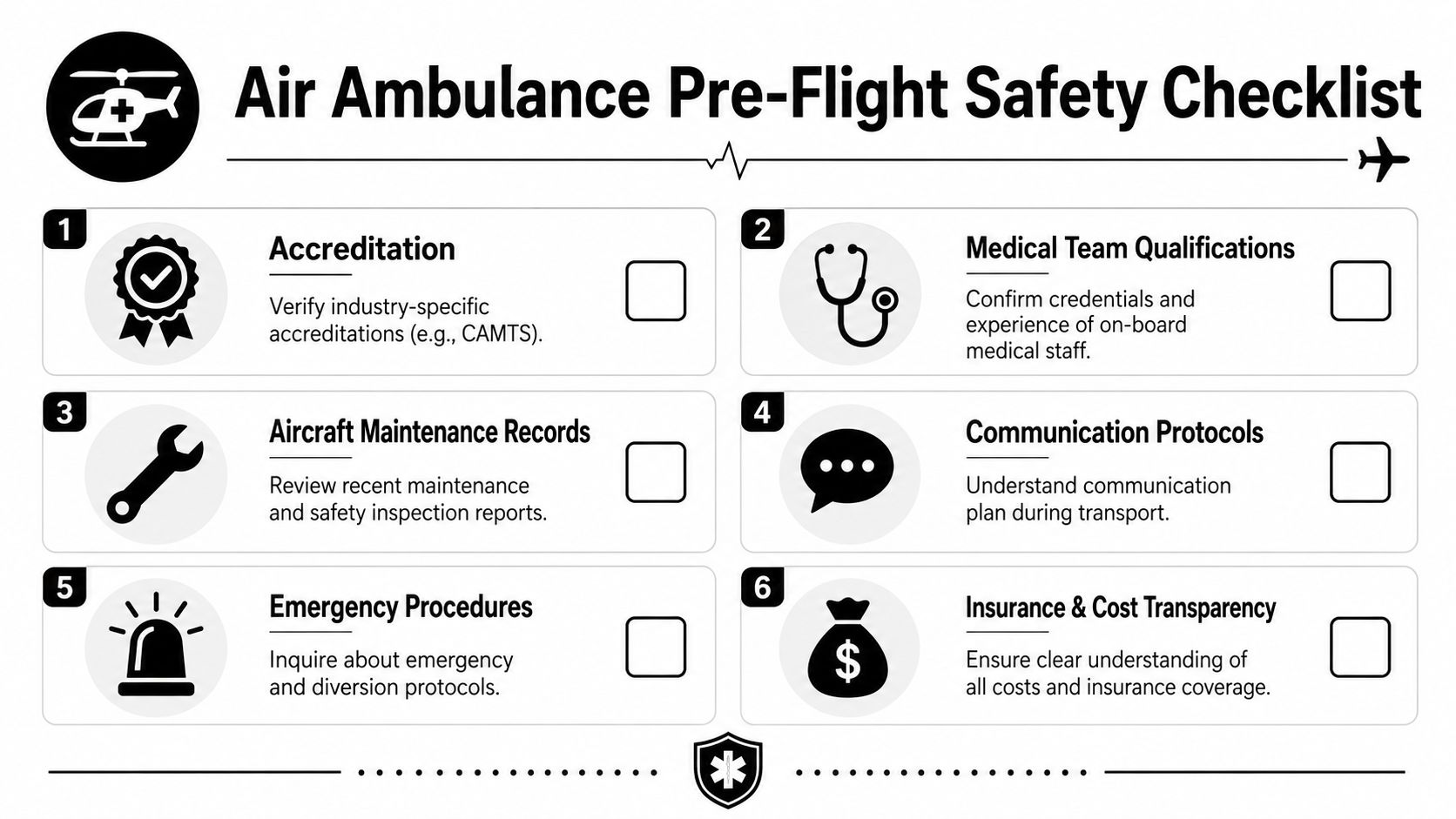
Safety checklist for families and case managers
- Accreditation: Ask whether the program is CAMTS accredited and how it maintains compliance in day-to-day operations, not only during formal review.
- Clinical screening: Ask who makes the final fit-to-fly decision, what clinical findings trigger escalation, and whether borderline cases get physician review before launch.
- Equipment readiness: Review how the service maintains monitors, ventilators, and onboard medical gear. For readers who want a maintenance-centered framework for thinking about failure prevention, Forge Reliability's maintenance FMEA solutions offer a useful overview of how teams analyze failure modes before they cause harm.
- Monitoring capability: Ask what the crew can continuously monitor in flight, what backup options exist if a device fails, and how deterioration is escalated. This overview of patient monitoring systems used in medical transport gives helpful context.
- Communication policy: Ask who updates the family during the mission, who speaks with them after an event, and how the team explains changes without hiding behind technical language.
- Event review process: Ask how near misses, not just harm events, are reported, investigated, and turned into changes in training or protocol.
- Care equity: Ask how the provider handles interpreter access, family communication barriers, and discharge or receiving-facility coordination when a patient has limited support. These details affect safety.
Useful metrics to ask about qualitatively
A provider's ability to discuss these metrics clearly is a strong indicator of its safety culture.
Ask whether the provider tracks:
- Near-miss reporting
- Time from event to investigation
- Corrective action completion
- Repeat event patterns
- Family communication follow-up
- High-risk case review before launch
Listen for specifics. A strong team can explain who reviews these cases, how quickly concerns are escalated, and what changed after the last serious event. That matters to hospitals and families alike, because adverse event management is not only a reporting process. It is also a commitment to honest communication, fair treatment, and a plan that protects the patient when conditions become less predictable.
If you need an experienced team to coordinate a medically complex transfer, Med Jets by Air Trek provides air ambulance and medical transport support with around-the-clock coordination for hospitals, families, and assistance companies.