

The call usually comes when three clocks start at once. The donor hospital is moving. The receiving transplant team is preparing. Your own phone starts filling up with questions about aircraft availability, ground handoffs, packaging, documentation, and whether the fastest option is also the right one.
That's where many new case managers get tripped up. They assume organ transport is mainly about getting a plane in the air. It isn't. The actual work is matching the organ, the preservation method, the route, the handoff plan, and the backup plan before one delay turns into a failed transfer.
Families often ask, “Who moves the organ?” Hospital teams ask, “Should we charter?” Administrators ask, “What happens if weather shuts down the route?” Those are the right questions. The strongest organ transport companies aren't just fast. They're disciplined about chain of custody, realistic about transport-mode tradeoffs, and prepared for the moment the original plan breaks.
The Lifeline in the Sky What Organ Transport Companies Do
A transplant coordinator gets the alert that an organ is available. Within minutes, several groups have to act in sequence. The donor-side surgical team, the organ procurement organization, ground couriers, flight operations, the receiving transplant center, and hospital staff all need the same operational picture.
That's the core job of organ transport companies. They connect medical timing with transportation execution. They don't function like ordinary couriers, and they don't function like a basic charter broker either. They sit in the middle of medicine, aviation, packaging, dispatch, and handoff management.

Why this work is bigger than many people realize
This isn't a niche side service. The United States transplant system includes more than 250 Organ Transplant Programs tracked in the HRSA data warehouse. More than 100,000 people were awaiting solid organ transplantation as of December 2022, 42,888 transplants were performed that year, and the U.S. performed over 45,000 transplants in 2023. That activity sits inside a global transplantation market valued at USD 11.93 billion in 2025, according to HRSA transplant system data.
Those figures matter because they change how you should think about transport. Organ transport companies aren't an accessory to transplant medicine. They're part of the operating infrastructure that keeps donor hospitals, transplant centers, and procurement teams connected under extreme time pressure.
What they actually coordinate
A competent transport partner usually handles some combination of these tasks:
- Route planning: Selecting air and ground segments that reduce avoidable transfer time.
- Mode selection: Deciding whether dedicated air, scheduled commercial service, or a mixed ground-air plan makes clinical sense.
- Chain of custody: Tracking exactly who has possession of the organ at each handoff.
- Packaging compliance: Confirming that the organ is moving in the correct preservation system and transport container.
- Communication control: Keeping donor-side and recipient-side teams updated with one timeline, not five conflicting ones.
- Disruption response: Rerouting when weather, airport operations, or mechanical issues interfere.
Practical rule: If a provider talks only about aircraft speed, you're not hearing the full answer. The mission succeeds or fails on handoffs and contingency management.
What new case managers should expect
You'll often be asked for details quickly. The transport team may need the pickup point, receiving facility, timing from organ recovery, escort or courier details, packaging method, and receiving contact information. If the provider has to chase basic facts after launch, time gets lost in exactly the place you can least afford it.
The best early mindset is simple. Treat organ transport as a medical operation with aviation components, not an aviation trip with medical cargo.
From Donor to Recipient Understanding Organ Transport Logistics
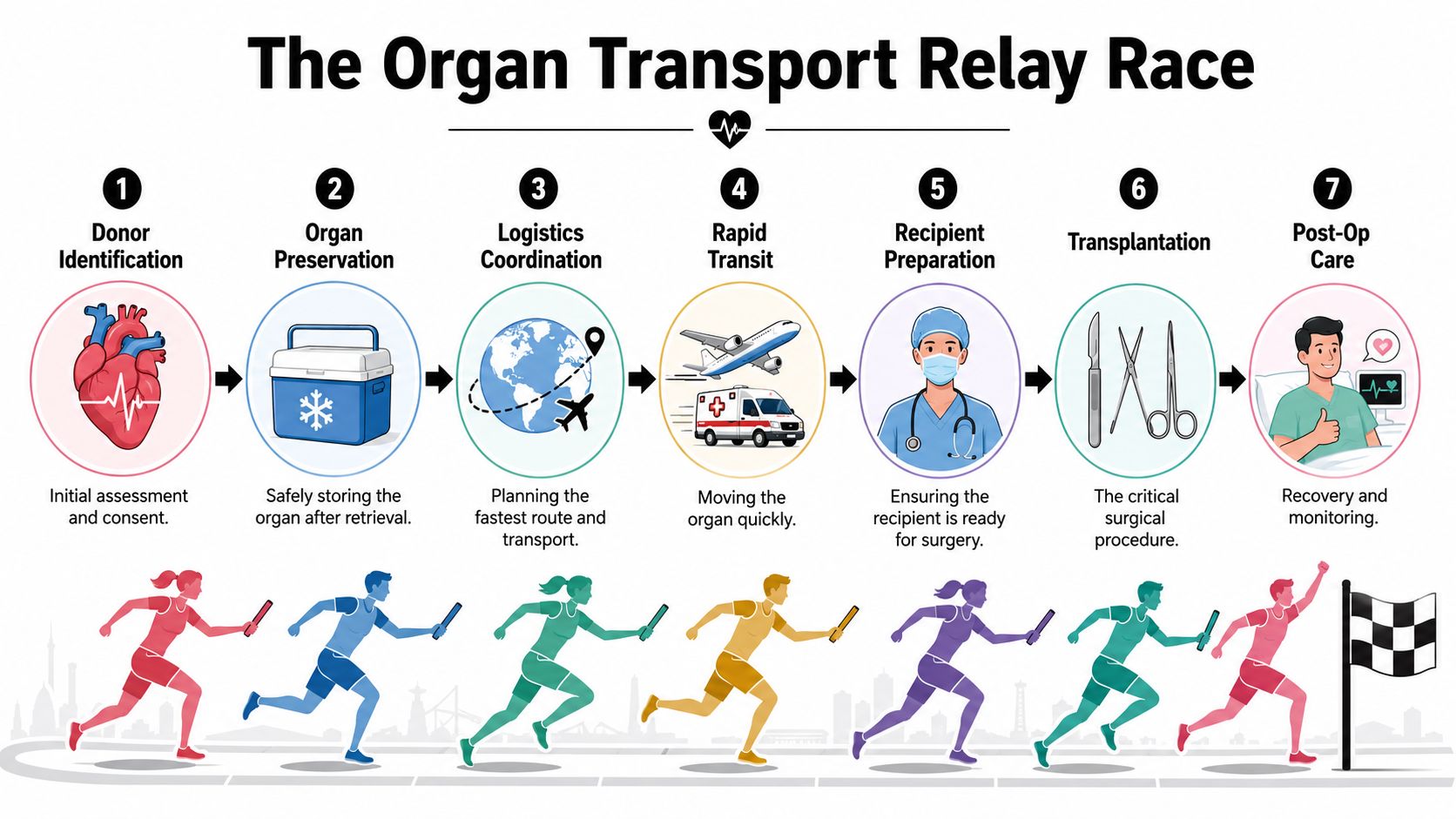
The easiest way to understand organ transport is to think of it as a relay race where every handoff matters as much as the distance covered. Speed is important, but a sloppy handoff can erase any time gained in the air.
The relay starts before the vehicle moves
The first stage is operational confirmation. The donor-side team confirms the recovery timeline, the receiving center confirms readiness, and the transport coordinator starts building a route around real constraints instead of ideal assumptions.
That means asking practical questions early:
- Where exactly is pickup happening?
- Who releases custody?
- What preservation method is being used?
- Is the receiving OR on pace with the transport timeline?
- What happens if the original route slips?
If those questions aren't settled up front, the route may look fast on paper and still fail in practice.
Packaging is not just a box
Once the organ is recovered, packaging becomes a clinical and logistical issue at the same time. The organ transport field is moving beyond basic cold storage toward more advanced systems. The market for organ transport devices, including portable perfusion units and GPS-tracked smart containers, is projected to grow from about USD 501.4 million to USD 809.0 million by 2036, according to Future Market Insights on organ transport devices.
That shift changes vendor selection. Some companies still operate as if transportation starts once the package is sealed. In reality, preservation technology now shapes route choice, tracking expectations, and acceptable handoff risk.
A new case manager should always ask whether the transport provider is experienced with the specific containment system in use. A crew that knows standard cooler transfer but not device-specific handling can create avoidable friction.
The handoff chain that matters most
The journey usually involves several transitions:
- Surgical team to courier: Documentation, labeling, and release need to be explicit.
- Courier to ground unit: Pickup timing and airport access have to be synchronized.
- Ground unit to aircraft: Ramp coordination must be ready before arrival, not improvised at the gate.
- Aircraft to destination ground crew: The receiving side needs real-time updates, not estimated guesses.
- Ground crew to transplant center: Final delivery must align with OR readiness.
A delayed handoff is often harder to recover than a delayed takeoff.
That's why experienced coordinators pay close attention to chain of custody. Every transition should have a named person, a time stamp, and a communication path if something changes.
Why visibility matters in transit
Modern teams expect more than “wheels up” and “landed.” They want tracking, milestone confirmation, and immediate notice when the route changes. GPS-enabled containers and structured dispatch updates are useful because they reduce uncertainty during the most time-sensitive period of the process.
For case managers reviewing providers, one useful benchmark is whether the company can explain its update rhythm in plain language. If the answer is vague, the communication plan probably is too.
For a working example of how patient and organ logistics can intersect operationally, Med Jets outlines its organ recovery transport process. Even when you're comparing several vendors, that kind of end-to-end view is what you want to see: pickup, air segment, ground transfer, and receiving coordination treated as one workflow.
What works and what fails
What works is disciplined simplicity. One command structure. One agreed route. One backup path. One contact tree.
What fails is fragmented communication. The donor hospital thinks the courier has arrived. The aircraft team thinks pickup is still in process. The receiving center is preparing to receive on an outdated ETA. That's how time disappears without any single dramatic error.
Navigating the Rules Accreditation and Regulatory Standards
Regulation in organ transport matters for one reason above all. It tells you whether the company understands that this is a controlled medical movement, not just an urgent package run.
The legal and operational framework can look confusing at first because multiple bodies influence the mission. Some govern flight operations. Some govern security. Some shape transplant system coordination. Your job isn't to memorize every agency. Your job is to know what each one means when you vet a vendor.
What the federal framework means in practice
In the U.S., organs can move on commercial airlines as well as dedicated air and ground services because FAA, TSA, and HRSA frameworks permit organ transport through security checkpoints and aboard aircraft. The placement of the organ in the cabin or cargo area is left to the airline's operating policy, and the FAA notes there are no special statutory size or weight restrictions beyond standard securement requirements, as outlined in the FAA organ transport guidance.
That single point has big consequences for hospital teams. A provider may say commercial transport is possible, and they may be right. But “possible” doesn't mean “operationally simple.” The company still has to know the carrier's policy, security process, airport handling workflow, and what to do if the planned flight is disrupted.
How to separate a medical transport partner from a basic charter
A general charter operator may be perfectly capable of flying an aircraft from one airport to another. That isn't the same as being ready for organ transport. What you want is evidence of a repeatable medical transport process.
Look for signs such as:
- Document discipline: They can explain release forms, custody logs, and communication records clearly.
- Medical familiarity: They understand preservation devices, transplant timelines, and hospital receiving procedures.
- Dispatch depth: Their operations center can coordinate ground segments and not just the air leg.
- Compliance culture: They can discuss inspections, operating procedures, and escalation steps without sounding improvised.
If your team is reviewing broader digital operations as part of compliance readiness, it also helps to enhance healthcare compliance with cloud so dispatch records, communication logs, and coordination workflows aren't scattered across unsecured channels.
Accreditation and operational maturity
Many hospital buyers ask about accreditation because it serves as a shorthand for process discipline. That's reasonable, but accreditation should start a conversation, not end it.
Ask follow-up questions such as:
- How are crews briefed before pickup?
- Who owns the communication timeline during a mission?
- What's the escalation path if a runway closure or delay occurs?
- How is chain of custody documented at each transfer?
Compliance isn't paperwork after the fact. It's the set of habits that keeps a mission orderly while it's happening.
For hospital teams evaluating options, it helps to compare providers that explicitly describe medical organ transport services rather than providers that only advertise aircraft availability. Availability gets you airborne. Process gets the organ delivered correctly.
Choosing Your Partner A Checklist for Selecting an Organ Transport Company
The wrong way to choose among organ transport companies is to ask one question: “Who can move fastest?” The better question is: “Who can move this organ by the right mode, with a defensible plan, under the current conditions?”
That changes the buying process. Sometimes a dedicated charter is the obvious answer. Sometimes a commercial route may be clinically acceptable and operationally sound. The decision shouldn't be ideological. It should be based on timing tolerance, preservation method, airport access, chain-of-custody requirements, and disruption risk.
Private charter versus commercial flight
Private charter remains the default when timing is tight and route control matters most. You control departure timing more directly, often reduce intermediate handling, and can choose airports that simplify the ground leg.
Commercial transport has become more relevant because federal frameworks allow organs on commercial airlines, but airline policy still matters. For case managers, that means the question isn't “Are commercial flights allowed?” It's whether this airline, on this route, with this container and this timeline, is a clinically acceptable option.
The questions that surface hidden weakness
Some providers sound polished until you move past the sales script. Ask operational questions that force specificity:
- What is your backup if the original flight cannot depart?
- Who updates the donor hospital, receiving center, and courier?
- Can you support specialized preservation equipment, not just static cold storage?
- How do you handle airport handoffs after hours?
- What parts of the route are subcontracted?
- If commercial is proposed, which carrier policy controls cabin versus cargo placement?
A provider that answers in generalities is showing you a future problem.
Organ Transport Company Selection Checklist
| Criteria | What to Ask | Why It Matters |
|---|---|---|
| Clinical fit | Which organs and preservation systems do you regularly handle? | Not every transport model fits every organ or device. |
| Mode selection | Why are you recommending charter, commercial, ground, or a mixed route? | You want reasoning, not habit. |
| Dispatch control | Is there one operations lead for the entire mission? | Fragmented communication creates delay. |
| Chain of custody | How is each handoff documented? | Clear custody protects the organ and the hospital. |
| Packaging familiarity | Have your teams handled this box or perfusion system before? | Device errors often happen during transfer, not flight. |
| Airport strategy | Which airports are planned, and why those airports? | The shortest flight isn't always the fastest total route. |
| Ground coordination | Who handles first-mile and last-mile transport? | Ground delays can erase airspeed advantage. |
| Commercial flight competence | If using an airline, what is the carrier's operating policy for organ placement? | Allowed transport still depends on carrier rules. |
| Contingency planning | What's your backup for storms, reroutes, or maintenance issues? | Resilience matters as much as launch speed. |
| Communication cadence | How often are updates sent, and to whom? | Hospitals need one reliable timeline. |
| Coverage hours | Is your dispatch team active at all hours? | Organ offers don't arrive on a clean business schedule. |
| Documentation support | What paperwork do you need from us before launch? | Early document clarity prevents last-minute scrambling. |
| Billing transparency | What exactly is included in your quote? | Cost surprises usually come from assumptions, not rates. |
One mention worth making
If you're comparing companies that can coordinate both medical flight segments and related ground movement, providers such as Med Jets by Air Trek may fit certain hospital-to-hospital or transplant-related transport needs because they describe integrated air medical and ground coordination rather than only selling an aircraft slot. That kind of model is often more useful than a simple charter listing when the mission involves multiple handoffs.
A simple decision rule
Use charter when control, timing, and direct routing are the priority and the tolerance for disruption is low.
Use commercial only when the preservation method, route, carrier policy, handoff structure, and backup plan all support it. Lower cost means nothing if the plan is brittle.
Cost Coverage and Communication Planning for the Financials
Most hospital teams don't need a lecture about cost. They need clean answers while everything else is moving. The problem is that quotes for organ transport can sound simple even when they're built on assumptions that haven't been tested.
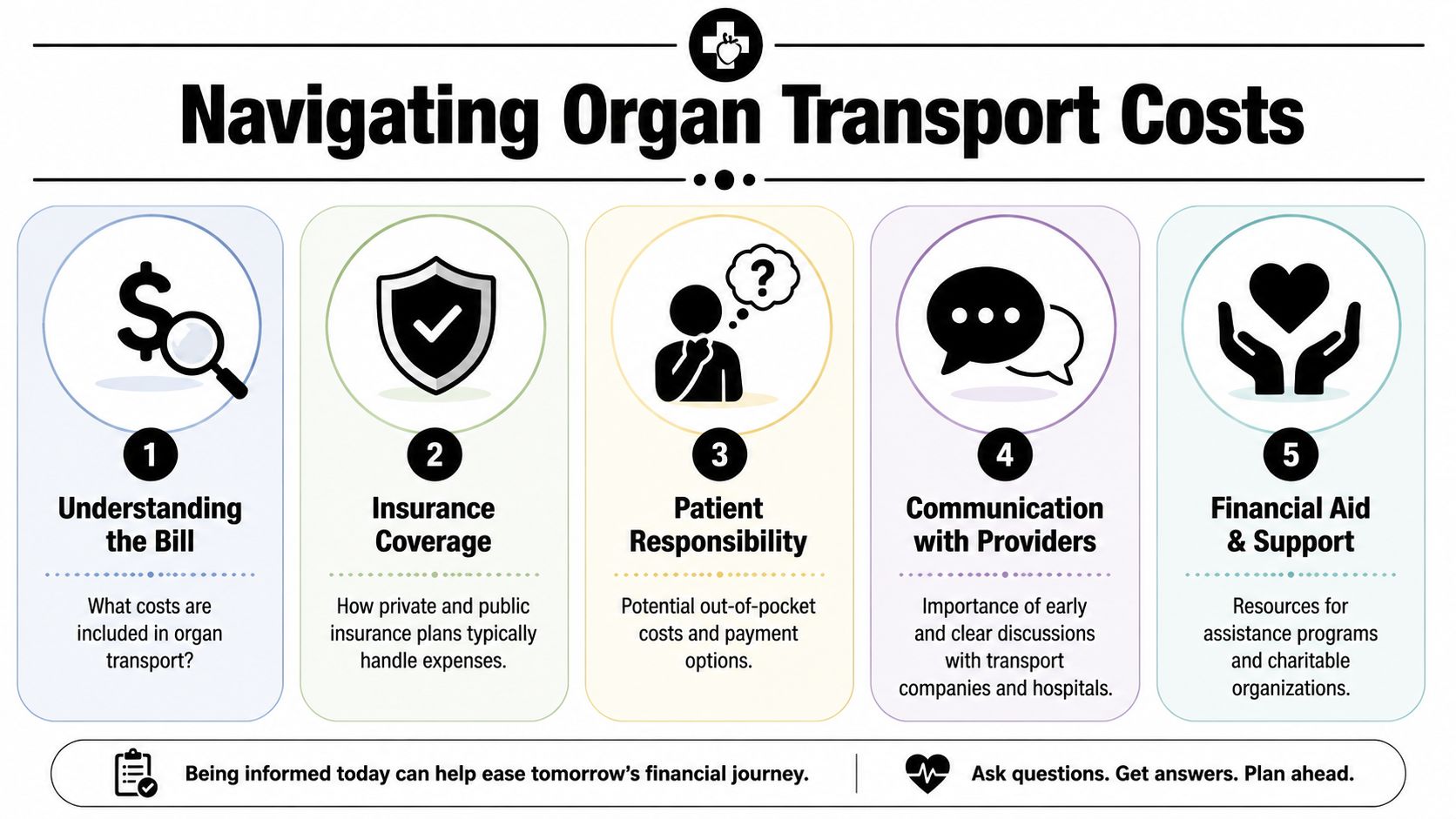
The first financial mistake is asking only for a total price. The second is failing to ask what breaks the quote. If the route changes, if ground segments expand, or if a different airport becomes necessary, your “all-in” number may no longer be all-in.
What a serious quote should clarify
A usable quote should spell out operational components, not just a final bill. Ask the company to walk through:
- Air segment assumptions: Which route, which departure window, and what aircraft or airline arrangement is being priced.
- Ground legs: Whether pickup and final delivery are included or handled separately.
- Standby or waiting time: What happens if the donor or recipient timeline shifts.
- Special handling: Whether preservation devices or special containment create added operational requirements.
- Reroute terms: How costs are handled if weather or airport conditions force a change.
If the provider gets vague when you ask about these items, the billing risk rises.
Why commercial alternatives are part of the cost conversation now
Recent market activity makes one thing clear. Buyers are no longer asking only how quickly an organ can move. They're also asking whether the expensive option is clinically necessary. Paragonix and NORA announced a commercial-flight organ courier initiative in August 2024 and explicitly described it as a “cost-effective alternative” to traditional air transportation in their transport alternative announcement.
That doesn't mean commercial is always the right choice. It means hospital case managers should expect cost-benefit analysis to be part of the discussion. If a company cannot explain when lower-cost transport is appropriate and when it isn't, they're not advising you. They're defaulting.
Questions to ask before authorizing transport
Use these questions with every vendor:
- What is included in the quoted price, specifically?
- What events would change the price after launch?
- If you recommend commercial, what assumptions make that option acceptable?
- Who is responsible for obtaining and documenting route changes?
- What financial approvals do you need from the hospital before dispatch?
- How are cancellation or aborted mission charges handled?
- Who receives the final invoice and supporting trip documentation?
Financial rule: A fast quote is useful only if the operational assumptions behind it are visible.
For teams that manage broader transport risk across air and ground vendors, even adjacent insurance topics can help sharpen procurement questions. A resource on commercial truck insurance in Florida is a useful reminder that liability, vehicle use, and route-specific exposure all need to be defined clearly in transportation contracts, even when the mission itself is medical.
If your facility also helps patients and families think through related travel protections, it may be useful to review how medical flight insurance is framed for patient transport scenarios. Organ movement and patient movement aren't billed the same way, but the questions about authorization, exclusions, and documentation discipline are often similar.
Communication keeps cost from spiraling
Financial control depends on communication control. If the transport company notifies the transplant coordinator about a reroute but nobody informs the financial approval side, the hospital can end up arguing over charges after the fact.
The cleanest practice is to assign one hospital contact who can receive both operational and billing-impact updates in real time. That one habit prevents many of the disputes that surface after a stressful mission.
When Every Second Counts Emergency Workflows and Contingency Planning
The providers that stand out in this field don't stand out because nothing ever goes wrong. They stand out because they stay organized when something does.

A realistic disruption looks ordinary at first. The pickup is on schedule. The donor team finishes recovery. Ground courier timing is solid. Then weather starts to interfere with the planned departure corridor, or the destination airport begins delaying inbound traffic, or a mechanical issue changes the original aircraft plan.
In this context, weak providers go silent. Strong providers start communicating more often, not less.
A disruption scenario that shows the difference
The organ leaves the donor hospital on time. During the ground leg to the departure airport, operations learns the planned air route may not launch within the needed window. The dispatch lead doesn't wait for the delay to become final. They alert the transplant center, donor-side contact, and receiving ground team that the route is under review.
At the same time, they evaluate alternatives. Can a nearby airport reduce the bottleneck? Is there a different aircraft already positioned? Does a mixed plan with a different ground endpoint protect the timeline better than waiting for the original plan to recover?
The receiving center gets one message with one decision path, not a chain of confusing updates from separate vendors.
What resilience actually looks like
System resilience is one of the least discussed buying criteria, even though it may be the most important under pressure. AOPO has publicly urged federal agencies to improve transport coordination, highlighting that friction still exists in the broader system, as described in AOPO's transportation coordination statement.
That matters because the right question for buyers isn't only whether a company can move an organ quickly under ideal conditions. It's whether they can keep the mission intact through storms, outages, reroutes, and airport friction.
Here's a useful way to test that during vendor review:
- Ask for the first backup move: Not “Do you have contingencies?” but “What is your first backup move if the aircraft cannot depart?”
- Ask who speaks for the mission: If three parties own communication, nobody does.
- Ask how reroutes are authorized: Good providers have a defined chain for operational decisions.
- Ask what changes for the hospital: The transport company should explain what your team must do differently if the route changes.
A short video can help hospital teams visualize how quickly logistics pressure builds in transport settings:
The mistake to avoid
Many hospitals assume backup planning means “we'll find another plane.” That's incomplete. A real contingency plan includes alternate airport access, replacement ground movement, updated custody documentation, revised ETA communication, and a clear decision-maker.
When a route breaks, the mission doesn't need optimism. It needs a preassigned sequence of actions.
That's the standard worth buying.
Frequently Asked Questions About Organ Transport
Can organs be moved on commercial flights
Yes, in the U.S. they can be, subject to the governing framework and the airline's own operating policy. The practical question isn't just whether it's allowed. It's whether that specific commercial route supports the timeline, packaging method, custody requirements, and backup planning needed for the case.
Are private charters always better
Not automatically. They're often the preferred option when timing control and direct routing matter most. But “better” depends on the organ, the route, the preservation setup, and the acceptable level of disruption risk. A thoughtful provider should be able to explain why the chosen mode fits the mission.
What should a case manager ask first
Start with four questions:
- What transport mode are you recommending, and why
- Who owns chain of custody across the full route
- What is the first backup plan if the route breaks
- What exactly is included in the quote
Those four questions reveal more than a long generic capability deck.
Do organ transport companies only handle flights
No. The strongest ones coordinate the full route, including pickup and final delivery. The air segment gets most of the attention, but first-mile and last-mile movement can create major delays if they aren't integrated into the same plan.
Can family members accompany the organ
That depends on the transport model and operational policy. Organ transport and patient transport are different missions. In many cases, the organ moves with designated handlers or couriers rather than family members. If family travel is part of a broader care plan, treat that as a separate coordination issue and confirm it early.
What makes one provider more reliable than another
Reliability usually shows up in process, not in marketing language. Look for clear custody documentation, experience with preservation equipment, a defined communication cadence, and a concrete contingency plan. If the company can't explain what happens when the original route fails, you don't yet know how reliable they are.
Is international organ transport possible
It can be, but the planning burden rises quickly. Cross-border movement adds security, customs, airline policy, routing, documentation, and timing complexity. If a mission has an international dimension, confirm early that the provider has handled cross-border medical logistics before and can explain the route in detail.
What happens after delivery
The receiving center takes custody, and the transport company closes out the movement record. That usually includes final handoff confirmation, mission documentation, and billing support. Good providers don't disappear at the door. They leave a clean audit trail.
If you're evaluating organ transport companies, keep the standard simple. Don't buy speed by itself. Buy a transport plan that matches the organ, the route, the preservation method, the cost reality, and the backup path. That's what protects the mission when the first plan is no longer viable.