
At many hospitals, the warning signs show up before anyone officially declares a surge. The ED board starts holding admitted patients. ICU transfers stall because stepdown beds aren't moving. Families want answers. Case management gets pulled into bed flow, discharge barriers, outside placements, and transport coordination all at once.
That's usually the point when people ask the wrong question. They ask, “How many beds do we have left?” The better question is, “How fast can we create safe capacity across the system?”
For hospital case managers, surge capacity management isn't an abstract emergency planning term. It's daily operational reality under pressure. It affects discharge timing, transfer prioritization, staffing escalation, post-acute placement, and whether a hospital can keep accepting the next critically ill patient without breaking internal flow.
Beyond Full Beds What Is Surge Capacity Management
A hospital can be “full” and still have options. It can also have beds on paper and no real capacity because the limiting factor is staffing, equipment, transport, or placement. That's why surge planning has to be operational, not symbolic.
According to the U.S. Administration for Strategic Preparedness and Response, surge capacity is the ability of a healthcare facility to evaluate and care for a markedly increased volume of patients. For mass casualty incident response, the Health Resources and Services Administration recommends at least 500 beds per one million people as a planning benchmark, as summarized in this ASPR and HRSA surge capacity overview.
Capacity is a function, not a room count
Case managers see this clearly. A med-surg bed doesn't help if the patient waiting for it needs dialysis support, isolation capability, specialty transport, or a receiving facility that can take report and accept transfer. A discharge order doesn't create capacity if medications, home oxygen, family teaching, or transport haven't been arranged.
Surge capacity management works when hospitals treat it as a dynamic response capability. That means using what's available, matching it to demand, and changing operations quickly enough to protect access.
Practically speaking:
- Static capacity means counting licensed beds and hoping that solves the problem.
- Operational capacity means asking what can safely open, what can safely close, and what patient movement will relieve the most pressure.
- Regional capacity means looking beyond the building, because your best next bed may be in another facility, another county, or another state.
Practical rule: If your surge plan starts with bed count and ends there, it's incomplete.
What case managers need during a surge
When patient volume jumps, case managers don't need a vague emergency policy. They need clear triggers and a usable process.
That usually includes:
- A shared definition of surge status so everyone knows when normal discharge pace is no longer enough.
- A prioritization method for identifying who can discharge, who can downgrade, and who needs transfer.
- Fast escalation pathways for transport, outside placement, and physician-to-physician communication.
- Real-time visibility into what barrier is blocking movement.
The hard truth is that surge capacity management isn't mainly about owning excess empty space. It's about building flexibility before volume spikes, then using that flexibility without delay.
The Foundational Framework of Surge Capacity
The traditional framework still matters. Most hospitals organize surge planning around the four S's: Staff, Stuff, Structure, and Systems. That model remains useful because it reflects what fails first when patient flow starts to jam.
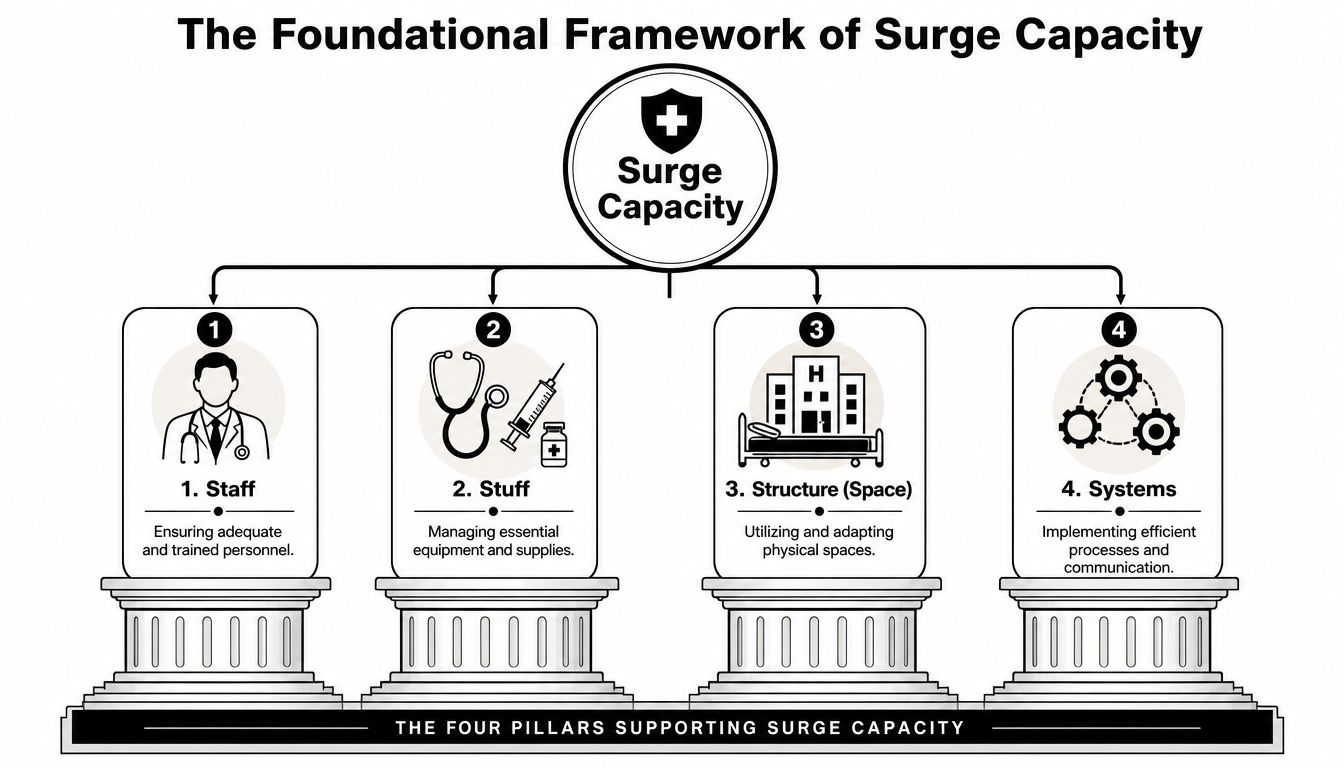
Staff
Staff isn't just physicians and bedside nurses. In a real surge, hospitals also need pharmacists, phlebotomists, security, case managers, social work, patient access, environmental services, and transport coordinators functioning without bottlenecks.
For case management leaders, the staffing question is often less about raw headcount and more about role flexibility. Who can handle rapid placement calls? Who can clear transfer packets? Who can stay focused on discharge barriers while command staff pulls attention in multiple directions?
Stuff
“Stuff” sounds simple until supply friction starts slowing patient movement. In a transport-heavy surge, stuff includes oxygen availability, monitors, infusion support, paperwork packets, signed transfer forms, face sheets, medication lists, imaging access, and working communication tools.
Missing one of those can delay a transfer for hours. That delay turns into another held bed, another backed-up admission, and another problem for the ED.
Structure
Structure is the physical environment. It includes standard inpatient units, overflow areas, retrofitted rooms, procedural spaces, and other licensed or adaptable areas that can absorb volume.
The physical layout matters to case managers because every converted space changes discharge planning and destination decisions. A patient who could remain in a temporary overflow area for observation may not belong there for extended boarding if placement is delayed.
Systems
Systems are what make the other three usable. The American Hospital Association presentation on surge response notes that the four S's are the cornerstone of surge planning, and that hospitals use capacity command centers, along with tactics such as expediting discharges and canceling elective surgeries, to manage real-time volumes and bed availability, as shown in this California Hospital Association surge management presentation.
A strong system answers practical questions fast:
- Who declares surge status?
- Who can authorize nonstandard placement decisions?
- Who contacts receiving facilities?
- Who owns family communication when transfers happen quickly?
- What happens if a partner hospital is also saturated?
Hospitals that rely on informal relationships usually struggle here. Formal coordination agreements help because expectations are already defined. A useful example is how providers structure mutual aid agreements for healthcare coordination.
The four S's work best when every department understands its job before the phones start ringing.
Core Operational Strategies for Managing Surges
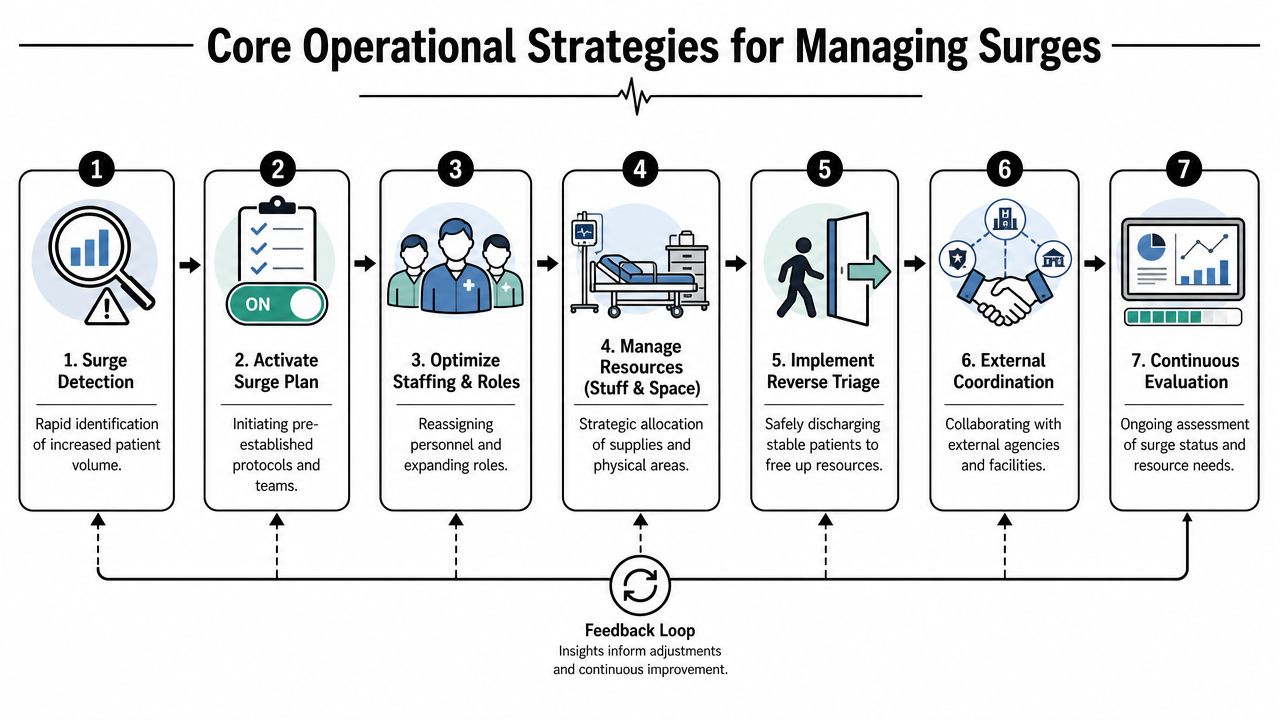
Internal surge response succeeds or fails on execution speed. Once patient volume rises beyond normal throughput, hospitals have to create usable capacity quickly, not perfectly.
Effective surge management relies on mobilizing Staff, Stuff, Space, and Systems. In emergency department surge planning, hospitals can typically activate about 10 to 20% of operating bed capacity within hours, with another 10% available by converting flat spaces such as lobbies, for a total immediate surge capacity of 20 to 30% of operating beds, according to this University of Nebraska Medical Center surge management resource.
What works first
The fastest gains usually come from operational moves that don't require construction or new capital spending. Teams that do this well tend to act in parallel instead of waiting for one tactic to finish before starting the next.
Common high-yield actions include:
- Reverse triage: Identify patients safe for early discharge or lower-acuity placement.
- Level-of-care downgrades: Move stable patients out of high-demand beds when clinically appropriate.
- Elective case adjustments: Reduce scheduled activity that consumes beds, staff time, and recovery space.
- Room reconfiguration: Use licensed space more aggressively when clinically safe.
- Overflow activation: Open alternative care areas with defined staffing and escalation rules.
What slows everything down
Surge plans often look solid until logistics get in the way. The usual weak points are predictable.
| Bottleneck | What it does to flow | What case managers should check |
|---|---|---|
| Discharge paperwork lag | Keeps medically ready patients in beds | Are orders, reconciliations, and instructions aligned? |
| Post-acute acceptance delays | Stalls lower-acuity movement | Has someone escalated destination outreach early? |
| Transport delays | Leaves transfer-ready patients sitting | Is mode selection happening early enough? |
| Power and equipment gaps | Makes overflow space unsafe or unusable | Is the area actually ready for patient care? |
One issue gets missed too often. Newly activated surge areas need reliable power support for the patients placed there. Guidance for hospital surge operations states that facilities must prioritize emergency power access for areas housing the most critical patients, and if emergency power isn't available, they must provide flashlights or battery-powered light sources for those areas, as outlined in these hospital surge capacity guidelines.
A bed without power, lighting, oxygen access, or monitoring support isn't surge capacity. It's an unsafe idea.
The trade-off case managers have to manage
Every internal surge tactic has a cost. Fast discharges increase follow-up complexity. Converting flat space creates staffing strain. Canceling elective work protects capacity but disrupts revenue and scheduling. Doubling up rooms may relieve pressure but can complicate infection control, privacy, and family communication.
That's why case management has to stay inside operational command, not outside it. The team coordinating discharges and transfers often sees the primary limiting factor before anyone else does.
The Fifth Pillar Integrating Medical Transport Into Your Plan
Most surge plans still stop at the hospital walls. That's a mistake. If capacity management only focuses on what can be opened internally, it ignores one of the most effective ways to relieve strain across a region.

Transport should be treated as a fifth pillar of surge capacity management.
Most surge plans focus on internal hospital solutions and overlook air ambulances as a source of mobile surge capacity. Proactive air evacuation of stable patients to more distant facilities can reduce bed strain in overwhelmed regional systems, yet transport is rarely built into the classic 4 S framework.
Why transport belongs in the core model
Case managers already know that patient movement is what turns planning into capacity. A bed opens because a patient leaves safely. A higher-acuity patient gets access because a lower-acuity patient moved to the right setting. Transport isn't an afterthought in that chain. It's the mechanism.
In daily operations, hospitals often treat air medical transfer as a last resort. During a surge, that mindset creates delay. If a patient is clinically stable for relocation and the receiving facility is available, waiting too long to move that patient only deepens local congestion.
This is especially true when:
- ground units are tied up
- road conditions are compromised
- regional hospital options are limited
- the receiving bed exists farther away than a normal referral pattern would allow
What proactive evacuation changes
A transport-integrated surge plan lets hospitals use the broader healthcare network instead of recycling the same local bottlenecks. That matters when every nearby facility is triaging admissions in the same time window.
The logistics principle is similar to how operations leaders think about network flow in freight. A useful comparison is this explanation of TMS for container operations, where movement planning isn't just about having assets, but about routing them at the right time to prevent choke points from spreading across the system.
Healthcare is more complex because patients aren't containers. Clinical handoff, family communication, physician acceptance, equipment compatibility, and level-of-care matching all matter. But the operational lesson still applies. Movement capacity is system capacity.
Field observation: Hospitals that call transport partners early have more options. Hospitals that wait until every local bed is spoken for usually end up negotiating from a weaker position.
What a fifth pillar looks like in practice
Adding transport as a formal pillar changes planning questions:
- Which patients are potential transfer candidates before conditions deteriorate?
- Who owns the decision to escalate from ground search to air option?
- Which distant facilities are acceptable during declared surge conditions?
- How are records, family updates, and bedside handoff handled when time is tight?
For organizations building that capability, a specialized critical care transport resource is useful because it frames transfer coordination as a clinical and operational process, not just a vehicle request.
A modern transport partner can also function as surge-in-motion when supply chains or local infrastructure are unstable. That matters during extended events, not just sudden trauma spikes.
A short overview of how air medical coordination supports complex movement is worth watching here:
Coordinating Patient Transfers During a Surge Event
During a surge, transfer coordination has to become simpler, faster, and more disciplined. The hospitals that manage this well don't reinvent the process each time. They reduce decision points and assign ownership early.
Start with transfer candidacy
Case managers should screen for patients who are clinically appropriate to move before the transfer request becomes urgent. That list usually includes stable patients waiting for specialty placement, repatriation, lower-acuity continuation of care, rehab transition, or return to a home-market facility.
The key question isn't just, “Can this patient travel?” It's “Does moving this patient improve capacity where it matters most?”
A useful workflow is:
- Confirm clinical stability with the treating team.
- Identify the receiving level of care needed, not just the receiving bed type.
- Package the record early so documentation isn't the rate-limiting step.
- Escalate transport mode quickly if distance or timing makes ground inefficient.
Ground versus air under surge conditions
The choice isn't ideological. It's situational.
| Consideration | Ground transport may fit | Air transport may fit |
|---|---|---|
| Distance | Shorter regional movement | Longer-distance relocation |
| Road access | Intact and predictable | Congested, disrupted, or impractical |
| Time sensitivity | Moderate urgency | Need to decompress sending facility faster |
| Regional saturation | Nearby destination available | Receiving facility is outside usual referral radius |
Ground transport works well when the receiving facility is close and road operations are stable. Air becomes more valuable when geography, traffic, weather windows, or network saturation make local movement too slow to help.
Keep one point of contact
The biggest operational win during a surge is reducing communication fragmentation. If nursing calls one vendor, case management calls another, the physician team handles accepting contact separately, and the family gets updates from whoever is available, delays and errors multiply.
That's why hospitals benefit from a single coordinated pathway for hospital-to-hospital transfer logistics. The exact provider matters less than the model. One intake path, one clinical coordination process, one documentation channel, one status update stream.
Fast transfers don't happen because everyone is working hard. They happen because ownership is clear.
Questions teams should ask in real time
Case managers often ask:
- Who is stable enough to move now instead of later?
- Is the patient waiting on medicine, paperwork, or transport?
- Are we searching only locally when we should be searching regionally?
- Has the family been told what transfer will and won't include?
- If the first destination declines, who activates the next option?
Those questions save time because they expose where the delay resides.
Actionable Surge Response Checklist for Case Managers
A good checklist should reduce hesitation. In a surge, case managers need a short operational tool that helps them move patients safely while preserving communication and documentation quality.
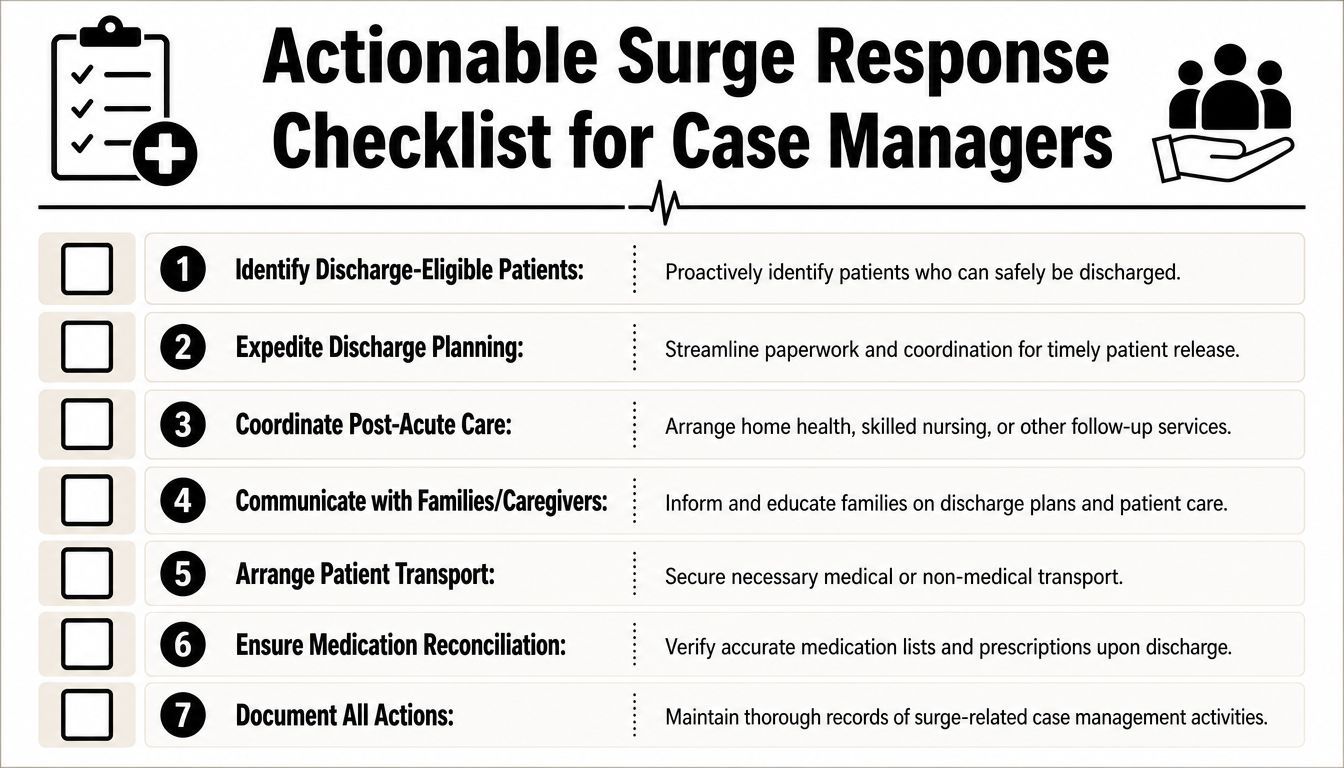
Preparedness
- Build the contact map: Keep current numbers for command, transfer center, accepting facilities, transport providers, pharmacy, respiratory, and post-acute partners.
- Predefine escalation triggers: Know when routine discharge planning shifts into surge workflow.
- Clarify destination rules: Identify what can move locally, what can move regionally, and what requires specialty review.
Immediate response
- Create a live candidate list: Separate likely discharges, likely downgrades, and likely transfers.
- Remove administrative delay: Start records, consents, summaries, and imaging access before the receiving side asks twice.
- Coordinate family communication: Assign who explains why the move is happening and what the timeline looks like.
- Escalate transport early: If local ground options are tightening, don't wait for complete gridlock before considering air.
System recovery
- Track return movement needs: Some transferred patients will need repatriation later. Document that early.
- Capture the barriers: Note which delays came from placement, staffing, transport, equipment, or communication.
- Debrief fast while details are fresh: Short operational reviews usually improve the next response more than long reports written weeks later.
A working habit that helps
Keep one surge board or shared tracker focused on movement. Not census. Movement. The most useful fields are usually patient name or identifier, destination plan, current barrier, owner, and next action time.
That keeps the conversation grounded in actions instead of frustration.
Frequently Asked Questions About Surge Capacity
What's the difference between routine high census and a true surge?
A high census becomes a surge when normal workflows no longer restore flow reliably. If routine discharge pace, standard staffing, and ordinary transfer patterns can't keep up, the hospital has crossed from busy into surge operations.
What happens when supply chains break down during an extended event?
This is one of the most important questions in surge planning. A common but critical issue is how plans function when normal supply channels fail. In that setting, air ambulances can act as a surge-in-motion resource, operating with onboard medical equipment and pre-stocked supplies while also evacuating patients when hospital-based infrastructure and inventory are compromised.
When should case managers think about air transport?
Earlier than commonly practiced. Not for every patient, and not because it's dramatic. Air transport becomes strategically useful when time, distance, regional saturation, or road limitations make ground movement too slow to relieve the sending facility.
Does adding transport as a pillar replace the four S's?
No. It strengthens them. Staff, stuff, structure, and systems remain essential. But if patients can't move to where care is available, the rest of the surge plan loses value quickly.
What's the most common mistake during a surge?
Treating transfers as an exception instead of part of the operating model. Hospitals often focus on internal bed creation first and external movement second. In a real surge, both have to happen at the same time.
If your team is refining how it handles high-pressure transfers, Med Jets by Air Trek can help with end-to-end coordination for complex patient movement, including air ambulance, medical escorts, and ground logistics. Learn more at Med Jets by Air Trek.